China Military Studies Review
The PLA Is Intended to Fight and Win Wars
Eli Tirk
16 April 2026
https://doi.org/10.33411/cmsr2026.02.003
PRINTER FRIENDLY PDF
EPUB
AUDIOBOOK
Abstract: Within the People’s Liberation Army (PLA) studies community, there is much debate about the primary mission of the PLA and its ability to carry out modern military operations. The spectrum of thinking on the credibility of the PLA’s warfighting capability ranges from the more dovish view that the PLA is incapable of overcoming its cultural and organizational challenges or is restricted by its overriding purpose as the ultimate backstop to Chinese Communist Party (CCP) rule to the extreme hawkish view that the PLA is so focused on Taiwan that it has already attained the capability of seizing the island nation in the face of military intervention by the United States. The author uses PLA publications and activities to argue that the PLA is primarily focused on its warfighting functions and does not view its primary mission as serving as the primary tool for crushing domestic unrest but has yet to reach its 2027 capabilities benchmark.
Keywords: People’s Liberation Army, PLA, Taiwan, military modernization, military training, PLA missions
Introduction
Within the People’s Liberation Army (PLA) studies community, there is a debate about the primary mission of the PLA and its ability to carry out modern operations. The spectrum of thinking on the credibility of the PLA’s warfighting capability ranges from the more dovish view that the PLA is incapable of overcoming its cultural and organizational challenges or is restricted by its overriding purpose as the ultimate backstop to CCP rule to the extreme hawkish view that the PLA has already attained the capability of seizing Taiwan in the face of military intervention by the United States. Extremely hawkish arguments generally are not based in an accurate understanding of the PLA and CCP policy preferences. More dovish arguments tend to have stronger footings in political science, China studies, and PLA studies.
The dovish arguments against the PLA being focused on warfighting, preparing to be capable of using different types of campaigns to militarily force unification of Taiwan, and preparing to become the world’s most powerful military boil down to four core lines of reasoning: the PLA’s primary mission that overrides all other interests is serving as a direct backstop to CCP rule; the PLA is too focused on political indoctrination, ensuring loyalty to the party, and rife with corruption so it must be ineffective; the PLA is not actually interested or likely to try to conduct a joint island landing campaign (JILC) against Taiwan or otherwise attempt to militarily force unification due to the escalation concerns or military difficulty of the problem set; and that the PLA is in fact not procuring the numbers and types of systems or training to become the world’s most powerful military.[1]
These lines of reasoning do not reflect how the PLA has changed since Xi Jinping became the chairman of the Central Military Commission (CMC) in 2012. The PLA’s missions and responsibilities have expanded just as Xi has been attempting to change it into a force that can fight and win wars. The PLA’s activities abroad, procurement of traditional and asymmetric capabilities, and coercive activities all serve to accomplish multiple goals, including becoming capable of annexing Taiwan in the face of U.S. intervention by 2027 and becoming a world-class military by 2049. The PLA’s modernization and reorganization efforts, activities abroad, and training exercises all clearly demonstrate that the PLA is laser focused on becoming the world’s preeminent military, capable of fighting and winning wars. The rise of the People’s Armed Police (PAP), China’s gendarmerie, into an expansive internal security force further mitigates the need to employ the PLA in that role. There are a few exceptions that must be acknowledged. PLA border defense forces, the Hong Kong garrison, and the Tibet and Xinjiang Military Districts are all positioned to provide support for internal or more defensive security priorities. Collectively, these factors indicate that the PLA is focused on warfighting, not a military split between remaining a garrison force to be employed to suppress the people of the People’s Republic of China (PRC) while also developing some modern capabilities.
The removal of CMC vice chairman Zhang Youxia (张又侠) and CMC Joint Staff department director Liu Zhenli (刘振立) in January 2026 and further ongoing investigations and purges of PLA generals will have an immense impact on the experiences and capabilities of future PLA senior leaders. The official explanations in PLA Daily and People’s Daily cite corruption, undermining the CMC Chairman Responsibility System, endangering the CCP’s absolute control over the PLA, damaging the PLA’s ability to fight, and impeding the PLA’s pursuit of the 2027 modernization goals.[2] There are several competing explanations from external analysts for the removal of these officers that can be summarized as either focused on military capability or internal politics. The first argues that Xi viewed Zhang, Liu, and the other generals as impediments to achieving the 2027 capabilities benchmark.[3] The latter argues that these purges are primarily motivated by internal political issues, either amassing unacceptable levels of political influence or factionalism. [4] There is likely some gap between the official explanation and Xi’s rationale to make this decision and it is possible that these purges were motivated by both political factors and modernization goals. Whatever the cause of this purge, it is likely to prevent the CMC from executing its strategic-level leadership tasks and hinder theater commands leadership of large scale, complex joint operations. There will likely be minimal interruptions to line units’ ability to fight. Despite these setbacks, the PLA is focused on developing the ability to seize Taiwan in the face of U.S. intervention.
The Missions of the PLA and CCP Regime Security
As the armed wing of the CCP, the PLA’s primary mission has and will always be linked to CCP regime security and pursuing CCP political objectives. Disentangling what the PLA does to pursue the objectives of the party-state from its role as a backstop to ensuring CCP rule demonstrates that the PLA is used for a variety of objectives. Official documents, statements by PLA leadership, and PLA activities clearly demonstrate that the PLA is being increasingly used to pursue CCP political objectives along China’s periphery and further abroad. Xi Jinping has clearly identified that strong countries need strong militaries (强国必须强军), linked operational effectiveness of the PLA into a military capable of supporting the development of CCP interests, and specifically identified that the PLA’s ability to support overseas interests (为扩展我国海外利益提供战略支撑) and that expanded PRC interests overseas have security requirements that the military must be capable of addressing.[5] Clearly some PLA activities are directly linked to serving as a backstop to CCP rule. Other activities, however, are linked more to achieving CCP political objectives and its pursuit of modernization and are only indirectly linked to maintaining regime security.
The Official Missions of the PLA
The CCP’s official missions for the PLA outline broad requirements for the Party’s military. Activities conducted in pursuit of these missions, such as military diplomacy, often serve other purposes that further the PLA’s modernization into a force focused on warfighting. The reforms and reorganization of the PAP under the CMC also reflect an increased reliance on the PAP for internal security and a diminishing focus on the PLA as serving as the backstop to CCP rule at home.
The 2019 national defense white paper outlines the missions of the PLA in the following order: safeguarding territorial sovereignty; maintaining combat readiness; carrying out realistic training; maintaining credible nuclear, space, and cyber deterrents; maintaining counterterrorism and stability; protecting China’s overseas interests; and participating in humanitarian assistance and disaster relief missions.[6] In a speech celebrating the PLA’s 93d anniversary, Xi Jinping described the PLA as “a military [that] is built to fight. Our military must regard combat capability as the criterion to meet in all its work and focus on how to win when it is called on.”[7] This emphasis on warfighting spans these missions, including those explicitly tied to ensuring continued CCP rule, require the PLA to be a military designed to conduct informationized operations, whether that be for so-called stability maintenance or for fighting other states to defend territorial claims. These activities serve multiple purposes and do not prevent the PLA from becoming an operationally competent force. In fact, these activities are crucial to that transformation.
Modernization Goals
The PLA’s modernization goals clearly outline that the CCP requires the army to become one of the world’s preeminent military forces. The three military modernization goals for 2027, 2035, and 2049 outline a roadmap for how the PLA seeks to become the world’s strongest military. The 2027 modernization benchmark clearly outlines that the PLA is expected to have made sufficient progress on mechanization, informationization, intelligentization, and associated organizational reforms and procurement to develop the capacity to force unification of Taiwan in the face of U.S. intervention.[8] Components of the 2027 goals explicitly include the capability to win a “strategic decisive victory” (战略决胜), nuclear and conventional capabilities to deter or defeat U.S. intervention in a Taiwan scenario, and strategic deterrence and control enabling the PLA to control escalation in the region during the conflict.[9] The 2035 modernization benchmark further outlines the requirement of the PLA to be an intelligentized force, capable of using advanced technologies like artificial intelligence to shape the information domain to give the PLA freedom of maneuver.[10] The 2049 modernization goal outlines that the PLA is expected to become the world’s strongest military, capable of fighting and winning wars and deploying globally in pursuit of CCP interests.[11] These goals involve transforming the PLA into a high-tech military capable of precisely employing military force to attack an enemy system of systems and paralyze it, while protecting the PLA’s. This necessitates effective employment of advanced artificial intelligence to process large amounts of data, employment of new high-tech weapons platforms and systems, and continual adaptation and advancement of PLA personnel recruitment and training. In the PLA conception of advanced warfighting, this would enable rapid decision-making and force employment. These modernization goals and associated capabilities do not enable the PLA to be a more effective force for internal security. This modernization effort demonstrates that the PLA is not simply pursuing advanced capabilities for national pride or the spiritual needs of the people.
PLA Activities Abroad
PLA activities also serve as an important indicator of how the organization is preparing to achieve CCP strategic objectives, preparing to fight modern conflicts, and acting as a coercive tool during peacetime. These activities clearly demonstrate that the PLA is becoming more capable of conducting its concept of modern military operations.
PLA activities abroad are frequently used to secure CCP interests to ensure the continued security and prosperity of China, ensuring CCP legitimacy domestically. This is the clearest example of one of the missions from the 2019 national defense white paper that links PLA activities with regime security. However, the activities conducted in pursuit of overseas economic interests and geopolitical interests cover the overlap between the interests of the CCP and the PRC state, making those activities quite similar to the activities of other militaries in the pursuit of securing state priorities. Furthermore, the PLA has a history of being employed in regional conflicts to pursue objectives not directly linked to regime security, such as the PLA’s last combat experience in 1979 against Vietnam. The so-called self-defensive counterattack against Vietnam is a prime example of the PLA being used to pursue CCP strategic objectives that are only indirectly related to supporting its position domestically.
The PLA Navy’s (PLAN) activities abroad also serve many purposes and are not simply efforts to ensure continued CCP control over the PRC. Many of these activities relate to the missions stated in the 2019 national defense white paper while furthering other objectives related to developing warfighting capabilities in pursuit of fulfilling the PLAN’s strategic requirements under “Near Sea’s Defense (近海防御), Far Sea’s Protection (远海防卫).”[12] The 2049 military modernization goals state that the PLA is expected to become a world-class military. Clearly, a navy capable of conducting sustained operations globally is a component of that intent.
The PLAN launched its first circumnavigation of the globe in 1997, and clearly needed a way to develop tactics, techniques, procedures (TTPs), and experience for sustaining blue water operations. Since 2008, PLAN naval escort task forces have provided opportunities to operate more effectively far from China’s shores, while also securing overseas economic interests linked to continued economic development and thus CCP regime legitimacy. More recently, the PLA has supported carrier battle group exercises around Taiwan and out to the Second Island Chain as well as conducted live fire exercises in the Tasman Sea. These activities serve as stepping stones to developing a more operationally proficient force that now regularly sails and trains well outside of waters surrounding the PRC.
Another of the PLA’s noteworthy longstanding overseas military presence—the PLA Rocket Force’s (PLARF) Golden Wheel Engineering Command—furthers the PRC’s relationship with Saudi Arabia at the risk of developing capabilities that could be destabilizing to the military balance between the kingdom and the Islamic Republic of Iran. This activity involves the PLARF assisting the Saudi military to produce solid fueled ballistic missiles.[13] This is an explicit use of a niche military capacity to further CCP geopolitical and economic interests. This relatively secretive activity does not mesh well with the idea that PLA military diplomacy’s primary mission is bolstering CCP authority at home but that it is primarily a tool of influence that relates to the CCP’s strategic priorities.[14]
Other elements of the PLA’s global presence tied to maintaining or bolstering regime legitimacy also have important impacts on its ability to develop operational competencies. The PLA’s relationship with Tanzania, its longest-standing military diplomatic relationship, is rooted in the PLA’s support for the anticolonial struggle on the continent and the growing economic importance of African countries to China’s overseas economic endeavors.[15] This relationship has shown potential for developing an operationally impactful experience for the PLA. The July/August Peace Unity-2024 exercise between the two countries provided the PLA with an important opportunity to test its sustainment capabilities, to conduct joint operations, and to utilize its newest component, the Information Support Force. By using the PLA Air Force (PLAAF), PLAN, and Joint Logistics Support Force to transport and sustain it during this exercise, the PLA had a rare opportunity to test its ability to deliver a battalion-size element over long distances.[16]
While this was a relatively small-scale exercise, it allowed the PLA to test its ability to project military forces without the ability to rely on mobilized civilian capacity that is integral to operations within China or along its periphery. The presence of elements of the ISF’s Central Theater Command’s (CTC) Information Communications Regiment at this exercise and their role in setting up networks vital to connecting command posts back to the theater command headquarters is important. This exercise provided the newly established arm of the PLA with experience operating in unfamiliar environments and establishing networks linking their formation back to CTC headquarters, and likely to the CMC.[17] Clearly, this example serves to further PRC overseas interests and conduct militarily useful training abroad.
PLA Coercive Activities
Another common argument against the PLA’s warfighting acumen targets PLA coercive behaviors. These are sometimes described as “muscle-flexing demonstrations that do not actually entail combat” and “are another important way for the military to bolster popular support for the CCP.”[18] While muscle flexing is certainly a component of the decision calculus for CCP leadership, it is important to note that these demonstrations are not primarily intended to bolster popular support for the CCP for two important reasons.
First, it is the responsibility of the CMC to provide the chairman with a variety of options for the use of the military to achieve political objectives, and coercive activities are part of that toolkit. The PLA is expected to provide options for the peacetime employment of military force, nonwar military operations, and quasiwar operations short of actual war.[19] PLA and China Coast Guard (CCG) coercive activities in the South China Sea and along the PRC border with India are clear demonstrations of the peacetime use of military force in the pursuit of political objectives. Additionally, these activities can also be in the pursuit of cognitive domain objectives intended to deter an adversary.[20] The PLA and the CCG are clearly tasked with employing limited levels of violence in concert with displays of military capability to solidify PRC control over these disputed areas and to reduce their counterclaimant’s ability to exert control over them.
Second, the PLA uses its coercive activities to further its goal of getting vital training experience through employing new joint capabilities, testing its logistics enterprise, and training with an actual opposing force. These activities provide opportunities to expose commanders to more complex joint operations and test the PLA’s ability to utilize its doctrinal concepts, providing learning opportunities to improve effectiveness. The PLA needs as many opportunities as it can get to work through its concept of joint operations, gaining experience on what works and what does not before it attempts to conduct these operations during crisis or conflict. As the invasion of Taiwan in the face of U.S. intervention would be the most costly and risky approach to forced unification, PLA and CCP leadership are likely hesitant to take the riskiest approach to forced unification if they do not trust the PLA is up to the task.
As a result, the PLA views its coercive maritime and air domain activities as an opportunity to “use the enemy to train the troops” (拿敌练兵), which has served to further sovereignty claims and develop military proficiency.[21] These activities also encourage PLA operational familiarity with Taiwanese forces, the operational environment, and complex joint operations, even in a scripted context. The complexity of the PLA exercise conducted in response to then-U.S. Speaker of the House Nancy Pelosi’s visit to Taiwan and subsequent Joint Sword exercises, for example, demonstrate that while these are surely acts of coercion, they also provide important opportunities for joint training. Commander of Indo-Pacific Command admiral Samuel J. Paparo stated that PLA exercises around Taiwan are “not exercises; they are rehearsals” and that the PLA is showing “clear intent and capability” with respect to militarily forcing unification.[22] Not only do these coercive activities mesh with the mission of ensuring territorial sovereignty, but they also relate to the requirement of the PLA to maintain combat readiness and conduct realistic training.
Even the PLA activities with the most direct links to improving its domestic image and relationships with local governments help the PLA to be more operationally effective. On the surface, these efforts to spread goodwill for the military and the party appear to be tied to regime legitimacy objectives. These activities may help the PLA more effectively leverage military-civil fusion and leverage mobilized civilian capabilities to support operations within China and along its periphery. The PLA’s contributions to poverty alleviation and continuous engagement with party organizations in areas they operate in China can provide the PLA with a better understanding of the individuals it will be required to engage with and rely on for mobilized rear area support and service support functions in wartime.
An Alternative Backstop to CCP Rule: The People’s Armed Police
The PLA’s increased focus on developing warfighting capabilities has resulted in a force structure that it is morphing away from being used as an effective domestic tool. As a result, the PLA is not currently the CCP’s first choice to serve as a backstop to their rule. The PAP, a paramilitary force under the CMC, now serves in this capacity. In PLA publications from the early 2000s, the PAP is referred to as the force in charge of defending domestic security and safeguarding social stability in peacetime and are the “main strength” for maintaining social stability in wartime.[23] The PAP is structured to surveil, disrupt, and crush unrest at home and conduct counterterror operations across the PRC. Removing elements of the PRC State Council from the PAP chain of command in 2018 placed the PAP under the absolute control of the CMC and CCP Politburo Standing Committee, ensuring the central party apparatus has ultimate control over its armed internal security focused military organization. This was done explicitly to prevent provincial CCP leaders from employing the PAP for their own ends like Bo Xilai attempted to do in 2012.[24] The PAP’s organizational structure and geographic disposition indicate it is well situated to handle “mass incidents” in Beijing or other large coastal cities and perceived hotspots of terrorism in Xinjiang and Tibet. With sizable force concentrations across major metropolitan areas and border regions seen as unstable or rife with terrorist or separatist activity, the PAP is well positioned to handle any direct threat to CCP Rule.
The PAP’s performance in Hong Kong demonstrates the speed and efficacy of this force.[25] It is likely that the PAP surveilled protests, identified key activists and organizers, and mapped out their networks to develop an understanding of who was protesting to develop lists of individuals to arrest. PAP officers also accompanied police to the front lines of protests to help plus-up manpower to crush the protest movement as well. In 2022, a PAP officer was made the commander of the PLA garrison in Hong Kong, a potential indicator of the success PAP operations had in Hong Kong and the PAP’s role as the force primarily concerned with handling threats to internal stability and CCP rule.[26] So, while the PLA could ultimately be called on should the PAP fail, the organization has transitioned into a professional internal security force that is more than capable of using various levels of violence to ensure CCP rule.
The Taiwan Mission
Arguments that the PLA is only nominally focused on seizing Taiwan to assuage domestic political desires do not reflect the PLA’s expansive preparations toward developing a credible capability to do so. PLA senior leaders clearly view the Taiwan mission as integral to the army’s purpose and the 2027 centennial modernization goal specifically calls on the PLA to be capable of seizing Taiwan in the face of U.S. intervention. The PLA has developed capabilities, is publishing material related to operations to seize Taiwan, and is conducting training exercises to get the repetitions it needs to test joint operations concepts and capabilities needed to achieve these objectives. The PLA is also undertaking efforts to develop organization redundancy and harden its facilities to help offset the impact of casualties and U.S. intervention. These efforts are expensive and taxing on an organization and would likely detract from the pursuit of other priorities. Collectively, this behavior demonstrates that the PLA is pursuing its centenary modernization goals of developing a credible capability to seize Taiwan in the face of U.S. intervention. In sum, these efforts are a central element of the PLA’s transformation into a military that is intended to do more than simply backstop CCP rule.
Arguments against the likelihood of a PLA-led invasion of Taiwan center around the contention that the CCP neither wants to nor is ordering the PLA to prepare for the use of military force to unify Taiwan due to the difficulty of the military problem set, domestic political considerations, and escalation management concerns.[27] Currently, a full-scale joint island landing campaign (JILC) is not the first choice of the CCP for pursuing unification. A JILC against Taiwan in the face of U.S. intervention would be the costliest and riskiest military campaign undertaken by the PLA in its history. Despite this, the CCP does not preclude using varying levels of military force in pursuit of unification. The 2005 antisecession law clearly outlines a legal framework for justifying the use of the PLA to force unification.[28] PLA procurement across the joint force, capabilities development, and force structure clearly reflect that developing the capacity to prosecute campaigns ranging from a blockade, a punitive joint firepower strike campaign, to a JILC is a priority for the PLA. In August 2024, then-senior vice chairman of the CMC Zhang Youxia told then-national security advisor Jake Sullivan that “it is the mission and duty of the Chinese People’s Liberation Army to resolutely oppose ‘Taiwan independence’ and promote reunification. The PLA will definitely take countermeasures against the provocations of the ‘Taiwan independence’ forces.”[29] This is a clear statement that the PLA leadership considers using military means to force unification of Taiwan one of its primary missions.
Some analysts contend there is a lack of evidence within PLA military academic interrogation of a Taiwan invasion. Publications associated with these requirements do exist. In fact, the PLA has been publishing academic research on the military concepts and operational requirements of a Taiwan scenario for decades. The 2006 Science of Campaigns, for example, clearly outlines a Taiwan invasion in the form of the joint island landing campaign.[30] Other publications on Taiwan’s military geography, academic interrogations of the requirements of seizing hostile enemy ports, and logistics requirements of large scale conflicts clearly align with those for combat and sustainment in a Taiwan scenario.[31] Beyond academic texts, the PLA continues to update its doctrine. In 2020, it published the “Chinese People’s Liberation Army Joint Operations Outline (Trial),” began publishing additional theater-, domain-, and service-specific doctrinal texts, and in the CMC probably began revising the military strategic guidelines.[32] This ongoing effort to develop classified PLA strategic and official guidance on operational art clearly shows the PLA remains laser focused on iterating its doctrine with a continued focus on Taiwan and countering U.S. intervention.
The PLA used to be more transparent in its publicly available academic materials, but their content has become less forthright and the diminishing availability of those materials to outside observers has made them more difficult to exploit. A dearth of information on this subject in these sources cannot be taken as evidence that explicit planning is not taking place, however. Existing explicit and oblique references to these problems in the context of the development of capabilities explicitly useful to a JILC and counterintervention efforts clearly demonstrate the PLA’s focus on developing the capabilities to militarily coerce or otherwise force unification in the face of U.S. intervention. References to PLA Rocket Force modernization as a strategic counterbalance (战略制衡) to the United States indicate how the PLA intends to defeat a “strong enemy” (强敌) and continued efforts to understand large-scale conflict and efforts to prepare for it keenly demonstrate that the PLA remains focused its 2027 goals.
Aside from PLA academic publications and statements by CMC leaders, the PLA’s activities and training clearly reflect an intense focus on preparing for a Taiwan scenario. The PLA is providing the PLA Army (PLAA) the repetitions it needs to successfully conduct modern combat operations. This is not a flashy counterintervention-focused set of capabilities and units, but it is an expensive effort to develop a modern PLAA capable of providing PLA commanders with credible options to present to their leadership.
The PLAA’s service-level training center at Zhurihe, akin to the National Training Center at Fort Irwin, California, contains mockups of the Taiwanese Presidential Office Building, Ministry of Foreign Affairs, and highway interchanges, which seems to be a strong indicator that the military operations in urban terrain (MOUT) facilities here are intended to replicate urban combat on Taiwan.[33] MOUT facilities at Zhurihe have grown even more complex, to include numerous multistory buildings with walled courtyards built very close together and other tightly grouped multistory structures.[34] Other training facilities outside of Zhurihe specifically built to replicate intersections in Taipei are either target ranges or other MOUT training facilities.[35] Other replicated facilities at PLA training ranges include a mockup of the Taiwanese Air Force’s Ching Chuan Kang Air Base at the PLAAF’s Dingxin testing and training base.[36]
Figure 1. Recently constructed urban training facilities at Zhurihe training base
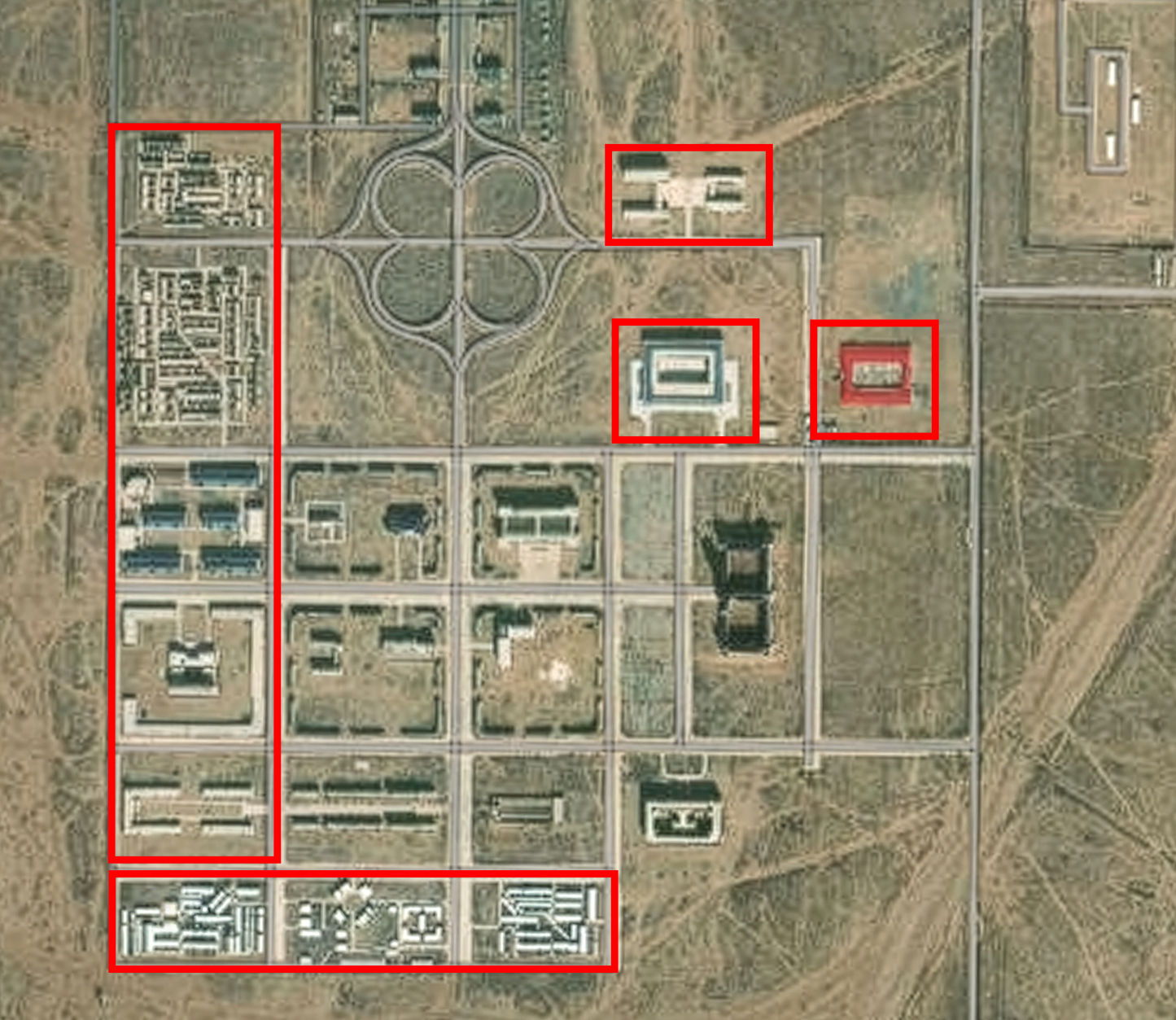
Source: ESRI World Imagery Wayback, captured 8 March 2025.
The PLAA also continues to develop MOUT training sites outside of Zhurihe to support training for urban operations, conducts more regular out-of-garrison exercises at the combined arms battalion level, and fields better training aids and facilities for these units.[37] A training facility on the southern end of Nantian Island in Xiangshan County represents the evolving nature of PLAA training facilities (figure 2). This facility has dedicated ramps that amphibious assault vehicles could use to swim ashore (figure 3).
Figure 2. Nanshan Island training area training facilities
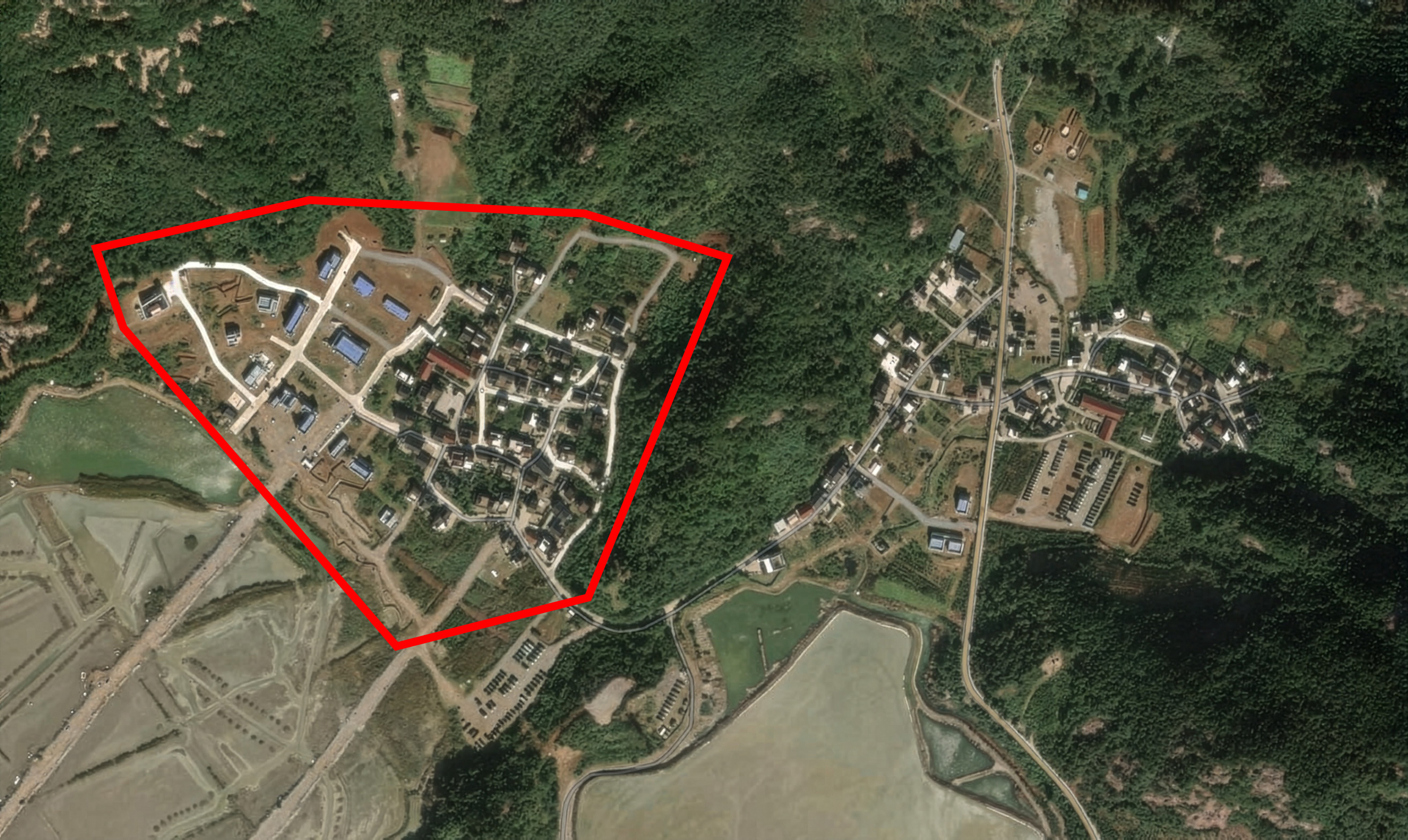
Source: ESRI World Imagery Wayback, captured 25 November 2024.
Figure 3. Nanshan Island training area amphibious landing area
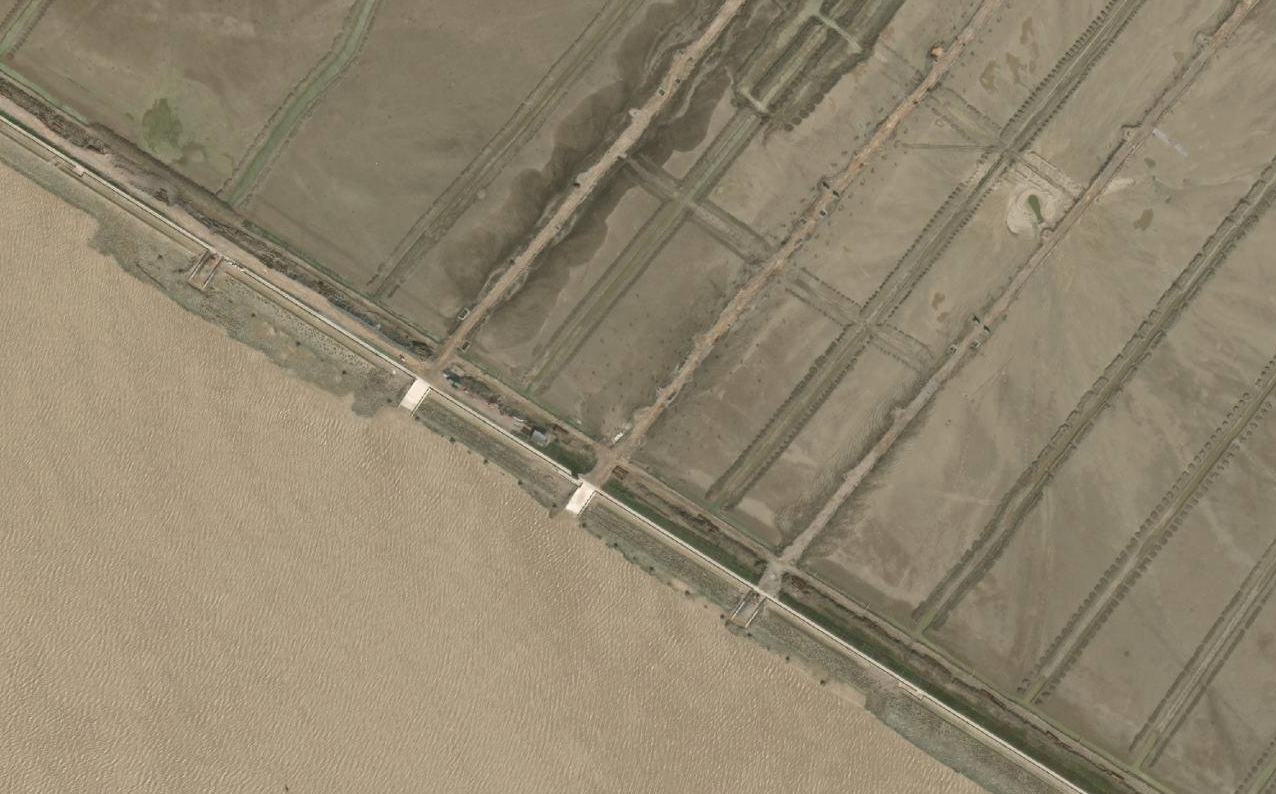
Source: ESRI World Imagery Wayback, captured 25 November 2024.
From here, these vehicles would have to traverse a tidal plane that has been reclaimed to allow for the construction of roads with obstacles and mock intersections to pass through. These roads terminate in a village that has defensive trench lines, numerous multistory buildings, compounds, a pedestrian overpass, and what is likely an underground facility (figure 4).
Figure 4. Nanshan Island trench lines, buildings, and other facilities
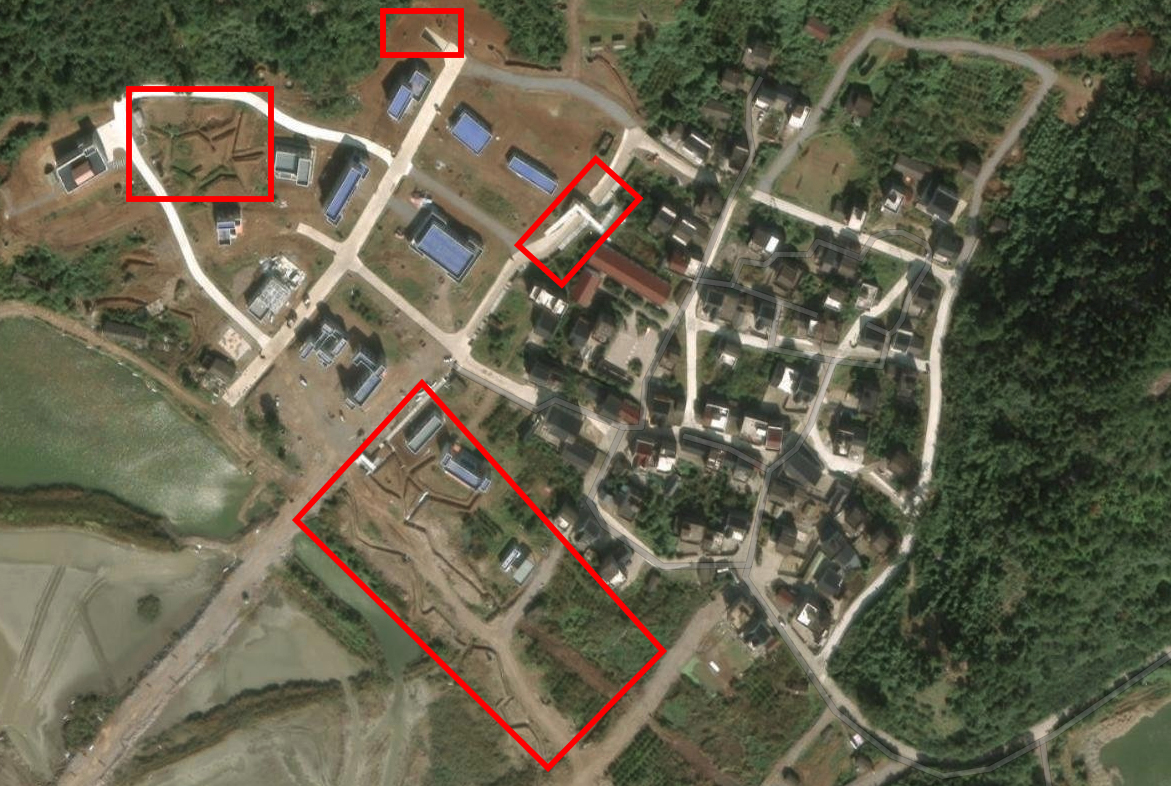
Source: ESRI World Imagery Wayback, captured 25 November 2024.
This facility is likely intended for battalion-size units given the number of armored vehicles present at the facility across several images.[38] This facility allows PLAA units to incorporate multiple, complex elements advancing from a beachhead and assaulting targets in urban terrain. In addition, references to joint training opportunities at the battalion level have become more frequent in PLA media, suggesting that these may be more frequent than large named service or theater command exercises like the Joint Sword series.[39] The Eastern Theater Command Army also maintains a substantial training area in Anhui Province that added a MOUT facility between 2021 and 2022 (figure 5).[40] This facility and the surrounding training area could allow for multiple battalion-size combined arms formations to rotationally train on a substantial training range without requiring to travel to service-level training areas or across theater commands. These facilities suggest an intent to provide ground forces the opportunities required to develop and refine TTPs and generate training experience necessary for the PLAA to conduct ground operations on Taiwan.
Figure 5. Sanjie Training Base MOUT facilities under construction
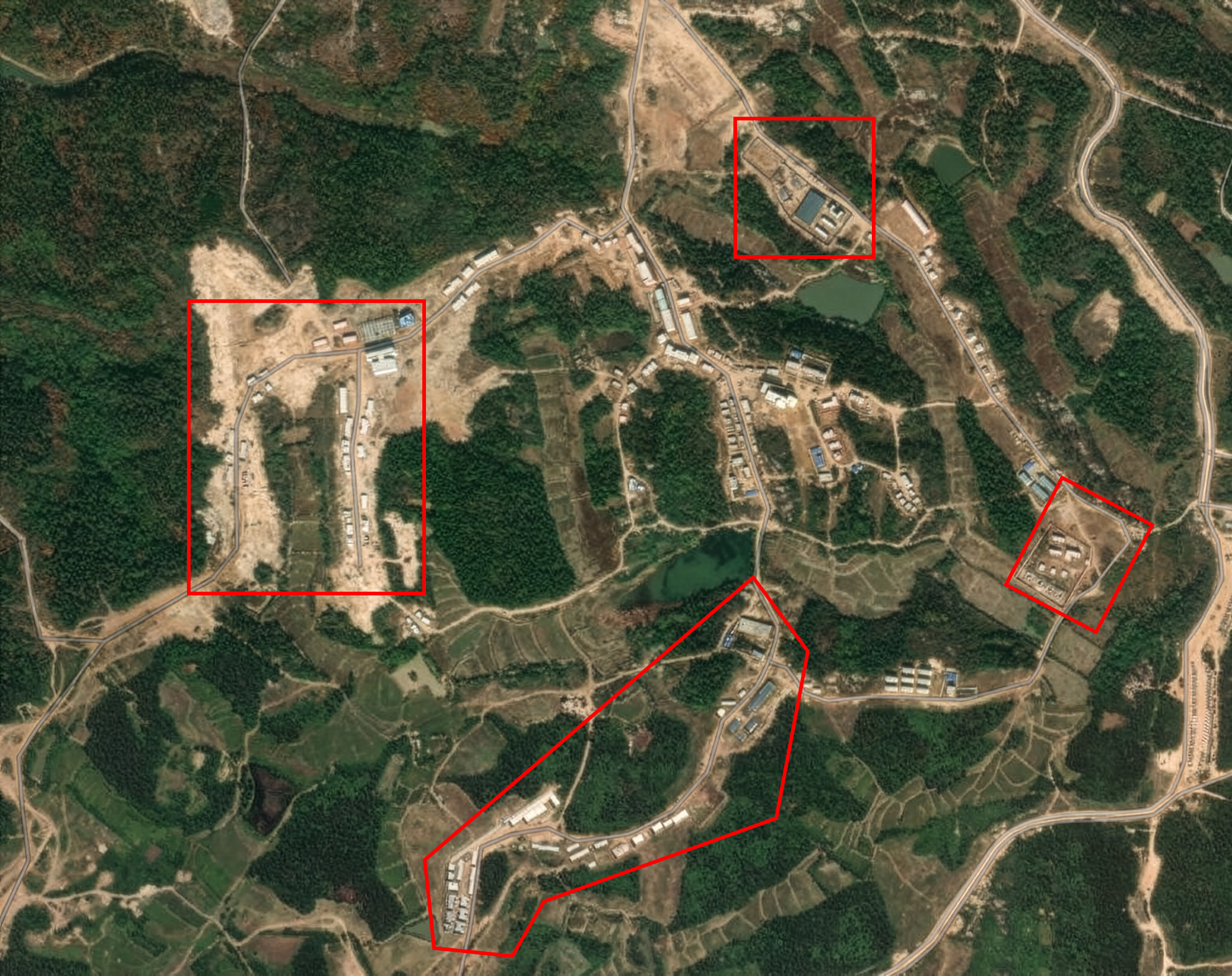
Source: ESRI World Imagery Wayback, captured 25 November 2024.
Aside from the blatant replication of urban combat conditions on Taiwan and targets on the island, the PLAA continues to develop capabilities that are uniquely useful for a Taiwan mission. The long-range rocket systems fielded by the PLAA enable it to engage targets on Taiwan, and are frequently depicted engaging important tactical and operational target sets by PLA media.[41] This system has been clearly demonstrated striking a target simulating a gas terminal on Taiwan.[42] The Eastern Theater Command Army possesses the bulk of the amphibious landing forces for a Taiwan scenario, and it will likely be in command of ground operations during wartime. Having this capability at this level allows for more efficient coordination between Theater Command joint command constructs in wartime, enabling more efficient use of the system for engaging tactical and operational targets.[43] Evolving this capability and developing the structures necessary to effectively employ it in wartime show that the PLA is focused on deploying this capability effectively. It is not for show.
Some analysts argue that the PLA is not building out the amphibious capabilities it needs for a Taiwan invasion.[44] This is demonstrably untrue. The PLA has been expanding its use of civilian roll-on/roll-off vessels (RO/RO) to support amphibious assault training and over-the-shore logistics since 2020.[45] Additionally, it appears that at least one PLA Army training center in the Central Theater Command contains a mockup of amphibious ships or RO/RO that units can use to train to embark and disembark from without requiring to go to coastal areas.[46] The PRC shipbuilding industry has also expanded its capacity to build RO/RO vessels of various types in recent years, updating the design of these vessels to make them more effective transports of military equipment.[47] The PLA has also begun procuring special purpose barges tailor made for flowing follow-on forces to beachheads after successful amphibious assaults.[48]
To further bolster beach landing capabilities, the PLA has been experimenting with the use of civilian landing craft, tanks (LCTs) to further expand its ability to land armor and follow-on logistics elements after first echelon forces seize a beachhead.[49] This could be a way to support landed forces before the PLA has erected floating causeways, seized a port, or positioned Shuiqiao-class landing platform utility vessels at a beachhead.[50] The PLA is also building more large hovercraft to deliver armor and soldiers to beaches.[51] To further enable the PLAA to effectively utilize the wide array of military and mobilized civilian vessels, numerous combined arms units have erected temporary and permanent training aids to simulate loading and unloading on civilian RO/ROs, PLAN landing ships, tank, and other landing ships. These appear at facilities across Eastern Theater Command, Central Theater Command, and Southern Theater Command.
The PLAA is also using mobilized civilian semisubmersible vessels to act as refuel and rearming points with its fleet of helicopters, which would assist with the PLAA’s ability to rely on timely close air support for amphibious operations on Taiwan and facilitate air assaults against the island.[52] In concert, these capabilities enable the PLA to expand the amphibious landing capabilities it needs for a Taiwan scenario, without the need to expand its landing ship fleet that would only be useful for an invasion of region.[53] This allows the PLA to save money and to invest in amphibious platforms like landing helicopter docks, landing platform docks, and landing helicopter assault ships that have utility for peacetime noncombatant evacuation operations and for expeditionary operations globally.
Other components of the PLA joint force maintain Taiwan-specific capabilities as well. The Eastern Theater Command Air Force has for several years maintained an unmanned attack brigade that operates legacy fighters converted into unmanned systems.[54] These systems only have the range to conduct operations over Taiwan. This is a niche capability that would only serve to otherwise improve TTPs for employing unmanned combat aerial vehicles (UCAVs) in support of manned platforms; but given the size and continued operation of its aged platforms, this suggests that it continues with a Taiwan-specific mission. The PLA Rocket Force also maintains multiple brigades operating short-range ballistic and cruise missiles that are almost certainly intended to continuously strike targets on Taiwan and U.S. bases positioned to intervene in southern Japan.
Aside from Taiwan-specific capabilities and training, the PLA is undertaking widespread efforts to harden its infrastructure and expand its ability to absorb casualties to fight a protracted war if required. These efforts are tied to enabling the PLA to sustain combat operations during a protracted conflict, not enable the PLA to sustain domestic stability operations to ensure continued CCP regime security or legitimacy. In preparation for potential conflict, the PLA has hardened facilities against attack. This is directly linked to the PLA being able to effectively mitigate U.S. attempts at intervention in a potential Taiwan scenario and reflects the requirement to maintain the command and control of the PLA’s joint forces, logistics, and counterintervention forces.[55] The expansion of underground facilities has been accompanied by the hardening of and additional redundancy of PLAAF airfields. The PLAAF has more than doubled the number of hardened aircraft shelters at its airfields, expanded taxiways, increased ramp areas, and bolstered its airfield reconstitution capabilities.[56] This is done to make the PLAAF better able to weather strikes on its bases during wartime. While this does little to ensure the PLA can serve as a backstop to CCP rule, it does ensure the PLA can provide credible options to commanders.
PLA reserve reforms are also an indicator of the shift of the PLA into a modern military intended to prosecute CCP military objectives. Prior to the reserve reforms that began in 2020, the PLA reserves were composed primarily of legacy single combat arms regiments and divisions with outdated equipment. The recent restructuring of the PLA reserves indicate that it is a force intended to surge manpower in critical career fields to support modern combat operations across the services.[57] The reserves train more regularly to perform critical support functions in support of active-duty units from the company to brigade level. This change shows the emphasis the PLA places on combat service support’s role in ensuring operational effectiveness. This is the hallmark of a military intending to fight and win wars. These changes support the PLA’s ability to sustain informationized warfare by retaining the talent necessary to conduct it at scale during a conflict, not for supporting regime legitimacy or for using the PLA to put down domestic unrest.
Modernization in Pursuit of Informationized Warfare
PLA modernization programs are focused on developing the PLA into a modern military intended to fight and win wars through realistic training and effective use of modern technologies. This modernization program is focused on efforts ranging from improving logistics capabilities to procurement of conventional long-range, cross-domain strike capabilities. From the national level down to specific service efforts, the PLA is focused on developing an array of capabilities that have nothing to do with its domestic missions and everything to do with its pursuit of modernization to fight and win wars.
Some PLA watchers argue that components of PLA modernization have been focused on prestige projects to bolster the PLA’s image. This position does a disservice to the threat posed by the engineering and manufacturing prowess of the PRC defense industrial base. The technical achievements that underpin these systems and the kill chains that support them are threats to be respected. To suggest that the world’s largest navy, the largest and most capable missile force in the world, and long-range air-to-air missiles are intended to primarily serve the spiritual fulfillment of the people misses the mark. These capabilities are clearly intended to kill Americans and its allies and partners if called on to do so.
National policies are focused on driving efforts toward important military capacities that are critical to sustaining combat operations. At a plenary meeting of military delegates to the National People’s Congress in March 2025, PLA and PAP delegates emphasized the importance of joint operations, combat casualty treatment, national defense mobilization, network information systems, and military theory as important issues to be addressed by the central government’s work report.[58] These areas have little to do with the use of the military to deal with direct threats to the CCP or manage the PLA or CCP’s image domestically. They are focused on important capabilities that the PLA needs to improve for effectively coordinating joint operations and sustaining its forces in the face of combat losses. This focus is emblematic of the PLA’s modernization program focused on developing the capabilities it perceives are required to manage crises, deter, and fight and win wars.[59]
Aside from these less flashy but critical military capabilities, the PLA has long viewed developing weapons reliant on high technologies as a method to deter or defeat the United States military. The 995 Project (a.k.a. Assassin’s Mace), for example, was intended to develop advanced technologies to deter the United States, resulting in the fielding of weapons systems like the DF-21D antiship ballistic missile (ASBM), the first intermediate-range ASBM operationally fielded by the PLARF.[60] This paved the way for follow-on systems like the DF-26 and DF-17, resulting in a robust counterintervention capability intended to overwhelm enemy air defenses and precisely engage targets at U.S. bases in the First and Second Island Chains as well as surface vessels operating in the western Pacific Ocean. The PLAAF has for several years now fielded extremely long-range (exceeding 250 nautical miles) air-to-air missiles intended to take out high-value airborne assets that are critical to sustained projection of airpower into the First Island Chain.
PLAA modernization is driven by the requirement to transform the massive service into a modern and operationally effective force. The PLAA is developing into a rapidly mobile force with the basic operational unit being combined arms brigades that allow it to flexibly assemble larger theater, theater-direction, and group-army-level taskforces from available forces. The PLAA is fielding light tanks, high-mobility brigades with new vehicles designed to accommodate weapons and sensors to perform a variety of roles and readily incorporate information systems, new helicopters to support ground operations, and long-range guided rockets across its theater command components.[61] This is undoubtedly an expensive endeavor, but it is integral to broader PLA modernization goals focused on becoming a world-class military by 2049.[62] These capabilities make the PLA Army more capable of conducting the operations commanders will require of it, and they do not directly serve the PLA’s mission as a backstop to CCP control.
The massive buildout of PLA space and cyber capabilities, all vital components for turning the PLA into a modern military designed for warfighting, was done not as a vanity project or merely to maintain the CCP’s control over the state, but to enable informationized operations. The explosive growth of the PRC and PLA’s space-launch capabilities and space-based architectures for supporting military and intelligence operations serves little purpose in maintaining CCP control over the PRC. Instead, its continued investment in space-based capabilities will be integral to any mission set that involves counterintervention, long-range fires, detection of enemy threats, and connecting the joint force. The PLA is also developing a robust space-based architecture for tracking and characterizing orbiting satellites and ballistic missile early warning, critical to developing a more credible nuclear deterrent.[63] The PLA’s command and control architecture appears to allow for network electromagnetic capabilities to be deployed to theater commands, and theater commands can direct their operations if they restrict effects to a target in theater.[64] The variety of counterspace capabilities held across the PLA services and arms and evolving thought on how to most effectively employ them demonstrate an intent to focus on maturing the technology and employment concepts necessary for their effective use. These are not tools of prestige; they are directly linked to furthering the PLA’s ability to seize information dominance and effectively conduct military operations.
In cyberspace, PRC state-sponsored and PLA-affiliated actors are already conducting network reconnaissance and preparing to exploit vulnerabilities that would both impede U.S. military mobilization and impact civilians in the American homeland, potentially impacting the political decision-making process in a time of crisis. The activities of advance persistent threat groups like Salt, Flax, and Volt Typhoon make it clear that the PLA views cyber preparation of the battlefield as a key component to seizing Taiwan and preventing the United States from intervening. These high-end capabilities are directly tied to enabling the PLA to fight its conception of modern warfare and be victorious. While the specific efforts of these threat actors may have been addressed, their efforts will persist against U.S. and Taiwanese targets.
Political Work and Operational Efficacy
Political work and political commissars in the PLA have long been criticized as a detriment to the PLA’s warfighting ability. While this may have been true at one point, the PLA is working to adopt this system to suit its modern requirements. Analysts frequently argue that the political work system and expectations regarding political loyalty are impediments to modernization and restrict the PLA’s ability to attain the combat readiness it seeks.[65]
The political work system is critical to the administrative management of the PLA, and understanding what constitutes political training is critical to understanding its impact on the PLA. The political work system is responsible for important administrative functions, supporting soldiers and their families and information operations, not just ideological indoctrination. The oft-cited statistic of the 60/40 split of military and political indoctrination tasks is important to place in context. The original source for this claim relies explicitly on initial PLA enlisted training, and it should not be hastily applied to the operational force.[66] Much of initial military training is about breaking down individuals and building them back up into soldiers, and in the U.S. military it is not uncommon for trainees to spend time learning the stories of their service or notable historical figures and their actions. This process inherently involves some level of political indoctrination; the PLA just takes this more literally and spends more time on it as a Leninist party army and not a national military. This focus occurred at the same time that PLA services, notably the PLAAF, have begun to restructure basic training to include more career field-specific technical preparation at training bases while increasing the time of initial training.[67] By doing so, the PLAAF intends to foster more competent, technical personnel and make them capable of conducting their job effectively when they reach their operational unit.
In addition to this context, what constitutes political work training has also shifted to focus on addressing organizational deficiencies that impact warfighting. The PLA uses political training as a means to address personnel deficiencies, with political training being used to address the “Five Incapables,” deficiencies associated with an inability to carry out mission command type orders.[68] While political indoctrination remains a time suck, much of what constitutes “political” training is not necessarily merely indoctrination. The PLAAF in particular has worked to reduce training burdens on operational units and pushed to better prepare the junior enlisted for their roles. However wasteful, the PLA is spending time conducting political indoctrination and is still making efforts to better prepare its enlisted force to perform their roles than it has in the past.
While the PLA undoubtedly spends time on indoctrination that could be better spent on the range, the political work and the commissar systems have become more entwined with the military side of the PLA than ever before. The PLA has long extolled the combat utility of its dual command structure comprised of an operational commander and a political commissar.[69] The dual command structure is extolled by the PLA as an efficient division of labor that provides redundant command layers to make for more robust chains of command that are resilient to casualties. The PLA has regulated a division of labor between military commanders and political officers intended to provide clarity regarding the different, nonconflicting responsibilities of political officers and military commanders so these officers stick to their decision-making lanes.[70]
Under Xi Jinping, the expectation is for political commissars to be both politically reliable and militarily proficient. This shift is an important signal of the future of the political officer corps. While underway submarines are a unique example, political track officers are considered submariners first, required to meet the same military qualifications as their military affairs counterparts, and are considered an integral part of the crew.[71] Political track officers on submarines serve as military affairs officers or enlisted prior to switching to the political track.[72] This also extends to the PLAA, where company commanders frequently change roles with political instructors in exercises. Building experience and interchangeability of combat role personnel and political officers, combined with the expectation that all officers are “double experts,” could eventually lead to an increase in military proficiency of the political officer corps.[73]
For promotion criteria, the PLA has taken steps to institutionalize the expectation that officers are both “red” (politically loyal to the CCP) and “expert” (proficient in modern warfare). The PLA is implementing a new talent development strategy, prioritizing combat-proven personnel for promotions and focusing on military assessment performance and major mission performance as promotion criteria.[74] This takes place while ensuring that these candidates are politically reliable. If the PLA was not prioritizing both military competence and political reliability, it would not be developing and implementing new promotion criteria that place military competency, joint operations, and technical experience on equal footing with political reliability. This requirement will eventually build a sizable cadre of leaders at all echelons who will be equally well versed in military and political affairs. Those officers should understand why their counterparts believe in certain courses of action, and they will be less likely to run into a situation where disagreement among the command team leads to ineffective military decision-making, likely placing competent commanders in places of authority.
However, the political work apparatus is obviously not without its problems. The removal of Admiral Miao Hua, former director of the CMC Political Work Department, in June 2025 from the CMC for “serious violations of discipline and law,” possibly related to selling promotions to the current cadre of senior PLA Navy leadership, represents lingering rot within the service. This recent debacle exemplifies broader difficulties with the PLA’s promotion system. Despite these high-level purges, operational units have taken steps to prevent corruption that would have adverse impacts on readiness.[75] These efforts exemplify that the PLA has taken serious efforts to ensure that only the most competent senior enlisted and officers are promoted to leadership positions.[76] The continued removal of CMC members signals that while certain problems persist, the PLA has taken measures to mitigate the impacts of corruption on operational units. This is an important step toward ensuring the combat readiness mandated of operational units.
Ignoring the Writing on the Wall Is Dangerous
While there are many through lines of the pre-reform PLA to the PLA of today, ignoring the changes PLA has undergone is dangerous. The PLA has become a tool the CCP primarily uses to pursue its strategic objectives abroad, coerce its neighbors in pursuit of its territorial claims, defend the PRC, and force the unification of Taiwan, potentially in the face of U.S. and allied intervention. This is clearly demonstrated by PLA literature, activities abroad, modernization, and behavior along the PRC’s periphery. While the PLA has made progress toward reaching its modernization goals, it still must undergo even more change to meet its capabilities benchmarks. It is doubtful that the CMC chairman believes that the PLA will achieve all the requirements demanded of it by 2027, given his decision to investigate and or purge the majority of theater command leader grade officers. This capability benchmark goal may have been an unrealistic timeline based on the difficulties the PLA faces in light of the cultural and organizational reform required to fight its conception of modern warfare. As an organization, it is clearly intent on forcing unification through all potential means. The upheaval caused by the purges of Zhang Youxia and Liu Zhenli and the continued investigations into PLA senior leaders provides a critical opportunity for the United States to make progress across all instruments of national power to develop the ability to fight with its allies and partners; develop relationships to expand access, basing, and overflight in the region; and modernize the U.S. military to counter the PLA at all levels of the conflict continuum in the First Island Chain. Continued collection of CCP and PLA documents, media, and research into PLA behaviors and activities is critical to maintaining an up to date and accurate understanding of CCP leadership’s expectations of the PLA and the status of PLA efforts to meet those requirements.
The PLA is no longer primarily concerned with serving as the ultimate backstop to CCP rule. Assuming that the PLA remains concerned with its ability to handle any perceived domestic threats and maintaining the domestic image of the CCP does not reflect reality leads to a false sense of security. The PLA’s primary focus remains on meeting its modernization goals. Goals that are focused on its ability to fight and win wars and becoming the world’s strongest military by 2049. The PAP enables the PLA to focus on warfighting first and foremost. If policymakers were to believe that the PLA primarily remains focused on issues at home and will not reach its modernization goals, they would be unprepared to develop strategies to mitigate the impacts of PLA military diplomacy and peacetime coercion on U.S. interests and policy priorities. This analytical approach leads to a false sense of complacency with respect to PLA modernization and could ultimately make marshalling the military and nonmilitary resources necessary to plan for a variety of potential contingencies more difficult, potentially leading to a conflict with the PRC that the United States is underprepared for.. The roads to a crisis or conflict are often not intentional; however, not taking the threat of an adversary seriously or being unable to engage in meaningful dialogue with adversaries makes the situation all the more dangerous. Should a crisis occur, the price of a faulty threat perception of the PLA today is much higher in blood, treasure, and reputation than preparing for it.