https://doi.org/10.21140/mcuj.20261701004
PRINTER FRIENDLY PDF
EPUB
AUDIOBOOK
Abstract: The concept of a combatant’s “will to fight” is frequently invoked during military discourse yet remains poorly defined and inconsistently applied in analysis. This article argues that the will to fight is most effectively sustained when military leaders connect combatants to clearly defined, credible, and enduring goals. Drawing on Rand’s research of will to fight and its national-level analytical framework, the article examines how training, ideology and purpose, and leadership and trust influence a force’s willingness to continue fighting across different conflict environments. The article employs comparative historical case studies representing three conflict types: peer-to-peer warfare, advantaged versus disadvantaged state conflict, and nation-state versus nonstate actor conflict. Each case illustrates how the interaction of leadership, institutional preparation, and ideological coherence shapes will to fight at the macro level of whole-of-society mobilization and the micro level of individual and unit behavior. The article concludes by considering the implications of will-to-fight dynamics for contemporary military leadership in the context of great power competition and Joint all-domain operations, emphasizing the continued centrality of human factors in future warfare.
Keywords: will to fight, military leadership, readiness, peer-to-peer warfare, state conflict, nonstate conflict, Joint all-domain operations, societal mobilization
Is the will to fight really that important? Every strategist and historian references a combatant’s will to fight or lack thereof. There is no quantitative method to effectively analyze a force’s willingness to fight. Any commander worth their salt concerns themselves with their force’s readiness, morale, and equipment. But the most prepared or well-armed force does not always prevail. The will to fight is not a stagnant object that exists in perpetuity. The will to fight is a reactive or dependent feature that can change during the course of a conflict or engagement. Historical examples show us that one combatant may possess the stronger will to fight for months or years, then crumble due to the result of a single engagement. This leads us to try to make sense of this ghost we call the will to fight. This article asserts that one of the keystones of affecting a combatant’s will to fight is evaluating a commander’s ability to connect forces to clearly defined goals. To support this, the following research will address leadership and the impact of the will to fight on militaries or nonstate actors and how it affects a combatant’s ability to achieve victory.
This study first defines the term will to fight and establishes a common conceptual framework for its use in military analysis. It then identifies and analyzes selected case studies to evaluate their effects on a combatant’s will to fight, with particular emphasis on training as an enabler of readiness, ideology and purpose, and leadership and trust. These case studies are measured to determine the root causes and indicators that most strongly influence a combatant’s willingness to continue fighting. Finally, the analysis examines these cases across a range of conflict scenarios, including peer-to-peer competition, disadvantaged versus advantaged nations, and engagements between nation-state and nonstate actors.
For the purposes of this analysis, the terms advantaged and disadvantaged combatants are author-defined constructs, developed to enable comparative evaluation across disparate conflict scenarios. The distinction between advantaged and disadvantaged combatants refers to relative material, institutional, and strategic capacity rather than moral legitimacy or battlefield competence. An advantaged combatant is defined as one possessing superior access to industrial production, manpower, technological capability, alliance support, and strategic depth at the outset of a conflict. A disadvantaged combatant lacks one or more of these structural advantages and must compensate through alternative means, such as ideological cohesion, effective leadership, or the mobilization of whole-of-society resistance. This distinction provides a consistent analytical framework for comparing how will-to-fight dynamics manifest across different conflict environments.
For this research to remain within the length and scope of this article, the analysis will select specific events to evaluate the impact of the case studies on the will to fight (e.g., the battle of Gettysburg versus the entire Civil War). Additionally, this article will not address political policy that does, or did not, have a clear and obvious impact on a conflict. An acceptable example would be the impact of Jim Crow laws/segregation on Black U.S. servicemembers during World War II or the Korean War. Finally, this article will focus on combatants’ national militaries (e.g., the Red Army) or U.S. State Department or Department of Defense defined nonstate actor combatants (e.g., the Taliban, the Irish Republican Army, or Chechen military forces).
Defining the Will to Fight
It is assumed that combatants do not go to war without purpose or intent. As a result, these combatants must constantly evaluate strategic, operational, and tactical factors such as supply chains, terrain, military industrial output, weather, etc., all of which affect a combatant’s will to fight. To address this wide array of factors, a broad definition must be applied with the acknowledgment that there is not a universally accepted answer. The definition used for this article was produced by Rand’s Army Research Division, which states,“In general terms, the will to fight is the disposition and decision to fight, to keep fighting, and to win.”[1] The most critical element of the will to fight is the decision to keep fighting. This disposition overcomes doubt and fear of failure, especially in moments when an outcome is uncertain. But why do troops make that decision? The analysis examines training, ideology, and faith in leadership. Analyzing these factors allows the reader to assess the accuracy of the assertion that the will to fight is directly tied to a commander’s ability to connect their forces to clearly defined goals.
To maintain analytical discipline and avoid overextension, this article employs one primary historical case study for each conflict type. Peer-to-peer warfare is examined through the First World War, which illustrates endurance and will to fight in the absence of decisive technological, strategic, or ideological advantage. Advantaged versus disadvantaged state conflict is analyzed through the Russo–Ukrainian War, highlighting how ideology and whole-of-society mobilization can offset material inferiority. Nation-state versus nonstate actor conflict is assessed through the Taliban’s campaign against the U.S.-backed Afghan government, demonstrating the centrality of leadership, ideology, and societal integration in sustaining will to fight. Additional historical examples are referenced only to illustrate specific mechanisms within these categories, not as independent case studies.
To achieve this, the analysis applies the Rand national model that evaluates “fifteen variables [that] can be applied to a wide range of historical and future conflict scenarios. Some variables will be more relevant than others, depending on the particular scenario, and how the variables are tailored for the circumstances . . . but this model provides a useful starting point for discussion and can drive a much-needed dialogue among analysts conducting threat assessments, contingency plans, wargames, and other efforts requiring conflict evaluation.”[2] The Rand model also “analyzes the following questions: what are the political, economic, and military variables that may strengthen or weaken national will to fight, and which are most important?”[3] This is the only practical method that applies the contributing factors for a large combatant forces willingness to fight. Additional considerations for evaluating the national model are an actor’s perspective on the probability of conflict and the likelihood of victory. This process evaluates the willingness to resist an aggressor and affirm the validity of their own position while preparing plans to operationalize the cause to motivate the whole of society.
Figure 1. Rand national model
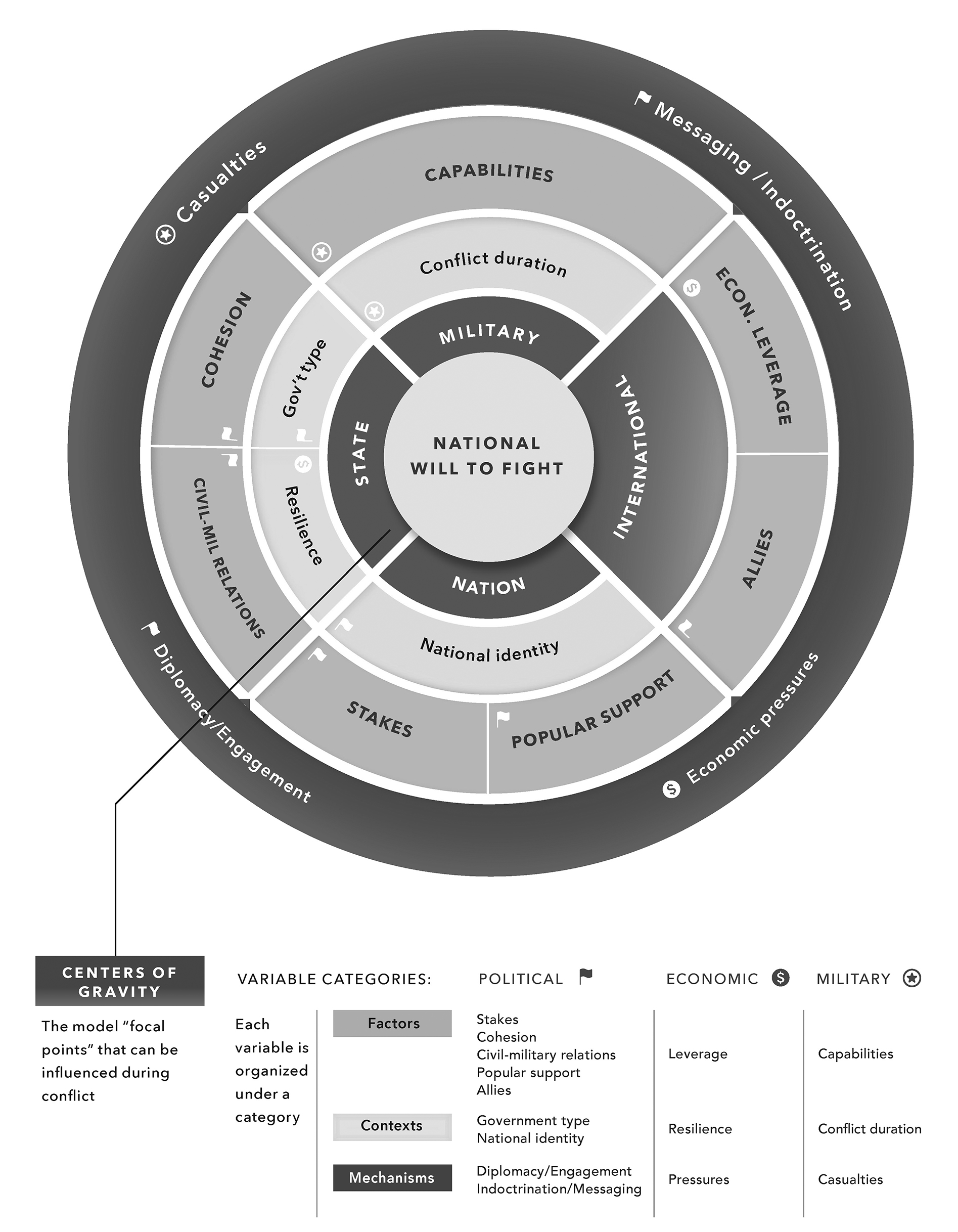
Source: Ben Connable et al., Will Fight: Returning to the Human Fundamentals of War (Santa Monica, CA: Rand, 2019), https://doi.org/10.7249/RB10040, adapted by MCUP.
This concept is addressed by Dr. Jeremiah Lumbaca in his analysis of whole-of-society in conflict. Dr. Lumbaca asserts that it is nearly impossible to determine a true or comprehensive resistance capability. To operationalize the whole-of-society resistance acceptance scale shown in figure 2, a set of metrics enables a more objective assessment of a nation’s propensity to resist. These measures evaluate two primary dimensions: societal perceptions of existential threat posed by invasion or occupation, and societal willingness to train, organize, resource, and participate in resistance. Drawing on political, social, economic, and cultural indicators, states can be more accurately positioned along the scale, with higher aggregate values reflecting greater cohesion and preparedness (e.g., Ukraine), while lower values indicate fragmentation or ambivalence, as seen in the United States. No formal weighting is applied here, though such refinements could be incorporated if required.[4]
Figure 2. Resistance acceptor scale
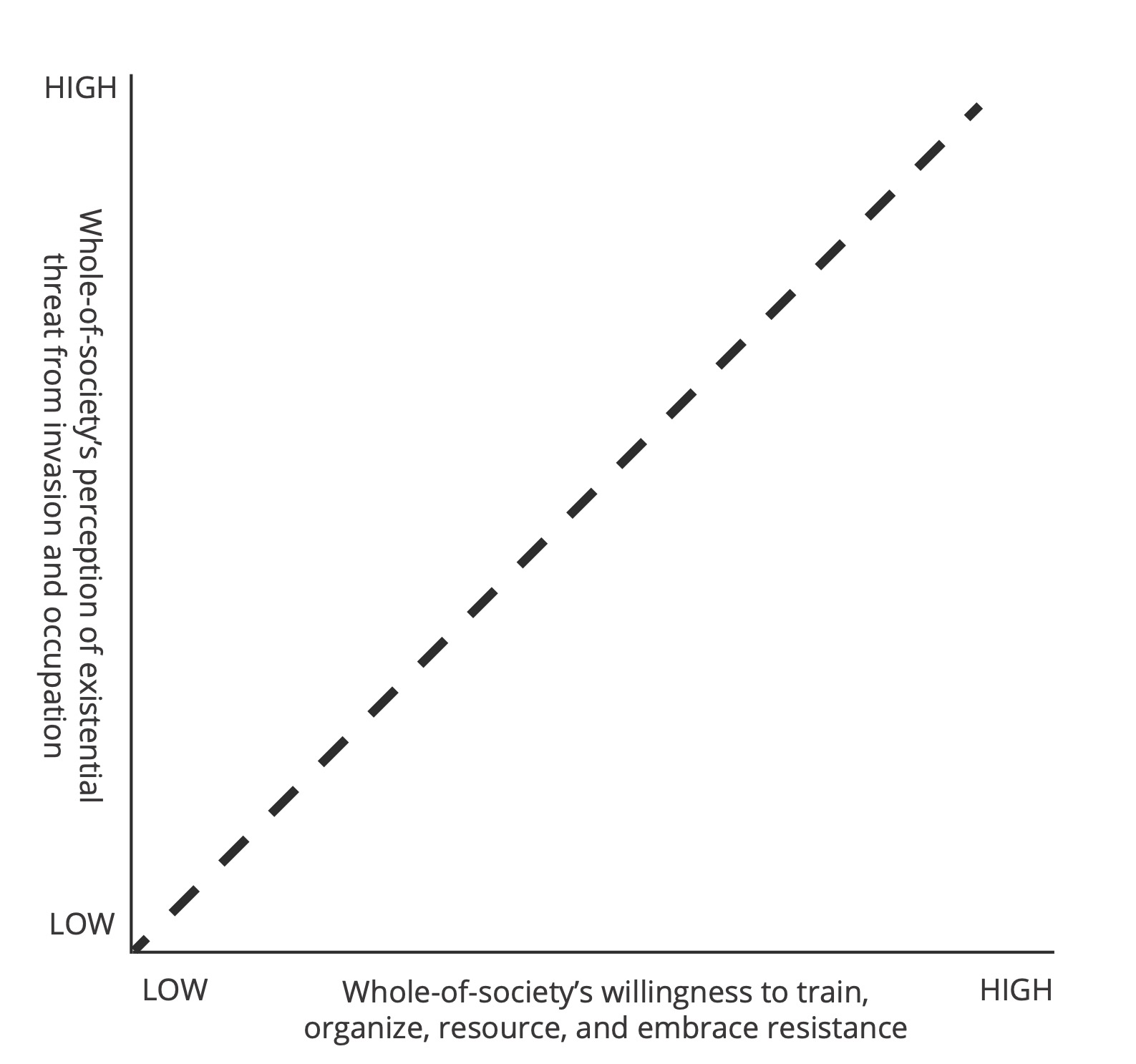
Source: Jeremiah “Lumpy” Lumbaca, “Resistance Is Futile . . . until It’s Not: Assessing a Nation’s Willingness to Build Resistance Capability Prior to Invasion,” Small Wars Journal, 11 November 2025, adapted by MCUP.
For the purposes of this analysis, the will to fight is examined at two interrelated levels. The first being the macro level, which evaluates national consciousness and whole-of-society mobilization, and the second being micro level, which analyzes individual and unit decision-making. The macro level is shaped by whole‑of‑society factors such as political legitimacy, shared narratives, institutional capacity, and perceived stakes of the conflict. At the micro level, will to fight is manifested in the behavior of individual combatants and units, where cohesion, trust in leadership, training, and perceived purpose influence the decision to continue fighting under conditions of risk and loss. Training, ideology, and faith in leadership operate across both levels: they contribute to societal cohesion and legitimacy at the macro level while simultaneously shaping morale, resilience, and motivation at the micro level. Understanding how these levels interact is essential to explaining why some forces sustain their will to fight over time while others collapse despite apparent material advantages.
Training as an Enabler of Readiness
When reviewing a large fighting force, training serves as the universal shared experience. Frontline soldiers and noncombat troops all have shared experience of the angry drill sergeant or the first thoughts of chaos when arriving at Basic Military Training (BMT). Training contributes to the will to fight in numerous ways beyond that of shared experience. “The integration of [these] will to fight concepts into military education, training, planning, assessments, international engagement,” and operational analysis will almost certainly have an impact on active battlegrounds.[5] However, it has been proven that not all training is equal, and this may detract from the will to fight, regardless of prestige or reputation.
Two twentieth-century case studies—Egyptian and Israeli preparation for war from 1967 to 1973 and the French experience during World War I (1914–18)—demonstrate the significant impact training can have on military readiness, while reinforcing that training alone does not sustain a nation’s will to fight. The immediate aftermath of the 1967 Six-Day War dealt a crushing blow to the Egyptian armed forces, particularly the Egyptian Air Force (EAF). After being nearly destroyed by the Israeli Air Force (IAF) while still on the ground, the EAF was left demoralized and shrouded in disgrace and blame. Yet within six years, Egypt not only reconstituted as a fighting force but also regained confidence across its military and broader society. As Navy commander Youssef H. Aboul-Enein observes, “There morale like that of the general population required reconstruction. This segment of society was under tremendous pressure as their reconstruction directly related to the morale of the overall population.”[6]
In a nation where nearly every adult male possessed military service or training, recovery within the armed forces played an important role in restoring confidence at the national level. Shared experience and renewed emphasis on training contributed to institutional cohesion, while a shift in military philosophy encouraged accountability rather than excuse-making. As Aboul-Enein further notes, “The recovery of the morale of the armed forces was quicker than that of the general population because mistakes that led to the 1967 War were openly discussed in an effort toward reform.”[7] Early postwar efforts focused on replacing lost equipment and training new recruits; as confidence increased, the Egyptian military sought further improvement and “expanded their ground force holdings and put their ground troops through intense and nearly continuous training.”[8] Israeli leaders, though aware of these reforms and increases in Egyptian morale and ground-force proficiency, evaluated their own position differently after 1967. From the Israeli perspective, the war had unfolded largely according to plan, reinforcing the belief that limited institutional change was required. Consequently, Israeli activity from 1967 to 1973 focused on maintaining acceptable equipment ratios with Arab forces and continuing training to preserve qualitative superiority. This disparity was particularly evident in the air domain, where “the main reasons for the disparity in performance between Arab and Israeli pilots are the exacting training of IAF air and ground crews.”[9]
Taken together, these cases illustrate that training plays a critical role in restoring and sustaining readiness, enabling forces to adapt, endure losses, and perform effectively under pressure. Egypt successfully used training to recover military confidence and surprised Israeli planners with its discipline and resilience in 1973. Israel, meanwhile, relied on superior training—particularly in the air domain—to offset early setbacks and maintain operational effectiveness. These outcomes reinforce the conclusion that training is an enabler rather than a root cause of will to fight. Well-trained forces perform better and are better prepared to endure hardship, but training alone does not explain a society’s willingness to sustain sacrifice. As Rand’s national-level model emphasizes, will to fight is shaped by broader conditions of leadership, legitimacy, and purpose, of which training is a necessary—but insufficient—component.
The French experience during the First World War further reinforces this distinction. Keen to avoid repeating the failures of the 1870 Franco-German War, French military leaders applied hard-won lessons drawn from that defeat. As one contemporary assessment notes,
It had been a major weakness of the army in 1870: the new Republic undertook from the beginning the task of elevating technical ability, skills and leadership of officers and of banning the past “improvisation culture” of the officers’ corps. The multiplicity of schools, training centres and journals dedicated to officers’ technical or scientific education, gave rise in the 1880s and 1890s to innumerable articles, studies, courses, books, and conferences. This permitted the republican professional officers to cope with the growing complexity of their function. After 1900, most of them were not expecting war passively but were trying to contribute to war preparation.[10]
In contrast to cases where training deficiencies undermined battlefield effectiveness, the French and German armies entered the First World War as peer adversaries, each possessing professionalized forces shaped by sustained training and doctrinal development. Neither side was able to secure and maintain decisive technological, strategic, or ideological advantage, and even as the Treaty of Versailles was being signed on 28 June 1919, German troops maintained they had not been beaten. This outcome underscores that training enhances battlefield performance but does not determine a nation’s will to fight. As Canadian lieutenant colonel Dominic M. Beharrysingh argues, “Doctrine and training lay the groundwork for the professional development of soldiers, significantly enhancing their ability to execute their duties effectively. Soldiers perform better when they are well-resourced through training and the provision of the latest weaponry and protective equipment. . . . Soldiers are expected to go beyond their training and what comes naturally when deployed into a conflict zone.”[11] Training alone cannot sustain a fighting force, and inadequate training significantly increases the likelihood of defeat. It remains an enabler—not the root cause—of a nation’s ability to maintain its will to fight.
During the initial phase of a conflict a force with adequate training is likely to outperform an ill-prepared one, even if the less prepared is superior in numbers and weaponry. However, during a protracted conflict, regardless of peer-versus-peer, advantaged-versus-disadvantaged, or nonstate, the will to fight amongst the combatants will certainly look for a purpose to continue to make sacrifices. Effective leaders understand the necessity to connect the fighting apparatus to the purpose of the conflict. Even well-trained forces can fail when leadership and purpose are unclear, as illustrated by the French experience in 1950s Vietnam. The French recovering from a diminished role in global affairs aimed to utilize its highly trained military force to crush the rising Communist elements. However, the purpose of this campaign was bundled both at home and abroad due to lack of interest, poor diplomatic strategy, ineffective logistical planning, and ill-defined military objectives resulting in the loss of its far east colony. Some nations have sought to address this challenge directly via political officers, or commissars to ensure its fighting members understand both military and political objectives of the conflict. In the People’s Republic of China (PRC), “political commissars are assigned to all organizations at the regimental level and above, while political directors are assigned to all battalion-level organizations, and political instructors are assigned to all company-level organizations.”[12] Looking beyond the Hollywood depiction of the foxlike Communist commissar reporting on officers and noncommissioned officers to the politburo, it is likely that commissars may elevate the effectiveness of a military force: “Its principle mission is to insure the PLA’s loyalty to support of the Party. To do this, the General Political Department [GPD] has been given broad powers in the fields of Party organization within the PLA personnel actions, propaganda, education, cultural activities, political loyalty, internal security, morale, [training] and military justice.”[13] Military theorists may be quick to dismiss this type of “continuation training” as a force detractor. However, when analyzing military forces of an authoritarian government this style of training may be an effective means to ensure its forces maintain a strong will to fight while maintaining a connectedness to the mission. Authoritarian systems have employed similar mechanisms, such as political commissars, to reinforce ideological cohesion, an example is the Sino-India War in 1962. The “PLA [People’s Liberation Army], records show that some 160 small unit leaders were cited for heroism while the much-maligned commissar system did not seem to adversely affect leadership hierarchy or overall morale.”[14] For a nation such as China, where the state is the highest priority, it is necessary that all troops, whether party members or not, be constantly reminded and encourage to continue to carry on their will to fight. While training restores a force’s capacity to fight, it does not explain why combatants choose to endure prolonged sacrifice—an outcome more directly shaped by ideology and perceived purpose.
Ideology and Purpose
The mindset and spirit behind a conflict is just as important as the people, aircraft, and tanks fighting in it. Commanders are burdened with connecting their subordinates to their objectives and tying it directly to the sacrifices they may endure. Ideology and purpose are not as simple as right or wrong, good, or bad, but rather represents the driving force for how a combatant will prepare and motivate their forces to win. For peer adversaries, this aspect is more stagnate as the strengths and weakness of their forces are unlikely to change significantly. Rather, they will be subject to the combatant’s warfighting capabilities, political strategies, and industrial capacity. Peer adversaries’ ideology is often driven by calculated (yet often misguided) decisions that seek a specific political or tangible outcome. One such example is the Iraq-Iran War (1980–88), which saw two nations of equal power and will clash over a contrasting ideology and purpose. Saddam Hussein, then dictator of Iraq, sought to crush the idea of revolution in the Middle East. Meanwhile, Iran, fresh from its 1979 revolution and led by Ruhollah Khomeini, was no less determined to usurp further American, British, and French influence and defeat Iraq. When assessing Iraq’s perceived strategic opportunity during the early stages of the Iran–Iraq War, one contemporary analysis observed that “[w]ith Iran threatening to export Shia revolution to overthrow the monarchies of the Arab Gulf states, Saddam was well positioned figuratively and geographically to lead the Arab riposte.” Furthermore, as Dilip Hiro indicated, “If the Iraqi army could cross the Iranian border and liberate the Arabs of Arabistan/Khuzistan . . . then it would entitle Iraq to a leading role in the Arab councils.”[15] Leadership of the Pan-Arab movement might also help vault Hussein into the leading position of the so-called Non-Aligned Movement, whose worldwide summit the Iraqi dictator was slated to host in 1982.[16] This example highlights several critical aspects of ideology that are necessary for the will to fight to enduring through a protracted campaign. Understanding that neither Iraq nor Iran were “politically” free states raises the question as to why they would continue to fight for almost 10 years. Throughout history, armies of nations that are controlled by dictators or oppressive regimes often have success on the battlefield. Examples such as Nazi Germany (1939–42), Imperial Japan (1936–42), the Mongol Empire (1279–1309 at its peak), and the Roman Empire (117 CE at its peak) prove this as a fact. These regimes were not established overnight, rather they were methodically built by conquering smaller and much less organized actors that were incapable of overcoming the disparity in weapons and troops (i.e., Imperial Japan conquering Korea during the Three Kingdoms period, or Rome overwhelming the nonaligned barbarian tribes of Europe). This blueprint led to the creation of an ideology founded on victory and superiority to any potential adversary.
When analyzing the likelihood of success in conflict between nonfree states versus free states it is critical to define what makes a state free. According to World Population Review, this is based on analysis of 82 indicators across 12 categories that make up the Human Freedom Index. Human freedom is commonly conceptualized in the literature as an inherently valuable social construct, defined as follows:
Human freedom is an inherently valuable social concept that recognizes the dignity of individuals. Human freedom enables and empowers people to do as they please, free from constraints or punishments, so long as it does not impinge upon one’s freedom of another. [12 categories are:] Rule of Law, Security, Safety, Movement, Religion, Association/Assembly/Civil Society, Expression and Information, Relationships, Size of Government, Legal System, Property Rights, Access to Sound Money, Freedom to Trade Internationally, & Regulation.[17]
The will to fight likely decreases in national actors that do not score well on the Human Freedom Index, which in turn will result in battlefield shortcomings. One example is the inferior performance by the Austro-Hungarian Army during WWI. Though the army was comparable in size and arms to their adversaries on the western front, they suffered significantly.[18] Reasons for this included a lack of representation in the government or military leadership, as only the Austrians and Hungarians held any power, in a multinational army composed of at least 17 nationalities. This was despite a large portion of its civilian and military population being of Slavic or minority descent, leading to the commonly used phrase “shackled to a corpse” when referencing the
Austro-Hungarian Army.[19]
In 2026, we continue to observe the Russo-Ukrainian War, furthering the analysis on the impact that freedom has on ideology during a peer conflict and a combatant’s will to fight. According to Global Firepower, the military advantages clearly lie with Russia (figure 3), while Human Freedom Index advantages are with Ukraine (figure 4).[20] With these data points in mind, we are reminded of the mantra that it is not the weapons that win wars, but the will of the person who wields it. Russia has not performed as well as initially predicted, while Ukraine outperformed their assessed abilities, despite being dependent on external support to maintain its defense. However, both nations regardless of tactical outcomes on the battlefield have a shared history of struggle and endurance which have now collided.
Figure 3. Country comparison: Russia versus Ukraine military strengths, 2026
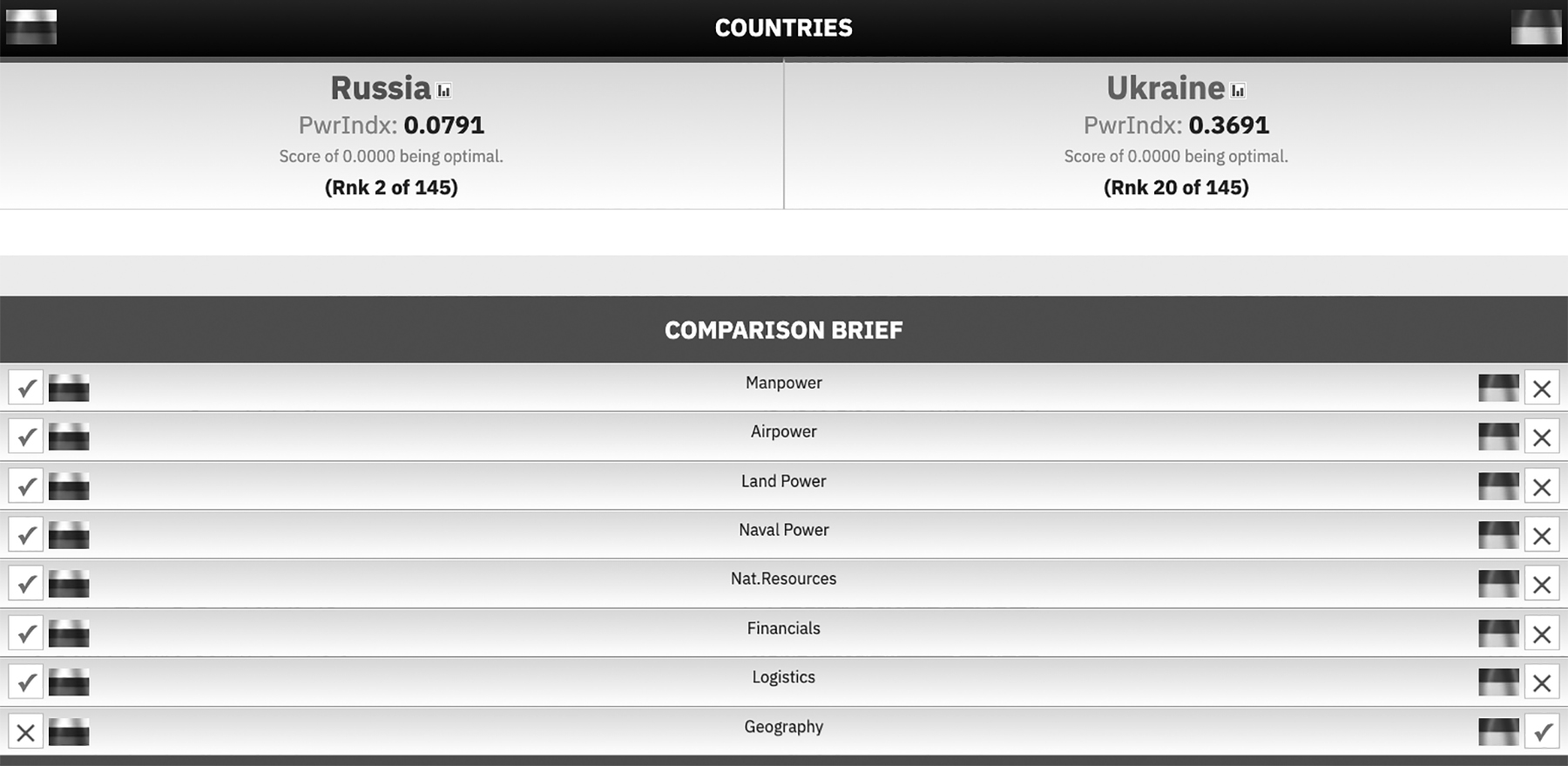
Source: “Comparison of Russia and Ukraine Military Strengths (2026),” Global Fire Power, accessed 2025.
Figure 4. Country comparison: Human Freedom Index, 2019–22

Source: “Freedom Index by Country 2025,” World Population Review, accessed 13 November 2025.
Russia and Ukraine are unlike Western powers in that their ideology and concept of freedom are starkly different. Sacrifice and struggle are to be expected and seen as a strength, meaning that they will outlast any possible adversary. Both countries demonstrated this during WWII as member states of the Soviet Union. One battlefield commander that both sides have been encouraged to emulate is a common legend of the Great Patriotic War, General Georgy Zhukov.[21] Zhukov’s approach to command reflected both individual temperament and the broader institutional culture of the Soviet system: “What distinguished Zhukov was his exceptional will to win. . . . Zhukov’s reliance more on energy and vigor than on imagination to achieve his goals was consonant with the prevailing ethos of the Soviet system.”[22] However, despite this common history, both nations have long and divergent memories that shape their current perception of reality. Russian soldiers maintain that they are fighting against the invasion of alleged Nazism left over from the Ukrainian “assimilation” to the German takeover in WWII. While Ukrainian soldiers often point to the decades of oppression and tragic historical events imposed on them by their Russian (Soviet) rulers, such as the Ukrainian famine (Holodomor) in 1932–33.
The traits that are associated with Zhukov are that he was uncompromising, cold, calculated, heartless, and unflappable. Additionally, Zhukov has been perceived as emotionally detached from his troops’ suffering, simply wielding mass human attacks and meat-grinder tactics to achieve military objectives. This perception is inaccurate, as Zhukov was described by his closest confidants to truly care about the lives of his troops.[23] However, this did not cloud his ability to be realistic. To defeat the mass mechanized army of Germany, sacrifices would be needed. This Russian and Soviet way of war can be highly effective when well executed, as in the closing years of WWII. The Russian military continues to draw on the Soviet experience as an aspirational model of effective conventional maneuver warfare. The deeply ingrained popular idea of the “Soviet steamroller”—and by extension modern Russia—wins wars by simply outlasting its opponents is inaccurate.[24] However, it continues to shape flawed perceptions of contemporary Russian capabilities. Three primary factors enabled the Soviet Union to leverage its enormous army to achieve operational and strategic objectives.
• First, the Red Army developed excellent operational art over time and concentrated on effectiveness at the operational level over skill at the tactical level of war.
• Second, the Red Army was not simply a large but highly effective mechanized force by the end of the war—the Soviets fielded high-quality breakthrough and exploitation formations in addition to large numbers of line rifle divisions.
• Third, the Soviet Union fully mobilized a truly massive base of manpower and material to fight an existential total war (unlike the mobilization in support of the Russian invasion of Ukraine, as much as the Kremlin tries to portray its unprovoked invasion of Ukraine as an existential war) and received substantial international support through the Lend-Lease program.[25]
What is often overshadowed by the mythology left by the Eastern Front of WWII onto the current battlefield today is the strategic mindset and ideology of the leaders and operational plans. During large-scale protracted conflicts, failure on the tactical level is the most easily remedied by leaders and does not affect the large-scale ideological purpose of the conflict. On the operational and strategic level, lack of success or repeated defeat can shatter a forces’ will to fight. Commanders often seek to overcome this by maintaining an aggressive mindset that promotes “their cause.” This creates the risk that, to be accepted by the forces at the sharp end, they must achieve success, or perceived success. Failure to do so will result in a breakdown in morale and result in a loss of faith in their cause. Additional considerations necessary for leaders to ensure that men maintain a positive will to fight are the: belief that leadership cares about their wellbeing, they have the support of the home front, what they are doing is morally right, and trust in leadership as competent warfighters.
As we return to the modern battlefield, the will to fight again is brought to the surface as new threats ranging from long-range ballistic missiles and lethal and stealthy one-way attack drones continue to inflict significant casualties. Neither side (Russia or Ukraine) is willing to give in as the number of casualties continues to rise: “Nearly one million Russian troops have been killed or wounded in the country’s war against Ukraine, according to a new study by CSIS. The study also said that close to 400,000 Ukrainian troops have also been killed or wounded since the war began. That would put the overall casualty figure, for Russian and Ukrainian troops combined, at almost 1.4 million, as the [New York Times] NYT reports.”[26] From a U.S. analytical perspective, the Ukrainian position is a logical one. Ukraine is the victim of aggression trying to hold off an authoritarian regime without ceding any further territory; their will to fight makes sense. The Russian position is much more difficult to comprehend. The Russian mindset dating back to the Bolshevik revolution in 1917 has always embraced struggle and adapted to loss and sacrifice to endure. From an ideological perspective, it has been crucial that the current regime present the “special military operation” as a way of protecting the Russian people through offensive means. Despite the battlefield short comings and the international pressure, the Russian government seems to have executed a formidable grassroots campaign to maintain support for the operation (figure 5).[27]
Figure 5. Russian support for the special military operation
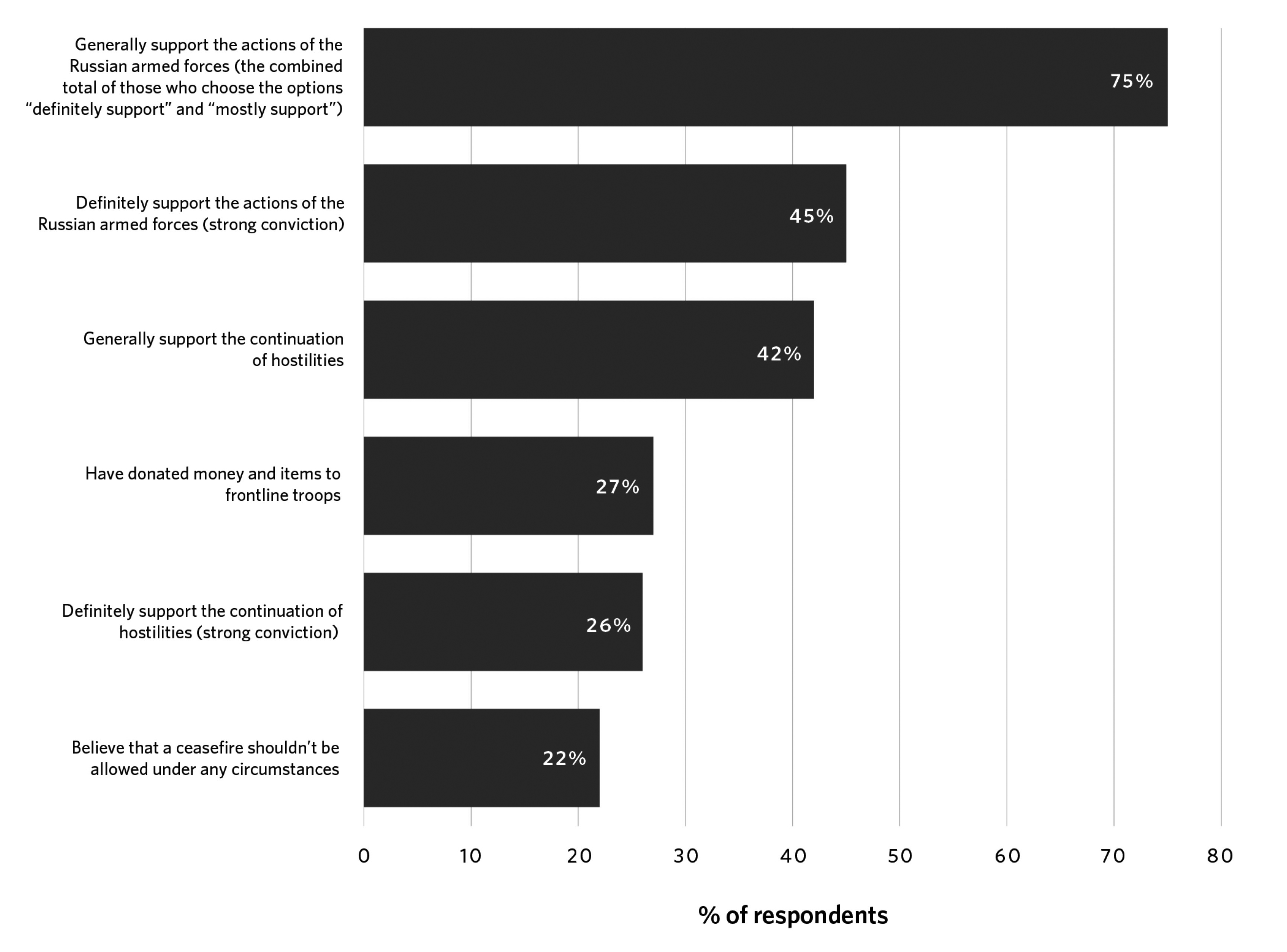
Source: Denis Volkov and Andrei Kolesnikov, Alternate Reality: How Russian Society Learned to Stop Worrying about the War (Washington, DC: Russia Eurasia Center, Carnegie Endowment for International Peace, 2023).
For nation states, the ability to maintain a collective ideology of winning, operationalize popular support, and connect clear directives during a prolonged period is easier than that of a nonstate group. As introduced by Dr. Lumbaca, the whole-of-society (WOS) model rests on a society’s readiness to train, organize, resource, and accept resistance. This dimension measures the collective commitment—through policy, action, and community involvement—to establishing an effective resistance structure.[28] The WOS metrics include:
• Volunteerism and participation rates
• Legislative and policy initiatives
• Community and organizational resilience
• Availability of resources and infrastructure[29]
Once combined across the spectrum, the intent is to mobilize preparedness and willingness to join the unified cause of defending against a perceived aggression. Unlike nation-states, which can rally to a national identity or flag, nonstate groups must maintain their collective ideology without the benefit of established institutions. Though it is common for nonstate groups to fracture after initial success, those that maintain cohesion can leverage their cause into an effective will to fight. The Taliban’s ability to leverage the WOS and apply it to an ideology with a high probability of success led to the eventual overthrow of the American-backed government. Illustrating how organizational adaptation and information dominance reinforced the Taliban’s operational effectiveness, one assessment notes that “the Taliban evolved from a rural insurgent network into a complex force of roughly 80,000 fighters, integrating information operations and decentralized command structures to enable local initiative and sustain momentum.”[30]
For nonstate groups to maintain the required unifying ideology they must ensure, or enforce, continued assistance from the local communities. Underscoring the role of civilian perceptions in sustaining armed group support, one analysis argues that “civilians are more likely to support combatants they believe can meet basic needs, as subjective assessments of resolve and capacity—shaped by limited information and cognitive bias—often outweigh concerns about violence.”[31] For all parties involved in a conflict, ideology is a keystone of success. However, the foundation of ideology must tie back to the purpose of an accepted unified goal. Ideology of a combatant can be molded over time for the betterment (or detriment) of fighting forces. Effective ideology of nonstate actors must be promoted by leadership at all levels and be clearly connected to the success of their cause. This in turn will support the successful operation of a fighting force and enable those engaged to maintain connectedness to the accepted objectives. Otherwise, the ideological aspect of warfare will fracture into self-interested items that do not necessarily support the unified/winning cause. If this occurs the will to fight will disintegrate across the force and will be dependent on individuals dedicated to their specific cause.
Leadership and Trust
The conception of military leadership as a moral and just guardian has become eroded during the last several decades. This is in part due to the expansion of the general and flag officer (GO and FO) corps and the increased frequency of change at the top for civilian leadership (i.e., secretary of defense, chief of staff of the Army, etc.). Many American citizens do not know who these high-ranking individuals are, as result the faith is naturally degraded. This contrasts the historical narrative of the U.S. and Western European nations who all but worshiped its wartime GO and FOs (i.e., General Douglas MacArthur, General George S. Patton, Admiral Chester W. Nimitz, Field Marshal Bernard Montgomery, General Ulysses S. Grant, etc.). Despite these factors, effective leadership for any entity engaged in conflict is a must have. However, to ensure that will to fight does not diminish, it demands faith in leadership and trust at all levels. For every successful army or fighting force, the belief that the one who is leading them is making decisions for the betterment or conclusion of their cause. There is also faith that their leader is concerned about their wellbeing. Finally, there must be confidence that their leader will lead them to victory. When combined, these characteristics will ensure a positive will to fight during prolonged campaigns and will afford the combatant to overcome temporary shortcomings or small tactical defeats. Faith in leadership and overall trust is the glue that holds armies together. Doubt in leadership leads to the eventual defeat and the crumbling of the will to fight.
Faith in a leader is something that is hard to gain and can be easily lost. The traits that are associated with developing this faith or trust in leadership are difficult to define. However, numerous recognized leaders highlight core principles that are often associated with good leadership and the subsequent faith that will be derived from implementing these traits:
39th chief of staff of the Army, Gen. Mark A. Milley (Ret): “[T]raits we seek in today’s Army leaders include agility, adaptability, flexibility, mental and physical resilience, competence, and most importantly character.”[32]
Norwich University’s Master of Science in Leadership: “Military leadership involves making critical decisions, often in high-pressure situations with consequential risks. Effective military leaders ask the right questions and think strategically in making well-informed conclusions upon which they can act. Military leaders also build and motivate teams. This responsibility involves looking out for their welfare, developing individual talents, recognizing successes to create a unified team confident to accomplish assigned missions”[33]
41st chief of staff of the Army General Randy A. George: “First, good leaders immerse themselves in their craft. They understand the importance of self-development and spend the effort necessary to properly prepare themselves before they train their units. . . . Second, good leaders focus on the here and now. In other words, they play the positions they’re assigned. They are laser focused on the jobs they’re in and aren’t consumed worrying about their ratings or their next jobs. . . . Third, good leaders are phenomenal teammates. They’re always professional and prepared. They are ambitious for their teams, not for themselves. And, even more important, they are trustworthy. They genuinely want to do whatever they can to help their team and teammates succeed.”[34]
Though aspects of tactical expertise, dedicated work ethic, and care for subordinates may seem simple, they are invaluable to establishing the faith of those in deployed roles. In a peacetime or garrison environment, these are easier for a leader to adhere to. However, for those who are in a deployed or combat environment, these traits may be diminished due to the nature of quick action or unfavorable decisions being made by a leader. Tough decisions can be understood by informed troops but still may not be perceived as the best option. Still, their unpopular decisions do not degrade the will to fight. Uninformed or bad decisions coupled with lack of clarity and a failure to understand why a decision was made will almost certainly lead to a degraded will to fight.
For nonstate actors, faith in leadership is essential for any chance of success. The leader of a nonstate actor is the rallying point for all aspects of their cause. They provide the objective, inspiration, and operational plan to achieve victory. Though these are not always successful, these leaders are dependent on the faith of their subordinates. The reason is simple: without the backing of their subordinates, nonstate actors divulge into an ununified mob that will inevitably disintegrate or, they (the former leader) are left to carry on the struggle alone. If either were to occur, the prospects of maintaining any will to fight are impossible and failure is assured. Any successful nonstate actor that has either contended with or defeated a nation’s state is led by either a singular or group of well-established and trusted leaders. This leadership dynamic can also be observed in the American Civil War from a little-known anti-Confederate group established in Jones County, Mississippi. Its leader, Newtown Knight, following his defection from the Confederate Army, returned to his home in Mississippi to find his family and land had been destroyed for the needs of the Confederate Army. Newton Knight rapidly assembled a force of roughly 125 men drawn from Jones, Jasper, Covington, and Smith counties to resist Confederate authorities. Known as the Knight Company, the group elected Knight as its leader, and he quickly earned a reputation as a formidable and resourceful guerrilla commander. Physically imposing and highly skilled with his shotgun, Knight led his men in evading capture by operating from concealed swamp strongholds such as Devil’s Den and Panther Creek. The group maintained communication through coded horn signals and relied heavily on assistance from sympathetic local civilians, both White and Black, including an enslaved woman named Rachel who provided food and intelligence. [35]
Knight serves as a perfect case study for leadership and trust, fostering an enduring will to fight. Not only did Knight demonstrate excellent military skills, but his ability to unify a conflicting group (White and Black people) under a singular banner proved that clear objectives and goals of protecting themselves from aggression of an invading force. Knight applied the WOS aspect of warfare perfectly and, as a result, his nonstate actors effectively achieved their objective. In the twenty-first century, however, it is unlikely that Knight would have the same level of success. The Information Age prevents any leader from completely hiding their past. For nonstate actor leaders, this can end a movement before it even begins. Much like rising politicians’ faith in nonstate military leaders is built on trust, that the leader embodies the collective cause. In the case of Knight, he was able to rally both White and Black people in Mississippi to him. It is possible that the Black people he recruited were unaware that Knight had once been a Confederate soldier. This information may have discouraged them from joining his cause as they would associate him with White slave owners who were looking to continue their abuse.
To avoid this kind of response today, nonstate actor leaders must remain dynamic and be ready to justify their actions. This requires an active campaign plan that can explain how their past still aligns them with the collective goal. A clear example of this is the current President of Syria Ahmed al-Sharaa. As Syria’s de facto leader, al-Sharaa oversaw the rebel campaign that ousted Bashar al-Assad and subsequently emphasized to military commanders the gravity of the responsibilities facing the new leadership. He identified restoring legitimacy through lawful governance as the immediate priority, followed by maintaining civil peace through transitional justice and the prevention of reprisals. Al-Sharaa also called for the reconstruction of core state institutions, including the military, security services, police, and economic infrastructure. Support for these initiatives have largely mitigated internal concerns for al-Sharaa’s connection to Hay’at Tahrir al-Sham—a former al-Qaeda affiliate designated as a terrorist organization by the UN, United States, European Union, and United Kingdom.[36] President al-Sharaa serves as a unique example for the modern nonstate actor leader turned statesman. He was able to unify a myriad of conflicting parties under a single goal despite a murky and complicated past. He also achieved what many Western military strategists believed to be an impossibility: maintaining the will to fight after more than a decade of civil war and broken trust in leadership. As indicated by his statements, al-Sharaa has mobilized the people of Syria behind his cause by offering what they have lacked for more than 40 years—an alternative to a violent dictatorship. Though it is still early in his term, al-Sharaa has taken his nonstate actor mentality and applied it well across the now controlling government. He has built faith between factions, though they are still fragile, and has begun to build relationships that affirm his objectives. Though all of Syria is not united under the al-Sharaa government, pockets are controlled by ISIS and other terror networks, his delivery and clear aims have ensured the will to fight across his former cells, but also in the Syrian armed forces.
For peer competitors and advantaged versus disadvantaged combatants, leadership is not solely reliant on a figurehead. Rather, these state-controlled militaries are the embodiment of the government, military service, or nation they represent. Leaders of these forces are bound by laws and regulations, and they are shaped by doctrine and training developed by institutions. Furthermore, their objectives and goals are tied to a strategy that has been approved by governmental institutions. Because of this, commanders are burdened with maintaining the militaries and political arms will to fight while also continuing to earn the trust of the fighting men and women. To execute effectively, one needs strategic knowledge, emotional intelligence, political skill, risk tolerance, confidence, and composure. Each of these skills has been proven to not only aid military leaders but also support the will to fight in combat forces and political institutions. In modern militaries, especially in a peer versus peer or advantaged versus disadvantaged conflict, mastery of these is critical. This is due to the scale on which conflicts are now waged. Prior to the turn of the nineteenth century, wars could be won or lost in a single or small series of battles. The American Civil War is the first modern conflict as it incorporates the WOS model and prepares combatants for the future scale and scope of conflict.
The Union undoubtedly held all the resource advantages, including industry, manpower, financial resources, and established political institutions. The South, however, was armed with two distinct capabilities. First, they had an aligned mindset of oppression via the North and were unified to defend what they saw as their “country.” Second, they had unquestionable faith in their military leadership, especially under the command of General Robert E. Lee. These two factors enabled an outgunned and outnumbered force to maintain its position as a formidable threat for four years. In contrast, the Union struggled despite all its apparent advantages. Early Union commanders, such as General George B. McClellan, struggled to rally behind a unified cause. McClellan, like so many other Union commanders, did not possess the traits needed to win a bloody and costly war. As a result, the will to fight and faith in leadership nearly disappeared from the Union cause. This changed when General Ulysses S. Grant was promoted to commander of all Union forces. Grant commanded the respect of his forces due to his battlefield success. Additionally, he presented a clear plan for success and chose to maintain aggressive offensive action. Grant, unlike McClellan, instilled a fighting spirit into the Union army. He did not allow for tactical failures to inhibit the Union grand strategy. As result Grant was able to overcome a checkered past, assaults on his character, and at times popular calls for his removal from leadership due to him being labeled a butcher. However, Grant understood that to overcome the collective goal of the South this aggressive leadership strategy was the only way to ensure Union victory.[37]
When Lee was named commander of the Confederate Army, the Southern WOS supported the belief in the right of secession and, in general, support for the continued practice of slavery (figure 6).[38] However, contrary to popular belief, Lee did not immediately inherit the blind faith of the Southern government. Rather, faith in him was earned based on the merit of his brilliant command of forces and repeated victory against larger Union armies. Additionally, Lee had established a strong support network among his officer corps, which eventually fostered loyalty throughout the entire army. Lee earned the faith from his army via his consistent and clear strategy of victory. He understood that, given the stormy nature of Southern politics, his army needed a unified cause to maintain a will to fight. Lee built this faith politically and militarily by maintaining a fearless resolve and by not accepting complacency. This provided strong evidence of Lee’s superior capacity to recognize, develop, and effectively employ talented leaders, a skill he exercised decisively by reshaping his command team early in his tenure and removing division commanders who failed to meet his expectations.
Figure 6. Confederate reasons for secession
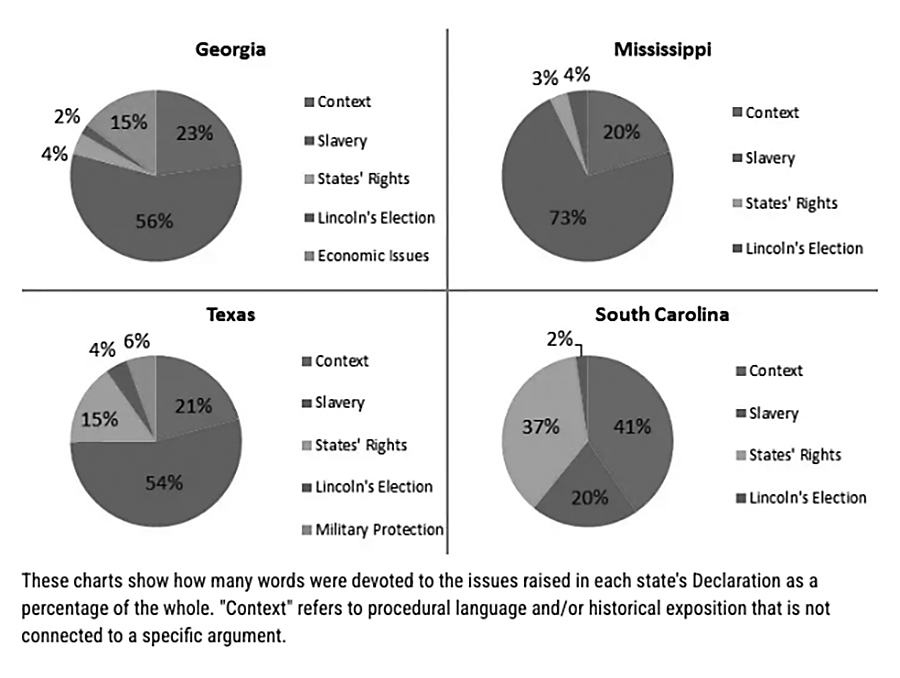
Source: John Pierce, “The Reasons for Secession: A Documentary Study,” American Battlefield Trust, updated 3 October 2023.
Because of his respected past and success on the battlefield, he was able to establish a successful command network that set him up as the hero of the South. Lee was also armed with the WOS aspect to fuel his campaign, which was fought overwhelmingly on his “nation’s” soil. Those supporting his army were directly impacted by battlefield results. Many Southern apologists later claimed that those who fought for the South did not do so in the name of slavery but rather states’ rights; however, they overlook the fact that the “aggression” being imposed on their way of life was directly tied to slavery. Lee used this to ensure his army was supported to the extreme ends of the Confederate capacity. Lee also succeeded early on where the Union failed in providing a clear objective for his army’s cause. Defending the South from Northern invasion was the singular goal that was repeated and echoed across its staff. From his headquarters to the lieutenant in charge of the volunteer companies, every man knew their objective and duty. Simply put, forces under the direction of Lee believed that he was going to lead them to victory and that he cared for them, meaning any sacrifice would not be in vain.[39]
Unfortunately, McClellan did not have the same success as Lee. His failures were not due to malign intent or lack of intelligence. Prior to stepping onto the battlefield, the Union suffered from a lack of clear objectives and vision. The internal conflict of what the war was being fought for inhibited the cohesion and effectiveness of the Union Army. The opportunity for McClellan to fill this gap was missed and, as a result, his forces were left to fight on assumption rather than on solidified military objectives. McClellan is not without fault for his failings on the battlefield. Throughout his command, McClellan consistently overestimated enemy strength and favored excessive caution, prioritizing the preservation of his forces over decisive action. He repeatedly delayed offensives, demanded unrealistic reinforcements despite numerical superiority, tolerated enemy escapes, and withdrew even in the absence of defeat. Although intellectually capable, his lack of originality and reluctance to act decisively ultimately constrained his effectiveness as a military leader. McClellan’s failure to seize the initiative and the inability to rally his forces, even after victory, nearly destroyed the Union war effort. After the war, veterans and historians credit McClellan for training and equipping the army. However, his failure to execute core leadership principles that required him to rally the army to a collective cause led to his eventual dismissal.[40]
Leadership-driven will-to-fight dynamics are also evident in figures such as Napoléon Bonaparte and Horatio Nelson. Napoléon forever changed the understanding of large-scale warfare and need for motivating the WOS to ensure the will to fight. Napoléon operationalized French pride and used his superb logistical and tactical skills to crush weaker rivals. As a result, Napoléon was able to impose his own will and desires onto the army. The combination of battlefield success and individual gain experienced by his subordinate’s propelled him into a god-like status among his army, ensuring the utmost faith in him. Nelson was no less capable of establishing his own cult of personality. However, unlike Napoléon he was bound by that of his king and country. Nelson also was provided with an advantage for maintaining the will to fight. This advantage was provided by no one other than Napoléon. Britain, in this case being the disadvantaged nation in the conflict, was able to use the threat of invasion from Napoléon as their cause. Britain’s WOS did not need to look further than the headlines of the daily newspapers, though biased and factually liberal, to see the threat of aggression. Nelson and Napoléon both demonstrated the impact of a singular national military leader can have on the will to fight. The unimpeachable faith in their status and belief in victory could empower an army beyond its perceived limitations. Napoléon demonstrated this by conquering all of Western and Central Europe, North Africa, and large parts of Eurasia (now Russia and Eastern Europe). Napoléon asserted that he was the current Caesar and that his will was directly tied to that of France. Nelson became the first man of England’s finest hour, responsible for holding off the hordes at the gate. His burden was offset by his fame to carry the weight of his nation, which subsequently saved Britain from invasion. He made the world aware of his ability and effectively built the global empire via naval power that dominated the seas for more than 120 years. Both men commanded the uncompromising faith from all those who served under them and demonstrated that faith in leadership and trust at all levels can lead to a near limitless will to fight.[41]
Conclusion
The will to fight is something that will continue to evolve just as warfare has. There will never be a prescribed method for motivating forces to continue to fight. The root cause for ensuring the will to fight will be dependent on how military leaders choose to use the resources at their disposal. As discussed, training, ideology, and leadership are key components to measuring a force’s willingness to fight. This article argues that combatants maintain their will to fight when commanders connect forces to clearly defined goals. Without it, these combatants are at risk of failing and eventually being defeated by a lesser or equal force. Training alone will not suffice as forces may become disillusioned during a prolonged period of combat and will then refuse to place themselves at risk. However, without training forces will descend into undisciplined mobs destined for disaster. Ideology can be a massive force enabler and driver of the will to fight. The belief in victory, the acceptance of the righteous cause, and historic understanding of conflict and sacrifice all fuel the will to fight. This is clear in the aftermath of the fall of Afghanistan to the Taliban, the clash of ideology between Iran and Iraq, and in 2025 the shared historic past of sacrifice and victory through sheer will in Ukraine and Russia. However, as seen in conflicts such as WWI, Korea, and Iran-Iraq, simply relying on ideology often results in stagnation and negative peace (or peace simply due to the lack of violence). Additionally, ideology regarding prolonged conflicts often is subject to political freedom that may negate the ability to maintain the will to fight. Leadership is the most dynamic and adjustable aspect for a combatant’s ability to maintain or elevate its forces’ will to fight. Crucial is the faith that the leaders of the combatants’ forces are capable, intelligent, and care for their force. Additional aspects are the cult of personality that make the soldiers under their command believe that they will succeed. The analysis presented here engages with the central concepts surrounding will to fight. Although it is open to debate as to what will make forces increase or maintain their will to fight, one thing is certain. Future great conflicts will shatter all previous understandings of front lines, strategy, mission execution, WOS, and loss. Any future combatant will need to be flexible if they seek to win as warfare has changed drastically since the end of the last great disaster known as WWII. The will to fight will affect everyone, not just those wearing a uniform or those in a city that has been bombed. The WOS will be affected and the will to fight will be determined by the grit of the nation and its ability to come together for the ultimate cause of achieving peace as quickly as possible.
Endnotes
[1] “Will to Fight,” Rand Army Research Division, accessed 7 November 2025.
[2] Ben Connable et al., Will to Fight: Returning to the Human Fundamentals of War (Santa Monica, CA: Rand, 2019), https://doi.org/10.7249/RB10040.
[3] Connable et al., Will to Fight: Returning to the Human Fundamentals of War.
[4] Jeremiah “Lumpy” Lumbaca, “Resistance Is Futile . . . until It’s Not: Assessing a Nation’s Willingness to Build Resistance Capability Prior to Invasion,” Small Wars Journal, 11 November 2025.
[5] Connable et al., Will to Fight: Returning to the Human Fundamentals of War.
[6] Youssef H. Aboul-Enein, review of The Quranic Concept of War, by Brigadier S. K. Malik, Air & Space Power Journal, 15 July 2005.
[7] Aboul-Enein, review of The Quranic Concept of War.
[8] The 1973 Arab-Israeli War: Overview and Analysis of the Conflict (Washington, DC: Central Intelligence Agency 1975), 14.
[9] The 1973 Arab-Israeli War, 22–45.
[10] Olivier Cosson, “Pre-War Military Planning (France),” International Encyclopedia of the First World War, 8 October 2014.
[11] D. M. Beharrysingh, The Will to Fight: An Enduring Term or Endearing Sentiment (Toronto: Canadian Forces College, 2025).
[12] Kenneth W. Allen et al., Personnel f the People’s Liberation Army (Washington, DC: U.S.-China Economic and Security Review Commission, Blue Path Labs, 2022), 17–18.
[13] Post-Mao Party-Military Relations: The Role of the General Political Department (Washington, DC: Central Intelligence Agency, 1976), 1.
[14] Larry M. Wortzel, “Concentrating Forces and Audacious Action: PLA Lessons from the Sino-Indian War,” in The Lessons of History: The Chinese People’s Liberation Army at 75, ed. Laurie Burkitt, Andrew Scobell, and Larry M. Wortzel (Carlisle Barracks, PA: Strategic Studies Institute, U.S. Army War College, 2003), 327–52.
[15] Dilip Hiro, The Longest War: The Iran-Iraq Military Conflict (New York: Routledge, 1991), 38.
[16] LtCol Mark Bucknam and Frank Esquivel, Saddam Hussein and the Iran-Iraq War (Washington, DC: National Defense University, National War College, 2001), 7. The Non-Aligned Movement is an international organization of 120 member states that represent the interests of developing nations. The summit was forced to relocate due to the war.
[17] “Freedom Index by Country 2025,” World Population Review, accessed 13 November 2025.
[18] Western front for the Austria-Hungarian empire refers to campaigns against the British or French forces, which were limited. However, Austro-Hungarian forces performed better on the Italian and Russian fronts. For further insight, see Hew Strachan, The First World War (London: Simon & Schuster, 2014).
[19] John J. Tierney Jr., “Shackled to a Corpse,” Institute of World Politics, 9 June 2008.
[20] “Comparison of Russia and Ukraine Military Strengths (2025),” Global Fire Power, accessed 2025; and “Freedom Index by Country 2025.”
[21] Great Patriotic War refers to a Soviet term describing the Eastern front during WWII.
[22] Henrik Bering, “Zhukov: The Soviet General,” Hoover Institution, 1 December 2012.
[23] Bering, “Zhukov: The Soviet General.”
[24] Bering, “Zhukov: The Soviet General.”
[25] Mason Clark, The Russian Military: Forecasting the Threat (Washington, DC: Institute for the Study of War, 2025), 10.
[26] H. Andrew Schwartz, “The Evening: One Million Russian Casualties, U.S. to Have Slower Growth, Truckin’, and More,” CSIS, 3 June 2025.
[27] Denis Volkov and Andrei Kolesnikov, Alternate Reality: How Russian Society Learned to Stop Worrying about the War (Washington, DC: Russia Eurasia Center, Carnegie Endowment for International Peace, 2023).
[28] Lumbaca, “Resistance Is Futile . . . until It’s Not: Assessing a Nation’s Willingness to Build Resistance Capability Prior to Invasion.”
[29] Lumbaca, “Resistance Is Futile . . . until It’s Not: Assessing a Nation’s Willingness to Build Resistance Capability Prior to Invasion.”
[30] Benjamin Jensen, “How the Taliban Did It: Inside the ‘Operational Art’ of Its Military Victory,” New Atlanticist (blog), Atlantic Council, 15 August 2021.
[31] Karl Kaltenthaler, Arie W. Kruglanski, and Austin J. Knuppe, “The Paradox of the Heavy-Handed Insurgent: Public Support for the Taliban Among Afghan Pashtuns,” Studies in Conflict & Terrorism 47, no. 12 (2024): 1699–1723, https://doi.org/10.1080/1057610X.2022.2055008.
[32] Quoted in LtGen Robert S. Ferrell, “What Makes a Good Leader?,” Army.mil, 4 January 2016.
[33] “What Is Military Leadership? Learn More about This Career Path,” Norwich University Online, accessed 2025.
[34] Gen Randy George, “Three Qualities of Good Leaders: A Message for New Lieutenants from the Chief of Staff of the Army,” Modern War Institute, 23 May 2025.
[35] James R. Jelly, “Newton Knight and the Legend of the Free State of Jones,” Smithsonian Associates Civil War E-Mail Newsletter 10, no. 3, 2014.
[36] David Gritten, “Ahmed Al-Sharaa Named Syria’s Transitional President,” BBC News, 31 January 2025.
[37] Maj Mark E. Scott, McClellan and Grant: The Importance of Personal Trust for Effective Command at the Operational Level of War, Report no. ADA422705 (Newport, RI: Naval War College, 2003).
[38] John Pierce, “The Reasons for Secession: A Documentary Study,” American Battlefield Trust, updated 3 October 2023.
[39] Mike Hennelly, “Lee’s Lieutenants: Leadership Lessons from the Civil War for the Battlefield and the Boardroom,” War on the Rocks, 8 May 2017.
[40] Stephen K. R. Howarth, “George McClellan: Problematic U.S. Civil War Commander,” History Is Now Magazine (blog), 10 October 2023.
[41] James Davey, “Napoleon & Nelson: The Parallel Lives of Rivals,” Sotheby’s, 9 July 2020; and “Napoleon, Emperor of France vs Nelson, Britannia’s ‘God of War’,” Old Royal Naval College, 18 August 2023.