https://doi.org/10.21140/mcuj.20261701006
PRINTER FRIENDLY PDF
EPUB
AUDIOBOOK
Abstract: This article argues that research on citizens’ willingness to defend their country, often referred to as “defense will” and “will to fight,” must move beyond narrow, binary measures of armed resistance. The individual defense relationship (IDR) theory provides a multidimensional analytical framework to understand how individuals position themselves in relation to the state, society, national defense, and comprehensive security. IDR specifies three framing factors (belonging, worth, and threat) and four positioning factors (attitude, trust, competence, and agency) to clarify the cognitive, social, and emotional mechanisms of commitment. By incorporating nonmilitary forms of defense and a comprehensive security perspective, the theory expands the scope of citizen roles and agency beyond military defense. This article also discusses how IDR has been operationalized qualitatively (e.g., thematic interviews) and quantitatively (e.g., standardized surveys validated with factor analysis) and shows how the approach applies across conscription-based and all-volunteer force contexts. IDR provides a rigorous tool to assess citizen agency in contemporary environments characterized by hybrid, cyber, and other subconventional threats.
Keywords: citizenship, civil-military relations, comprehensive security, defense will, individual defense relationship theory, IDR, national defense, total defense, will to fight
Introduction
The willingness to defend one’s country, often proxied as a “defense will” or “will to fight,” has long been a significant topic in political science and military sociology.[1] Russia’s full-scale invasion of Ukraine in 2022 altered the European security environment and intensified scrutiny of how scholars and policymakers gauge citizen commitment, particularly in the Nordic and the Baltic region that buffers the North Atlantic Treaty Organization (NATO) and the European Union against Russian coercion. In this context of change within the military, security and geopolitical environment, traditional survey questions of defense will typically condense the phenomenon to binary judgments about armed resistance or personal readiness to fight. While such approaches remain informative, they understate the diverse ways in which citizens relate to national defense and contribute the national preparedness in an era of hybrid warfare, cyber operations, disinformation, economic coercion, and large scale of subconventional threats (i.e., gray zone warfare).
The traditional Nordic model of defense will, which has typically centered on citizens’ willingness to protect their nation, has faced significant criticism for its vague definitions and methodological limitations.[2] The tradition of quantitative research measuring national willingness to defend has often crystallized around two main types of survey questions. The first type, concerning general national defense will, often asks (by national perspective): “If [your country] were attacked, should citizens, in your opinion, defend the country militarily in all situations, even if the outcome seemed uncertain?[3] This formation of the survey question is based on the original Swedish version used since the 1950s: Anser Ni att vi bör göra väpnat motstånd även om utgången för oss ter sig oviss?[4] The second type, concerning individual participation and willingness in integrated security asks (by national perspective): “If [your country] were attacked, would you personally be willing to participate in various national defence duties according to your abilities and skills?”[5] or “If there were a war that involved [your country], would you be willing to fight for your country?”[6] The question of personal participation includes also the perspectives of individuals’ agency in national defense, total defense, or comprehensive security.[7]
Traditional survey questions and variables on national defense have been developed within the context of Nordic welfare states (Denmark, Finland, Iceland, Norway, and Sweden) and have been widely used in various countries. These questions have proven effective as variables in citizen surveys, public opinion polls, and in various types of polls collected for different purposes.[8] In states where the defense system is based on (universal) conscription, the relationship between the armed forces, society, and citizens is more closely intertwined than in countries that rely on occupational contracts to recruit personnel for their all-voluntary military forces.[9] Within the context of conscription, citizens’ willingness to defend their country plays a crucial role in supporting the armed forces, influencing public opinion, endurance the defense system, and shaping the readiness of citizen-soldiers to participate in national defense.[10]
This review article advances the claim that modern national resilience is better explained when “defense will” is conceptualized as a dynamic relationship rather than a single attitude. Building on prior Finnis and Nordic work, the IDR theory introduced by the author in 2019, the article reconceptualizes the domain by specifying the social, cognitive, and emotional mechanisms that underpin perceptions and commitment to the state, national defense and its comprehensive security.[11]
IDR connects attitudes toward armed defense with broader experiences of social belonging, the perceived worth of the state and its institutions, and perceptions of threat that extend beyond conventional war. This analytical depth is essential because a citizen’s commitment to defense is inextricably linked to the social contract; if the state fails to provide essential security and services or maintain legitimacy, the individual’s reciprocal motivation to defend that state may diminish.[12]
The strategic necessity of this nuanced understanding of IDR is underscored for instance by the total defense model, comprehensive security framework, and the resistance operating concept. Total defense and comprehensive security models are concerned with the overall security of the state and society, where armed defense is just one component of security. Both models emphasize the significance and agency of various societal authorities and citizens in addressing different threats. Total defense encompasses all sectors of society, including the military, authorities, citizens, and infrastructure. It considers not only military threats but also cyber threats, economic crises, and internal security disturbances in relation to national security. It highlights active citizenship in supporting preparedness and defense.[13] Comprehensive security, conversely, approaches security as a broader concept, incorporating factors such as the national economy, health, environment, education, and other societal sectors as contributors to security and influencing factors. This model fosters cooperation across different societal sectors to enhance and maintain the resilience and stability of society.[14] Within the context of the resistance operating concept (ROC), comprehensive resistance by the civilian population refers to a national, whole-of-society effort, in which the population is not merely a passive target, but rather the primary actor in resistance. This approach is grounded in national resilience, or the population’s will and ability to withstand external pressure and restore sovereignty in terms of foreign occupation.[15]
Following the extensive dialogue on defense willingness at the 2024 European Research Group on Military and Society (ERGOMAS) Conference in Stockholm, this review article introduces IDR theory in English to an international audience and demonstrates its relevance as an extension of the traditional concept of defense will.[16] These discussions have become central to the ongoing academic dialogue on national defense, making it particularly timely and relevant to contribute to the U.S. academic literature with this review on modern military sociological research on national willingness to defend and will to fight.[17]
The article seeks to answer the following research question: How can the IDR theory serve as a comprehensive analytical framework for understanding the multidimensional nature of citizen commitment to national defense in contemporary military and societal contexts? By synthesizing modern military sociology with the operational requirements of national resistance, this article contributes to the academic debate on maintaining sovereignty in an increasingly changing security environment in the world.
Individual’s Defense Relationship Theory
IDR extends the traditional “defense will” and “willingness to defend” research by moving from a one-dimensional, linear attitudinal measure toward a multidimensional and comprehensive analytical framework that structures the individual’s relationship with the state, society, national defense, and security.[18] It separates (a) framing factors that shape an individual’s orientation to state and society from (b) positioning factors that capture how a person locates themselves within national defense and its security.[19] In terms of understanding the individual’s relationship with national defense, the theory recognizes that commitment to national defense and security is not merely a static attitude toward conventional warfare, but also encompasses social, emotional, and cognitive dimensions. The theory is deliberately inclusive, encompassing classical national and total defense along with nonmilitary forms of defense, civil protection, and preparedness activities across the comprehensive security field. Consequently, IDR remains applicable when threats manifest as cyber operations, disinformation, economic shocks, public‑health crises, or environmental hazards rather than armed invasion.[20]
An individual’s defense relationship is built on a set of framing factors, including perception of belonging to society and the country (belonging), perception of one’s country as worth defending (worth), and perception of threats to society and the ability to respond to them (threats).[21] The individual is positioned within national defense through positioning factors such as attitudes, trust, competence, and agency.[22] This framework broadens the understanding of how citizens locate themselves within the field of national defense, for example, on the basis of their knowledge, skills, or perceived self-efficacy.
Framing Factors
The model posits three main factors that frame an individual’s defense relationship.
• Belonging: This factor refers to an individual’s felt of membership and sense of belonging in the political community, society and country. Belonging includes perceptions of fairness, inclusion, cohesion, and reciprocity that sustain legitimacy and readiness to contribute. The factor encompasses trust in societal systems and institutions, and the belief that the state fairly represents and protects its citizens’ interests. Unlike traditional models that might stress societal structures within a welfare state, the IDR model prioritizes individual agency, action, and commitment to societal values, highlighting freedom of choice and self-interest.[23]
• Worth: This factor reflects an individual’s perceived value of the state and country and their order as worth defending. Worth is shaped by their trust in the defense system, the integrity of democratic institutions and the quality of essential services, such as healthcare, education, and social security. Declines in these services provision or pronounced societal polarization can depress the perceived worth of the state.[24]
• Threat: This factor involves individuals’ perceptions and awareness of risks and threats facing society or country and assessment of capacity to respond to them. Threat perceptions draw on direct experience as well as mediated understanding of military, hybrid, economic, epidemiological, and ecological hazards.[25]
Figure 1. Individual’s defense relationship (IDR) theory
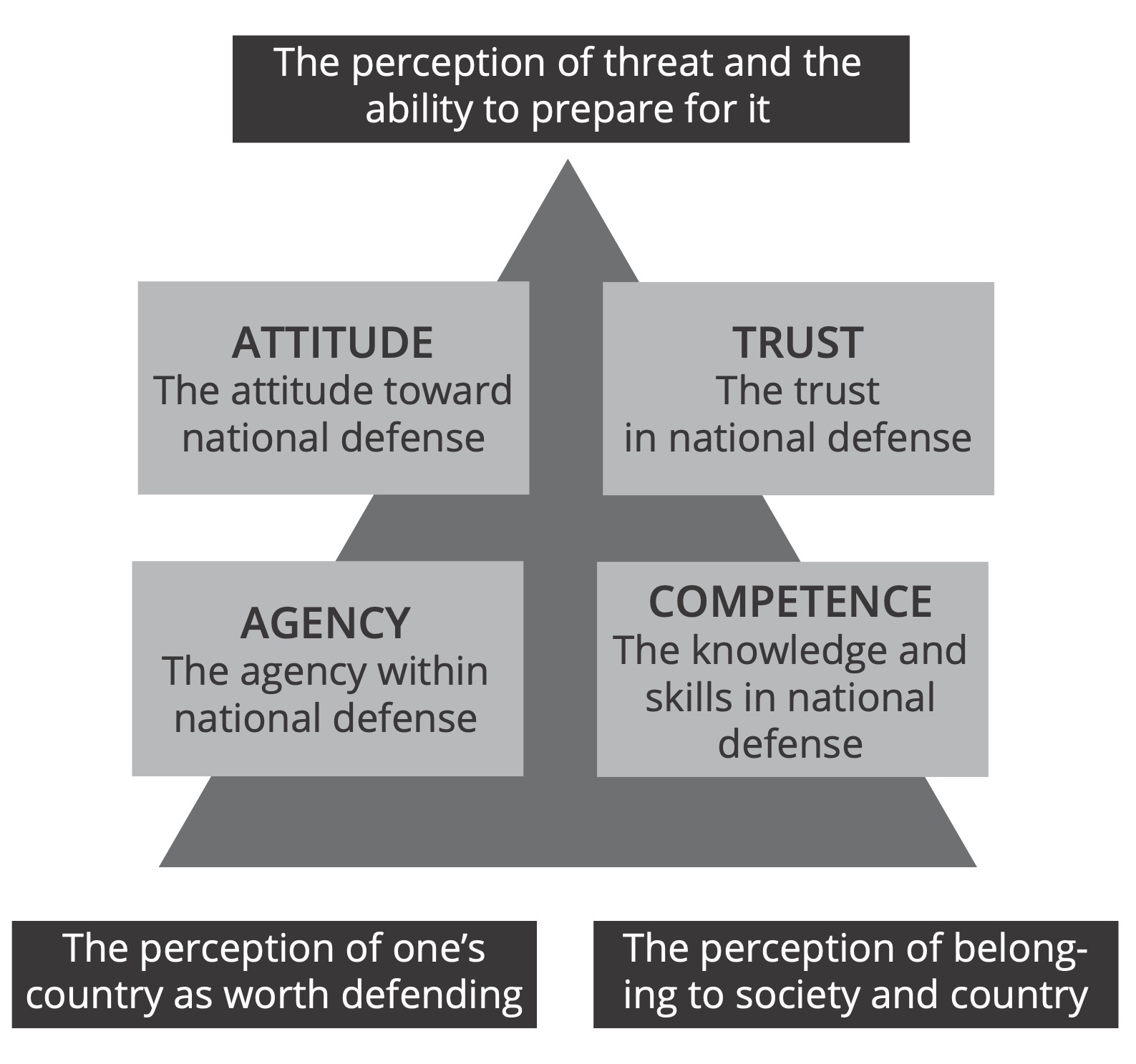
Source: adapted and translated from Jarkko Kosonen, Alisa Puustinen, and Teemu Tallberg, “Maanpuolustustahdosta Maanpuolustussuhteeseen–Siviilipalvelusvelvollisten ja Reservistä Eroavien Kokemuksia Asevelvollisuudesta ja Hyvinvointivaltiosta” , Sosiologia 56, no. 3 (2019): 61.
Positioning Factors
There are four key factors that position the individual toward national defense. These factors are shaped, developed, and mutable at a personal level. Through these factors, the individual engages in dialogue about their relationship with national defense and the meanings it assumes. The defense relationship is not static, but subject to continuous, process-like change at the individual level, guided by the individual’s actions and social interactions.[26]
• Attitude toward national defense: This factor reflects an individual’s stance (or disposition) regarding national defense, the armed forces, conscription and related service, and the legitimate use of military force, including attitudes toward weapons and killing. Attitudes range from supportive to critical and shape whether an individual perceives mandatory service as a state-imposed compulsion, a socionormative obligation, or a personal opportunity.[27]
• Trust in national defense institutions and capabilities: This factor encompasses confidence and trust in the various elements of national defense, from personal efficacy in facing security threats to confidence in the nation’s defense capabilities during various crises. It also includes trust in the defense policy management, shaped by experiences, perceptions, and knowledge and judgments about national readiness across military, hybrid, and civil contingencies.[28]
• Agency, roles, and participation in national defense: This factor characterizes how individuals claim, accept, or decline and navigate various roles or positions in national defense and security system. It is being done either independently or based on social interaction and normative expectations. It may manifest actions such as desire to actively seek a role through volunteering or a profession, performing military service, actively seeking a role in national defense or conversely, opting out, such as resigning from the military reserve or adopting political pacifism.[29]
• Competence, knowledge, and skills, in national defense: This refers to the domain-relevant knowledge and skills related to national defense and acquired through education, conscription or nonmilitary service, vocational training, employment, hobbies, or civic security-
related activities. It reflects an individual’s ability to contribute to societal defense and security in both normal and wartime conditions.[30]
The Societal Context in Studying IDR
IDR aligns with whole‑of‑society approaches. It is both as a theoretical concept and an analytical tool for examining how individuals or entire populations perceive matters related to national defense and security. It takes into account nonmilitary forms of defense and citizens’ agency within the context of total defense or comprehensive security models by integrating nonmilitary forms of defense, hybrid threats, and citizens’ willingness to participate national defense in these forms.
Total Defense and Comprehensive Security
Total defense integrates military and civil sectors to ensure continuity of governance, critical infrastructure, and societal functions during crises.[31] Comprehensive security broadens the concept still further by emphasizing interdependencies among defense, economy, health, environment, education, and internal security.[32] Within these frameworks, threat perceptions and preparedness are not solely state-centric; they hinge on citizen competence and agency, participation in conscription or all-volunteer professional forces, but also in nongovernmental organizations, volunteer rescue services, first-aid and resilience training, and spontaneous civic action.[33]
The analysis of threat for the framing factors addresses the diversity of citizens’ perceptions of threats, highlighting temporal, geographical, social, or societal class-related similarities and differences. This broadens the analytical use of IDR as a research tool to encompass a wide array of societal threats, such as hybrid threats, information warfare, cyber operations, ecological crises, climate change, pandemics, economic crises, and societal polarization.
The perception of threats and responses to them is tied to both state and individual levels, particularly through citizens’ competence and agency in total defense or comprehensive security contexts. Agency includes participation in armed defense (obligatory conscription or all-volunteer forces) as well as involvement in third-sector organizations, nongovernmental organizations and volunteer organizations like the Red Cross, or rescue services. It also acknowledges agency in compulsory nonmilitary (civil service) service and voluntary crisis management and rescue training. These all serve as tools for building societal resilience by fostering citizens’ agency and competence.
From the perspective of societal preparedness and resilience, it is crucial to understand how citizens trust their own abilities and the society’s readiness to respond to contemporary threats, such as hybrid warfare and cyber operations. This viewpoint demonstrates that the IDR theory has been developed to analyze individuals’ relationships with total defense in a broader sense, where threats are not limited to traditional military invasions.
The IDR theory connects the defense relationship to the functioning of the welfare state. An individual’s experience of the value of state services and rights (worth) and social belonging forms the foundation for national unity, resilience, and the capacity for resistance. This suggests that societal stability and services are seen as a core component of the defense relationship as these objects have seen reciprocal factors in ROC.[34]
Alignment with the Resistance Operating Concept
The resistance operating concept envisions the population as an active agent of resistance, armed and unarmed, grounded in resilience and the will and ability to withstand external pressure.[35] IDR complements ROC by providing a diagnostic lens on the values and perceptions that underpin civilian commitment: the perceived worth of the state and society, and a sense of social belonging bolster psychological defense and help citizens resist coercion and propaganda. IDR thereby offers an empirical path to assess legitimacy, cohesion, and the connective tissue between society and the security apparatus.
The IDR aligns with the ROC in terms of the “will and ability to withstand external pressures and influences and/or recover from the effects of those pressures or influences.”[36] Each of the ROC, total defense, and comprehensive security frameworks emphasizes citizens’ active role in societal preparedness, resilience, and crisis endurance, but each does so with slightly different emphases. The IDR theory can support both theoretically and empirically the role of citizens within the ROC and their commitment to defending society. The knowledge and insights derived from it can be utilized in societal decision-making and preparedness planning.
In the ROC model, the civilian population is envisioned as participating in both unarmed and armed resistance. The model depicts the population not as a passive target but as the primary agent of resistance. Citizens’ commitment to resistance is not a static state but a dynamic process linked to the social contract.[37] According to the IDR theory, the civilian defense relationship depends on whether individuals perceive the state’s services and rights as worth defending.[38] Psychological defense will and a strong national identity are prerequisites for the civilian population to resist the occupier’s propaganda and maintain faith in liberation.[39] In this regard, IDR provides a research tool for examining citizens’ defense will, agency, competence, and the underlying values that support these aspects.
The IDR theory was developed within the context of Nordic welfare states, it can be extended and applied globally to different societies. The perception of one’s country, state, society, or local community as worth defending, along with social belonging, are universal and cross-cultural values.[40] These values are part of the social contract between the state and its citizens, regardless of geopolitical location or circumstances.[41]
IDR beyond Conscription: All-Volunteer Force Contexts
Although developed in Nordic conscription settings, IDR is not country‑ or system‑bound. The application of the IDR theory to all-volunteer forces outside the Nordic countries is based on its ability to function as a universal analytical framework that is not tied to a specific country, military system, or conscription. It is noted within the theory that it is not intended to serve as a measure of good citizenship, and that its application to different societies should be further explored.[42]
In all-volunteer force contexts, the social contract still conditions citizen commitment: people appraise defense policy and budgets through perceived worth (rights protection, service quality, democratic integrity) and belonging. Support for defense may coexist with a preference for peaceful instruments (diplomacy, civil resistance). IDR captures this spectrum by tracing how attitudes, trust, competence, and agency manifest outside the uniformed force, including volunteerism, civil protection, and specialized contributions (e.g., cybersecurity).
The worth of defense and sense of belonging to society are part of the social contract, particularly in countries with all-volunteer military forces. In practice, citizens evaluate their attitude toward defending the state based on the fundamental rights, public services, and democratic integrity that the state provides. These factors shape each individual’s defense relation, their willingness, competencies, and agency in supporting homeland security. Notably, democratic values such as solidarity, freedom, and dignity build civic resilience; when people trust institutions and feel they belong to the state, they see themselves as part of something larger and are more inclined to defend it.[43]
Even if an individual does not serve in the military, their experience with the state’s worth defending forms the basis for whether they support the defense system, the use of armed force, and the work of professional soldiers. This is reflected, for example, in policy. The public opinion, level of support for national defense, armed forces, and defense budgets in Western democratic countries can be shaped by these attitudes. The opposite of the worth of defense is not necessarily political pacifism. A state may be considered worthy of defense, yet an individual may emphasize peaceful means to defend its sovereignty, such as diplomacy and civil resistance.[44] The theory enables a broader understanding of various forms of agency that are crucial in total security alongside all-volunteer military forces. Through the IDR theory, citizens’ roles in national defense can be studied through voluntary organizations, spontaneous volunteerism, or civil resistance.[45] In the total defense model, the utilization of citizens’ civil competencies (e.g., IT skills or professional expertise) is seen as part of national resilience, which responds to the competences of hybrid threats and other nonmilitary challenges.
The IDR theory can be integrated into the resistance operating concept model, which addresses national resilience and resistance. This would allow for further research into civil population attitudes, competence, trust, and agency across different countries and various social and security contexts, examining citizens’ relationship to national defense through broader, nontraditional, and nonmilitary means. The IDR theory, as well ROC and total defense model, emphasize that “warfighting” is only a small part of the broad spectrum of resistance (taxonomy of action), and it helps analyze the factors that encourage civilians to engage in these different roles.[46]
Methodological Perspective
By disaggregating commitment into seven factors, IDR improves construct clarity over single‑item will-to-fight measures. It links citizens’ attitudes to societal functioning (belonging, worth, threat) and maps concrete pathways for action (attitude, trust, competence, agency). The framework supports qualitative inquiry and survey research alike and enables targeted policy interventions.
While traditional measures focus on armed resistance, the IDR model explores broader spectrum of agency and also considers nonmilitary forms of defense, hybrid threats, and the broader perspective of total security. This opens up space for understanding the diverse roles and forms of action (e.g., agency and competence) that citizens can play outside of military combat.
The theory’s framing factors (belonging, worth, and threat) directly link the willingness to defend the nation to the functioning of society. By breaking down the relationship into seven variables, the theory serves as a tool to identify, alongside academic interests, those societal areas that require social and strategic actions to strengthen resilience. For example, if trust is high but citizens national defense competence is low, the state can take targeted actions by enhancing and expanding national defense training in governmental or nongovernmental volunteer organizations.[47]
It provides a validated tool for both qualitative and quantitative research, helping overcome the methodological limitations and definitional ambiguity of traditional survey methods.[48] It is also applicable for analyzing the complex relationships of various population groups, such as immigrants or conscientious objectors.[49] The operationalization of the IDR theory through standardized surveys allows for comparisons and cross-national analysis between different countries, regardless of their defense systems. International researchers can analyze how factors emphasize differently in countries with all-volunteer military forces compared to conscription-based countries, or in Western democracies compared to authoritarian or totalitarian states.
Operationalization of IDR Theory
Operationalizing IDR involves converting the theory for use in qualitative and quantitative research.[50] In qualitative studies, such as focus group interviews and studies examining various reference groups’ understanding of the will to defend or their relationship in national defense, IDR factors can be used to form a comprehensive understanding of the multidimensional and complex nature of the phenomenon. IDR has been applied in Finland, for example, in studies of individuals with migrant background defense relationships, the interaction between integration indicators for Finns with migrant background and defense attitudes, and the relationship between the sense of belonging among conscription-age/call-up-age individuals and their defense attitudes.[51]
Thematic interviews can be structured around open-ended questions based on the IDR factors, facilitating an in-depth exploration of these dimensions. An example of qualitative categorization of IDR theory, as a result of theory-guided analysis is found in Jarkko Kosonen, Reetta Riikonen, and Ilona Bontenbal.[52] The data set for this article included 47 interviews with individuals with migrant background in Finland, which provided rich insights these dimensions (table 1).
Table 1. Example of theory-guided categories mapped to IDR positioning factors
|
IDR positioning factor
|
Interview-derived category
|
Illustrative subcategories
|
|
The attitude toward national defense
|
Attitudes toward military service and conscription
|
Desire to join the military (conscript service)
Experience of the importance of national
defense
One’s role and duty to the homeland
Family and close social circle’s appreciation of military service
(Perception of) national defense as a source of security
(Debate on individual level) of time commitment to fulfilling duties
|
|
Experiences of military/conscript service
|
Experiences with war and weapons
Experiences with military service and time in the armed forces
|
|
|
Equality in conscription
|
Equality within the system
Law as a mandate and obligation
|
|
|
Freedom of choice within the system
|
Choice between service options (i.e., military service or nonmilitary civil service)
Perceptions and knowledge of service
alternatives
|
|
The trust in national defense
|
Trust in the armed forces and its capabilities
|
Relationship between the armed forces (Finnish Defense Forces or FDF) and society
Institutional appreciation
Visibility of the armed forces (FDF) in society and the media
Finland’s military strength: A comparison with other countries’ armed forces
Appreciation of conscripts
|
|
Trust in basic military/conscript training
|
Expectations and experiences of military/
conscript service
Quality of (military/conscript) training
|
|
Finland’s NATO membership
|
—
|
|
Sense of security
|
Sense of security
Fear and anxiety
|
|
The agency within national defense
|
Participation in national defense
|
Military service versus nonmilitary civilian service
National defense in normal and wartime
circumstances
|
|
|
The impact of military/conscript
service on (get or keep) citizenship
|
Impact of service on participation
Impact of service on integration
|
|
|
The significance of international
(military) experience
|
International service (i.e., peacekeeping or crisis management operations)
Participation in national defense abroad (i.e., international exercises)
|
|
The competences in national defense
|
Concrete skills related to national defense
|
Wartime duties
Personal development
Civilian life skills benefiting from conscript service
Driver’s license
Proficiency in Finnish
|
|
Knowledge related to national defense and conscription
|
-
|
Source: based on Jarkko Kosonen, Reetta Riikonen, and Ilona Bontenbal, “Ulkomaalaistaustaisten asevelvollisten maanpuolustussuhde ja sitä asemoivat tekijät” [Individual’s Defense Relationship among Conscripts of Foreign Background and the Factors that Position It], in Sodankäynnistä ja Sotilaskoulutuksesta, ed. A. T. Pulkka and J. Hollanti (Helsinki: National Defence University, 2023), 87.
The use of quantitative research in the operationalization of IDR was initiated in 2025. Dr. Anni Ojajärvi, serving as a consultant at Finnish Swan Lake Consulting, carried out the operationalization under a research project commissioned by the Finnish Army Command and Ministry of Defense. The theory was translated into a quantitative format through the development of a standardized questionnaire designed to measure attitudes and preparedness using numerical scales. The survey variables were developed to assess the positioning factors of the IDR theory in alignment with the qualitative examples provided earlier.
The IDR variables of attitude, trust, and competence were measured using Likert-scale statements (ranging from “Don’t agree at all” to “Agree completely” on a scale from 1–7 or 1–10), where respondents evaluate, for example, the success of the activities of the armed forces or their sense of duty. The agency factor was operationalized through dichotomous (yes/no) questions that assess concrete participation, such as membership in national defense organizations or involvement in voluntary training.
Statistical validation of the variables and the functionality of the structure were ensured through factor analysis (exploratory [EFA] and confirmatory [CFA]), which tested whether the questions formed theoretically coherent constructs. According to the data, national defense attitude and trust emerged as statistically strong and consistent indicators. The more detailed operationalization process and analysis with the results of factor loadings are presented in article that is in referee process.[53]
While attitudes and trust were easily measurable, agency and other aspects of national defense within the broader framework of comprehensive security have proven more challenging to operationalize. This is often due to response bias (e.g., the fact that most citizens do not actively engage in organizations) or the political charge of certain issues (such as climate change), which weakens the statistical consistency of the measures (table 2).
Table 2. Illustrative survey variables derived from IDR
|
Variable (statement or indicator)
|
Variable scale
|
|
Universal conscription is a value in itself in Finland and should be preserved under all circumstances.
The general national defense obligation applying to all citizens is a value in itself and should be upheld in all conditions.
Preparing for Finland’s military defense is just as important today as it was during the previous wars.
The Finnish society and societal order is worth defending.
It is my duty to defend Finland, either through military service or in other capacities, if the country is under threat.
Military defense and activities related to it are incompatible with my personal values.
Nonmilitary service, in its current form, constitutes a legitimate form of national defense.
It would be justified if a Finnish citizen did not have to defend the country, militarily or otherwise, if they contribute significantly through taxation or economic activity.
The societal benefit of conscription outweighs the individual cost.
If Finland were attacked, I believe citizens should engage in armed defense in all circumstances, even if the outcome seems uncertain.
If a NATO member state is attacked, Finland should participate in its military defense under all circumstances, even if the outcome appears uncertain.
If Finland faces devastating consequences from climate change, I believe Finns should take climate action in all circumstances, even if the outcome seems uncertain.
If Finland enters an economic crisis, I believe citizens should support economic measures in all circumstances, even if recovery seems uncertain.
If Finland is struck by a pandemic, I believe citizens should adopt protective measures in all circumstances, even if the outcome seems uncertain.
If societal inequality increases significantly in Finland, I believe citizens should take measures to promote equality in all circumstances, even if the outcome seems uncertain.
|
1–10 Opinion scale
1 = Do not agree at all
10 = Agree completely
|
|
Finnish citizens should defend their country, either militarily or in other roles, even if the state is unable to guarantee basic public services.
Finnish citizens should defend their country, either militarily or in other roles, even if the state is unable to guarantee their fundamental rights.
Participation in national defense should be voluntary.
Every citizen should be responsible for themselves and for securing their own well-being.
|
0–100 Opinion scale
0 = Do not agree at all
10 = Agree completely
|
|
What is your past/current participation in national defense? I have completed / I am currently completing
|
1 = Military service
2 = Unarmed service
3= Nonmilitary service
4 = I have been exempted from service
5 = None of the above
|
|
Are you, or do you act as:
I am a member of a national defense association.
I am a member of an association that promotes comprehensive security (e.g., Voluntary Rescue Service, Finnish Red Cross).
I am actively involved in a national defense association.
I am actively involved in an organization or association that promotes comprehensive security.
In the past five years, have you participated in any training related to national defense or crisis preparedness in any capacity (e.g., as a student, reservist, instructor)?
Training organized by the Finnish Defense Forces.
International operations and related training (e.g., peacekeeping, military or civilian crisis management).
Voluntary national defense training (e.g., organized by The National Defense Training Association or defense-related NGOs).
Training supporting authorities or comprehensive security (e.g., voluntary rescue services, first aid courses, or other training provided by civic associations).
I have not participated in any of these.
|
yes/no
|
|
I would likely leave the country if Finland experienced a major crisis or war.
I have an above-average understanding of Finland’s national defense.
Security and national defense are regularly discussed within my close social circle.
My knowledge of the various ways in which I can participate in national defense is excellent.
I know what my role would be in a crisis or state of emergency.
Finland is well prepared for a range of security threats.
Finnish citizens are capable of defending the country against various types of threats.
If Finland were attacked militarily, I would trust in the country’s ability to defend itself.
If Finland were subjected to hybrid warfare, I would trust in the country’s ability to defend itself.
It is highly unlikely that Finland will face a military threat within the next ten years.
Finland is not currently subject to cyber or information influence operations.
|
1–7 Opinion scale/Likert
1 = Do not agree at all
7 = Agree completely
|
Source: Timo Rantama, Jarkko Kosonen, and Torik Sieberg, “Evaluating the Strength and Internal Consistency of Positioning Factors in the Individual’s Defence Relationship Theory: Implications for Survey Based Research on Defence Will,” (forthcoming).
The operationalization of IDR in quantitative research presents somehow some challenges, despite its aim to address the methodological limitations and vague definitions of traditional studies. One of the primary difficulties is measuring agency, as aspects such as attitudes and trust are easier to quantify, while agency and other components of the broader security concept are more complex to operationalize. Additionally, response bias complicates the measurement of agency, since most citizens are not actively engaged in organizational activities, which can skew statistical results. Political sensitivity also plays a role, as some total defense and comprehensive security topics, such as climate change, are politically charged, undermining the statistical consistency of the measures. To fully utilize the theory, large-scale surveys are required to analyze all seven variables across different nations, demanding extensive data. Furthermore, although IDR provides a more precise framework than traditional research, converting its variables into numerical scales requires complex statistical validation, including factor analysis (EFA and CFA), to ensure theoretical consistency.
Conclusion
The individual’s defense relationship (IDR) theory represents a necessary paradigm shift in military sociology, moving from a static, one-dimensional attitudinal measurement of “defense will” to a dynamic, multidimensional and comprehensive analytical framework of individual’s commitment to the state, society, and security. While traditional metrics have often been criticized for their methodological narrowness and vague definitions, the IDR provides the “connective tissue” required to understand how individuals relate to the state in an era of hybrid warfare and subconventional threats. This review article introduces the IDR to the international academic community as a rigorous tool capable of overcoming the methodological limitations and vague definitions often associated with conventional defense will metrics.[54]
The IDR theory emerged from sociological research conducted in Finland and other Nordic countries, a nation historically based on (universal) conscription and structured as a Nordic welfare state.[55] This foundational context informs the model’s core premises. The theory acknowledges that civic duties, such as conscription, and civic rights, such as access to welfare services and education, form a unique, though not strictly reciprocal, relationship in the Finnish social contract.[56] Crucially, the model incorporates the belief that the perceived “worth” of the state, including its essential services and democratic integrity, strongly influences a citizen’s commitment to national defense. This directly links defense willingness to the functionality of the (welfare) state, suggesting that as the state’s perceived value and legitimacy decline, so too might the willingness of its citizens to defend it.[57]
The contemporary security environment underscores the importance of adopting a nuanced approach of studying the willingness to defend or will to fight. Considering Finland and other Baltic states’ geopolitical position, now as a NATO and EU member and a border state to Russia, requires a detailed understanding of citizen commitment, especially in light of escalating complexity of military and hybrid threats, as well as nonmilitary challenges.[58] The IDR theory explicitly addresses this complexity by disaggregating defense will and will to fight into measurable factors and variables. This capacity to model citizen commitment across political, social, and cognitive domains, alongside military readiness, provides the crucial insights for understanding national defense in a total defense context. Furthermore, the empirical need for such a tool is highlighted by study indicating that traditional defense willingness measures have constrained both theoretical exploration and methodological rigor.[59]
The study of defense will has long been rooted in the Nordic and Baltic countries, where national discourse and patriotism play a central role in structuring civil-military relations, particularly in defense systems dependent on conscription and military reserves.[60] Historically, national identity, patriotism, and the necessity of defense have been pivotal in shaping military sociology in these regions.[61] The IDR theory enhances this research tradition by providing a structured academic framework that enhances scholars to analyze the commitment of various demographic groups, including regular citizens, conscripts, military professionals, and marginalized groups such as conscientious objectors or individuals with migrant or diverse backgrounds. These groups’ relationships with national defense are often far more complex than traditional survey responses can capture.[62] By offering a validated tool for quantitative survey measures and qualitative interpretation, IDR theory contributes significantly to military sociology by providing evidence that reflects the intricate interplay between citizens, society, and the armed forces.[63]
The primary benefit of this expanded theory lies in its diagnostic precision for strategic decision-making in different countries with different defense systems. By disaggregating commitment into seven distinct factors, the theory allows policymakers to move beyond generalities to targeted strategic or policy making interventions. For instance, the state can prioritize expanding training through governmental or nongovernmental organizations rather than focusing on broad patriotic information operations. This level of granularity transforms defense will from an abstract sentiment into a somehow manageable asset for national resilience.
The IDR theory highlights the unique mechanisms of resilience in liberal democracies. Unlike authoritarian regimes that may coerce resilience at the expense of the population, a democratic state’s resilience is rooted in the perceived worth of the social contract, specifically the protection of fundamental rights and the provision of essential welfare services. When citizens feel a sense of belonging and perceive their state as worth defending, their commitment to national defense probably increases. As state legitimacy or service quality declines, the theory predicts a corresponding shift in the individual’s defense relationship, providing an early warning system for societal cohesion before or during various military or societal crises.
While developed within the Nordic context, the core mechanisms of IDR’s positioning factors (trust, belonging, and worth) are universal values and components of the social contract. This framework is not a measure of “good citizenship” but a tool for cross-national analysis. It allows researchers to compare commitment across diverse geopolitical contexts, from mandatory conscription systems to all-volunteer forces, and from Western democracies to states facing existential threats.
Expanding the spectrum of agency by integrating the IDR theory with the resistance operating concept and the taxonomy of action demonstrates that “fighting” is merely one small part of a larger spectrum of national defense and resistance, making the theory highly relevant even for all-volunteer forces where the majority of citizens do not serve in uniform.[64] The author therefore encourages international scholars to engage with the IDR theory.[65] By applying this framework, scholars can test, refine, and further develop its constructs in diverse geopolitical and defense contexts globally. Exploring the four positioning factors and the three framing factors of IDR theory across different nations, whether they operate mandatory, selective, or all-volunteer force defense systems, will advance our universal understanding of the mechanisms that underpin citizen commitment to national defense and security.
Endnotes
[1] Māris Andžāns and Andris Sprūds, “Three-Decade Evolution of the Willingness to Defend One’s Own Country: The Case of the Baltic States,” Lithuanian Annual Strategic Review 18 (2020): 195–220, https://doi.org/10.47459/lasr.2020.18.9; and Ralph Sundberg and Gina Gustavsson, “Defending the National Identity: Exploring the Links Between a Multidimensional National Identity Concept and the Willingness to Defend One’s Country,” European Security (August 2025): 1–21, https://doi.org/10.1080/09662839.2025.2540091.
[2] Jarkko Kosonen, “Kansalaiset sotilaina ja maan puolustajina: Asevelvollisten sitoutuminen maanpuolustukseen ja sen eri tehtäviin” (PhD diss., National Defence University, 2019); and Risto Sinkko, “Maanpuolustustahto Asevelvollisen Koulutuksen ja Palveluksen Onnistumista Selittävänä Tekijänä” [The Will to Defend the Country as a Factor Explaining the Success of Conscripts’ Training and Service] (PhD diss., National Defence University, 2015).
[3] Finns’ Opinions on Foreign and Security Policy, National Defence and Security, Bulletins and Reports 2024:6 (Helsinki: Advisory Board for Defence Information Ministry of Defence, 2024), 18–20.
[4] Psykologiskt Försvar: Betänkande Avgivet av Kommittén för Utredning om det Psykologiska Försvaret, Statens Offentligar Utredningar 1953:27 (Stockholm: Emil Kihlstroms Tryckeriaktiebolag, 1953). English translation: Do you believe that we should resist with armed force even if the outcome seems uncertain for us?
[5] Finns’ Opinions on Foreign and Security Policy, National Defence and Security, 20.
[6] “Fewer People Are Willing to Fight for Their Country Compared to Ten Years Ago,” Gallup International Association, 11 March 2024.
[7] Security Strategy for Society: Government Resolution (Helsinki: Security Committee Finnish Government, 2025); and Vesa Valtonen and Minna Branders, “Tracing the Finnish Comprehensive Security Model,” in Nordic Societal Security: Convergence and Divergence, ed. Sebastian Larsson and Mark Rhinard (London: Routledge, 2020), 93–96, https://doi.org/10.4324/9781003045533.
[8] Timo Rantama, Jarkko Kosonen, and Torik Sieberg, “Evaluating the Strength and Internal Consistency of Positioning Factors in the Individual’s Defence Relationship Theory: Implications for Survey-Based Research on Defence Will,” (forthcoming).
[9] Maya Hadar and Teemu Häkkinen, “Conscription and Willingness to Defend as Cornerstones of National Defense in Israel and Finland,” Journal of Political & Military Sociology 47, no. 2 (2021): 188–218; and Kosonen, “Kansalaiset sotilaina ja maan puolustajina.”
[10] Jarkko Kosonen and Juha Mälkki, “The Finnish Model of Conscription: A Successful Policy to Organize National Defence,” in Successful Public Policy in the Nordic Countries: Cases, Lessons, Challenges, ed. Caroline de la Porte et al. (Oxford, UK: Oxford University Press, 2022), 456–73, https://doi.org/10.1093/oso/9780192856296.003.0022; Kosonen, “Kansalaiset sotilaina ja maan puolustajina”; and Sinkko, “Maanpuolustustahto Asevelvollisen Koulutuksen ja Palveluksen Onnistumista Selittävänä Tekijänä.”
[11] Jarkko Kosonen, Alisa Puustinen, and Teemu Tallberg, “Maanpuolustustahdosta Maanpuolustussuhteeseen–Siviilipalvelusvelvollisten ja Reservistä Eroavien Kokemuksia Asevelvollisuudesta ja Hyvinvointivaltiosta” , Sosiologia 56, no. 3 (2019): 300–19; Kosonen, “Kansalaiset sotilaina ja maan puolustajina”; and Teija Sederholm, Rasmus Rannikko, and Mikael Salo, “Total Defence Model at the Heart of Finland’s National Defence and Resilience,” in European Total Defence: Past, Present and Future, ed. Gjermund Forfang Rongved (London: Routledge, 2025), 115–34, https://doi.org/10.4324/9781003497370-7.
[12] Otto C. Fiala, Resistance Operating Concept (MacDill Air Force Base, FL: Joint Special Operations University Press, 2020), 32, 66; Kosonen, “Kansalaiset sotilaina ja maan puolustajina”; and Alisa Puustinen, Jarkko Kosonen, and Teemu Tallberg, “Kansalaisuuskäsitykset ja asevelvollisuus Suomessa” [Concepts of Citizenship and Military Service in Finland], Tiede ja ase 76 (2018): 98–125.
[13] Jan Angström and Kristin Ljungkvist, “Unpacking the Varying Strategic Logics of Total Defence,” Journal of Strategic Studies 47, no. 4 (2024): 498–522, https://doi.org/10.1080/01402390.2023.2260958; Ieva Gajauskaite, “Defining Societal Resilience as a Defensive Power,” in Democratic Resilience in the Baltics, vol. 2, Baltic Security and Defense, ed. Rasa Smaliukienė, David Schultz, and Vidmante Giedraitytė (Cham: Springer, 2026), https://doi.org/10.1007/978-3-032-10146-4_5; and Kristin Ljungkvist, “The Military-Strategic Rationality of Hybrid Warfare: Everyday Total Defence under Strategic NonPeace in the Case of Sweden,” European Journal of International Security 9, no. 4 (2024): 533–52, https://doi.org/10.1017/eis.2024.18.
[14] Security Strategy for Society: Government Resolution; Sederholm, Rannikko, and Salo, “Total Defence Model at the Heart of Finland’s National Defence and Resilience”; and Vesa Valtonen and Minna Branders, “Tracing the Finnish Comprehensive Security Model,” 93–96.
[15] Fiala, Resistance Operating Concept.
[16] Kosonen, Puustinen, and Tallberg, “Maanpuolustustahdosta Maanpuolustussuhteeseen”; Ilona Bontenbal, Jarkko Kosonen, and Reetta Riikonen, “The National Defense Relationship of Military Service Recruits with a Migrant Background” (forthcoming).
[17] Ben Connable et al., Will to Fight: Analyzing, Modeling, and Simulating the Will to Fight of Military Units (Santa Monica, CA: Rand, 2018), https://doi.org/10.7249/RR2341; and Michael J. McNerney et al., National Will to Fight: Why Some States Keep Fighting and Others Don’t (Santa Monica, CA: Rand, 2018), https://doi.org/10.7249/RR2477.
[18] Kosonen, Puustinen, and Tallberg, “Maanpuolustustahdosta Maanpuolustussuhteeseen”; Kosonen, “Kansalaiset sotilaina ja maan puolustajina”; and Sederholm, Rannikko, and Salo, “Total Defence Model at the Heart of Finland’s National Defence and Resilience.”
[19] Kosonen, Puustinen, and Tallberg, “Maanpuolustustahdosta Maanpuolustussuhteeseen”; Kosonen, “Kansalaiset sotilaina ja maan puolustajina”; with the English translation referencing also Einar L. Opedal, “The Will to Defend: Exploring Finnish Political Efforts to Influence the Will to Defend the Country” (master’s thesis, Norwegian Defence University College, 2023).
[20] Kosonen, Puustinen, and Tallberg, “Maanpuolustustahdosta Maanpuolustussuhteeseen.”
[21] Kosonen, Puustinen, and Tallberg, “Maanpuolustustahdosta Maanpuolustussuhteeseen”; Kosonen, “Kansalaiset sotilaina ja maan puolustajina”; and Pasi Jalkanen, A. T. Pulkka, and T. Norri-Sederholm, “Maanpuolustussuhde: Monipuolisempi näkökulma maanpuolustukseen” , in Maanpuolustustahto Suomessa, ed. Teemu Häkkinen, Miina Kaarkoski, and Jouni Tilli (Helsinki: Gaudeamus, 2020), 196–216.
[22] Kosonen, Puustinen, and Tallberg, “Maanpuolustustahdosta Maanpuolustussuhteeseen”; Kosonen, “Kansalaiset sotilaina ja maan puolustajina”; and Jalkanen, Pulkka, and Norri-Sederholm, “Maanpuolustussuhde.”
[23] Kosonen, Puustinen, and Tallberg, “Maanpuolustustahdosta Maanpuolustussuhteeseen”; Kosonen, “Kansalaiset sotilaina ja maan puolustajina”; Jalkanen, Pulkka, and Norri-Sederholm, “Maanpuolustussuhde”; and Bontenbal, Kosonen, and Riikonen, “The National Defense Relationship of Military Service Recruits with a Migrant Background.”
[24] Kosonen, Puustinen, and Tallberg, “Maanpuolustustahdosta Maanpuolustussuhteeseen”; Kosonen, “Kansalaiset sotilaina ja maan puolustajina”; Jalkanen, Pulkka, and Norri-Sederholm, “Maanpuolustussuhde”; and Bontenbal, Kosonen, and Riikonen, “The National Defense Relationship of Military Service Recruits with a Migrant Background.”
[25] Kosonen, Puustinen, and Tallberg, “Maanpuolustustahdosta Maanpuolustussuhteeseen”; and Bontenbal, Kosonen, and Riikonen, “The National Defense Relationship of Military Service Recruits with a Migrant Background.”
[26] Jalkanen, Pulkka, and Norri-Sederholm, “Maanpuolustussuhde”; Kosonen, Puustinen, and Tallberg, “Maanpuolustustahdosta Maanpuolustussuhteeseen”; and Kosonen, “Kansalaiset sotilaina ja maan puolustajina,” 59–67.
[27] Jalkanen, Pulkka, and Norri-Sederholm, “Maanpuolustussuhde”; Kosonen, Puustinen, and Tallberg, “Maanpuolustustahdosta Maanpuolustussuhteeseen”; Kosonen, “Kansalaiset sotilaina ja maan puolustajina,” 59–67; Opedal, “The Will to Defend”; and Timo Rantama, Jarkko Kosonen, and Torik Sieberg, “Evaluating the Strength and Internal Consistency of Positioning Factors in the Individual’s Defence Relationship Theory: Implications for Survey-Based Research on Defence Will,” (forthcoming).
[28] Jalkanen, Pulkka, and Norri-Sederholm, “Maanpuolustussuhde”; Kosonen, Puustinen, and Tallberg, “Maanpuolustustahdosta Maanpuolustussuhteeseen”; Kosonen, “Kansalaiset sotilaina ja maan puolustajina,” 59–67; Opedal, “The Will to Defend”; and Rantama, Kosonen, and Sieberg, “Evaluating the Strength and Internal Consistency of Positioning Factors in the Individual’s Defence Relationship Theory.”
[29] Jalkanen, Pulkka, and Norri-Sederholm, “Maanpuolustussuhde”; Kosonen, Puustinen, and Tallberg, “Maanpuolustustahdosta Maanpuolustussuhteeseen”; Kosonen, “Kansalaiset sotilaina ja maan puolustajina,” 59–67; Opedal, “The Will to Defend”; and Rantama, Kosonen, and Sieberg, “Evaluating the Strength and Internal Consistency of Positioning Factors in the Individual’s Defence Relationship Theory.”
[30] Jalkanen, Pulkka, and Norri-Sederholm, “Maanpuolustussuhde; Kosonen, Puustinen, and Tallberg, “Maanpuolustustahdosta Maanpuolustussuhteeseen”; Kosonen, “Kansalaiset sotilaina ja maan puolustajina,” 59–67; Opedal, “The Will to Defend”; and Rantama, Kosonen, and Sieberg, “Evaluating the Strength and Internal Consistency of Positioning Factors in the Individual’s Defence Relationship Theory.”
[31] Angström and Ljungkvist, “Unpacking the Varying Strategic Logics of Total Defence”; Gajauskaite, “Defining Societal Resilience as a Defensive Power”; and Ljungkvist, “The Military-Strategic Rationality of Hybrid Warfare: Everyday Total Defence under Strategic NonPeace in the Case of Sweden.”
[32] Security Strategy for Society: Government Resolution; and Valtonen and Minna Branders, “Tracing the Finnish Comprehensive Security Model,” 93–96.
[33] Harri Raisio et al., “Beneath the Surface: Spontaneous Volunteering and Its Perceived Role in Shaping Community Resilience in National Defence,” Scandinavian Journal of Military Studies 8, no. 1 (2025): 484–502, https://doi.org/10.31374/sjms.371; and Harri Raisio et al., “Co-
Producing National Defense?: Strategic Considerations for Spontaneous Volunteer Involvement,” International Journal of Public Sector Management (2025), https://doi.org/10.1108/IJPSM-02-2025-0056.
[34] Fiala, Resistance Operating Concept.
[35] Fiala, Resistance Operating Concept.
[36] Fiala, Resistance Operating Concept.
[37] Fiala, Resistance Operating Concept.
[38] Kosonen, Puustinen, and Tallberg, “Maanpuolustustahdosta Maanpuolustussuhteeseen”; and Kosonen, “Kansalaiset sotilaina ja maan puolustajina.”
[39] Fiala, Resistance Operating Concept.
[40] Kelly-Ann Allen et al., “Belonging: A Review of Conceptual Issues, an Integrative Framework, and Directions for Future Research,” Australian Journal of Psychology 73, no. 1 (2021): 87–102, https://doi.org/10.1080/00049530.2021.1883409; and Shalom H. Schwartz, “Universals in the Content and Structure of Values: Theory and Empirical Tests in 20 Countries,” in Advances in Experimental Social Psychology, vol. 25, ed. Mark P. Zanna (New York: Academic Press, 1992), 1–65, https://doi.org/10.1016/S0065-2601(08)60281-6.
[41] Fiala, Resistance Operating Concept, 23, 66; and Justin P. Bruner, “Diversity, Tolerance, and the Social Contract,” Politics, Philosophy, and Economics 14, no. 4 (2015): 429–48, https://doi.org/10.1177/1470594X14560763.
[42] Kosonen, Puustinen, and Tallberg, “Maanpuolustustahdosta Maanpuolustussuhteeseen.”
[43] Rasa Kazlauskaitė Markelienė, “Civic Resilience and Defence Preparedness: Training Citizens to Defend Their Country,” in Democratic Resilience in the Baltics, vol. 2, Baltic Security and Defense.
[44] Kosonen, Puustinen, and Tallberg, “Maanpuolustustahdosta Maanpuolustussuhteeseen”; and Fiala, Resistance Operating Concept.
[45] Raisio et al., “Beneath the Surface: Spontaneous Volunteering and Its Perceived Role in Shaping Community Resilience in National Defence”; Raisio et al., “Co-Producing National Defense”; and Fiala, Resistance Operating Concept.
[46] Kosonen, Puustinen, and Tallberg, “Maanpuolustustahdosta Maanpuolustussuhteeseen”; and Fiala, Resistance Operating Concept.
[47] Kazlauskaitė Markelienė, “Civic Resilience and Defence Preparedness.”
[48] Rantama, Kosonen, and Sieberg, “Evaluating the Strength and Internal Consistency of Positioning Factors in the Individual’s Defence Relationship Theory.”
[49] Bontenbal, Kosonen, and Riikonen, “The National Defense Relationship of Military Service Recruits with a Migrant Background”; Kosonen, Puustinen, and Tallberg, “Maanpuolustustahdosta Maanpuolustussuhteeseen”; and Jarkko Kosonen, Reetta Riikonen, and Ilona Bontenbal, “Ulkomaalaistaustaisten asevelvollisten maanpuolustussuhde ja sitä asemoivat tekijät” [Individual’s Defense Relationship among Conscripts of Foreign Background and the Factors that Position It], in Sodankäynnistä ja Sotilaskoulutuksesta, ed. A. T. Pulkka and J. Hollanti (Helsinki: National Defence University, 2023), 77–109.
[50] Sederholm, Rannikko, and Salo, “Total Defence Model at the Heart of Finland’s National Defence and Resilience”; Kosonen, Puustinen, and Tallberg, “Maanpuolustustahdosta Maanpuolustussuhteeseen”; and Kosonen, “Kansalaiset sotilaina ja maan puolustajina”; and Sinkko, “Maanpuolustustahto Asevelvollisen Koulutuksen ja Palveluksen Onnistumista Selittävänä Tekijänä.”
[51] Kosonen, Riikonen, and Bontenbal, “Ulkomaalaistaustaisten asevelvollisten maanpuolustussuhde ja sitä asemoivat tekijät”; Bontenbal, Kosonen, and Riikonen, “The National Defense Relationship of Military Service Recruits with a Migrant Background”; Skippari 2023; and Ville Pikkarainen, “Asevelvollisuuden Kynnyksellä: Kutsuntaikäisten kuuluvuuden tunteen ja maanpuolustusasenteen välinen yhteys” (master’s thesis, National Defence University, 2024).
[52] Kosonen, Riikonen, and Bontenbal, “Ulkomaalaistaustaisten asevelvollisten maanpuolustussuhde ja sitä asemoivat tekijät.”
[53] Rantama, Kosonen, and Sieberg, “Evaluating the Strength and Internal Consistency of Positioning Factors in the Individual’s Defence Relationship Theory.”
[54] Rantama, Kosonen, and Sieberg, “Evaluating the Strength and Internal Consistency of Positioning Factors in the Individual’s Defence Relationship Theory.”
[55] Kosonen, Puustinen, and Tallberg, “Maanpuolustustahdosta Maanpuolustussuhteeseen”; Kosonen, “Kansalaiset sotilaina ja maan puolustajina”; and Bontenbal, Kosonen, and Riikonen, “The National Defense Relationship of Military Service Recruits with a Migrant Background.”
[56] Puustinen, Kosonen, and Tallberg, “Kansalaisuuskäsitykset ja asevelvollisuus Suomessa”; Kosonen, Puustinen, and Tallberg, “Maanpuolustustahdosta Maanpuolustussuhteeseen”; and Kosonen, “Kansalaiset sotilaina ja maan puolustajina.”
[57] Puustinen, Kosonen, and Tallberg, “Kansalaisuuskäsitykset ja asevelvollisuus Suomessa”; Kosonen, Puustinen, and Tallberg, “Maanpuolustustahdosta Maanpuolustussuhteeseen”; and Bontenbal, Kosonen, and Riikonen, “The National Defense Relationship of Military Service Recruits with a Migrant Background.”
[58] Bontenbal, Kosonen, and Riikonen, “The National Defense Relationship of Military Service Recruits with a Migrant Background”; and Jalkanen, Pulkka, and Norri-Sederholm, “Maanpuolustussuhde.”
[59] Kosonen, Puustinen, and Tallberg, “Maanpuolustustahdosta Maanpuolustussuhteeseen”; and Sinkko, “Maanpuolustustahto Asevelvollisen Koulutuksen ja Palveluksen Onnistumista Selittävänä Tekijänä.”
[60] Andžāns and Sprūds, “Three-Decade Evolution of the Willingness to Defend One’s Own Country”; and Māris Andžāns et al., Willingness to Defend Own Country in the Baltic States: Implications for National Security and NATO’s Collective Defence (Rīga: Rīga Stradiņš University, 2021); Christofer Berglund, Kairi Kasearu, and Juhan Kivirähk, “Fighting for the (Step)Motherland?: Predictors of Defence Willingness in Estonia’s Post-Soviet Generation,” Journal of Political and Military Sociology 49, no. 2 (2023): 146–69, https://doi.org/10.5744/jpms.2022.2002; Ieva Bērziņa and Uldis Zupa, “Factors Affecting Willingness to Fight for a Country in the Latvian and Russian-Speaking Communities in Latvia,” National Identities 23, no. 3 (2021): 239–52, https://doi.org/10.1080/14608944.2020.1851668; Bontenbal, Kosonen, and Riikonen, “The National Defense Relationship of Military Service Recruits with a Migrant Background”; and Virgilijus Rutkauskas, “Factors Affecting Willingness to Fight for One’s Own Country: The Case of Baltic States,” Special Operations Journal 4 (2018): 48–62, https://doi.org/10.1080/23296151.2018.1456286.
[61] Opedal, “The Will to Defend”; and Teemu Häkkinen, “Maanpuolustustahdon poliittisuus 1970-luvulta kylmän sodan päättymiseen” [The Political Nature of National Defense Will from the 1970s to the End of the Cold War], in Maanpuolustustahto Suomessa, ed. Teemu Häkkinen, Mikko Kaarkoski, and Jouni Tilli (Helsinki: Gaudeamus, 2020), 108–27.
[62] Kosonen, Puustinen, and Tallberg, “Maanpuolustustahdosta Maanpuolustussuhteeseen”; Kosonen, “Kansalaiset sotilaina ja maan puolustajina”; and Bontenbal, Kosonen, and Riikonen, “The National Defense Relationship of Military Service Recruits with a Migrant Background.”
[63] Kosonen, Puustinen, and Tallberg, “Maanpuolustustahdosta Maanpuolustussuhteeseen”; Kosonen, “Kansalaiset sotilaina ja maan puolustajina”; and Rantama, Kosonen, and Sieberg, “Evaluating the Strength and Internal Consistency of Positioning Factors in the Individual’s Defence Relationship Theory.”
[64] Fiala, Resistance Operating Concept.
[65] Kosonen, “Kansalaiset sotilaina ja maan puolustajina,” 83–84; see also Opedal, “The Will to Defend,” 63.