PRINTER FRIENDLY PDF
Official U.S. Navy photo
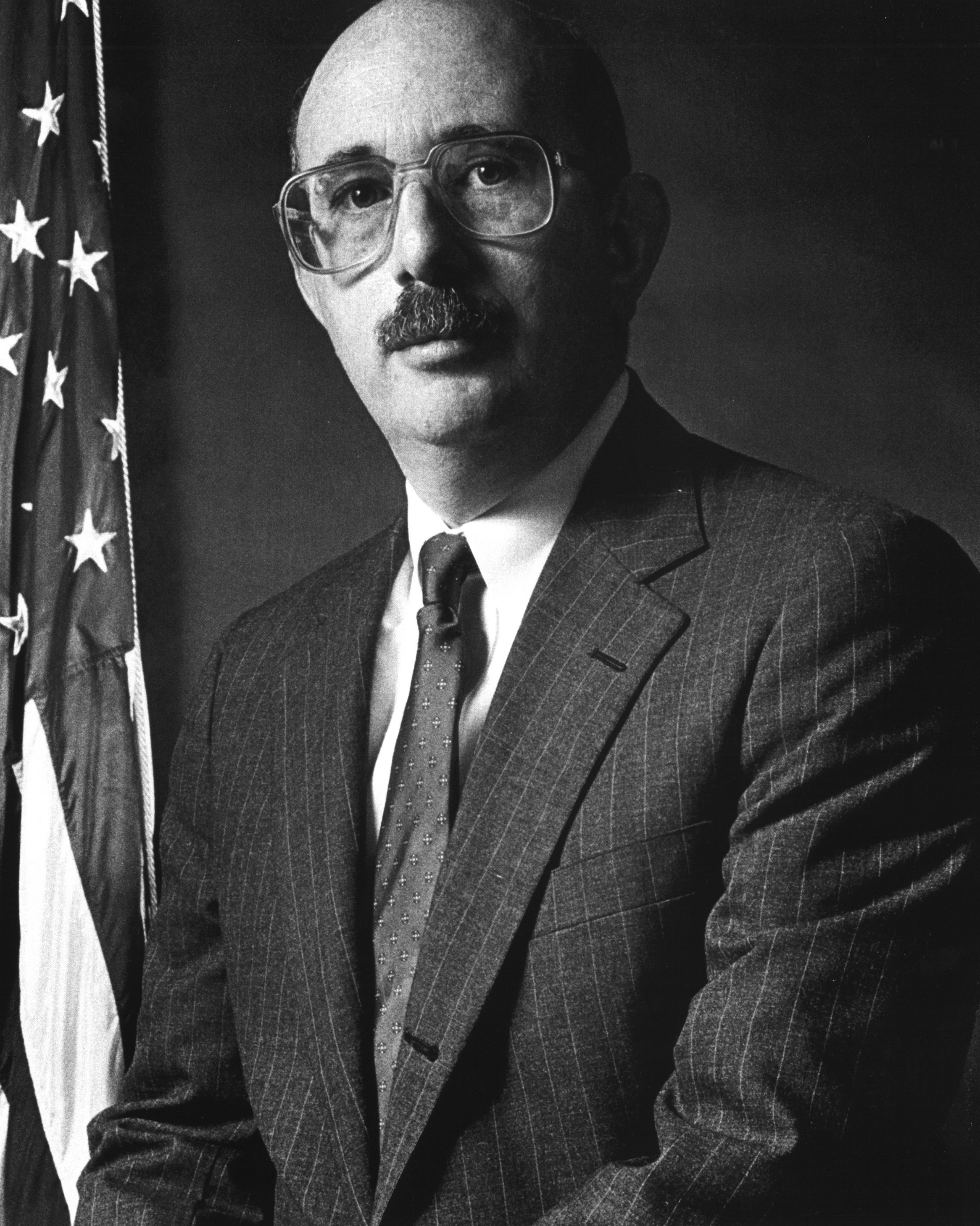
Ronald H. Spector, here photographed as director of the Naval Historical Center.
On 26 March 2026, retired lieutenant colonel Ronald H. “Ron” Spector, PhD, passed away. Spector enlisted in the Marine Corps in September 1967. Following basic and advanced training, he served as a combat historian in Vietnam from 3 April 1968 through 27 February 1969.[1] He was discharged from active duty in May 1969. In January 1980, he returned to uniformed service and was commissioned as a specialist officer in the Marine Corps Reserve.[2] He then served as a historian and Marine Corps Command and Staff College faculty member from 1980 to 1998.[3] In his civilian life, Spector worked as a historian for the U.S. Army Center of Military History (CMH) from 1971 to 1984 and later as director of naval history and curator for the Department of the Navy from 1986 to 1989. He held various academic appointments in history departments at Louisiana State University, the University of Alabama, and the George Washington University from 1969 to 2020. His publications include Eagle Against the Sun: The American War with Japan (1984), winner of the Theodore and Franklin Roosevelt Prize for Naval History; and At War at Sea: Sailors and Naval Combat in the Twentieth Century, winner of the Society for Military History Distinguished Book Award (2002).[4]
Spector grew up in Pittsburgh, Pennsylvania, and attended Johns Hopkins University, graduating in 1964 with a degree in history. He then earned his PhD at Yale University in a record three years, graduating in May 1967. Eager to escape academia and work in the “real world,” he applied for positions at government history offices after graduation and soon found himself in Washington, DC, working for the historical division of the Joint Chiefs of Staff. However, just four months into the job, his draft board, as he put it, “decided I should see some more active service.”[5] Consequently, he enlisted in the Marine Corps as a private on 25 September 1967.[6] His decision to join the Marine Corps was influenced by both his draft status and his heritage. As he recalled, “All of the elders in my Pittsburgh neighborhood had served in the Marines during World War II and Korea.”[7]
After completing recruit training at Marine Corps Recruit Depot Parris Island in South Carolina, Private Spector attended advanced infantry training at Camp Geiger, North Carolina, in preparation to serve as an artillery cannoneer. Reflecting on his boot camp experiences many years later, Spector wrote, “I discovered that graduate school had been an excellent preparation for Marine Corps training since I was already used to losing a lot of sleep, sitting through boring lectures, and gulping down my food while in a kind of standing crouch.”[8]
He arrived in Vietnam on 3 April 1968, during phase two of the Tet Offensive.[9] For the next 10 months, he traveled extensively throughout northern South Vietnam (I Corps tactical zone) conducting oral histories with hundreds of Marines, soldiers, and sailors. He also collected documents and wrote historical reports. The citation for his Navy Achievement Medal with Combat “V” noted that “as a historian, he displayed outstanding professionalism and initiative despite extremely adverse conditions and the difficulties of a combat environment.”[10] Major General Harold W. Chase, a legendary Marine who was wounded twice at Iwo Jima, was a colonel when he served with Spector at III Marine Amphibious Force Headquarters, and later wrote, “[Spector] exhibited strength of character and personality that were noteworthy. He has integrity, and innate leadership ability and a cooperative spirit. He takes his work seriously but not at the expense of good humor.”[11]
Spector’s field work in Vietnam would later form part of the research for his book, After Tet: The Bloodiest Year in Vietnam, which was published in 1993. This work not only provides a detailed account of the major military operations of 1968 but also examines the experiences of average troops, including significant social issues such as drug abuse, alcoholism, and racial tensions.
Following his return home from Vietnam in February 1969, Spector received an honorable discharge in May 1969.[12] In 1980, the Marine Corps Reserve offered him a direct commission as a major to return to service as a historian with Mobilization Training Unit (MTU) DC-7. As a reserve officer, he researched and wrote official history with MTU DC-7 and later with the History and Museums Division, Headquarters Marine Corps. He also taught at the Marine Corps Command and Staff College.[13] In 1983, he deployed to Grenada and later published U.S. Marines in Grenada, 1983, which he called “an experiment in writing contemporary military history.”[14]
Colonel Allan R. Millett, who wrote the definitive single-volume history of the Marine Corps and led MTU DC-7 in the late 1980s, wrote in Spector’s fitness report that he was the “star” of the unit.[15] Lieutenant General Paul Van Riper, the director of the Marine Command and Staff College when Spector taught there in the late 1980s, described him as an “extremely talented officer, an accomplished writer, widely read, and an unusually effective instructor.”[16] Spector retired from the Marine Corps Reserve in 1998.[17]
Spector’s long career as a civilian academic commenced a few months after his return from Vietnam. From 1969 to 1971, Spector taught history as an assistant professor at Louisiana State University, where he finished writing his first book, Admiral of the New Empire: The Life and Career of George Dewey (1974).[18] The book remains the definitive biography of Dewey and a major contribution to the history of the U.S. Navy in the Spanish-American War.
In 1971, he accepted a job offer from CMH’s Southeast Asian History Branch to work on the Army’s official history of the Vietnam War, eventually rising to acting chief of the branch. While there, he published Advice and Support: The Early Years, 1941–1960 (1983), a work that examines the early origins of America’s military involvement in Vietnam.[19] Among other topics, it analyzes U.S. intelligence activities in Indochina during World War II, support to the French during the First Indochina War, and the U.S. advisory mission from 1954 to 1960. The official history examined the growing U.S. role in Vietnam during the period and is critical of U.S. policymakers for underestimating local support for the Viet Cong, the difficulty building the Army of the Republic of Vietnam, and the unpopularity of Ngo Dinh Diem’s regime.
In 1984, Spector moved to the University of Alabama as an associate professor of military history. During his time there, he completed Eagle Against the Sun, a single-volume history of the American war in the Pacific during World War II. The book was widely acclaimed for its engaging and accessible narrative, which skillfully blended original research and accounts of large-scale military operations with the personal experiences of the service personnel involved. A reviewer for the New York Times hailed it as “the best work of its kind” on that complex conflict.[20] The product of nine years of dedicated research and writing, Eagle Against the Sun achieved the rare distinction of being chosen as a Book-of-the-Month Club Main Selection and a New York Times Book Review editor’s choice.[21]
As his prominence as a military historian grew, especially after the success of Eagle Against the Sun, Ron Spector was hired by Secretary of the Navy John F. Lehman as the director of naval history and tasked with modernizing the Naval Historical Center (NHC) (now Naval History and Heritage Command). With additional funding from Secretary Lehman, Spector established the Contemporary History Branch, which under his leadership produced many significant naval histories, including a comprehensive account of the 1991 Gulf War, works on the Navy in Vietnam and the Cold War, and studies on the Navy’s personnel. He also reinvigorated NHC’s combat documentation efforts by sending a team of historians and reservists to the Middle East to conduct oral histories and collect documents related to the Tanker War.[22] Reflecting on Spector’s time as director of naval history, Secretary Lehman later wrote, “He made a special effort to attract writers, scholars and journalists to the Navy Yard.”[23] In so doing, he helped transform the institution into what it is today.
Official U.S. Navy photo
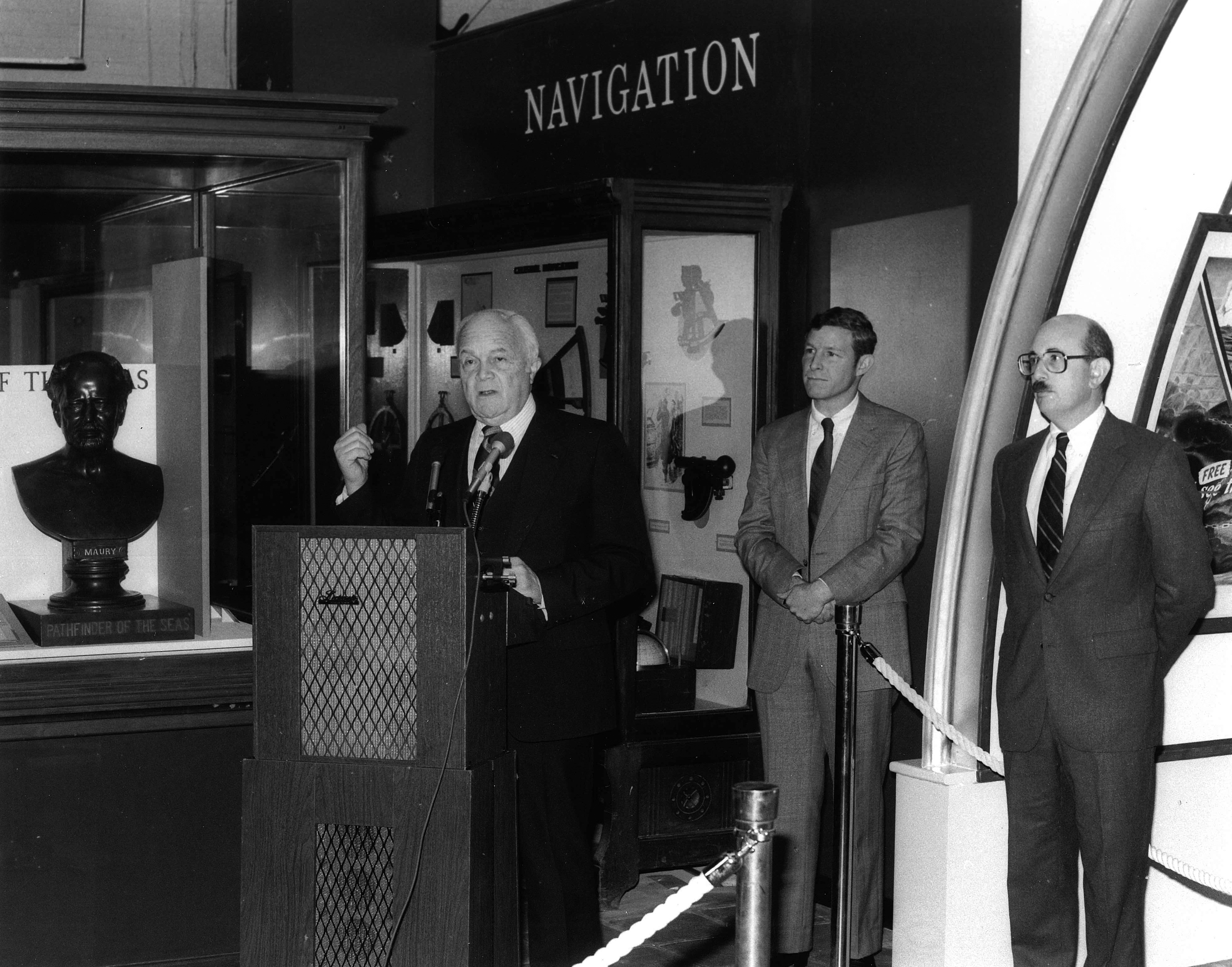
Ronald H. Spector (right) with Oscar P. Fitzgerald (center), and Capt Edward L. Beach Jr., USN (Ret) (left), at the Navy Department Museum.
During his last year as director of naval history in 1989, the Society for Military History (SMH) elected Spector as its vice president after he successfully hosted the society’s annual meeting at the Washington Navy Yard the year before. Since its origins in 1933, SMH has evolved from an organization closely associated with the military to one that includes a broader group of historians from a wide range of academic and nonacademic institutions. Epitomizing this shift was the decision in 1988 to change the name of its journal from Military Affairs to the Journal of Military Historyand the organization’s name from the American Military Institute to SMH. Spector and SMH’s president Richard H. Kohn, who was at the time the U.S. Air Force chief historian, were instrumental in managing this shift. Both had worked in official history offices and as professors in academia and understood implicitly how to bridge these two cultures.[24]
Spector returned to academia in 1989, initially at the University of Alabama and then George Washington University, where he held appointments in both the history department and the Elliott School of International Affairs. In addition to After Tet, Spector published several other monumental works during his time at George Washington University. At War at Sea (2001) focuses on the evolution of naval warfare across the twentieth century. In his analysis of seagoing combat, Spector considers factors such as technology, the human experience of naval warfare, and command and control. The book’s core argument is that despite dramatic technological change, the fundamental human dimensions of naval warfare—leadership, training, morale, and decisionmaking—continue to be decisive. In addition to winning the SMH book award in 2003, it was also a History Book Club main selection and included in the Washington Post’s “Best Books of 2001” list.[25]
During his 30 years at George Washington University, Spector supervised numerous master’s and doctoral students, many of whom became official historians. Scores of his Elliott School students entered or continued government service in the Department of Defense, Department of State, and the intelligence community. One former student played a leading role in discovering the location of Osama bin Laden in Pakistan and later became the inspiration for the lead character in the HBO series Homeland.[26]
Spector’s academic life was enriched by extensive and prestigious international research and appointments. As one of the few scholars to receive three Fulbright awards, he undertook research sabbaticals in India (1977–78), Israel (1993–94), and Singapore (2007). His global research was further broadened through his service as a U.S. Information Agency visiting lecturer, which took him to the Philippines, Thailand, Taiwan, New Zealand, Fiji, China, and Australia on various visits. In addition to these engagements, he served as the distinguished visiting professor of strategy at the National War College from 1995 to 1996; a visiting professor at the School of International Affairs at Ritsumeikan University in Kyoto, Japan, in 1998; the U.S. Army War College’s Harold Keith Johnson Chair of Military History for 2005–6; and the U.S. Naval Academy’s Class of 1957 Chair in Naval Heritage for the 2009–10 academic year.[27]
These sabbaticals and appointments offered Spector unique opportunities to conduct research at numerous archival repositories, both at home and abroad, and were instrumental in the success of his subsequent publications. Two later publications benefited greatly from his far-flung research: In the Ruins of Empire: The Japanese Surrender and the Battle for Postwar Asia (2007) and A Continent Erupts: Decolonization, Civil War, and Massacre in Postwar Asia, 1945–55 (2022). The former examines the collapse of the Japanese Empire and the civil wars, revolutions, and decolonization conflicts that followed between 1945 and 1950. The book shows how the United States tried and mostly failed to balance its anticolonial ideals with support for its World War II European allies in the postwar Pacific. It also reveals how all the Allied powers underestimated local nationalist movements.
A Continent Erupts expanded on the scholarship of In the Ruins of Empire by bringing the story forward to 1955. Among other conflicts, it explores the conclusion of China’s civil war and consolidation under Communism, the Indonesian war of independence, the war in Korea, and the First Indochina War in Vietnam. In A Continent Erupts, Spector argues that the Japanese surrender did not usher in a period of peace but triggered a wave of postwar conflicts and a Cold War in Asia, and that for the most part, the United States and its European allies mismanaged these wars.
Spector’s later years were marked by serious health challenges, including a heart transplant in 2013 and his ultimate battle with cancer. Despite these obstacles, he continued to publish and contribute to our understanding of military and naval history until his final days. As a military and naval historian, Dr. Spector possessed the rare ability to produce impeccable scholarship made accessible to the general reader by clear and vivid writing. As Secretary Lehman put it:
Ron viewed his principal job as getting out the real and exciting story of the Navy and its people, and he was perfect for the job. His scholarship was unimpeachable, but he really knew how to tell a riveting story.[28]
In his roles as an acting branch head at CMH and director at NHC, Spector was instrumental in establishing these organizations as leading publishers of modern military and naval history. His legacy endures through the thousands of students he influenced through his teaching and scholarship. He is survived by his wife Diane and his two sons, Daniel and Jonathan.