PRINTER FRIENDLY PDF
EPUB
AUDIOBOOK
Abstract: Since 1775, the U.S. Marine Corps has continually refined its close combat training to address the ever-evolving demands of warfare. From shipboard actions to trench warfare to urban combat, close combat training has always been a major area of focus for the Corps. This progression led to the establishment of the Marine Corps Martial Arts Program (MCMAP) in 2000. Influenced by legendary figures such as Colonel Anthony J. D. Biddle, who introduced boxing and bayonet fighting, and the “China Marines,” who adopted judo and jujitsu in the 1920s–30s, MCMAP’s roots trace back to the Marine Raiders who applied all these techniques to their versatile hand-to-hand training in World War II. The Marine Corps’ close combat training has steadily evolved since World War II into the comprehensive martial arts system it is today. MCMAP is a cornerstone program that develops the warrior ethos by preparing Marines mentally, physically, and spiritually for any conflict. Despite MCMAP’s significance, no comprehensive history of its origins has been written. As MCMAP marks its 25th anniversary, this article provides a close study of its historical development and its crucial role in sustaining character transformation.
Keywords: Marine Corps Martial Arts Program, MCMAP, martial arts, China Marines, close combat, warrior ethos, character, leadership, core values, spiritual, resilience
Since its founding in 1775, the U.S. Marine Corps has continually refined its close combat training to adapt to the evolving nature of warfare, combining armed and unarmed techniques, while upholding its core ethos of aggressive adaptability. This evolution, shaped by lessons from shipboard actions, trench warfare, and urban combat, has witnessed the gradual integration of martial arts, particularly through the influence of legendary figures such as Colonel Anthony J. D. Biddle and the “China Marines” stationed in East Asia during the interwar period. This fusion of close-quarters combat with the martial arts began in earnest after World War I, as the China Marines drew from the brutal lessons of trench warfare to introduce concepts and techniques of martial arts into new hand-to-hand systems such as Defendu. These techniques were subsequently further developed and adopted more broadly during World War II, especially by the Marine Raiders, who integrated all these techniques and lessons learned into their training. Martial arts continued to be an important part of combat training over the ensuing decades, culminating in the Marine Corps adopting the Linear In-Fighting Neural-override Engagement (LINE) system in the 1980s, followed by the implementation of MCMAP in 2000.
Despite MCMAP’s examination in military journals, such as the Marine Corps Gazette, and in various research articles within academic institutions, including the Marine Corps Command and Staff College and Naval War College, a notable gap remains in the literature.[1] Among the published articles and research papers on MCMAP during the past 25 years, no single work offers a scholarly history of MCMAP’s origins, development, and institutional impact. Existing articles and research papers address certain aspects of the program such as training methods, cultural integration, ethical development, and program effectiveness. However, none provide a comprehensive historical account tracing MCMAP’s historical development and evolution from earlier combatives programs. This article fills that gap.
The authors conducted a comprehensive review of dozens of articles sourced from notable military journals and publications in the field of military studies.[2] Of the 32 articles reviewed, 5 touch on the program development and structure of MCMAP, including its establishment, evolution, and structure, as well as its design, training methodologies, and integration into Marine Corps culture.[3] Six explore MCMAP’s role in fostering ethical decision-making and character development that fosters the cultivation of an ethical warrior mindset.[4] Seven examine MCMAP’s impact on developing mental toughness, resilience, and a warrior ethos among Marines.[5] Six evaluate MCMAP’s effectiveness, propose improvements, or critique its shortcomings.[6] Two focus on how MCMAP enhances leadership skills, decision-making under stress, and adherence to rules of engagement.[7] The final six look at MCMAP’s adaptability and practical applications beyond combat, including its scalability for in noncombat situations and other intangible benefits.[8]
This article seeks to address the research gap by providing the first comprehensive historical account of the program to preserve the institutional memory of its development and clarify its original intent as it germinated during the course of 15 years under four Commandants. The article provides the first detailed historical review of MCMAP, charting its evolution from the strategic vision of the Commandants, starting with General Alfred M. Gray, to its official implementation under General James L. Jones in 2000. Consideration is given to MCMAP’s unique integration of combat proficiency with character development, a focus that distinguished it from its predecessors. As MCMAP marks its 25th anniversary, this article provides a close study of its historical development and its crucial role in sustaining character transformation.
Evolution of the MCMAP
General Alfred M. Gray Jr. and the Renewal of the Warrior Ethos
Following the Vietnam War, the Marine Corps faced significant challenges. The war had inflicted 14,000 more casualties than World War II, resulting in a deep institutional wound to the Corps.[9] It was also a turbulent period in society, which was reflected in the Corps by the loss of good order and discipline. Thousands of Marines were involved in various conflicts and discipline issues, threatening its cohesion and institutional integrity.[10] These internal conflicts, insubordination, substance abuse, and violence eroded cohesion and military readiness, endangering its elite combat reputation and the sterling reputation the Corps had gained by the blood that was shed in earlier wars.[11] In a January 1975 article for Marine Corps Gazette, Lieutenant General Samuel Jaskilka, the Assistant Commandant of the Marine Corps, acknowledged these issues and called Marines to action.[12] His remarks spurred an intense period of institutional self-reflection to restore good order and discipline and reaffirm the Corps’ elite status, strength, discipline, and readiness.[13]
The Camp Lejeune race riots of July 1969 highlighted the concerns Jaskilka raised. Racial tensions were growing in American society during the 1960s, which boiled over after Martin Luther King Jr. was assassinated in April 1968.[14] The Marine Corps was in crisis. Black Marines found themselves in a highly volatile environment, where even minor disagreements could quickly escalate into major confrontations fueled by underlying racial tensions and societal unrest.[15] As racial animosity intensified, troops began rioting at Camp Lejeune, North Carolina, in 1969.[16] Corporal Edward Bankston, a White Marine and a decorated Vietnam veteran, was beaten to death by fellow Marines.[17] Additionally, two other White Marines were stabbed, and numerous others were seriously injured in the ensuing melees.[18] Between January and August of 1969, “there were 160 reported racial incidents at Lejeune (though numerous Marines, white and black, described the confrontations as constant).”[19] The incidents were not isolated to Camp Lejeune but were widespread, impacting Marine Corps bases and stations on the East and West Coasts, leading to open confrontations, as well as more subtle forms of discrimination.
Commanders also faced disciplinary challenges beyond racial tensions, insubordination, unauthorized absences, and substance abuse, which plagued the post–Vietnam Marine Corps.[20] The shift to an all-volunteer force was hindered by negative public sentiment, making military service less appealing than the private sector.[21] Already low recruitment standards were exacerbated by judges who offered offenders a choice between joining the Corps or serving jail time, which further diluted personnel quality.[22] Despite efforts to remove “ineffectives,” the Corps had some of the worst discipline indices among the U.S. military branches (table 1), raising concerns about combat readiness and the state of the warrior ethos.[23]
Ultimately, this challenging period in Marine Corps history was marked by the erosion of good order and discipline, as well as poor cohesion among both units and individuals throughout the Marine Corps as a whole. It was further compounded by a failure in leadership to recognize and stave off the growing racial tensions more effectively.[24]
The post–Vietnam era made it clear that the Corps needed to examine its combatives and its approach to physical conditioning. Unit-level conditioning in the 1980s was disorganized, often resembling pickup football, with a hodgepodge of personnel teaching varied boxing or hand-to-hand skills.[25] When Gray was selected as the 29th Commandant of the Marine Corps in 1987, his appointment marked a turning point in the Corps’ history, signaling a revival of the warrior ethic.[26] Indeed, his tenure was so pivotal that it is often referred to as the “second enlightenment of the Marine Corps,” following the first under General John A. Lejeune.[27]
Table 1. U.S. Marine Corps indiscipline

Millet, “The U.S. Marine Corps: Adaptation in the Post-Vietnam Era,” 379; and Franklin,
“Another Long March: Lessons from the Post-Vietnam Rebuild of the Marine Corps, 1969 to 1989,” 28.
Like Lejeune, Gray’s transformational leadership profoundly shaped Marine Corps culture.[28] He established the Marine Corps University and launched the Commandant’s Professional Reading List.[29] Most notably, he implemented significant doctrinal changes by establishing maneuver warfare through Warfighting, Fleet Marine Force Manual (FMFM) 1.[30] This publication became the cornerstone of how Marines fight. Known colloquially as the “little white book,” it was an immediate watershed that changed tactics and procedures throughout the Corps.[31] Gray also addressed other hangovers from the post–Vietnam years, such as the lack of a standardized close combat system and that units relied on boxing or hand-to-hand training on an ad hoc basis, depending on the personnel serving in the unit and their skill sets.[32] His concern catalyzed developing a formal martial arts program that improved fitness; restored discipline, pride, and professionalism; and renewed the Corps’ warrior culture.[33]
Gray determined to revitalize the Corps’ warrior ethic by reintroducing bayonet training as part of the basic package for all Marine recruits, supplementing this training with physically demanding martial arts skills that simulated one-on-one combat. The purpose of this bruising, demanding training was to reemphasize the importance of physical and competitive aggressiveness as a core element of the warrior ethos.[34]
The Marine Corps has a long history of close-quarters combatives training, evolving continuously over time.[35] Over the past century, pioneers such as Biddle, Stavers, Styers, and Walker developed various close combat systems that were adopted by different Marine Corps units.[36] In March 1989, the Marine Corps made a historical decision by adopting the Linear In-Fighting Neural-override Engagement (LINE) system.[37] LINE represented a major advancement in that it standardized and institutionalized close combat training for the first time in Marine Corps history.[38] Its unique design was tailored to meet the specific needs of the Marine Corps.[39] LINE was seen as a practical and effective solution for close combat training. Its key advantages include practicality and ease of learning.[40] The techniques were organized into smaller, manageable units called “ditties,” making them easier to remember and apply in high-pressure situations.[41] In a 1995 article published in the Marine Corps Gazette, Gunnery Sergeant Ronald S. Donvito described the significance of LINE, saying,
It is very popular today to speak of the sophistication of warfare, how we are moving ever so rapidly toward dehumanizing combat through technology. A mere moment’s return to reality is all that is necessary to point out that if anything, warfare is moving in the opposite direction of dehumanization. Conflicts remain vicious and ruthless affairs, often internal and personal struggles in which the enemy has no conception of honor or mercy. . . . It is our chosen profession to be warriors. At Parris Island or San Diego we train warriors, not aviation mechanics or disbursing clerks. At The Basic School there are no pilots or supply officers, there are only leaders of warriors. If anyone has joined the Marine Corps for any other reason than to be a warrior, he has made a mistake. It is our responsibility to fight our Nation’s battle, and we must be in constant preparation for this task. . . . Close combat training, when properly conducted, allows leaders and, just as important, peers to witness a Marine’s actions and reactions in the climate of intense interpersonal violence. Actual combat is not the proper time for an introduction to violence at this level.[42]
Donvito rightly emphasized the brutal, personal nature of close combat, asserting that every Marine must be a warrior first. This message resonated with Commandant Gray, who intended to rebuild a warrior-centric culture.
As the Marine Corps’ first standardized martial arts program from 1989 to 1998, LINE was a step forward, but it soon revealed its limitations.[43] However, its narrow focus on aggressive combat techniques, such as the “kill stomp,” lacked versatility for noncombat scenarios, including escalation-of-force or nonlethal encounters.[44] It was designed for deadly encounters that focused on techniques to dismantle an enemy’s attack through joint locks, breaks, and nerve damage. Although it excelled in straight-up combat, it fell short in versatility, with no appropriately scalable response when lethal force was not the answer. Thus, its singular focus on physical techniques also came at the detriment of character development, leadership, and warrior ethos, which the Corps considered essential for properly trained Marines. As a result, the Marine Corps began to search for a more flexible system that built on this initial foundation to develop a broader program that integrated physical fighting skills, mental resilience, ethical decisionmaking, and the Corps’ core values of honor, courage, and commitment. It just so happens that the Commandants who followed Gray were up to the task.
General Carl E. Mundy, Jr: Get an Ethics and Moral Values Effort Going!
In 1991, General Carl E. Mundy Jr., became the 30th Commandant of the Marine Corps, leading during a transitional period following the end of the Cold War that was marked by stability.[45] As a self-described “sustaining Commandant,” Mundy navigated force restructuring amid expectations of a “peace dividend,” prompting congressional downsizing debates.[46] Mundy’s lasting legacy is his role in establishing honor, courage, and commitment as the core values of the Marine Corps in 1991.[47] The initiative to define the Corps’ core values began with a little-known memorandum addressed to Mundy from Captain Larry H. Ellis, the chaplain of the Marine Corps. In this memorandum, Ellis wrote:
Many of the values to which the U.S. Marine Corps is committed are no longer supported by contemporary culture. The need to defend and support the values fundamental to the Corps requires a focused effort. . . . The strength of the Marine Corps is leadership within a context of honor, sustained by sacrifice. This strength has the potential to remedy the weaknesses of a culture that has forgotten that its young need to be mentored and nurtured, that a sense of honor must be taught, that for the good of all, individuals must be willing to sacrifice personal prerogatives. The Corps, therefore, has an opportunity and the obligation to protect Marines from the destructive consequences of an immoral lifestyle by teaching character and instilling a code of Honor.[48]
The Commandant’s reply was in “wholehearted support, penning over the memo, ‘Need to investigate and get an ethics and moral values effort going!’ ”[49] These core values would be key elements of the new martial arts program.
Mundy continued to build and expand on Gray’s warrior-ethos initiatives and innovations.[50] In 1994, his final year as Commandant, Mundy launched the Vision 21 Project to shape the Marine Corps’ twenty-first century role.[51] Led by Assistant Commandant General Richard D. Hearney, the initiative tasked leaders to envision future national scenarios and the Corps’ place within them.[52] All 19 lieutenant and major generals participated, ensuring Mundy’s successor (Charles C. Krulak in 1995) benefited from their collective insights.[53] It is significant to note that Vision 21’s recommendations directly informed Krulak’s 1995 Commandant’s Planning Guidance, facilitating a seamless leadership transition as all his senior officers “would be intimately familiar with the knowledge that informed the new Commandant’s thinking.”[54] It is also noteworthy that Krulak drew heavily from Vision 21’s final report in drafting his 1995 guidance.[55]
Vision 21 featured prominent participants, including futurist John L. Petersen, science writer M. Mitchell Waldrop, and military historian Roger A. Beaumont, who introduced the concept of nonlinearity into planning discussions.[56] Among the presenters was Richard Strozzi-Heckler, who holds a doctorate in psychology and a seventh-degree black belt in aikido.[57] In his book, In Search of the Warrior Spirit, he detailed his experiences at Camp Pendleton in spring 1995 while participating in Vision 21.[58] He noted that the diverse group included political scientists, physicists, technologists, defense consultants, ecologists, and futurists, as well as general officers.[59] Strozzi-Heckler emphasized that martial arts training transcends combat techniques, fostering an inner mindset and character development integral to the warrior ethos. Beyond a fighting system, it provides a value framework tied to the warrior ethos.[60]
His Vision 21 presentation sparked intense debate among the generals, who discussed how a martial arts program could relate to the Marine Corps’ mission, ethos, and culture.[61] He noted that such was the intensity of the discussion “that we went beyond the allotted time and were finally asked to clear the room. Even then, several generals stopped him in the hallway, eager to ask questions and debate the possibility of implementing such training in their specific units.”[62] Strozzi-Heckler noted their unexpected focus on spirituality, a topic he approached cautiously, as a surprising but welcome outcome, stating, “What was more astounding, though, was how often they returned the conversation to the subject of spirit. Over the years I’ve learned to be circumspect about how I approach the topic of spirituality in institutions.”[63] Strozzi-Heckler continues:
There are many interpretations on the subject, and on more than one occasion I’ve encountered fundamentalists who manage to unproductively dominate the conversation. But it was clear that for these men this was an essential matter that was not to be overlooked. They insisted, no, demanded, that training the spirit be first on the agenda. The concern for spirit, ethics, and morality was more in the foreground here than in any of the other institutions in which I had worked–by a landslide. What did it tell me? The senior leaders of one of the oldest institutions in America were deeply and sincerely committed to the ethical, moral, and spiritual development of the young men and women in the Marine Corps, and by extension the United States.[64]
Vision 21 provided the incoming Commandant, Krulak, with a strategic foundation for leadership. Strozzi-
Heckler’s speech inspired enthusiasm among the generals for a new, process-based martial arts program to replace LINE, igniting a wave of enthusiasm for a new martial arts initiative.
General Charles C. Krulak:
Sustaining the Transformation
General Charles C. Krulak served as the 31st Commandant of the Marine Corps from 1 July 1995 to 30 June 1999.[65] Krulak’s first order as Commandant was direct and to the point: “Continue to march.”[66] His straightforward directive acknowledged that the Corps he inherited from his predecessors was strong and that he intended to build on the foundation they had established. However, this did not mean Krulak was planning to rest on his laurels. He recognized the need for “a more visionary approach, one designed to shape the institution for the long term—not just for tomorrow, but for the day after tomorrow.”[67] Accordingly, his 1999 document, Sustaining the Transformation (originally Marine Corps Reference Publication 6-11D, now Marine Corps Tactical Publication 6-10A), serves as a powerful reminder of the enduring values of the Marine Corps.[68] Aside from the Crucible and the Strategic Corporal, Krulak was also instrumental in establishing a new martial arts program.
The LINE system is historically significant as it was the first standardized close combat training program to incorporate the martial arts, however, it had key shortcomings. The techniques within the LINE system were too rigid and focused on lethality, resulting in a lack of scalable, nonlethal options. This made it impractical for scenarios such as peacekeeping or operations with rules of engagement. Implementation also lagged; while it was practiced with intensity at training depots, LINE remained peripheral in the Fleet Marine Force. In 1998, Commandant Krulak discontinued LINE. Lieutenant Colonel George H. Bristol, a leading Marine Corps martial arts figure at the time, observed that LINE had never been fully integrated into the Corps. He remarked, “The Corps as a whole [was never able] to integrate the close-range combat piece to other aspects of training. It always remained just outside the mainstream, practiced with zeal in entry-level training and later by a few stalwarts, but ignored by the Corps as a whole.”[69]
Inspired by Strozzi-Heckler’s Vision 21, Krulak sought a new martial arts program effective across the range of military operations (ROMO), including low-intensity situations and noncombative engagements.[70] In spring 1996, he convened the Close Combat Review Board (CCRB) to revise the Marine Corps’ close combat doctrine.[71] Several subject matter experts representing diverse perspectives on close combat comprised the board, which was tasked with reviewing and revising the existing close combat program.[72] Notable board members included subject matter experts such as Jack Hoban and Master Gunnery Sergeant Cardo Urso.[73] During their discussions, the board debated two approaches: one that prioritized lethal techniques in the tradition of Biddle and Walker, and another advocating versatile skills across a force continuum that developed “ethical warriors.”[74]
While the concept of honorable Marines resonated with many members of the board, some were concerned that values-based training could hinder combat effectiveness.[75] Ultimately, the issue remained unresolved, and the final outcome was the Marine Corps Close Combat Training Program (MCCCTP, officially the Marine Corps Martial Arts Program or MCMAP), which emphasized practical and decisive techniques across a force continuum.[76] It incorporated elements of combat hitting, pugil stick training, lessons from LINE, and the insights from 10 martial arts experts in karate, judo, jujitsu, and aikido.[77] Despite its intentions, the new program was short-lived, operating from 1997 to 1999. The program, therefore, fell short of fulfilling the needs of the Marine Corps and subsequently came under scrutiny from the incoming 32d Commandant, General James L. Jones Jr. (1999–2003).
General Jones drew on his 1967 Vietnam tour as a second lieutenant with Company G, 2d Battalion, 3d Marines, to shape MCMAP. Observing the Republic of Korea (ROK) Marines, he noted that their tae kwon do training fostered a unified warrior ethos and intimidated the Viet Cong forces, who actively avoided combat with them.[78] Jones remarked, “Friend and foe alike knew ROK Marines were individually trained masters of close combat—black belts in tae kwon do—able to deal personally and ruthlessly with any enemy.”[79] His experience as a young officer had a profound impact on Jones, as he recognized the transformative potential of martial arts in building a warrior ethos within the military. Many years later, the discipline, lethality, and warrior spirit of the ROK Marines were the inspirations Jones drew on to develop what is now MCMAP.[80]
Jones identified the shortcomings of the MCCCTP and sought to develop a new martial arts program that would cultivate Marines who embody ethical, moral, and spiritual values with the capacity to defend, protect, and uphold those values in both word and action as warriors in the twenty-first century.[81] In June 1999, the program entered a testing phase. During the following weeks, two separate programs were evaluated, with Jones selecting an enhanced version of the prior system. This revised program merged the physical aspects of martial arts with the Marine Corps’ core value program.[82] The Commandant was committed to the new martial arts program and institutionalized it, officially launching the MCMAP on 1 October 2000 and mandating training for all Marines.[83] Although several differences make this system unique from its predecessors, according to Major Richard D. Hall, “One important facet of this program [was that it integrated] the previously overlooked mental and character disciplines into the physical.”[84] The resulting program integrated the best combat-tested martial arts skills and traditional close combat training techniques with proven Marine Corps core values and leadership training.[85] See table 2 for a comparison of MCCCTP with MCMAP.
Table 2. MCCCTP / MCMAP comparison
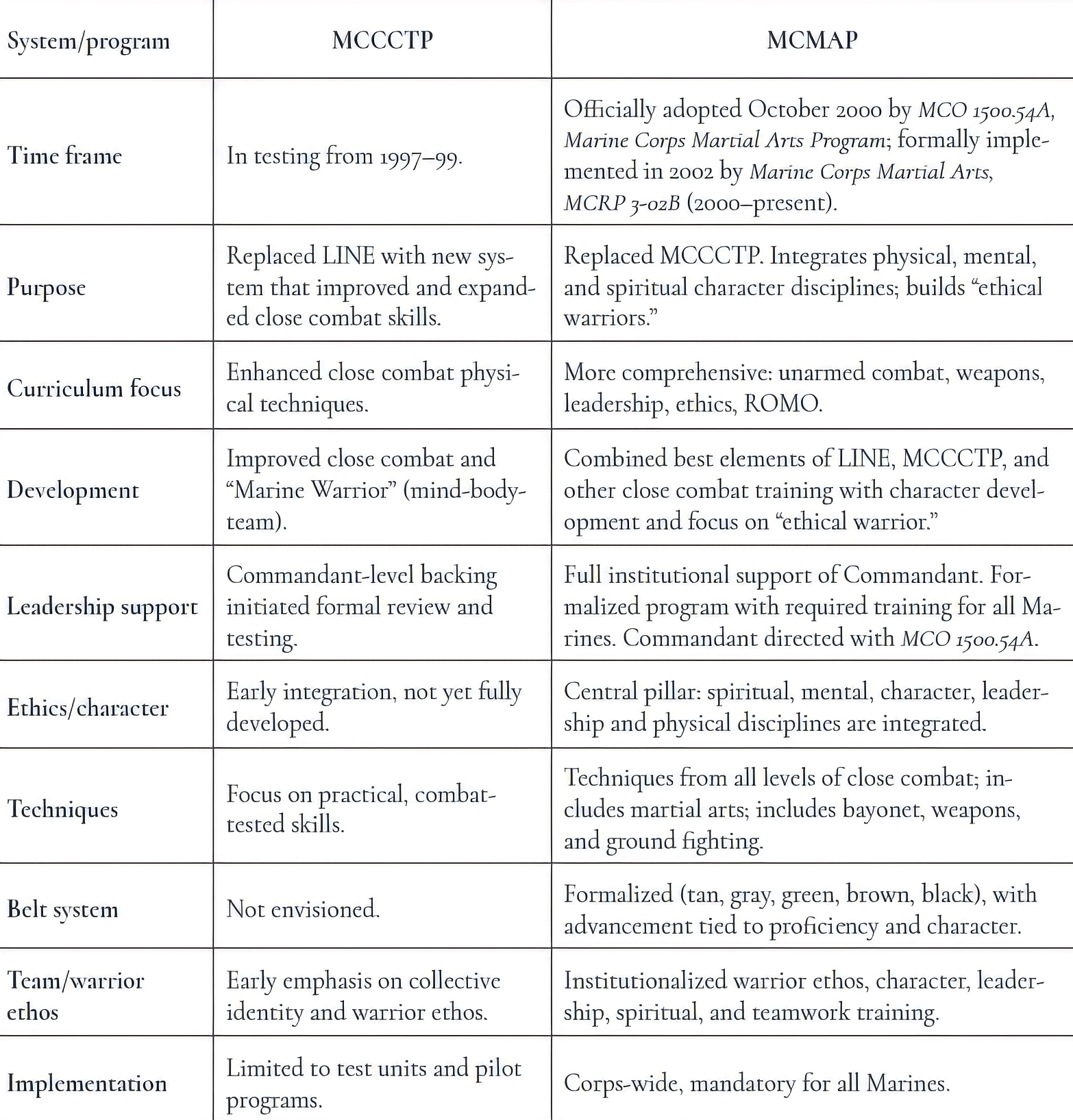
Source: compiled by authors.
Building on lessons learned from the flaws of LINE and the MCCCTP, MCMAP emerged as the Marine Corps’ long-sought comprehensive program. Unlike predecessors, MCMAP united the Fleet Marine Force through a career-long continuum. It enhanced individual combat skills, tying Marines to the warrior ethos via belt progression, while boosting unit cohesion across all ranks and military occupational specialties through shared training linked to the Corps’ legacy. An example of how MCMAP supported the Marine Corps’ legacy include guided discussions focusing on Marine Corps values and the fundamentals of leadership in two of the program’s training manuals.[86] To acknowledge that Marines are often tasked with completing military operations other than war (MOOTW), MCMAP included lessons such as the “Responsible Use of Force” and the “Force Continuum.”[87] Marine Corps Order 1500.59A, Marine Corps Martial Arts Program, also prioritizes “mental, moral, and physical resiliency” as critical to future victories, a stark contrast to earlier physical-only combatives.[88] By embedding warrior ethos studies and values-based tie-ins directly into belt advancement requirements, MCMAP ensures that the ethical and moral development of a Marine is considered just as critical as their physical proficiency.
Program architects Lieutenant Colonel Bristol and Master Gunnery Sergeant Urso understood that true combat readiness and the Marine Corps ethos demanded not just physical skills but also an ethical grounding and mental strength, woven and integrated into MCMAP. To this end, the mission of MCMAP is “to create mentally tough, morally sound, and physically capable warfighters . . . and ultimately the unit as a whole.”[89] By so doing, MCMAP seeks to “educate Marines in leadership, moral truthfulness, and warrior cultures.”[90] As a result, MCMAP is not merely about defeating an opponent; it is fundamentally about building the character of the Marine, directly linking physical training to the core values of honor, courage, and commitment—the Ethical Warrior.
From the rocky post–Vietnam years to the rise of MCMAP’s values-driven training, the Marine Corps has demonstrated a fierce determination to establish a close combat program rooted in the martial arts, striking a balance between raw skill, leadership, and character development. General Gray set the stage, General Jones brought it home, and subsequent Commandants have kept it alive during the past 25 years, turning MCMAP into a bedrock of Marine Corps training. Its strength comes from a well-rounded approach, sharpening each Marine’s combat abilities while tightening unit bonds and breathing life into the warrior spirit across the ranks, ready to tackle the demands of the twenty-first century and beyond.
| |
MARINE CORPS CLOSE COMBAT / MARTIAL ARTS KEY FIGURES
|
| |
Captain Samuel Nicholas
Commandant, 1775–83 (died 1790)
The first Marine Corps Commandant. He led early amphibious assaults and shipboard actions. He established practical demands of naval combat during the Revolutionary War, and martial skills of Marine boarding parties, relying on bayonet and cutlass techniques in close-quarters engagements.
|
|
Colonel Anthony J. D. Biddle Sr.
World War I through post–World War II (died 1948)
He pioneered formalized bayonet and hand-to-hand training, developed an eclectic system, and authored Do or Die: A Manual on Individual Combat (1944). He is considered the godfather of all China Marines, was a pioneer in Marine Corps hand-to-hand and bayonet combat training, and is known for the Biddle Method of Close-Combat.
|
|
|
Lieutenant Colonel Rex Applegate
Interwar through post–World War II (died 1998)
He is best known for his manual Kill or Get Killed: A Manual of Hand-to-Hand Fighting (1943), a foundational text for hand-to-hand combat. The Corps adopted and published an updated edition as Kill or Get Killed, Fleet Marine Force Reference Publication 12-80. He also coauthored (with Kelly Yeaton and Lieutenant Colonel Samuel S. Yeaton) The First Commando Knives (1996). He was heavily influenced by British Commandos William E. Fairbairn and Eric A. Sykes, with an even more streamlined and brutal system. He developed the Applegate-Fairbairn fighting knife, improving on the Fairbairn-Sykes dagger.
|
|
Captain Wallace M. Greene Jr.
Interwar through post–World War II (died 2003)
A China Marine and the 23d Commandant of the Marine Corps, he served with the 4th Marine Regiment in Shanghai, China, from 1937 to 1939 and in the South Pacific during World War II. He brought kung fu techniques into the Marine Corps.
|
|
Captain Samuel B. Griffith
Interwar through post–World War II (died 1983)
A China Marine who learned and disseminated kung fu techniques within the Corps, he served as executive officer and later commander of the 1st Marine Raider Battalion on Guadalcanal.
|
|
Lieutenant Colonel William E. Fairbairn; Major Eric A. Sykes
British Army, World War II (died 1960 and 1945, respectively)
Together, they created Defendu, which synthesized elements from various Asian and Western fighting styles, including judo, jujitsu, savate, boxing, and wrestling. They are renowned for designing the iconic Fairbairn-Sykes fighting knife, a double-edged dagger optimized for close-quarters combat. They coauthored a book on pistol shooting, Shooting to Live (1942).
|
|
Major Dermot Michael “Pat” O’Neill
World War II (died 1985)
A significant but often under-recognized figure in the early development of close-combat training in the Marine Corps. His methods directly influenced Linear Infighting Neural-override Engagement (LINE), used by the Marines from the 1980s to 2000. He developed the O’Neill Method of Close Combat. His teachings—alongside those of Fairbairn, Sykes, and Applegate—laid the groundwork for Marine Corps martial arts. His style emphasized “gouge-and-maim” combat.
|
|
Lieutenant Colonel Samuel G. Taxis
Interwar through post–World War II (died 1984)
A China Marine, he collaborated with Fairbairn on the evolution of Marine Corps close combat doctrine. He helped bridge Eastern martial arts (such as jujitsu) and Western military combatives. His work is cited in Biddle’s influential manual Do or Die for his developments in Defendu. He laid the groundwork for the practical hybrid approach that would eventually characterize Marine Corps martial arts training.
|
|
Colonel Anthony Walker
Interwar through post–World War II (died 1979)
A decorated Marine Raider in World War II, he led a company and earned recognition as the Corps’ knife-fighting champion. He was also instrumental in training the Raiders in close-quarters combat. He is renowned for his martial arts prowess within the Marine Corps; his expertise and legacy had a lasting impact on modern Marine Corps combat training.
|
|
Lieutenant Colonel Samuel S. Yeaton
Interwar through post–World War II (died 1979)
Another China Marine, he collaborated closely with other prominent close-combat pioneers, such as Fairbairn, Sykes, Moore, and Taxis. His work laid foundational elements that echoed in later formalized systems. He was the archetypal “scholar-warrior,” and his brother, Kelly Yeaton used their correspondence as the primary source for his influential book The First Commando Knives (1996), coauthored with Colonel Rex Applegate.
|
|
Lieutenant Colonel Ralph Hayward
1950s (died 1962)
He served in a pivotal role in the evolution of Marine Corps martial arts during the 1950s by tasking Gunnery Sergeant Bill Miller to develop a new lethal curriculum at Marine Corps Recruit Depot San Diego, California.
|
|
Gunnery Sergeant Bill Miller
1950s
He developed a standardized, lethal hand-to-hand curriculum that integrated techniques from Okinawan karate, judo, tae kwon do, boxing, and jujitsu (Miller’s Combat Curriculum) that was taught to all recruits at Marine Corps Recruit Depot San Diego. Miller’s approach emphasized not only physical techniques but also the mental and character development of Marines, a philosophy that continues in the modern MCMAP. His system became the foundation for later Marine Corps martial arts programs influencing the creation of the LINE system, which later gave way to MCCCP and ultimately to MCMAP.
|
|
Master Sergeant Arcenio James Advincula
Vietnam through 1990s
He is recognized as a pioneering figure in Marine Corps close combat training. His work influenced generations of Marines and contributed to the institutionalization of martial arts training throughout the Corps. Advincula’s philosophy emphasized discipline, adaptability, and the use of all available resources in combat. His teachings and innovations are foundational to the modern MCMAP.
|
|
Master Sergeant Ron Donvito
1989–98
He was the creator of LINE, the first standardized close-quarters combat system adopted by the Marine Corps. Donvito’s work is a significant chapter in the evolution of martial arts in the Corps.
|
|
Lieutenant Colonel George H. Bristol
ca. 2000
Bristol is recognized as a principal founder and architect of MCMAP. He transformed close combat training from a focus on purely lethal techniques to a scalable system suitable for both lethal and nonlethal engagements.
|
|
Master Gunnery Sergeant Cardo Urso
ca. 2000
He restructured the existing MCCCTP into what became MCMAP, creating a tiered belt system and a comprehensive program that develops “ethical warriors” who embody the Marine Corps’ core values. Urso was in charge of the MCCCTP from 1997 to 1999. Credited along with Bristol for transforming Marine close combat training.
|
Conclusion
Since the Marine Corps’ founding in 1775, its approach to close combat training has evolved from shipboard skirmishes to the trenches of World War I and through the urban battlegrounds of modern warfare. This journey stands as a testament to the indomitable fighting spirit of Marines. The formal integration of martial arts into this tradition began in the last century with pioneers like Colonel Anthony J. D. Biddle and the China Marines. This legacy was carried forward by the Marine Raiders of World War II and continued to develop in the decades that followed, culminating in the establishment of MCMAP in 2000. As this work has detailed, although many articles have touched on the program, a comprehensive history of its origins has been missing. This article fills that gap, tracing the lineage that led to the creation of MCMAP. Now marking its 25th anniversary, MCMAP represents both a continuation of a rich fighting legacy and evolution in Marine training. It is built on the institutional understanding that lethality alone is not enough. MCMAP was designed to forge not just proficient warriors, but honorable Marines who lead with moral clarity, mental resilience, and an unwavering dedication to honor, courage, and commitment.
•1775•
ABOUT THE AUTHOR
Cdr David A. Daigle is the command chaplain at Surface Combat Systems Training Command San Diego, CA. LtCol Daniel V. Goff (Ret) was the commanding officer of Marine Heavy Helicopter Squadron 366 and is now a professor of naval studies with the U.S. Naval Community College. Cdr Peter N. Ott is the Naval Education and Training Command deputy force chaplain and the N4 at the Naval Chaplaincy School in Newport, RI. The views expressed in this article are solely those of the authors. They do not necessarily reflect the opinions of Marine Corps University, the U.S. Marine Corps, the Department of the Navy, or the U.S. government. The authors recently published “Beyond Breakfalls: MCMAP and the Will to Fight” in JAMS, https://doi.org/10.35318/mch.2026120101