PRINTER FRIENDLY PDF
EPUB
AUDIOBOOK
Marine Corps History journal is pleased to offer the following professional reminiscences of a naval attaché officer to the Republic of El Salvador during a tumultuous time in the country’s history. Colonel John C. McKay was closely involved in the on-site investigations of the infamous El Mozote massacre in December 1981 as well as the March 1982 murder of four Dutch journalists, among other atrocities that took place during El Salvador’s civil war.
Mise en Scène
Reared in Latin America, I enlisted in the U.S. Marine Corps in 1962 at age 17. Six years later, I was commissioned a second lieutenant of infantry. In November 1977, James E. “Jimmy” Carter was elected president of the United States. Earlier that year in El Salvador, General Carlos Humberto Romero was elected president in an election fraught with irregularities. In October 1979, junior El Salvadoran reformist military officers and a small group of civilian politicians deposed President Romero in a successful coup d’état and established the joint civilian/ military Revolutionary Government Junta (Junta Revolucionaria de Gobiernio, JRG), ending 48 years of military dictatorship.[1]
Late in the same year in Nicaragua, the Sandinista National Liberation Front (Frente Sandinista de Liberación Nacional, FSLN) overthrew dictator Anastasio Somoza Debayle. In March 1980, Archbishop Óscar Arnulfo Romero y Galdámez was shot dead while celebrating mass in San Salvador. In El Salvador, the killings went on unabated. According to Christian Legal Aid of San Salvador (Socorro Juridico Arzobispado), 480 deaths were attributed to death squads in April 1980; in May, that rose to as many as 1,200.[2] In May, former National Guard (Guardia Nacional) intelligence officer Roberto D’Aubuisson was arrested and charged with plotting an unsuccessful coup. Three days later, owing to military pressure, D’Aubuisson was released for “insufficient evidence.”[3]
In November 1980, Ronald W. Reagan was elected president of the United States. In December, three U.S. Maryknoll Sisters and a lay missionary woman were tortured, raped, and murdered in El Salvador.[4] This incident forced the outgoing Carter administration to cut off military aid to the republic. A cornerstone of the Carter administration was human rights, a laudable goal unattainable in an environment of instability such as in El Salvador. In late January, two American Federation of Labor and Congress of Industrial Organizations (AFL-CIO) special advisors and their El Salvadoran host, Rudolf Viera, head of the controversial land reform program, were gunned down in the dining area of the Sheraton Hotel in San Salvador.[5] When the insurgents launched their “final” offensive in early January 1981, U.S. military assistance was restored. During the waning days of the Carter administration, six Bell UH-1H Iroquois helicopters were authorized for the Republic of El Salvador. Less than three months after the inauguration of President Ronald Reagan, the FSLN consolidated exclusive power in Nicaragua. In June 1981, I was accredited as the first U.S. naval attaché to the Republic of El Salvador.[6]
In addition to standard change of station orders to El Salvador, I was ordered by the office of the Commandant of the Marine Corps, General Robert H. Barrow, to notify his office within 24 hours of my arrival in the continental United States, regardless of the purpose of my presence. Those orders resulted in four one-on-one meetings with the Commandant and two one-on-one meetings with Chairman of the Joint Chiefs of Staff, Army general John W. Vessey Jr. These debriefings were scheduled for 15 minutes; they all exceeded 30 minutes.
Early in my tenure as naval attaché, a small, unheralded team of U.S. military officers under Army brigadier general Fred F. Woerner arrived in El Salvador. The U.S. embassy’s Defense Attaché Office (DAO) hosted the Woerner team, which attempted to design a winning strategy for the El Salvadoran military, known as the Woerner Report.[7] The effect of the Woerner Report on the outcome of the war is open to debate.
Incipiency
My interest in and thinking on Latin America is not perfunctory. From an early age, I self-identified more with Latin cultures, mores, and lifestyles than those of my own country. As a bilingual English/Spanish-speaker with a working familiarity of Quechua, the language of the Incas (still common in Ecuador, Perú, and Bolivia), I easily fit in. My parents were comfortable, even encouraging, of my language proficiencies. During our early years in Perú and Mexico, I became acculturated to the point of identifying more with my Peruvian and Mexican contemporaries than with Americans. As I matured, my thinking ventured into why the United States and its southern neighbors were not more closely knit. I came to appreciate poet Walt Whitman’s 1883 observation:
To that composite American identity of the future, Spanish character will supply some of the most needed parts. No stock shows a grander historic retrospect—grander in religiousness and loyalty, or for patriotism, courage, decorum, gravity and honor. (It is time to dismiss utterly the illusion-compound, half raw-head-and-bloody-bones and half Mysteries-of-Udolpho, inherited from the English writers of the past 200 years. It is time to realize—for it is certainly true—that there will not be found any more cruelty, tyranny, superstition, &c., in the resume of past Spanish history than in the corresponding resume of Anglo-Norman history. Nay, I think there will not be found so much.)[8]
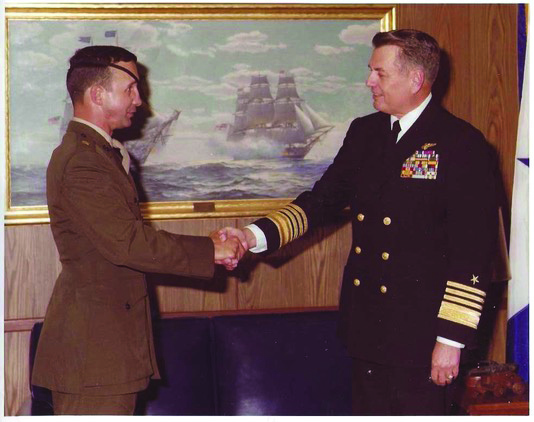
Official U.S. Navy photo
Chief of Naval Operations Thomas Hayward congratulating and giving guidance to the author, then a mere major, April 1981.
Geography and Demographics
El Salvador, approximately the size of Massachusetts, is the smallest mainland nation of the Western Hemisphere, thus the affectionate Spanish sobriquet el pulgarcito, “little or tiny flea” in English.[9] Similar to references to the El Salvadorans as los alemanes de América Central (the Germans of Central America), Salvadorans take pride of place in the region as a small yet dynamic country. El Salvador is situated on the southern shelf of the mountain chain running between Mexico and Panama. It is the only country in Central America that lacks a Caribbean Sea coastline. The country’s total area is some 8,620 square miles (13,872.5 kilometers), averaging 60 miles (96.6 kilometers) in width and 160 miles (257.5 kilometers) in length. Estimated population in 1981 was less than 4.7 million, with the greatest population density, excepting Haiti, in the Western Hemisphere at 792 people per square mile.
Historical Synopsis
Apart from modern Costa Rica, the Central American region is wracked by a history of violence and political upheaval. Today’s El Salvador was subjugated by Spanish conquistador Pedro Alvarado in 1524–25. It became a Spanish colony in 1540. It gained independence from Spain in 1821, and in 1823 it became a part of the United Provinces of Central America. With the dissolution of the United Provinces of Central America in 1840, El Salvador gained independence. During 1859–63, the introduction of coffee cultivation and resulting infrastructure flourished, including the rise and influence of those possessing large land holdings called latifundios.
Antecedents to La Matanza
Although of distinct origin, aura, comport, and outcome, the Mexican Revolution (1910–17) had singular political influence throughout Latin America greater than that of the subsequent 1959 Castro-led revolution in Cuba.[10] Some revisionist chroniclers of the Mexican Revolution would have the reader believe that it was a Communist affair; they are in error. The Mexican Communist Party (Partido Comunista de México, PCM) was not founded until 1919.[11] The Communist Party of El Salvador (Partido Comunista de El Salvador, PCS) was founded in 1925.
As throughout Latin America, the Great Depression (1929–34) exacerbated the socioeconomic structures of Mexico and El Salvador. The Depression of the 1930s allowed the PCS to grow and prosper in its early years, becoming the best organized Communist movement in Central America. The PCS was a leading advocate for the 1932 uprising. Prior to the Depression, imports and exports were about 25 percent of the gross national product. The leading export was coffee, followed by cotton and sugar.[12] Coffee prices were high in 1927, with the election of Pío Romero Bosque, in “the freest municipal and then Presidential El Salvador elections in Salvadorean history.”[13] Coffee prices plummeted in 1929.[14] In 1932, Agustín Farabundo Martí led a peasant and worker uprising, the first Communist revolution in the Western Hemisphere. The response of the Salvadoran Army, under President General Maximiliano Hernández Mártinez, resulted in more than 30,000 deaths—a seismic, if not the seismic, event in twentieth-century El Salvadoran history.[15] At the last minute, the PCS tried to call off the insurrection, but it was too late. La Matanza, as it is called in Spanish, still casts a ghostly specter over El Salvador. In 1961, the right-wing National Conciliation Party (Partido de Conciliación Nacional, PCN) came to power through a military coup. Border tensions increased between El Salvador and Honduras over issues of land reform in Honduras and immigration and demographic challenges in El Salvador. In July 1969, those tensions erupted in brief military conflict between the two countries.[16] These two events heightened an increasing deterioration and unraveling of the fragile El Salvadoran societal fabric. Although the causes are open to discussion, the roots of the 1979 insurrection may go back to the 1932 La Matanza, as again, manifested in the fraudulent 1977 election of General Carlos Humberto Romero, who was ousted in October 1979 by a group of reformists resulting in a mixed military-civilian junta. The administration of President Jimmy Carter welcomed the new El Salvadoran government, but “government repression persisted and killings continued at the rate of 1000 per month” following the post-October 1979 junta’s seizure of power.[17]
Context and Atmosphere
Following an interview in Washington, DC, with and gaining the approval of the newly designated U.S. ambassador, Deane Hinton, and the recently accredited U.S. defense attaché (DATT) to the Republic of El Salvador, I arrived in the nation’s capital, San Salvador, in June 1981. The tour of duty was one year, unaccompanied. From that point, I embarked on a melodramatic, storm-tossed voyage through the macabre. Any semblance of morality was conspicuously absent, high ideals and illusory wishful thinking notwithstanding. Joan Didion’s short book Salvador gives a contemporaneous glimpse of the dark, menacing, kaleidoscopic, shape-shifting aura of horrors heralding what seemed to be calamitous scourge.[18]
The U.S. embassy’s Defense Attaché Office (DAO) consisted of two attachés, the DATT (a U.S. Army colonel) and a naval attaché, with a supporting staff of one U.S. Army warrant officer-3 (CWO3) administration chief and a U.S. Army enlisted clerk/typist. Additionally, a bilingual Spanish-English El Salvadoran woman served at the entrance to the DAO as a receptionist and sometimes typist for unclassified Spanish pieces. As the U.S. naval attaché, I was a principal on the embassy’s staff, albeit the most junior. As one of two military attachés, my responsibilities encompassed much more than the small Navy of El Salvador. I was immediately immersed in reporting on the Salvadoran Air Force and Army, as well. Initially, I resided in a large, well-appointed house with the senior U.S. Navy representative on the embassy’s Military Group (USMILGRP) staff and the previously mentioned CWO3. Although both the DAO and USMILGRP were integral to the embassy’s staff, they reported through different military communication channels. The DAO reported through the Defense Intelligence Agency (DIA) in Washington, DC, while the USMILGRP reported through then U.S. Southern Command (USSOUTHCOM) in Panamá.
The embassy’s Regional Security Office (RSO) provided two armed El Salvadoran security personnel, not soldiers, for 24-hour security of the joint residence. Two live-in maids and a daytime houseboy were part of the package, all having been vetted by the RSO. Marta, the senior maid, was a diminutive, very personable individual whom I came to trust implicitly. Marta remained with me during the entire time I was in El Salvador.
The Vietnam War experience made me wary of U.S. vetting of foreign nationals. History indicates that the Vietnamese enemy were past masters at penetrating, infiltrating, and planting spies and informants amid the higher echelons of opposing military forces, first shown by the Viet Minh vis-à-vis the French and later by the Viet Cong/NVA vis-à-vis the United States. Consequently, as I spent more time in country, I came to eschew personal bodyguards. There were exceptions to be sure, for example, when detailed to escort a U.S. congressional delegation (CODEL) visiting a host country or when Ambassador Hinton designated me to escort the Dutch parliamentary investigating team after the murder of the four Dutch journalists in March 1982.
The atmosphere in San Salvador, the capital, was fraught and tense, with noticeable El Salvadoran troop movement bustling about. Prior to my arrival, the government issued a 2200–0500 curfew. Electricity was an on-and-off affair. The insurgents were adept at blowing up and toppling electrical pylons. Moving along the early morning streets of the city inevitably showed lifeless bodies, dispatched during the night, usually with thumbs tied behind their backs and a bullet to the back of the skull, or decapitated with the severed head grotesquely or obscenely placed on the headless corpse. Inevitably many of the dead were mutilated young women. Body mutilations, usually involving the genitals or breasts, were common and clearly visible. A plausible case can be made that many of the extrajudicial killings and kidnappings were carried out by right-wing death squads.[19] The leftist insurgents were less prone to such grotesqueries, although they too committed atrocities, tortures, and kidnappings.
The various elements of the insurgency were loosely umbrellaed under the Farabundo Martí National Liberation Front (Frente Farabundo Martí de Liberación Nacional, FMLN).[20] A palpable sense of fear and trepidation had seeped into the country’s social and economic fabric.
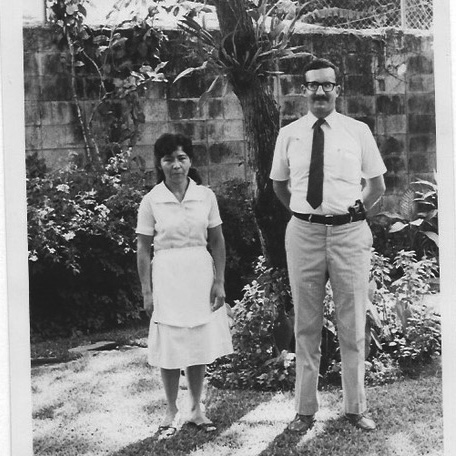
Author’s collection
Ever loyal and reliable maid Marta and the author in the garden of the new residence after the two attacks on the previous quarters.
Tempest in a Teapot
Within the embassy staff, a discernable disconnect was evident. Cooperation and coordination between the DAO, USMILGRP, and chief of station were all but absent. Personalities as well as agency bias played a role. A new U.S. ambassador, a new DATT and naval attaché, a fresh chief of station, plus a soon-to-depart USMILGRP commander, facilitated remedy. The new chief of station was a former Marine Corps officer.
Making the Rounds
Among many of the El Salvadoran government officials to whom I was invited to present my credentials were the senior officers of the El Salvadoran armed forces, starting with the minister of defense and public security, General José Guillermo García, and the armed forces chief of staff, Colonel Rafeal Flórez Lima. I was also introduced to the deputy minister of defense, Colonel Francisco Adolfo Castillo.[21] In quick succession, I met all six brigade commanders, the commanders of the Salvadoran Air Force (Fuerza Aérea de El Salvador or FAS), the meager Navy of El Salvador, and special units, e.g., cavalry and a light armored unit, with some of whom, both officers and rank, I became professionally close. In addition, I met the commanding officers of the six newly mustered rapid reaction infantry battalions (Batalión de Infantería de Reacción Inmediate, BIRI), then just coming into operational status under the U.S. aegis. I also made the rounds of the country’s security forces, encompassing the National Police (Policia Nacional) under Colonel Carlos Reynaldo López Nuila; the National Guard (Guardia Nacional) under Colonel Carlos Eugenio Vides Casanoa; and the Treasury Police (Policia de Hacienda) under Colonel Francisco Morán. Also included were the commanding officers, all colonels, of the military hospital, the National Military Academy, and the Maestranza.22] With few exceptions, e.g., the military hospital, the commanding officers were army officers; the head of the military hospital was an oral surgeon educated, certified, and licensed in Scotland holding the rank of colonel. All elements of the armed forces and security forces were under the jurisdiction the minister of defense and public security and numbered about 17,500. The makeup and mission-specificity of government paramilitary groups was less discernable.[23]
Certainly, fluency in Spanish and cultural assimilation were assets, as was a minor early gaffe at a welcome-aboard gathering of senior El Salvadoran officers in the officers’ club at the Ministry of Defense. Having lost an eye in Vietnam, I wore/wear an eye patch. Given the problematic environment in El Salvador at the time, I scrubbed the eye patch. The prosthesis was nicely done, but it “floats” quirkily. Certainly, it was good for comment at happy hour. It also tended to gratuitously fall out of the eye socket, which is exactly what happened during the welcome-aboard gathering. The prosthesis just plonked into the drink I held. Despite the formality of the occasion, it seemed the whole gathering burst into mirthful laughter and subdued applause. A small but significant sense of camaraderie emerged from what might have been an embarrassing faux pas. Having been twice wounded in Vietnam lent a certain cachet.
In Adversity the
FMLN Makes Its Mark
There was purpose to the previously noted troop movements. In January 1981, the FMLN launched the first full-scale rebel offensive of the civil war, to coincide with the inauguration of President Ronald Reagan. The purpose of the attack was to initiate a general uprising and oust the Revolutionary Government Junta (Junta Revolucionario de Gobierno). That same month, two U.S. AFL-CIO labor representatives and their El Salvadoran host in San Salvador were murdered.[24] Although the FMLN suffered a military setback, it did establish the insurgent organization as an effective fighting force and gained it further popular support. Concurrent with lax operational security in the El Salvadoran armed forces, plagued with shoddy field practices, the war was not going well for the government. In his chapter in the book Latin American Insurgencies, Jack Child does a credible job describing the societal, historical, and cultural footing of the ethics of the El Salvadoran officer corps in the early 1980s:
Intense personal and institutional loyalties are built up in each graduating class [from the Captain General Gerardo Barrios Military School]. These so-called “tandas” function as a parallel command structure, which is highly impervious to civilian control or change [author’s emphasis]. This results in a rigid, closed command system that protects incompetents, allows for widespread corruption, and condones attacks against civilians as an anti-guerrilla tactic. In the field, the effectiveness of Salvadoran tactical units is severely hampered by these leadership deficiencies and by a lack of effective communication, transportation, intelligence, coordination, and medical support systems. The net result is a reluctance and inability to engage in aggressive small-unit operations (especially night operations), which are considered paramount for defeat of a guerrilla adversary.[25]
Fomented by the weight of history and excesses that have been part of the El Salvadoran military’s approach to dissension for decades if not centuries, the ethos of the El Salvadoran armed forces was not surprising. Another often overlooked and rarely considered or understood facet of many Latin societies is the strong, binding allegiance and loyalty owed to the family, above ephemeral entities such as the state or nation or constitution.
The FMLN Brings
down the Puente de Oro
On the night of 15 October 1981, the second anniversary of the ouster of then President General Romero, the FMLN destroyed the Puente de Oro, one of the only two bridges spanning the Lempa River, in a cleverly planned and executed attack. Early the following day, I was dispatched to photograph and report on the bridge’s destruction.[26] The photographs and report were cabled late the same day by the U.S. embassy, San Salvador, to Washington, DC. Subsequent reporting claimed that some of the FMLN saboteurs were trained in Cuba and supported by Basque Euskadi ta Askatasuna (ETA) separatist explosive experts.[27]
Feeding Weakening Governance
In early November, I was directed by the DATT to coordinate and assist the El Salvadoran general staff in receiving and securing the delivery of the largest small arms and ammunition shipment thus far received from the United States. I coordinated closely with the chief of staff, Colonel Rafeal Flórez Lima, and the commander of the small Salvadoran Navy. It was agreed that I would meet the inbound ship on the high seas, about seven nautical miles out from the main port of Acajutla, brief the ship’s captain, and receive the El Salvadoran pilot on board about two nautical miles out from the port. One of the Salvadoran Navy’s patrol craft would ferry me to the ship. Armed with an M-16 and the Walther PPK (Polizeipistole Kriminal) automatic, I had drawn 10 concussion grenades from the Salvadoran Navy. They were to be used around the docked ship to discourage insurgent underwater mischief. Again, I was alone. On the day of the rendezvous, the weather was windy and drizzly. The patrol boat’s commanding officer and I checked in with the harbor master before boarding the patrol boat. I knew the skipper well. We were advised that in open water it was at sea state 3, winds gusting between 8 to 10 knots. We were in radio contact with the inbound ship. After requisite security clearances and coordination were completed, we drew alongside the incoming vessel. I was to board via a Jacob’s ladder amidship. The last wet-net training I had had was as an enlisted Marine back in 1963. Once aboard, I was escorted to the bridge to meet the captain. The gentleman was professional but obviously nervous. In early conversation, it came out that he had lost a ship pier-side in Saigon in 1967. Arrival dockside in Acajutla was on schedule, and unloading commenced immediately. It went into the hours of darkness. The El Salvadoran security forces and navy personnel, generously popping off concussion grenades, were excellent. I bade the relieved ship’s skipper farewell as the long convoy of loaded trucks departed the port area. I returned to the embassy in San Salvador, debriefed the deputy chief of mission, who waited until I had composed a lengthy cable on the operation, which he released immediately.
Welcome to El Salvador
Shortly after the Puente de Oro incident, the residence in which I lived with the two other officers was assaulted by about five armed insurgents. They wounded the two security guards and broke into the residence. Of the three occupants, only the U.S. Navy lieutenant commander and I were armed, the commander with a German MP5 submachine gun and I with an AR-15 rifle and PPK pistol. The two of us assured the safety of the CWO3, and Marta, the maid, who was wailing and crying uncontrollably out of pure fear. I also had five concussion grenades left from the earlier arms and ammunition unloading at Acajutla. The ensuing fire fight, which could not have lasted more than a few minutes, resounded thunderously off the tile floors and walls, rounds whooshing and swooshing about, ricocheting all around the room. I was lying prone behind a doorjamb, controlling my fire; short bursts on the MP5 heightened the cacophony. One of us wounded an assailant, at which point I pulled the pin on a concussion grenade and forcefully rolled it toward the location from whence the opposition fire was coming. That cleared the residence. The two wounded security men were taken to hospital and survived. Less than 10 days later, during midafternoon while I was in residence, automatic weapons fire from a fast-moving vehicle racked the front of the house with negative effect. The embassy RSO responded immediately. The insurgent Radio Venceremos (“we will vanquish” or “overcome”) claimed credit for both incidents in February 1982, declaring them as a warning to “meddling, imperialist gringos.”[28] As the assailants in the first assault seemed to have a good idea of the layout of the house, I again mentally pondered the vetting process. Nevertheless, what ensued was not about vetting but rather a minor, embarrassing quibble between USSOUTHCOM and DIA over who the purported target might have been. The fallout was that DAO and USMILGRP staff would be quartered in separate residences. My Navy comrade-in-arms from the minor incident rotated back to CONUS shortly thereafter. Again, I was afforded a very nice, comfortable, well appointed, colonial style residence, but alone, apart from Marta and two appointed RSO-provided security personnel. The newly arrived U.S. Navy representative to the USMILGRP staff, Lieutenant Commander Albert A. Schaufelberger, reported during the transition. Like his very professional predecessor, Schaufelberger was a SEAL. He was quartered three houses away from my new residence in Colonia Escalón, San Salvador.
Leadup to El Mozote Massacre?
In late November 1981, I received unsubstantiated rumors from El Salvadoran military sources of a military reprisal operation in retaliation for the destruction of the Puente de Oro. A massacre of innocent peasants was alleged in the pueblo of Quesera, Jiquilisco District, Department of Usulután. The unit purported to perpetrate the massacre was the U.S.-trained Atlácatl Battalion under the command of Lieutenant Colonel José Domingo Monterrosa Barrios.[29] Given the tempo of operations and paucity of collaborating information, I did not report the incident. Hindsight suggests the Quesara was a dry run for the subsequent El Mozote massacre the following month. On the evening of 24 December 1981, the rebel radio station, Radio Venceramos, broadcast that a major massacre, carried out by the Salvadoran Army, specifically the Atlácatl Battalion, had occurred in and around the small pueblo of El Mozote, Department of Morazán, in the eastern sector of El Salvador. Per Radio Venceremos, the massacre occurred during 11–13 December in and around the small village of El Mozote.[30] It was hardly a secret that the Ministry of Defense had been preparing for a major (the largest to date) operation in the Department of Morazán. Ironically, the operation was code named Operación Rescate (Operation Rescue). Through previous intelligence and embassy reporting, it was known that the Atlácatl Battalion, under Lieutenant Colonel Monterrosa, was the lead combat element in Operation Rescue. Not surprisingly, Radio Venceremos reports were discounted as “Christmas propaganda.” Based on what I was gleaning from some of the officers who had participated in Operation Rescue, I had my doubts. Bypassing the DATT, whose judgement I had come to question, I informed Ambassador Hinton of my reservations in a one-on-one meeting. The ambassador never shared the conversation with the DATT. Moreover, events were moving swiftly.
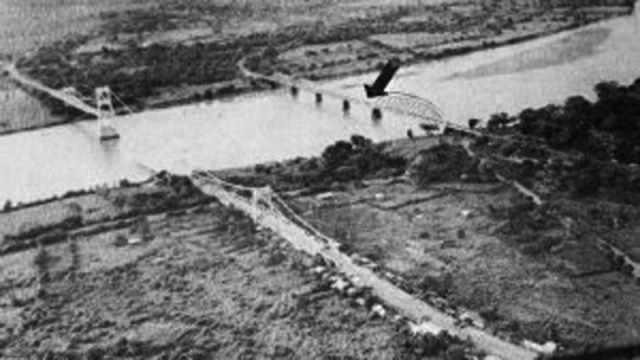 Author’s collection
Photograph, facing east-northeast, showing the destroyed Puente de Oro to the left. The old railroad bridge is to the right. Charges had been simultaneously placed on the latter only partially detonating, causing minor damage. The railway bridge (black arrow) was improvised to accommodate wheeled vehicles, causing a considerable reduction in traffic volume.
Attack on the Salvadoran Air Force:
Operational or Tactical Smackdown?
Some State Department embassy staff were away or just returning from Christmas leave. U.S. military personnel, however, were precluded from taking Christmas leave. The embassy was just getting back into full operational mode. Very early on the morning of 27 January 1982, I was awakened by far-off, successive, muffled explosions. Scantily clad, I exited the residence into the garden. The two sentries were chatting away excitedly, pointing and gesturing toward the bright red-lit night sky to the east. Instinctively, I knew the flames and explosions were emanating from the vicinity of the Salvadoran Air Forces’ main base at Ilopango, approximately seven miles (11.2 kilometers) east of San Salvador. I immediately dressed, armed myself, grabbed a camera, and drove to the Air Force base alone. I felt my diplomatic status, and the possession of El Salvadoran government access and identification cards would suffice, despite the curfew. As I approached the air base, I witnessed what I assessed as a well-planned and executed operation being carried out by elements of the FMLN. Even from afar, it was evident that several aircraft were burning and exploding. The base, of course, was in lockdown. By wile and a bit of chicanery—claiming I was a close professional colleague of the commanding officer, Colonel Juan Rafeal Bustillo (perhaps hyperbolic, but not entirely untrue)—I was allowed access to the base. The scene was chaotic. Small arms fire was immediately evident and sometimes intense. Fire trucks were darting here and there. Medics were responding to cries of the wounded and dying. I concentrated on trying to talk to those present at the beginning of the assault, especially officers. As dawn broke, I started taking photographs of as much of the damage as I could, concentrating on counting and photographing the destroyed or damaged aircraft. Small arms fire had diminished but not ceased; I gathered the assaulting force was withdrawing. Colonel Bustillo approached me, obviously not pleased. The conversation was sharp and short, Colonel Bustillo doing most of the talking. I acted humbled, affecting a false servility. I was ordered to leave the base immediately. To my relief, I was neither searched nor was any equipment confiscated. The intelligence report and photographs were dispatched to Washington, DC, that morning, summarizing that the Salvadoran Air Force had lost or had damaged 75 percent of its operable aircraft, including four of the six Bell UH-1H Iroquois helicopters.
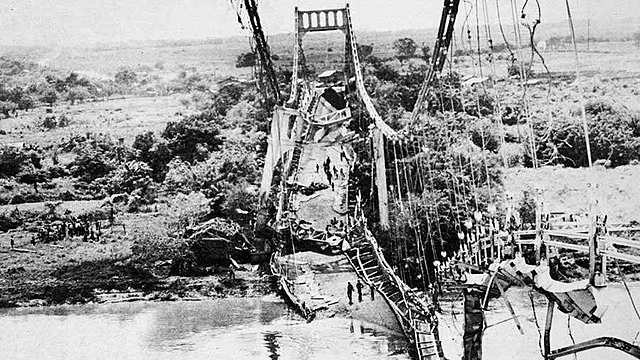 Author’s collection
The destroyed Puente de Oro on the morning of 16 October 1981, looking east-southeast.
Massacre at El Mozote
in the Public Square
While composing the intelligence reports for DIA addressing the insurgent assault on the air base, a cable arrived from Washington, DC, noting the publication that morning of front-page articles in two major U.S. newspapers on the El Mozote massacre. Through the focused efforts of journalist and photographer Alma Guillermoprieto for the Washington Post, and Raymond Bonner and photojournalist Susan Meiseles for the New York Times, the alleged massacre was now in the public square.[31] Consternation in Washington, DC, and in El Salvador under-describes the reaction. Ambassador Hinton immediately dispatched me and Todd Greentree, the embassy’s junior political officer, to the Department of Morazán to investigate. That the alleged massacre had occurred more than a month and a half prior to our arrival did not diminish the harsh dystopian environment we encountered. We were flown into northern Department of Morazán by an Salvadoran Air Force UH-1H helicopter and met on the ground by a 13-man security squad of El Salvadoran soldiers. Frankly, I was more apprehensive of the soldiers than of the insurgents. Despite the obvious security risk, Todd and I agreed to split up and interview as many individuals as possible. There were not many people around. Those we encountered understandably did not want to speak with us. When we did get answers, they were very short, vague, and ambiguous. I did encounter an elderly Catholic priest who claimed not to have been present during the killings but who had come into the area two days following them to minister to the grieving. The El Mozote massacre is undoubtedly the largest massacre in modern Latin American history. The priest spoke in parables and did not name names, but our conversation was revealing. The embassy cable with Todd’s and my findings went out shortly after our return to San Salvador, released by the embassy deputy chief of mission, Kenneth W. Bleakley.[32] Ambassador Hinton was temporarily absent. Thirty-four years later in 2016, I viewed a redacted copy of the cable via a Freedom of Information Act (FOIA) request. Two important, if not key, sentences I had written had been removed from the cable before its release by the embassy on 31 January 1982. As I recall, the deleted sentences read along the lines:
A major catastrophe involving the rape, torture, and wanton killing of over 500 unarmed old men, women, and children occurred in and around the village of El Mozote in mid-December 1981. It is assessed that the tragedy was likely perpetrated by members of the armed forces of the Republic of El Salvador.
Mentally, I had identified the wanton murders of unarmed women, children, and old men around and in El Mozote as the El Salvadoran replay of the March 1969 My Lai Massacre in Vietnam perpetrated by U.S. armed forces wherein up to 500 unarmed civilians, mostly women, children, and elderly males were mercilessly slaughtered.
On the afternoon of 1 February 1982, Ambassador Hinton directed me to go to the headquarters of the Atlácatl Battalion at Sito de Niño, 34 kilometers west of San Salvador, and debrief the commanding officer, Lieutenant Colonel Monterrosa, and his staff on what might have occurred at El Mozote in December. Once back at the embassy, an intelligence report was dispatched to DIA in Washington, DC.[33] A reporting officer is discouraged from stating unsubstantiated opinions, but as I informed the ambassador, I was convinced that the Atlácatl Battalion and/or its subordinate units were in the environs of El Mozote when the massacre occurred.
A contentious issue during my tenure in El Salvador was the certification process mandated by the U.S. Congress to authorize additional funding. DAO reporting was integral to the certification process. In simplistic terms, certification was premised on progress being made, especially within the Salvadoran armed forces, in the areas of human rights, professionalization of the forces, and instituting democratic governance. The embassy’s weekly “grim gram,” which reported violent deaths, disappearances, kidnappings, and torture and attempted to establish culpability was part and parcel of the process.[34] On the other hand, the U.S. Congress toiled under the apparition of who would lose El Salvador to the Communists. The “loss” of Nicaragua, and the failure of Desert One under President Jimmy Carter, were still fresh and piqued. The loss of South Vietnam in 1975 hung heavy, as did the loss of Cuba under President Eisenhower, and even of China under President Truman 30-plus years earlier. What would the loss of El Salvador under President Reagan bode for the Western Hemisphere or for the world? Stone-cold analytical fact is tempered by Washington, DC, political reality. The U.S. government certifying the Republic of El Salvador on 28 January 1982, one day after Guillermoprieto’s and Bonner’s articles broke the story of the likely massacre at El Mozote by elements of the El Salvadoran armed forces is illustrative of how much those losses still rankled.
February was focused on sorting out the facts on both the FMLN attack on the Ilopongo air base and the El Mozote butchery. The latter was aggravated by a contentious discussion between me and the DATT in early March over the amount of time that I was in the field. He threatened court martial for disobeying orders and “conduct unbecoming an officer.” The conversation took place at 1000, and I strongly suspected he had been drinking. On a more upbeat though curious note, I was invited to review my first fitness report. As an embassy staff principal, Ambassador Hinton wrote the fitness report. I assumed he received input from the DATT, but apparently not. The lead sentence in the narrative portion of the report read, “Major McKay has gone completely native.” I felt the statement fair and accurate but was sure the Marine Corps would view it otherwise, despite the extremely laudatory follow-on narrative. With the most respectful and tactful means at my disposal, I was able to convince the ambassador to emend the lead sentence.
Four Dutch Journalists Murdered
In the early morning hours of 18 March 1982, I received a call from an El Salvadoran source informing me that “four gringos had been murdered by the armed forces” in the Department of Chalatenango. Without getting bogged down in drama—there were multiple, interesting challenges—I arrived at Chalatenango in a Salvadoran Air Force helicopter close to 0400. I was simply armed with a PPK. Five filthy, debris-covered bodies, still oozing body fluids, were laid out on the concrete floor of an opened-sided, roofed structure. They were four unarmed Dutch journalists and their FMLN escort. There was no electricity, as the opposition had downed key electrical pylons the previous day. A wet-behind-the-ears sublieutenant informed me there was no fuel for the auxiliary generators. He had no idea what had happened to the FMLN escort’s weapon. The headlights of five roughly circled military trucks, random kerosene lamps, and wavering flashlights provided illumination. None of the brigade’s senior officers were available. The senior officer present was the Salvadoran Army sublieutenant. Unassisted, I carefully probed, rolled over, and examined each rigor mortis-gripped body to determine bullet entrance and exit locations. Messy though it was, I made notes throughout. Just after sunrise, blood and gunk befouled, I returned to San Salvador. I intentionally bypassed the chain of command, going directly to the ambassador’s residence. The residence’s security detail knew me. As I entered the residence, the ambassador, bathrobe clad, was descending the grand stairwell, ubiquitous cigar in hand. As he approached the landing, he said, “What the fuck do you want, McKay?” “Mister Ambassador,” I replied, “it’s not what I want but what you need to know.” I informed Ambassador Hinton of the previous hours’ events. The ambassador directed me to get cleaned up and return immediately, with a civilian embassy staff member, to the site where the five victims had allegedly been murdered. I remain involved today in judicial proceedings in the United States, the Netherlands, and El Salvador against three senior El Salvadoran officers deemed accountable for gross human rights violations.
The destruction of the Puente de Oro, the El Mozote massacre, and the murder of the Dutch journalists focused world attention on El Salvador. The Netherlands did not have an embassy in El Salvador. Primarily, the ambassador and deputy chief of mission handled diplomacy at that level. One of the consequences of the murders of the Dutch journalists was that the government of the Netherlands sent a parliamentary investigative delegation to El Salvador. Kenneth Bleakely, the embassy deputy chief of mission, was a professional, a good diplomat, and a team player. I was brought in early on the planning for the Dutch parliamentarians’ visit. They were to arrive in El Salvador in May. For protocol purposes, Bleakely had the lead but deferred to me on the particulars and personalities of the involved El Salvadoran officers. During the group’s last trip to Chalatenango, Bleakely asked if I would be interested in extending to stay in El Salvador, as the end of my one-year tour was approaching. I told him that if the Marine Corps concurred, I would extend. The visit went well. The consequences of the journalists’ murders linger still.[35]
Author’s collection
LtCol Monterrosa (foreground) and the author in April 1982 at Sitio de Niño, headquarters of the Atlácatl Battalion.
DATT Declared Persona Non Grata
On 23 March, in the throes of the aftermath of the Dutch journalists’ murders, there was a military coup d’état in neighboring Guatemala. The DAO Guatemala cable explicitly detailed the prelude and execution, named names, etc., of the coup. It was classified top secret/NOFORN, with limited distribution. I was in the field when the cable was received in the embassy. On returning to the DAO in the early morning hours of Saturday, 27 March, to write up intelligence top secret reports on my field observations, I accessed the classified vault. I noted the receipt of the DAO Guatemala cable in the classified log-in, but there was no cable in the vault. I made a mental note to check with the CWO3 administrative chief later in the morning. After drafting the reports, I returned to my residence to clean up and sleep. Sometime before 0600 the same morning, I was awakened by a ruckus between the two security men and someone trying to gain entrance to the residence. I thought I recognized the voice of the shouting visitor, inebriated though he sounded. I roused myself and went to identify the interloper. It was a Filipino American who had come to El Salvador years before and married into a rich coffee-growing family. I was leery of him as a source, although the DATT swore by him. Mario Sulit was, indeed, quite drunk, waving around a crumpled sheaf of papers clearly showing red-stamped top secret/NOFORN. He had spent a night of drinking with the DATT. I thanked Sulit for the papers and immediately delivered them to Ambassador Hinton, in residence. That event caused an internal diplomatic brouhaha in the DAO. In the opening days of June, the DATT was declared persona non grata by Ambassador Hinton. With everything else going on, that little incident was all but overlooked by the press. The DATT’s replacement, U.S. Army colonel John A. Cash Sr., was a breath of fresh air, and turned out to be splendid to work with.
FMLN Payback
In early June, the Salvadoran Army reported an FMLN atrocity in the northern reaches of the Department of Cabañas close to the border with Honduras. I was lifted to the site of the alleged attack on a Salvadoran Air Force UH-1H helicopter. The attack had occurred earlier the previous morning. There were no National Guard or civil defense units present. The air reeked of death, many of the deceased were unburied, and grieving survivors were building child-size coffins of untreated wood. Speaking with the survivors, I was informed that all the victims were unarmed women, children, and older men. None of the bodies I viewed had been mutilated. There were numerous AK-47 and battle rifle (Fusil Automatico Leger, FAL) shell casings lying about. Like many of the survivors, I used a cut lemon held close to my nose to ward off the stench. By my count, at least 33 individuals had been killed. I remained three days in that tragic environment, interviewing all the survivors, sleeping on the ground, sharing the meager portions of frijoles with those around me. On day two of the stay, five civil defense soldiers (patrullas contonales) arrived from Sensuntepeque, Department of Cabañas. Sensuntepeque was the headquarters of Military Detachment 2, (Destacamento Militar 2) commanded by Lieutenant Colonel Sigifredo Ochoa Pérez.
I returned on foot to Sensuntepeque, accompanied by two civil defense soldiers, then onto San Salvador via helicopter to file an intelligence report to DIA in Washington. At the behest of the DATT, I returned to Sensuntepeque two days later to further ascertain if the perpetrators had been FMLN. I reported the conviction that El Salvadoran soldiers were not culpable to Washington after my return to San Salvador on a Friday afternoon.
Official photo, U.S. Embassy El Salvador
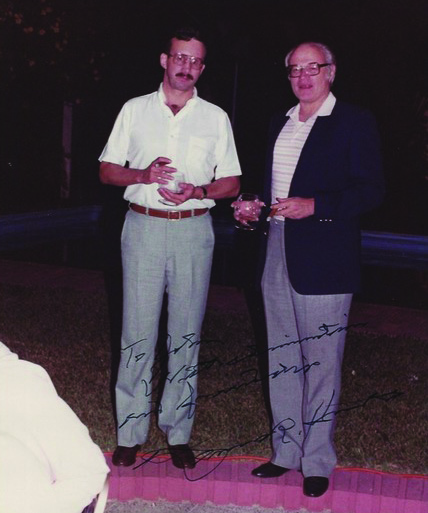
Ambassador Deane R. Hinton and the author at the going away party (despedida) that the ambassador hosted at the residence before the author’s departure from El Salvador in June 1984.
Lieutenant Colonel Monterrosa and Lieutenant Colonel Ochoa were two of the more tactically adept officers during the time I was in El Salvador. They were both field officers in the sense that they accompanied their units to the field, led from the front, and shared the same rigors as their soldiers. Notwithstanding, neither was a stickler for the rules or the law of land warfare. I recall several occasions while dining alone with Monterrosa when we seriously debated the efficacy of taking no prisoners.[36] Retired Salvadoran Army major Roberto D’Aubuisson Arieta was of the same 1966 tanda from the military academy as Monterrosa and Ochoa. D’Aubuisson was implicated in the murder of Archbishop Óscar Romero on 24 March 1980 and a subsequent unsuccessful coup attempt. As founder of the new political party, Nationalist Republican Alliance (Alianza Republicana Nacionalista), he declared he would contend for the presidency in the elections of 1984. Early in the U.S. tenure in El Salvador, Ambassador Hinton was clear that within the embassy only he was authorized to interact with D’Aubuisson and the other declared presidential candidate, José Napoleón Durate.[37] Given the professional relationship with many officers of the 1966 tanda, I could not but associate with D’Aubuisson and his fellow military academy classmates. I did so very carefully. If such socializing was known in advance, I would advise the ambassador’s private secretary prior to doing so. I was told to meet only twice, and those encounters were duly reported. Trickier were chance encounters. Again, those were reported directly to either the ambassador or to Bleakely. I was always told to be careful and very infrequently to walk away. It was an arrangement that worked well.
Adapted by MCUP
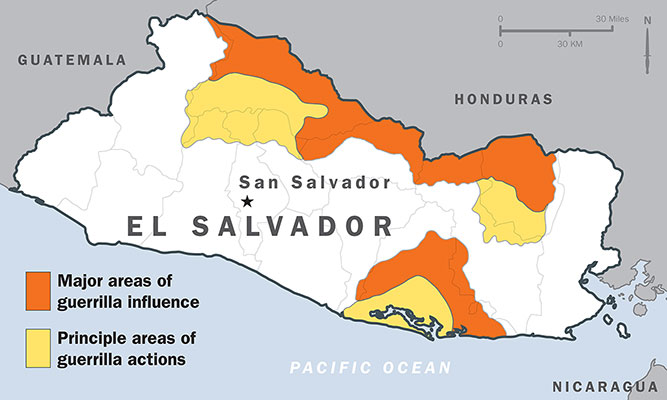
The 1982 intelligence assessment of areas of FMLN influence and military actions.
An Interesting Debrief
U.S. military attachés infrequently get involved in clandestine activities. When authorized to do so, it is only under very strict guidelines and multiagency coordination, cooperation, and concurrence. That I was involved in such activities was largely due to the support and concurrence of agencies outside DIA and DOD, particularly from Ambassador Hinton, Bleakely, the chief of station, and the USMILGRP commander in El Salvador. The previously mentioned Treasury Police (Policia de Hacienda, PH) were a small paramilitary unit very difficult to infiltrate. Familiarity with the commanding officer, Colonel Francisco Morán, and the operations officer, Major Edwardo Morán (no relation) facilitated getting chummy with the Treasury Police (approximately 2,500 men).
Courtesy of LtCol Ochoa, author's collection
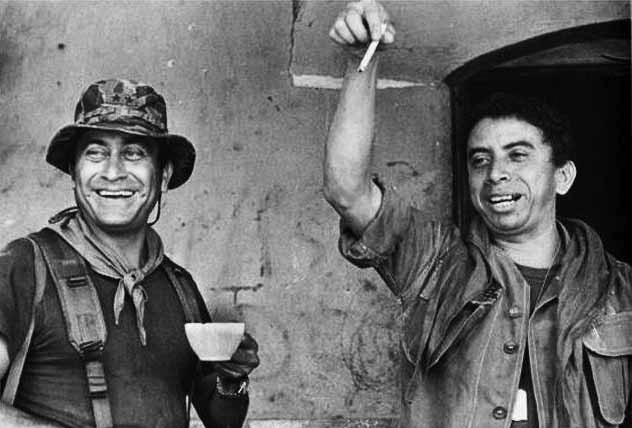
LtCol Sigifredo Ochoa Pérez (left) and LtCol Monterrosa Barrios (right). The two officers were from the same tanda at the Captain General Gerardo
Barrios Military School. Date unknown.
Sometime in early 1982, the Treasury Police took possession of a prisoner of war from the Dominican Republic who had been fighting with the FMLN. He had been captured on the El Salvador-Honduras border in a confrontation between the Salvadoran armed forces and the insurgents. After much finagling and double talk, Colonel Morán authorized me to debrief the Dominican, an avowed Communist, with the proviso that no audio or visual recordings would be made. I was allowed to take written notes, although the latter were read by a Policia de Hacienda (Treasury Police) intel officer prior to my being allowed to depart. I was searched prior to each interview. Of course, I kept the station chief, USMILGRP commander, and the ambassador’s office fully apprised.
The Dominican had been brutally tortured; legs, fingers, and arms broken, and worse. To gain any sort of trust, I ensured that all torture be ceased. I spent more than three months debriefing him three to four times a week. There was no intelligence windfall, but crumbs relating to training in Spain, the Soviet Union, and other Warsaw Pact countries did emerge. The Dominican was eventually turned over to the International Committee of the Red Cross. At the behest of the ambassador, I was present at the turnover.[38] The Treasury Police were formally disbanded under the accords of the March 1993 Report of the Commission on the Truth for El Salvador.
Author's collection
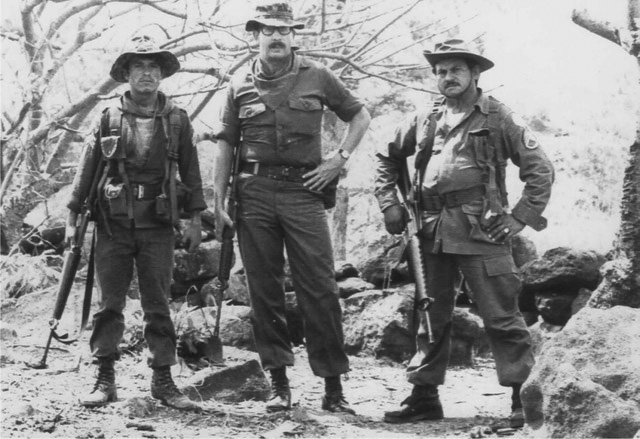
The author (center) with leadership elements of a civil defense unit (patrullas cantonales) in northern Department of Cabañas, El Salvador, June 1982.
CODEL Visit
Congressional delegations (CODELs) are a necessary nuisance for all U.S. overseas embassies, particularly those in conflict zones. Other than providing a general overview of the military situation and attending some general meetings to assess a country’s conditions, DAO San Salvador was not a principal player. That fell more to the USMILGRP and political section.
There was one exception during my tenure that brewed the proverbial tempest in a teapot. In July 1982, Senator Steven Douglas Symms (R-ID) visited El Salvador. Ambassador Hinton was absent, so the deputy chief of mission hosted him. Senator Symms was a former Marine Corps officer and was being escorted by then-colonel James L. Jones Jr., the Marine Corps’ senior Senate liaison officer. Prior to arrival in country, Senator Symms’s staff stated the senator would reside with the U.S. naval attaché during his visit. Consternation ensued. Although the deputy chief of mission hosted, Senator Symms and Colonel Jones were quartered in my residence. Senator Symms was a very social and sociable individual. Keeping him in residence during the hours of curfew proved an interesting but ultimately successful exercise. He was a staunch supporter of the Reagan administration’s policies in Central America. In subsequent debate in the U.S. Senate, Senator Symms’s testimony and support of those policies were clear.[39]
The request for extension was approved. As noted, I made it a point to spend as much time as possible with Salvadoran military units in the field. That was fully endorsed by both Ambassador Hinton and the new DATT, U.S. Army colonel John Cash. I spent considerable time in the field with those Salvadoran military units operating on the El Salvador-Honduras
border (see map 2). The purpose was to assess the operational capability and efficacy of the Salvadoran military in the field. I found that Ambassador Hinton had been correct in that first fitness report. I had very naturally and comfortably gone native, and the government of the United States, Ambassador Hinton, and the superb embassy staff in San Salvador benefited.
Author's collection
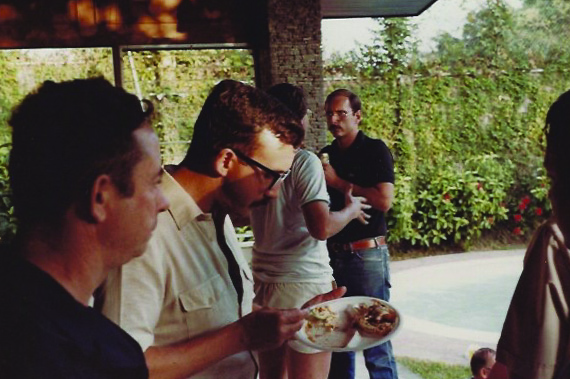
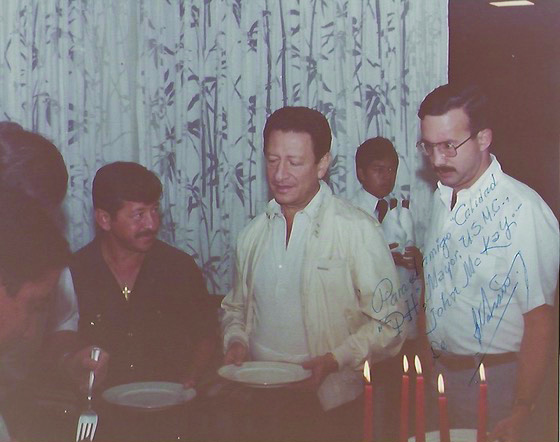
From left to right, Maj Ricardo Cienfuegos (assassinated on 6 March 1985), Col Francisco Antonio Morán, and the author at a formal buffet dinner in October 1982.
Postscript
Aside from the numerous intelligence reports and topic-specific papers I wrote, I kept a diary. Prior to arriving in country, I concentrated on familiarizing myself with the history and culture of El Salvador. As with the Vietnam imbroglio, I continue to think about and analyze what the United States’ involvement in Central America in general and El Salvador in particular meant and means. What have the consequences of that involvement been, both in the United States and in El Salvador? Might not the consequences of U.S. involvement in Central America, like that of Vietnam, Iraq, Afghanistan, and forward serve as a cautionary tale? Today, we once again appear disposed to meddling in other countries’ internal affairs, countries that pose no discernable threat to the national security of the United States. Another observation worth considering is that in the United States political party loyalty does not constitute doing the right thing. As historian and author Peter Hart recently wrote in Chain of Fire: The Siege of Khartoum and the Campaign of Egypt and the Sudan: “Today [Sudan] is one of the most dangerous countries in the world. Perhaps Gladstone had been right to try and stay out of it? Could the result be any worse had the British never set foot in Sudan?”[40]
I extended the tour of duty in El Salvador twice, not departing the country until August 1984. Events after that initial year were as fraught and eventful as the first year, but it became apparent, at least to me, that what the United States had engaged in was a war of attrition that was not winnable by the government of El Salvador. Nor, as far as I could discern, was there any sort of serious forethought given to what might happen after the war wound down. One example of that which the United States would have to deal with postwar is what I personally observed and ponder still: the receipt of arms and ammunition shipment I oversaw in November 1981. Of course, the shipping manifest listed all small arms by type and serial number, as well as the lot numbers for the ammunition. Copies of those documents were turned over to the Salvadorans. The subsequent issuance of weapons and ammunition was never itemized, adding to a deep pit of unaccountable weapons and ammunition with which El Salvador and the United States contend today.
Author's collection
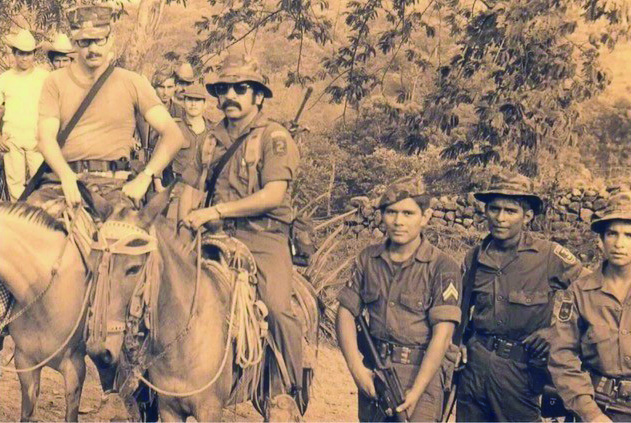
On patrol along the Honduran border with elements of the Salvadoran Army’s 3d Brigade out of San Miguel, Department of San Miguel, El Salvador, in July 1982. The author is the mounted individual at left. Capt Marquéz, Salvadoran Army officer, mounted at right, was killed in an ambush 10 days after this photograph was taken.
During the 1980–93 Salvadoran Civil War, 22 U.S. military personnel were killed in combat-related actions or through targeted terrorist assassinations. Of those 22 fine professionals, I knew or worked closely with two. Lieutenant Commander Albert Arthur Schaufelberger was the highest-ranking U.S. officer killed during the civil war. He was assassinated on 23 May 1983. Staff Sergeant Miles N. Kaiser, after being wounded in a clash with insurrectionists in 1985, received a tainted blood transfusion. He died in hospice of complications from AIDS on 19 June 1996. In addition, several fine, professional Salvadoran officers and enlisted personnel with whom I was close also perished in their country’s civil war.
•1775•
About the Author
Col John C. McKay enlisted in the U.S. Marine Corps in 1962. He deployed with combat elements during the 1962 Cuban Missile Crisis, received a Secretary of the Navy appointment (from the ranks) to the U.S. Naval Academy in 1964, served two tours in Vietnam as an infantry officer, and was twice wounded, losing an eye. He was a U.S. naval attaché to El Salvador during that country’s civil war. An Olmsted Scholar (Spain), he holds master’s degrees from Georgetown University and the National War College. Col McKay provided sworn depositions during the Iran-Contra hearings and has commanded infantry units up to a Joint Task Force. Post-retirement assignments have included time with the Central Intelligence Agency, Department of State, and Drug Enforcement Administration. Until the COVID-19 pandemic, he was an adjunct professor at California State University, Sacramento. At present, he is a key federal prosecutorial witness in an ongoing war crime trial emanating from the Salvadoran Civil War.