International Perspectives on Military Education
volume 3 | 2026
Invisible Prior Learning
How High School Special Education and English Language Learner Experiences Shape Enlisted Marines’ Professional Military Education Outcomes
Lindsay Reid, EdD
https://doi.org/10.69977/IPME/2026.002
PRINTER FRIENDLY PDF
EPUB
AUDIOBOOK
Abstract: While extensive literature exists on academic support in K–12 and postsecondary settings, minimal research has evaluated the educational histories and resulting support needs of enlisted Marines. With a diverse population in the Corps (Department of Defense) and many high school students viewing it as a stable career choice post-graduation, a large gap remains when identifying services needed for those Marines. To help identify an institutional blind spot, this study employed an intersectional framework to investigate how an enlisted Marines’ prior utilization of special education or English language learner (ELL) services in high school affects their ability to complete mandatory professional military education (PME) in a timely manner for promotion. Utilizing a sequential explanatory mixed methods design, this study and its subsequent findings act as foundational literature for future enlisted PME, not just within the Marine Corps.
Keywords: professional military education, PME, enlisted professional military education, EPME, intersectionality, universal design for learning, transformative paradigm, special education, English language learners, ELL, military andragogy
Introduction
Enlisted professional military education (EPME) is a mandatory, high-stakes credentialing system for enlisted personnel within the Marine Corps. As with any educational pursuit, students in this system bring their personal perceptions, experiences, and backgrounds with them. The Marine Corps has more than 150,000 enlisted personnel who are required to complete PME at any given time within their careers; these Marines come from different geographic locations, have different socioeconomic and cultural backgrounds, as well as diverse educational experiences.[1] While there is extensive diversity within the individuals enlisted in the Marine Corps, there should also be the understanding that an institution designed for a single typical style of learner will have inequitable outcomes with a large and diverse population. Given that population within the Corps, specifically within the Latin/Hispanic demographics that are overrepresented compared to the national demographics, research was necessary to establish the complexity of the students and evaluate the simplicity of the institution.[2]
There is a gap in research surrounding the military, its education, and any impacts of high school education on their professional military education. Each of these aspects are intrinsically linked, and to neglect one area of study within that subtopic is to also neglect multiple interconnected areas that require more focus and research. The following study addresses three primary gaps: 1) paucity of educational histories of enlisted Marines, 2) absence of educational accommodations in PME, and 3) limited understanding of how educational barriers affect promotion. It is not known how enlisted Marines within the Marine Corps and their educational history of utilizing services in special education or English language learner (ELL) settings affect their ability to complete their required PME in time for promotional boards. For the purposes of this article, students who received accommodations or support via Individualized Education Plans (IEPs), 504 plans, or ELL programs will be referred to as “service recipients.” Consequences of being PME-incomplete are far-reaching for the individual Marine and the Corps as a whole. Individuals who are unable to finish their PME in time for promotion boards generally cannot continue to grow within their Marine Corps careers and may find themselves exiting service earlier than anticipated. Further, if Marines leave the Service early, it opens gaps that must be filled with new enlisted Marines who do not have the same breadth of experience as those who leave.
Four specific research questions guided the study to analyze the aforementioned problem:
RQ1. What is the frequency with which enlisted Marines received services in high school?
RQ2. How does the frequency with which enlisted Marines received additional support in high school affect the rate at which they are able to complete required PME?
RQ3. How does the requirement of being PME complete affect those same enlisted Marines?
RQ4. What is the perception of increased-rigor PME among enlisted Marines?
Each of these research questions weave the individual’s complex experiences into the longstanding traditions within the Corps. This study examines how prior high school educational service recipients shape enlisted Marines’ experiences within PME. Drawing on a sequential explanatory mixed methods design framed by intersectionality and the transformative paradigm, this study argues that the institution’s reliance on informal peer support, in the absence of formal accommodation channels, reflects a disclosure-hostile culture that renders prior learning histories present in the force but invisible to the institution educating it.[3]
Literature Review
This study sits at the intersection of three bodies of scholarship that have, to date, rarely been read in parallel: research on enlisted professional military education (EPME) as a learning environment, research on adult learners with prior documented academic supports, and research on Universal Design for Learning (UDL). Read together and approached through analytic lenses of intersectionality along the transformative paradigm, this literature reveals a population whose learning experiences sit in the blind spot of each individual research tradition: enlisted Marines with prior special education or ELL supports.[4]
The Changing Landscape of Enlisted Professional Military Education
PME is a mandatory, career-long obligation across all U.S. military branches and is widely understood as essential to readiness, leadership development, and the cultivation of judgment under uncertainty.[5] Within the U.S. Marine Corps, that obligation reaches an unusually large share of the force: of approximately 180,000 active-duty Marines, roughly 150,000 are enlisted personnel for whom EPME is a recurring requirement throughout their careers.[6] Despite its scale, EPME has historically received far less scholarly and reform attention than its officer counterpart.[7]
The reforms that did reach EPME arrived largely through officer-focused legislation. The Goldwater-Nichols Department of Defense Reorganization Act of 1986 and the subsequent Secretary of Defense Ike Skelton panel reforms reshaped officer PME’s structure, content, and assessment expectations, and over time those reforms migrated into the enlisted system.[8] First Sergeant Brandon E. Smart, Erik G. Helzer, and Jennifer A. Heissel traced this migration and observed a pattern that long predates Goldwater-Nichols; across history, enlisted military education was reformed reactively in response to crisis, rather than proactively in pursuit of educational quality. They cite the Crimean War (1853–56) as a paradigm case; specifically, the British Army’s enlisted soldiers suffered casualties severe enough to force institutional recognition that basic literacy and self-care knowledge were operational requirements rather than optional refinements.[9] The Corps’ sustained, 14-year expansion of EPME rigor, particularly at the sergeant and staff noncommissioned officer (SNCO) seminar levels, represents one of the few proactive, non-crisis-driven reform periods in the system’s history.[10]
That expansion produced curricula organized around three core domains, specifically warfighting, leadership, and communication; it is also delivered through seminar discussions, rubric-based assessment, and writing-intensive assignments.[11] The pedagogical shift is documented in Marine Corps University’s institutional publications and in trade press coverage of recent EPME pilot programs.[12] What is much less well-documented is who now arrives in those seminars. The small but growing dissertation literature on military-affiliated learners begins to address this gap: Kittrell Henderson Jr. examined rigor and critical thinking in Army PME from senior leaders’ perspectives; Irina Rader documents the life factors that shape junior-enlisted soldiers’ educational trajectories; and Jeremy D. Pretty examines why enlisted educational programming does not consistently support active-duty members through degree completion.[13] Each of these studies establishes that enlisted learners’ experiences differ meaningfully from those assumed in officer-centric PME models, and each gestures toward learner-side variables, life circumstance, prior preparation, and institutional support that shape individual educational outcomes.
What this literature has not yet examined is the K–12 educational histories enlisted learners bring with them into PME, which can be, and frequently are, more varied and extensive than their officer counterparts. Recent institutional efforts to reduce burden by consolidating seminars have addressed the quantity of EPME demand without examining variation in learner readiness for the demand that remains. This is the first gap. EPME has been reformed structurally and pedagogically without corresponding empirical literature on its learners’ prior educational experiences.
Adult Learners with Prior Academic Supports
An expansive second set of literature exists on adult learners who received special education or English language learner (ELL) supports in K–12 settings, but it has been almost entirely confined to civilian higher education and workforce-development contexts.[14] This literature documents that prior support does not transfer cleanly into adult learning environments and that the legal infrastructure governing K–12 special education services gives way in postsecondary contexts to a substantially different and less prescriptive accommodations framework.[15] Recent journalism, especially in the years following the COVID-19 pandemic, documents that K–12 special education enrollment is at record high levels and that support is increasingly difficult to deliver at scale; recent transition-focused dissertation research examines what happens when students with disabilities move out of K–12 systems into adult settings.[16]
A particularly important contribution comes from Min Hyun Oh and Mancilla-Martinez, whose study of “waived English learners,” students who received both ELL and special education identification and whose ELL status was waived, establishes empirically that the intersection of these two categories is an understudied population. Their work matters for the present study in two specific ways: first, it confirms that the overlap between those who received educational services in both groups is a substantively distinct phenomenon that is rendered invisible when researchers examine either category alone; and second, it operationalizes what Kimberlé Crenshaw’s intersectionality framework has long argued at the conceptual level: that single-axis analysis cannot account for those who sit at the meeting point of multiple categories of individual identity. Dara Shifrer, Chandra Muller, and Rebecca Callahan reinforce this point from a different angle, demonstrating that learning disability identification is not categorically clean because it varies systematically across race, socioeconomic status, and language background, raising further questions about who carries which prior-support history into adulthood.[17]
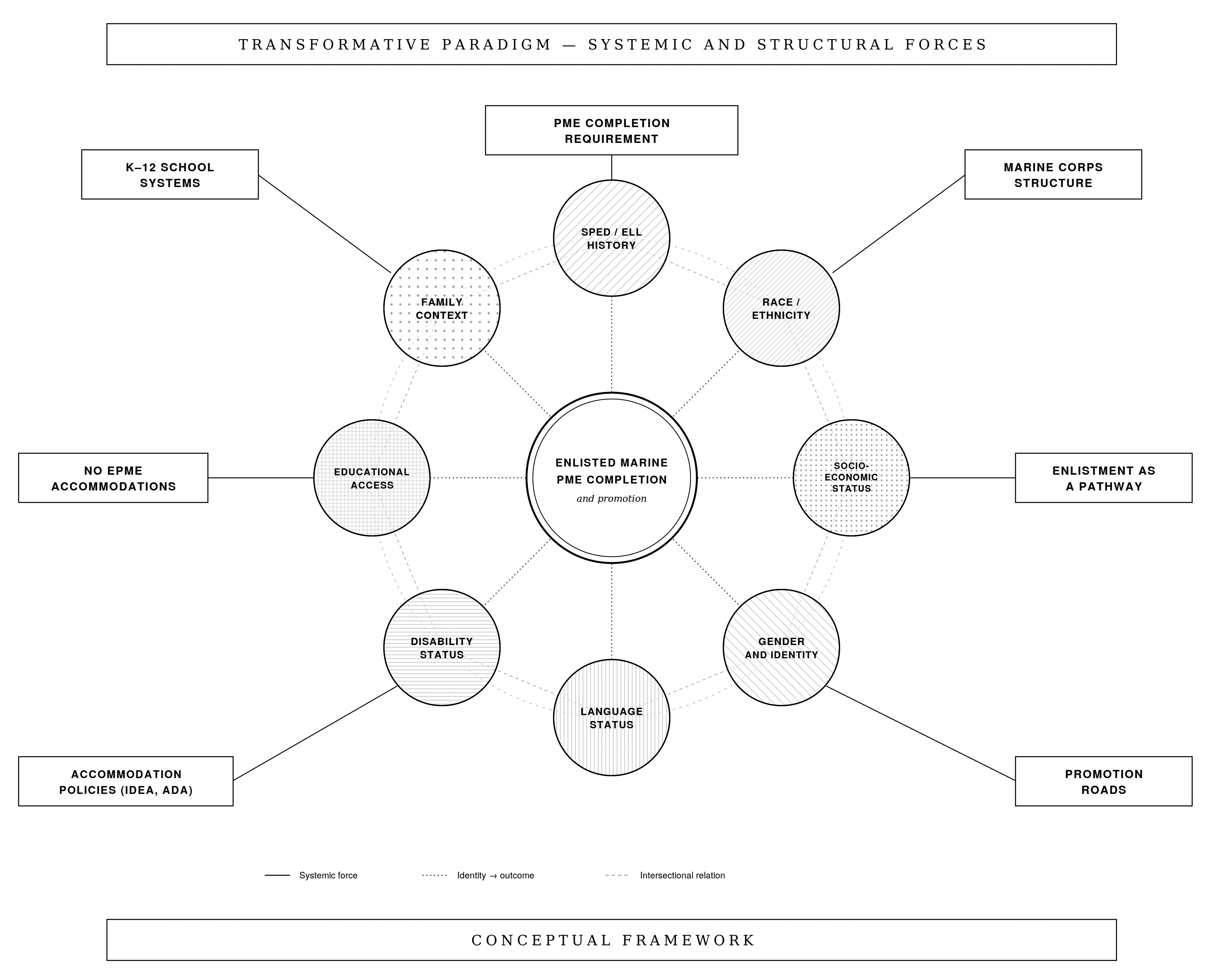
This is where Crenshaw’s framework becomes analytically essential rather than ornamental. Her original argument, developed in the context of Black women’s experiences of employment discrimination, was that examining one axis of identity at a time renders invisible the experiences of those who sit at the intersection of multiple marginalized categories.[18] Carbado and colleagues, in a later mapping of how intersectionality has traveled across disciplines, emphasize that the framework’s strength lies precisely in its refusal to allow institutional categories to dictate analytic categories.[19] A learner who is a sergeant, a Hispanic/Latinx Marine, a former ELL student, and a person whose K–12 record includes IEP-based services is not adequately described by any one of those categories alone or by any the literature that examines them. The reactive, additive approach that has shaped enlisted education historically, and that, as Smart, Helzer, and Heissel argue, still tends to characterize institutional response, is structurally incapable of seeing this learner.[20] Intersectionality, in this study, is therefore not a theoretical decoration. It is the analytic prerequisite for asking the research questions at all. Figure 1 showcases the intersecting factors affecting enlisted Marines and their ability to be PME complete.
Together, the explored literature raises a methodological question as well as a substantive one. If the population of interest sits at intersections that prior research has not examined, and if the institution does not collect data that would make these intersections visible, then conventional research designs that assume the validity of existing categories and existing data sources will reproduce the very invisibility this study seeks to address. Donna Mertens’s transformative paradigm offers a response. The transformative paradigm holds that research with, and about, historically marginalized populations carries an obligation to center those populations’ voices in the design, conduct, and interpretation of the work, and to treat the researcher’s positionality as analytically relevant rather than as a contaminant to be controlled.[21]
Woven into a novel conceptual framework, intersectionality identifies the relationship between extrinsic forces and the individual identity factors that ultimately impact the outcome: EPME completion and promotion within the Marine Corps. The transformative paradigm offers a lens from which the Marines who are rendered invisible within the scope of the Corps’ culture and institution can be viewed as they are: complex, multifaceted individuals within an institution that demands uniformity and coherence.[22]
Figure 1. Web of intersecting factors influencing enlisted Marine PME completion
Source: courtesy of the author, adapted by MCUP.
Ignoring any one of the intersectional qualities of an individual Marine impacts their ability to interact with, to complete, and to apply EPME within the scope of their careers. Not a single factor exists in isolation within the context of any one individual.
The second gap highlights how the substantial scholarship on adult learners with service-based backgrounds has not extended into military education contexts, and the scholarship on military education has not engaged the conceptual tools, including intersectionality, needed to examine these learners as learners. Bryan L. Sykes, Alex K. Bailey, Ryan Kelty, Meredith Kleykamp, and David R. Segal demonstrate that military enlistment functions as a major life-course transition that draws disproportionately from specific demographic and socioeconomic backgrounds. What this literature fails to pursue is what those backgrounds carry forward into the professional military educational components of military service.[23]
Universal Design for Learning as a Design Response
The third set of relevant literature concerns Universal Design for Learning (UDL), the framework developed by CAST that proposes designing instruction from the outset for variability across learners rather than retrofitting accommodations after the fact.[24] UDL’s central premise is that learner variability is the norm rather than the exception, and that instructional environments designed around multiple means of representation, expression, and engagement reduce the need for individual disclosure of learning differences to access effective instruction. For example, a Marine in a UDL-styled course would have access to printed reading materials, audiobooks, or even video supplements to ensure multiple means of understanding. Once that student has attained the necessary information, they may have a choice in whether to work alone or to collaborate with their peers in the seminar as well as a choice on how to best show the information they learned. Potentially, this could be a presentation, something written, or something designed. Each offers that Marine the opportunity to ultimately showcase what they learned, but in a way that highlights that Marine’s strengths. UDL’s applicability to military education specifically is essentially absent from the published literature. This absence is consequential. EPME’s current pedagogical model, reliant on writing- and communications-intensive assessments, seminar-based discussions, and rubric-based evaluations represents almost the opposite of UDL’s design principles; it offers narrow, standardized means of expression and assumes a relatively uniform learner.[25] UDL offers a nonstigmatizing design response to learner variability, one that does not require Marines to disclose prior educational accommodation or support histories for them to benefit academically and professionally. This is a meaningful feature in an institutional context where disclosure can carry professional risk, particularly given that learning disabilities such as dyslexia have historically intersected with military accession standards in complicated ways, and it is one reason UDL warrants serious attention as a framework for EPME reform.[26]
Synthesis and the Gap This Study Addresses
The three groups of literature above intersect in a population they have collectively failed to thoroughly examine. The EPME literature has not yet developed an empirical account of its learners’ prior educational experiences, specifically as it relates to enlisted military personnel and the support or accommodations they might have received within the parameters of IEP/504 or English language learner (ELL) identification. The adult-learner literature on both types of educational service recipients and their backgrounds has not extended into military contexts, even as its most recent contributions demonstrate that the intersections within that literature are understudied.[27] The UDL literature has barely entered military education at all. Where these three gaps overlap, at the lived experience of enlisted Marines whose prior K–12 supports remain present in their learning but invisible to the institution, sits the population this study examines. Crenshaw’s intersectionality provides the analytic frame for taking that overlap seriously rather than reducing it to a single axis; Mertens’s transformative paradigm provides the methodological commitments that make examining it credibly possible.[28] The remainder of this article reports findings from a sequential explanatory mixed methods study designed to examine this population on its own terms.
Methodology
This study employed a sequential explanatory mixed methods design to examine how prior high school academic supports shape enlisted Marines’ perceptions and experiences within EPME.[29] The design was selected to allow descriptive quantitative findings from phase one to inform the focus and structure of qualitative inquiry in phase two, and to permit interpretive integration of both data sources at the analytic stage. The transformative paradigm grounded methodological decisions throughout, foregrounding participant voice, treating researcher positionality as analytically relevant, and committing to the full reporting of divergent findings rather than their analytic suppression.[30]
Researcher Positionality
The author serves as an educational technologist within the College of Distance Education and Training (CDET) at Marine Corps University, with direct programmatic responsibility for EPME course design and delivery. Prior to this role, the author spent more than 15 years in collaborative public education settings serving high school students receiving their respective services. Consistent with the transformative paradigm’s treatment of positionality as a methodological resource, this dual experience is acknowledged here as the analytic vantage from which the study was both designed and interpreted; it shaped the recognition that prior K–12 educational supports might persist invisibly into PME, and it provided contextual familiarity with the institutional environments the study examines. Reflexive memoing throughout data collection and analysis, along with regular cross-checking with the author’s lead doctoral faculty mentor (LDFM), served as procedural safeguards against the overextension of personal interpretation or bias.
Trustworthiness
Trustworthiness in qualitative research is evaluated across four dimensions established by Yvonna S. Lincoln and Egon G. Guba: credibility, transferability, dependability, and confirmability.[31] While generally developed from a naturalist perspective, these dimensions are still relevant to this mixed methods study and its design. Each dimension was addressed through specific procedural decisions made during each phase’s respective data collection and analysis processes. Credibility was established through prolonged engagement with the data, member checking, and triangulation. Transferability was supported through intentional, thick description. Rather than claiming that the data could or should be generalized, which both the sample size and purposeful selection approach do not support, the study provides sufficiently detailed contextual information about participants, setting, and analytical procedures to allow readers to assess the degree to which findings may resonate with or inform other contexts. Dependability was addressed through the maintenance of a clear and documented audit trail. All data was stored on an external encrypted hard drive and retained in accordance with the Institutional Review Board (IRB) protocol.
Participants and Recruitment
Eligible participants were recently separated (within the last 10 years) enlisted Marines who had attained a minimum rank of sergeant and who had completed at least one EPME seminar between 2010 and the present. Recruitment occurred through targeted social media outreach on Facebook, Bluesky, and TikTok, supplemented by snowball sampling. Snowball sampling was selected because the population of interest, specifically enlisted Marines with prior service or support histories, is not represented in any institutional sampling frame and is reachable only through community-based recruitment.[32]
The study’s original phase one recruitment target was based on a 5 percent margin of error (n = 384). The realized phase one sample of 18 respondents fell substantially below this target. Within the transformative paradigm, this shift was treated as a meaningful study finding rather than as a sampling failure; the difficulty of recruiting enlisted Marines, even though they were separated from service, and who were willing to disclose K–12 educational support histories is evidence consistent with the study’s underlying premise about the invisibility and disclosure risk attached to these histories. Phase one analysis was therefore reframed from inferential to descriptive, and the qualitative phase took on greater interpretive weight than originally designed or anticipated. Of the 18 phase one respondents, 4 agreed to participate in phase two semistructured interviews. Participant pseudonym selection was managed by assigning anonymous numbers to each individual to maximize anonymity and confidentiality.
Data Collection
Phase one data was collected through a four-part Qualtrics survey instrument: a) personal demographics and service history, b) K–12 educational support services, c) PME participation and completion, and d) perceptions of EPME and rigor. Sections a–c used multiple-choice and conditional branching items; and section d used a five-point Likert scale (strongly disagree to strongly agree). The instrument was developed in alignment with the four research questions and the intersectionality framework, reviewed for content validity by a panel of subject matter experts that included a Marymount University faculty member with mixed-methods expertise and faculty members of military institutions familiar with military education, and field-tested with noneligible respondents (e.g., former officers and currently enlisted Marines) to confirm that items functioned as intended.[33]
Phase two data were collected through four semistructured interviews conducted via Zoom at participant-selected times. Interviews were recorded with participant consent and transcribed using Krisp; recordings were deleted following transcription, and transcripts were stored on encrypted external drives accessible only to the principal investigator. The semistructured interview protocol was developed following phase one analysis, with questions explicitly mapped to RQ3 and RQ4; these were worded to permit participant-driven elaboration rather than researcher-directed response. The protocol was reviewed by the author’s LDFM and refined following pilot interviews.
Data Analysis
Phase one analysis used descriptive statistics appropriate to the exploratory purpose of the phase and the realized sample size: frequency distributions, percentage calculations, and cross-tabulations across rank, EPME course, and perception items. Inferential procedures were not employed. Likert items were analyzed both individually and at the set level, with attention to the relationship between personal-preparedness items and systemic-accessibility items. A set-level pattern emerged in which Marines reported personal preparedness alongside systemic uncertainty about PME accessibility; this pattern directly shaped the focus of phase two inquiry.
A consequential analytic event occurred during phase one: the survey did not produce variance on the independent variable required to address RQ2 directly. No respondents disclosed prior educational service history through the survey instrument. Within a conventional methodological frame, this would constitute a sampling or instrument failure. Within the transformative paradigm, however, the absence is analytically significant; it is consistent with the disclosure dynamics documented in the literature on adult learners with prior educational support backgrounds, and it intensified rather than negated the rationale for the qualitative phase.[34] RQ2 was accordingly reframed to ask not whether prior supports influenced completion but how Marines whose K–12 histories included such educational supports made sense of EPME, which is a question only the qualitative data could address.
Phase two analysis used reflexive thematic analysis.[35] Reflexive thematic analysis was selected because it is theoretically flexible, compatible with the transformative paradigm, and acknowledges that themes are constructed through the researcher’s analytical labor rather than awaiting passive extraction from the data which is a premise consistent with the epistemological commitments of the intersectionality framework guiding the study. Coding was inductive, with codes developed through iterative engagement with transcripts and subsequently collated into themes.[36] Both descriptive and in vivo coding were employed, with the latter preserving participants’ own language as analytic anchors and supporting the transformative paradigm’s commitment to participant voice. Five primary themes and one divergent finding emerged from the analysis; the divergent finding is reported in full in the findings section, consistent with the transformative paradigm’s commitment to surfacing rather than smoothing accounts that depart from dominant patterns.
Results
Designed and executed using a purposeful sample in both phases of the research, five themes and one divergence emerged. Many of these themes were expressed within the Likert-style responses in phase one just as readily as they were by each of the four interviews in phase two. The following sections offer findings for each phase and analysis between the emergent themes and divergences.
Phase One: Quantitative Findings
The phase one survey was distributed through social media outreach and in-person events between June and November 2025. Of 30 surveys distributed, 20 were returned (66.7 percent) and 18 were retained for analysis after the exclusion of 2 incomplete responses. The realized sample represents more than three decades of enlisted Marine Corps service, spanning enlistment dates from 1990 through 2024 and capturing rank at separation across the full junior, mid-career, and senior enlisted pipeline (table 1). Among the 14 respondents who provided specific rank data, 1 separated as a corporal and was an outlier in the data, 3 separated as a sergeant (E-5), 3 as a staff sergeant, 1 as a gunnery sergeant, 3 as a master sergeant or first sergeant, and 3 as a master gunnery sergeant or sergeant major (E-9). Each of the 18 confirmed completion of at least one classroom-based EPME course, with the most commonly completed courses being Corporal’s Course (6 participants), Sergeant’s Course (4), the Advanced Course at the gunnery sergeant level (3), the Senior Enlisted PME/Senior Enlisted Blended Seminar Program (3), and the Career Course at the staff sergeant level (2).
Table 1. Demographic profile of Marine Corps quantitative interview participants
|
Dates of service
|
Rank at time of separation
|
Current highest education level
|
Highest education level while enlisted
|
|
1991–97
|
Other
|
N/A
|
High school diploma
|
|
2005–10
|
Sergeant
|
Bachelor’s degree
|
High school diploma
|
|
N/A
|
N/A
|
Master’s degree
|
Bachelor’s degree
|
|
2011–17
|
Corporal
|
Associate’s degree
|
High school diploma
|
|
2007–12
|
Staff sergeant
|
Bachelor’s degree
|
High school diploma
|
|
1992–2018
|
Master gunnery sergeant/sergeant major
|
Doctorate degree
|
Master’s degree
|
|
2003–23
|
Master sergeant/first sergeant
|
High school diploma
|
High school diploma
|
|
1998–2018
|
Gunnery sergeant
|
Bachelor’s degree
|
Bachelor’s degree
|
|
1999–2018
|
Master sergeant/first sergeant
|
Bachelor’s degree
|
Associate’s degree
|
|
2011–16
|
Sergeant
|
High school diploma
|
High school diploma
|
|
1996–2014
|
Staff sergeant
|
Bachelor’s degree
|
Associate’s degree
|
|
2004–12
|
Sergeant
|
Bachelor’s degree
|
Bachelor’s degree
|
|
2001–23
|
Master sergeant/first sergeant
|
High school diploma
|
High school diploma
|
|
2007–12
|
N/A
|
Associate’s degree
|
High school diploma
|
|
1993–2023
|
Master gunnery sergeant/sergeant major
|
Bachelor’s degree
|
Bachelor’s degree
|
|
1990–2020
|
Master gunnery sergeant/sergeant major
|
Bachelor’s degree
|
Bachelor’s degree
|
|
2018–22
|
N/A
|
High school diploma
|
High school diploma
|
|
2013–24
|
Staff sergeant
|
Associate’s degree
|
Associate’s degree
|
Note: This table displays the professional and educational backgrounds of the 18 participants. N/A indicates that the participant did not provide data for that specific field or it was not applicable to their status.
Source: compiled by the author.
Three findings from phase one bear directly on the article’s argument and warrant elaboration, starting with the post-service educational acceleration finding. Comparing participants’ highest educational attainment while enlisted to their current attainment produced the most analytically significant phase one result. While enlisted, nine participants held a high school diploma as their highest educational credential, three held an associate’s degree, five held a bachelor’s degree, and one held a master’s degree. Following separation, the distribution shifted substantially: four currently hold a high school diploma, three an associate’s, eight a bachelor’s, one a master’s, and one a doctorate. This represents a net increase of nine participants who advanced their educational attainment after leaving the Corps, with two achieving graduate-level credentials entirely post-service. Read through the lens of intersectionality, as well as the transformative paradigm, this acceleration suggests that the academic potential of these Marines was not absent during their service; simultaneously, it suggests that structural conditions within the institution may not have existed to support that acceleration.[37]
The Disclosure Finding
All 18 respondents indicated they did not receive documented academic support services, including individualized education programs or 504 plans accommodations for students with learning or physical disabilities, during high school. Eleven respondents explicitly reported no ELL support; seven did not respond to the ELL item. The seven nonresponses are methodologically distinct from a “No” response and should not be interpreted as confirmation of services not received. Read in isolation, this finding might suggest that the population of enlisted Marines with prior academic support histories is insignificantly small. Read alongside the qualitative findings detailed below, particularly theme four, the more defensible interpretation is that the absence of self-reported identification reflects a disclosure gap rather than a need gap. The literature on disability identification disproportionality and on the understudied IEP/ELL intersection supports this reading; in cultural contexts where disclosure carries social cost or even perceived social cost, self-report systematically undercounts prior support histories.[38]
The Personal-Success/Systemic-Uncertainty Divergence
Six Likert-scale perception items in part four of the survey produced a coherent set-level pattern that became the empirical anchor for phase two inquiry. On the personal preparedness item (“I felt adequately prepared for the academic demands of EPME”), 13 of 18 participants (72 percent) agreed or strongly agreed. On the systemic accessibility item (“EPME instruction and assessment methods were accessible to Marines of all educational backgrounds”), agreement dropped to 9 of 18 (50 percent), with 5 participants (28 percent) selecting neither agree nor disagree. Participants who reported feeling personally prepared were measurably less willing to extend that confidence to the system as a whole. A further pattern appeared in the item asking whether additional academic supports would have helped participants succeed: the modal response was neither agree nor disagree (eight participants, 44 percent), with combined agreement at six participants (33 percent). On its face, the neutral cluster could suggest indifference. Interpreted through the qualitative findings on stigma, it becomes legible as an artifact of the same disclosure-hostile culture: respondents who have internalized the cost of acknowledging academic need are unlikely to assert that structural, academic supports would have helped them, even on an anonymous instrument post-separation.
These three findings produced the analytic framing for phase two. Phase one could not address RQ2 directly because the absence of variance in disclosed and documented academic support history precluded comparative analysis between Marines with and without such backgrounds, but it generated three questions that the qualitative phase was structured to examine: what conditions suppressed the academic potential evidenced in post-service attainment, what cultural dynamics produced the disclosure gap, and what accounted for the personal-success/systemic-uncertainty divergence?
Phase Two: Qualitative Findings
Phase two consisted of four semistructured interviews conducted via Zoom, with audio captured and transcribed using Krisp and thematic coding conducted in Delve. Coding proceeded inductively using both descriptive and in vivo codes, which were subsequently collated into themes through reflexive thematic analysis.[39] Transcripts totaled 112 pages across more than three hours of interview material.
The four participants were purposefully selected to enable intersectional analysis (figure 2). They include two Black participants (one male, one female), one Asian/Pacific Islander male, and one White male; the ranks at separation range from corporal to gunnery sergeant, as one participant neared sergeant at separation; the current educational attainment varies from high school diploma to bachelor’s degree, with one participant pursuing further credentials; and the generational cohorts span Gen X through Gen Z. The sample includes one woman, consistent with the approximately 9.7 percent female composition of the active-duty Marine Corps in 2023, and includes Black and Asian/Pacific Islander Marines whose representation in the Corps falls below their proportion of the U.S. population.[40] One demographic absence should be acknowledged: no Hispanic/Latinx participants were included in phase two, despite this group’s overrepresentation within the Marine Corps. This is addressed in the limitations section.
Figure 2. Phase two participant demographic profiles and alignment with intersectionality framework
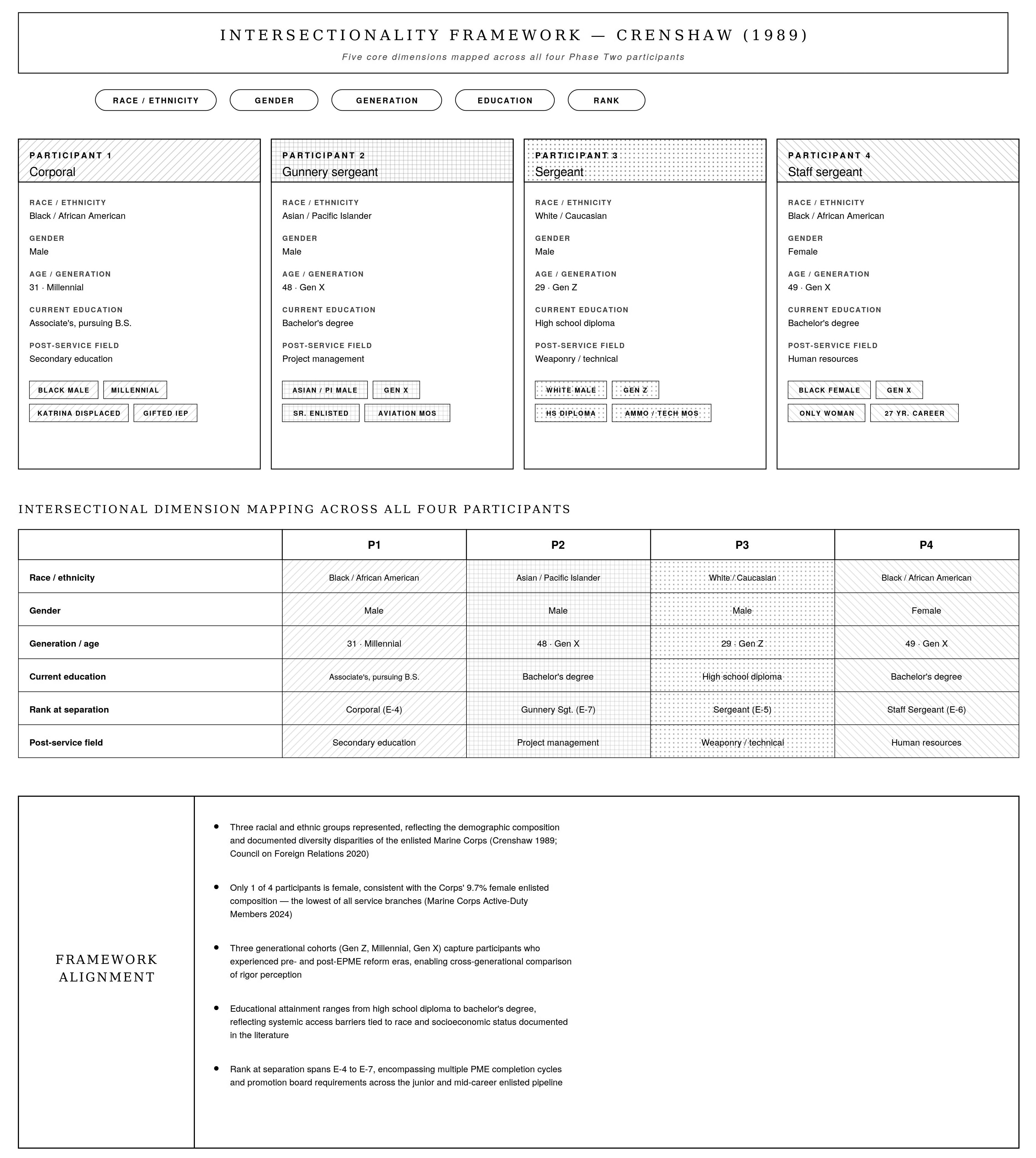
Note: This figure presents the demographic profiles of the four phase two semistructured interview participants while mapping each profile against the five core dimensions of the study’s intersectionality framework: race/ethnicity, gender, generation/age, educational attainment, and rank at separation. Participant identifiers are numerical to protect confidentiality. Generational cohort designations follow commonly accepted birth-year parameters: Gen Z (born 1997–2012), Millennial (born 1981–96), and Gen X (born 1965–80). Color coding in the intersection mapping grid is for visual differentiation only and does not imply value or hierarchy. The diversity represented across these four participants is reflective of the demographic composition of the Marine Corps as well as the intersectional nature of the barriers this study examines.
Source: compiled by the author, adapted by MCUP.
Five primary themes emerged from the analysis, with one further perspective from participant 1 (P1) constituting a divergent finding warranting separate acknowledgement.
Theme One: EPME as Academically Manageable for General Education Graduates
All four participants described EPME as academically accessible to those who completed a standard general education high school curriculum. None identified reading or writing as their primary EPME challenge; physical training and public speaking were named with greater consistency. P1 characterized the academic content as easily passed at 80 percent proficiency without significant study, attributing this to a combination of his gifted-track high school preparation and rote memorization skills developed as a musician. P3 described Marine Corps Institute (MCI) coursework as “not super challenging,” with content covering basic punctuation, grammar, and algebra in slideshow format. P4 identified writing in the Sergeant’s Course as a genuine challenge for many of their peers, but framed this as a function of distance from academic work, as most peers were on second enlistments and at least four years removed from formal schooling, rather than as a function of inherent course difficulty. P2 echoed this, locating peer concerns about EPME less in academic difficulty than in the perceived disconnect between EPME content and their aviation military occupational specialty’s responsibilities.
Theme Two: Peer and Informal Support as the Primary Academic Resource
Across all four interviews, participants described reliance on fellow Marines, rather than on institutional academic supports, as the primary mechanism for navigating EPME challenges. This pattern emerged organically in each transcript without direct prompting from the researcher. P4 described a reciprocal dynamic in which they helped peers with writing assignments in the Sergeant’s Course, and peers helped them with the mathematical content that emerged in the Career Course at the staff sergeant level. P3 described working through difficult MCI material with their roommate, framing collaboration as culturally embedded: “you’re never alone” in the Corps. P2 described group assignments as a structural feature of resident EPME courses. P1’s experience diverged here: as a member of the Commandant’s Own Drum and Bugle Corps, their peer cohort consisted of disproportionately high-scoring Marines, and conversations about EPME were characterized by shared ease rather than shared struggle.
Theme Three: Family as the Dominant Architect of Educational Identity
Every participant, when asked who shaped their relationship with education, named a family member as the primary influence. None named a teacher, school counselor, or institutional program. This pattern held across all four intersectional profiles. P1 described education in their household as “a job . . . your responsibility. No one’s going to give it to you.” P4 described their mother as a nonnegotiable standard-setter whose expectations they carried through EPME, college coursework, and beyond. P2 described their parents as setting graduation as the minimum expectation, with their now-spouse later providing the impetus for pursuing a bachelor’s degree during enlistment. P3 described their older sisters’ academic achievements (one valedictorian, one salutatorian) as an inadvertent benchmark against which they measured themselves, producing self-perception as average by comparison even where their own academic skills were adequate. Because of this comparison within the family, P3 illustrated that it caused them to be disengaged within their education, which permeated their perception of EPME as prolifically as the perception of those raised within a family who encouraged positive perception of education. The theme and the corresponding anecdotal evidence from both P2 and P3 demonstrate that this family-shaped educational identity can produce disengagement just as readily as engagement. Viewed and interpreted through intersectionality, this finding supports the argument that preenlistment identity factors shape educational posture in ways EPME’s current structure neither acknowledges nor accounts for. The household, not the school, is the primary educational environment for these participants. For Marines who had previous educational services while enlisted in K–12, regardless of whether they received specific academic accommodations, the family shaping their perception of education would also impact how diligently they approach and worked during their EPME.
Theme Four: Stigma as a Structural Barrier to Disclosure and Accommodation
Two participants identified Marine Corps culture as actively hostile to the disclosure of academic struggle, learning disability, or need for accommodation; the dynamic was strongly implied in the other two transcripts. Both P1 and P2 arrived at this observation independently of the researcher and unprompted. P2 framed it as a function of military culture’s resistance to the appearance of weakness, observing that even minor accommodations, such as asking an instructor for materials or requesting earphones, would not be voluntarily disclosed. P1 named the enforcement mechanism with greater specificity: “No one’s going to say, ‘I struggle reading’ or ‘I’m dyslexic’ because that’s all that’s going to become is a point of joking and gentle, or not-so-gentle, prodding from their fellow Marines.”
Theme Five: The K–12 Preparedness Gap and Its Implications for EPME Rigor
This theme emerged most fully from P1, whose dual identity as a former Marine and a current secondary educator produced the most forward-looking perspective in the qualitative dataset. While the other three participants assessed EPME rigor relative to their own high school experiences, P1 assessed it relative to the current state of K–12 education where Marines who received academic support services are most familiar. They described current students as struggling to produce a standard five-paragraph essay, noted the elimination of formal writing assessment prior to eighth grade in their current teaching context, and characterized contemporary literacy expectations as substantially more limited than those of their high school cohort. The implication is consequential: EPME, which felt manageable to a 2005 honors graduate, may represent a meaningful academic barrier to a 2022 enlistee whose K–12 system minimally assessed writing and operated with reduced literacy expectations. The gap between EPME’s academic expectations and the academic preparation of the Marines entering it is not static: it is widening. Students who enlist in the Marine Corps having received prior educational services will potentially be entering EPME which may not be prepared to lift them to the increasing levels of rigor of EPME courses and seminars.
P1’s Divergent Finding: Critical Thinking as a Structural Reform Imperative
Beyond the five primary themes, P1 offered a perspective on EPME reform that exceeded the experience of any single participant and entered the domain of institutional policy. Where the other three participants assessed EPME through personal experience and found it manageable, P1 argued that EPME’s current design, which they characterized as oriented toward fill-in-the-blank and multiple-choice formats consistent with the lower tiers of Bloom’s Taxonomy, was structurally insufficient for producing the kind of Marine the institution claims to value. Bloom’s Taxonomy categorizes learning objectives by levels of cognitive complexity. Lower-order thinking involves simple tasks such as recalling, remembering, or organizing information, while higher-order thinking requires more complex tasks, such as analyzing, evaluating, or creating. P1 elaborated that the seminars and its corresponding activities need higher-level cognitive demands: “It can’t just be all facts and dates and measurements and numbers. I think there needs to be more critical thinking . . . not only for the PME, for their promotions, but out in the field.” Given that critical thinking is named explicitly within Marine Corps learning doctrine, P1’s assessment exposes a gap between stated institutional aim and instructional design. While P1 is one participant, they alone had a unique lens from which to establish this divergence: their perspective as a former Marine as well as a current educator gives them a perspective the other participants did not have. They further proposed a structural mechanism: increasing the weight of EPME completion within the promotion cut score, on the argument that Marines who perceive EPME as worth more points will invest in it more meaningfully. Consistent with the transformative paradigm’s commitment to surfacing rather than suppressing accounts that depart from dominant patterns, this divergent finding is reported in full rather than smoothed into the broader thematic structure. Additionally, this finding could act as a foundation for future research within the scope of EPME courses.
Synthesis Across Phases
Read together, the two phases produce a coherent empirical picture. Phase one documented timely EPME completion, adequate self-reported preparation, and personal confidence among the surveyed sample, alongside uncertainty about whether EPME serves Marines of all backgrounds equally and a measured reluctance to affirm that additional supports would have helped. Phase two provided the qualitative explanation: a cultural climate that stigmatizes the disclosure of academic need, an institutional reliance on informal peer support in place of formal accommodation, a widening distance between K–12 academic preparation and EPME expectations, and a family-shaped educational identity that EPME’s current structure neither acknowledges nor addresses. The findings do not document widespread failure within EPME. They document the conditions under which failure, and the need that precedes it, is rendered structurally invisible.
Discussion
The findings reported above invite four interpretive moves, each of which carries implications for PME curriculum design, for faculty development, and for how military education systems conceptualize learner readiness. The first three concern the U.S. Marine Corps directly. The fourth situates the findings within the international PME conversation this journal exists to convene.
Disclosure Is the Variable, Not Identification
The most consequential analysis that emerged from the study is treating the absence of self-reported IEP and ELL identification as a finding about institutional culture rather than as a finding about prevalence. The phase one data documented that no participant disclosed prior IEP service and that only 11 of 18 explicitly reported the absence of ELL services. Read in isolation, this might be taken as evidence that enlisted Marines with prior K–12 support histories are rare. Read alongside theme four, the more defensible interpretation is that disclosure is the variable being measured, not identification itself. P1 named the enforcement mechanism with precision: peer ridicule. P2 documented that even minor accommodation requests would not be voluntarily made. The cultural pattern these accounts describe is consistent with the disclosure dynamics documented in the broader literature on adult learners with prior support histories.[41] This concept produces a direct interpretation of the phase one disclosure finding. Marines who received academic support services in high school did not lose those needs after enlistment. They lost the institutional structures that made addressing those needs legitimate and entered an institutional culture that made self-identification socially or potentially professionally unsafe. The absence of formally documented accommodations in EPME is not a policy gap. It is the predictable outcome of a cultural environment in which disclosure invites ridicule.
This finding has direct implications for how PME institutions design instruments to assess learner readiness. Instruments that ask Marines to self-report prior educational support histories, whether through formal accession data collection, course intake surveys, or the kind of research instrument used in this study, will systematically undercount the population they aim to identify. The institutional question this raises is not how to improve self-report instruments: it is how to design learning environments that do not require self-report to support learner variability. Regardless of Service branch, this is where intentional integration of UDL into EPME becomes meaningful.
Informal Peer Support as De Facto Accommodation
The second analytic move concerns the gap between what EPME formally provides and what its learners actually rely on. Across all four interviews, participants described peer-mediated support as the primary mechanism for navigating EPME academic challenges. This pattern emerged organically and was named without prompting. It is not a marginal phenomenon. It is, in this sample, the dominant academic resource.
Two implications follow. First, the institution is already accommodating learner variability, but it is doing so informally through channels that depend on the strength of individual peer networks, the visibility of academic challenges to peers, and the willingness of peers to assist. Marines whose learning differences are invisible to peers, such as someone with high-functioning autism with social difficulties or unaddressed attention-deficit/hyperactive disorder (ADHD), and who may lack access to strong peer networks, are structurally disadvantaged within a system that has displaced the work of accommodation and support systems from the institution onto its learners. The analytic significance of this lies in what it implies for Marines whose learning profiles are invisible to peers or who lack access to strong peer networks. If informal support is the primary scaffold for academic success in EPME, then Marines with undisclosed learning differences, or those whose differences manifest in ways peers cannot easily assist with, are structurally disadvantaged in ways the institution neither tracks nor addresses. Second, the institutional reliance on peer support means that the EPME system cannot accurately assess its accessibility or lack thereof. Aggregate completion rates reflect the success of the peer-support infrastructure as much as they reflect the design of the curriculum. A Marine who completes EPME with substantial peer scaffolding and a Marine who completes EPME independently both appear in the data as completions; the system has no mechanism for distinguishing them, and therefore no mechanism for recognizing where its formal supports are absent.
The Personal-Success/Systemic-Uncertainty Divergence
The third analytic move follows from the Likert pattern in which 72 percent of participants reported personal preparedness for EPME but only 50 percent affirmed that EPME was accessible to Marines of all educational backgrounds. This divergence between what participants knew about their own experience and what they were willing to claim about the system as a whole is interpretively rich. It suggests that participants recognize a gap between what worked for them and what works in general. Five participants (28 percent) selected neither agree nor disagree on the systemic accessibility item, indicating that even those who succeeded within EPME were unwilling to assert that the system serves the broader enlisted population equally.
This is not a finding of system failure. It is a finding of system opacity; the EPME system has produced a population of successful completers who themselves cannot speak with confidence about whether the system would have produced their success if their preparation had been different. The institution has, in effect, produced its own internal uncertainty about its accessibility; that uncertainty is unevenly resolved by formal data, because the data the institution collects, such as completion rates or promotion eligibility, cannot capture the differential effort that produced uniform outcomes.
What This Means for EPME Design
These three findings converge on a single design implication: EPME’s current pedagogical model, which combines limited writing-intensive assessment, discussion seminars, and rubric-based evaluation within a culture that suppresses disclosure, places the burden of accommodation on learners while denying them the legitimate channels through which to seek it. Universal Design for Learning offers a nonstigmatizing alternative. UDL’s central proposition, that variability is the norm rather than the exception, and that environments should be designed to accommodate variability from the outset rather than retrofitted to address it, is well-suited to the institutional context this study describes, precisely because it does not require learner disclosure to function.[42]
UDL-informed EPME would offer multiple means of representation (varied modalities for delivering instructional content), multiple means of action and expression (varied formats for demonstrating competency), and multiple means of engagement (varied entry points for learner motivation and persistence). None of these adjustments require Marines to self-identify as needing accommodation. All of them reduce the cultural cost of accessing support, because no support-seeking is required: the support is built into the environment.
This is not a call to lower EPME’s academic rigor. Theme five specifically points the other direction; as K–12 academic preparation becomes more variable, EPME’s rigor is more, not less, important to maintain. The argument is that rigor and accessibility are not opposed. A UDL-informed EPME can be both more rigorous and more accessible than the current model, and more forthcoming about the relationship between what it asks of Marines and what it does to support them in meeting those demands. Faculty development is the corresponding institutional investment; directors, instructors, and others involved in the curriculum design process who understand UDL principles can create and execute rigor that learners of varied backgrounds can demonstrably meet, rather than rigor that learners of varied backgrounds must work around through informal channels and supports.
Implications for International PME
This study examined U.S. Marine Corps EPME, but the phenomenon it describes is not bounded by national context. Every military that recruits its enlisted force from a demographically and educationally diverse population faces some version of the question this study raises: What prior educational experiences are present in the force, and what institutional structures recognize, accommodate, or render them invisible? The specific cultural mechanisms documented here, such as peer ridicule as enforcement, informal support as substitute for formal accommodation, the personal-success/systemic-uncertainty divergence among successful completers, are likely to find analogues in other military education systems, though the specific shape they take will vary.
Several lines of comparative inquiry follow. Military education systems with formal accommodation infrastructures could be examined for whether the existence of formal channels meaningfully shifts disclosure rates or whether cultural disclosure-suppression dynamics persist regardless of policy structure. Military systems that recruit from highly stratified educational pipelines could be examined for whether post-service educational acceleration is a generalizable phenomenon; a feature shared, in different forms, by many national systems. The integration of UDL into PME is, to this author’s knowledge, essentially absent from the published international literature; comparative work on whether and how UDL has entered any military education system would substantially advance the field.
The invitation, in short, is this: the population of enlisted military learners with prior educational support histories is almost certainly not a U.S.-only population. The cultural and structural dynamics that render those histories invisible to the institutions educating them are almost certainly not U.S.-only dynamics. This study offers one set of findings from one branch of one nation’s military, examined through one analytic frame. The international PME research community is positioned to test, complicate, extend, and where appropriate refute these findings against the experience of other forces. That work would be substantially more valuable than confirmation of the single U.S. case alone.
Limitations
All research carries limitations and addressing them transparently is essential to establishing both the boundaries of current findings and the directions future inquiry should take. This study is no exception. As Paula T. Ross and Nikki L. Bibler Zaidi note within the context of medical research, a principle equally applicable to educational inquiry:
Study limitations should leave the reader thinking about opportunities to engage in prospective improvements by presenting gaps in the current research and extant literature, thereby cultivating other researchers’ curiosity and interest in expanding the line of scholarly inquiry.[43]
In this research, there were a number of limitations to address in the interest of methodological transparency about where this, as well as future research, could improve. Participation bias existed for those who completed the quantitative survey; that bias was toward those who completed EPME successfully within the scope of their careers. Additionally, the small sample size in both phases of the study, the researcher’s positionality as an educator and someone who works within EPME, and the social media recruitment concentration are all addressed as limitations within the scope of the study.
Field-test participants did not match the criteria of who would ultimately participate in the study; they simply had the knowledge and the context to offer feedback on the structure of the quantitative and qualitative instruments. Within the study, lack of access to active-duty Marines potentially provided a different perspective than those who are recently separated from service. Additionally, the retrospective recall of those separated Marines could also be seen as a limitation of the research. Having single-researcher coding without an independent inter-rater reliability check represents an additional limitation. While the researcher was not limited to local groups due to social media, the majority of respondents and interviewees were currently located geographically in the Northern Virginia area, specifically near Quantico.
Moving from general study limitations to phase-specific, it is important to evaluate each. Within the quantitative phase, the seven ELL nonresponses cannot be treated as confirmed “no” responses; in research, a participant’s response can never be assumed nor is it prudent to do so. Self-reporting as the sole mechanism for both IEP/504 and ELL identification could be seen as a limitation, especially given the disclosure-hostile culture of the Marine Corps. This was identified by all four interview participants. While not ideal, it is a substantive finding that doubles as a limitation. That environment, especially if it currently exists within the Corps as it did for those respondents, will undoubtedly influence future research as well. Additionally, despite the Corps’ high percentage of enlistees who are of Hispanic or Latin descent, there were no interviewees who identified themselves as such. This is important as it is a missing perspective of an overrepresented population within the Marine Corps that could provide additional insight to the scope of the study. Taken together, each of these limitations reflects not the absence of rigor, but the complexity of investigating a historically understudied phenomenon within an institution whose cultural dynamics are part of what the study sought to understand.
Conclusion and Implications for International PME and Future Research
This study examined how prior high school IEP/504 and ELL academic support shapes enlisted Marines’ experiences within professional military education, using a sequential explanatory mixed methods design grounded in intersectionality and the transformative paradigm. Its central contribution is analytic rather than purely empirical; it reframes the absence of self-reported IEP/504 and ELL identification within an enlisted military population as a finding about institutional culture rather than a finding about prevalence. Disclosure, not identification, is the variable being measured. The cultural and structural mechanisms documented here produce an institutional environment in which prior learning histories remain present in the force but invisible to the institution educating it: peer ridicule as enforcement, informal support as substitute for formal accommodation, and a measured uncertainty among successful completers about whether the system serves Marines of all backgrounds.
While this study examined a relatively small sample of former enlisted Marines, the phenomenon it describes is unlikely to be bound by national context. Invisible prior-learning variation within enlisted populations is not unique to the United States or to any single branch of its armed forces. Military education researchers in the United Kingdom, Brazil, Spain, Norway, and beyond are well-positioned to test, extend, and where appropriate, complicate these findings against the experience of their forces. The specific cultural mechanisms identified here will almost certainly take different shapes in different military and educational contexts; that variation is a productive site of inquiry. An international conversation among peers would advance the field substantially beyond what any single national case can accomplish alone: comparing how different militaries recognize, accommodate, or render invisible the prior educational experiences their enlisted forces carry into PME could mutually benefit each nation and its military members. The goal is shared across forces: equitable access to professional military education, regardless of the invisible educational histories the learners in front of us bring with them.
Endnotes
[1] “2024 Demographics Profile: Marine Corps Active-Duty Members,” Department of Defense, 2024.
[2] “Demographics of the U.S. Military,” Council on Foreign Relations, 13 July 2020; 2023 Demographics: Profile of the Military Community (Washington, DC: Office of the Deputy Assistant Secretary of Defense for Military Community and Family Policy, Department of Defense, 2023); and “2024 Demographics Profile.”
[5] Professional Military Education: Programs Are Accredited, but Additional Information Is Needed to Assess Effectiveness (Washington, DC: Government Accountability Office, 2020); and “Professional Military Education Continuum,” Marine Corps University, accessed 2024.
[6] “2024 Demographics Profile.”
[7] BGen Jay M. Bargeron and Edward T. Nevgloski, A Brief History of Marine Corps Education (Quantico, VA: Marine Corps University Press, 2019).
[8] Another Crossroads?: Professional Military Education Two Decades after the Goldwater-Nichols Act and the Skelton Panel (Washington, DC: Subcommittee on Oversight and Investigations, Committee on Armed Services, U.S. House of Representatives, 2010).
[9] 1stSgt Brandon E. Smart, Erik G. Helzer, and Jennifer A. Heissel, “Invest in Enlisted Education,” U.S. Naval Institute Proceedings 149, no. 9 (September 2023).
[10] Bargeron and Nevgloski, A Brief History of Marine Corps Education; and Smart, Helzer, and Heissel, “Invest in Enlisted Education.”
[11] Jonathan Lehrfeld, “This Pilot Program Will Be Required for Marine Master, First Sergeants,” Marine Corps Times, 26 September 2022; and “Training & Education,” Marine Forces Reserve, accessed 2024.
[12] Lehrfeld, “This Pilot Program Will Be Required for Marine Master, First Sergeants.”
[14] Dianne August, “Educating English Language Learners: A Review of the Latest Research,” American Educator 42, no. 3 (Fall 2018): 4–9, 38–39; and Katherine Schaeffer, “What Federal Education Data Shows about Students with Disabilities in the U.S.,” Pew Research Center, 24 July 2023.
[15] 20 U.S. Code Chapter 33: Education of Individuals with Disabilities (2018); and “Auxiliary Aids and Services for Postsecondary Students with Disabilities,” U.S. Department of Education, revised September 1998.
[16] Sara Randazzo and Matt Barnum, “A Record Number of Kids Are in Special Education—and It’s Getting Harder to Help Them All,” Wall Street Journal, 20 June 2024; Elizabeth M. Duzy, “Documenting the Change Process as an Urban School District Creates a Community of Practice for Post-Secondary Transition Planning” (EdD diss., Marymount University, 2025); and Lacy Stanford, “A Case Study of Special Education Students’ Transition into Post-Secondary Opportunities” (EdD diss., Marymount University, 2025).
[22] Mertens, “Transformative Mixed Methods Research,” 469–74.
[24] “Universal Design for Learning,” CAST, accessed 2024.
[25] “Training & Education.”
[26] Taylor Beattie, “Can Dyslexia Exclude You from Military Service?,” LinkedIn, 8 July 2015.
[27] Min Hyun Oh and Jeannette Mancilla-Martinez, “Waived English Learners: The Understudied Intersection of English Learner and Special Education Status,” Exceptional Children 90, no. 3 (2024): 217–34, https://doi.org/10.1177/00144029231220302.
[28] Crenshaw, “Demarginalizing the Intersection of Race and Sex,” 138–67; Carbado et al., “Intersectionality,” 303–12; and Mertens, “Transformative Mixed Methods Research.”
[29] John W. Creswell and J. David Creswell, Research Design: Qualitative, Quantitative & Mixed Methods Approaches, 6th ed. (Los Angeles, CA: Sage, 2023); and John W. Creswell and Vicki L. Plano Clark, Designing and Conducting Mixed Methods Research, 3d ed. (Los Angeles, CA: Sage, 2018).
[30] Mertens, “Transformative Mixed Methods Research,” 469–74.
[32] R. Burke Johnson and Larry Christensen, Educational Research: Quantitative, Qualitative, and Mixed Approaches, 7th ed. (Los Angeles, CA: Sage College Publishing, 2020).
[33] Carbado et al., “Intersectionality”; and Crenshaw, “Demarginalizing the Intersection of Race and Sex.”
[34] Oh and Mancilla-Martinez, “Waived English Learners.”
[35] Virginia Braun and Victoria Clarke, Thematic Analysis: A Practical Guide (Los Angeles, CA: Sage Publications, 2022).
[36] Johnny Saldaña, The Coding Manual for Qualitative Researchers, 4th ed. (Los Angeles, CA: Sage College Publishing, 2021).
[39] Saldaña, The Coding Manual for Qualitative Researchers; and Braun and Clarke, Thematic Analysis.
[40] “2024 Demographics Profile”; and “Demographics of the U.S. Military.”