Expeditions with MCUP
Outside Actors as Centers of Gravity
Joseph Rudolphi
30 June 2026
https://doi.org/10.36304/ExpwMCUP.2026.08
PRINTER FRIENDLY PDF
EPUB
AUDIOBOOK
Abstract: When thinking about centers of gravity, one typically looks inside a country for its center of gravity. However, countries can have centers of gravity outside their own borders. This can happen for many reasons. For example, a weak ally could request assistance from someone stronger, or one ally could become another’s center of gravity after the latter suffers disaster. This article will establish a framework to determine whether an outside actor is a center of gravity. It will then use several case examples with varying events to show how this applies across different situations.
Keywords: alliance, center of gravity, Poland, Ukraine, intervention, intelligence support, material support, equipment support
Introduction
U.S. Joint doctrine defines center of gravity as “the source of power that provides moral or physical strength, freedom of action, or will to act.”[1] This source of power can take many forms, including economic resources, leadership, or manpower. In some cases, an outside actor serves as a center of gravity. Whether acting formally or informally, an ally can become the primary source of strength for a nation it supports. The policy choices of that outside actor’s leadership directly influence the outcome to the benefit or harm of the supported nation. Within alliances, power dynamics and policy decisions can shift the center of gravity from one actor to another. Both modern doctrine and theories of Prussian military theorist Carl von Clausewitz support the idea that an outside actor can serve as a center of gravity. This article presents historical and modern case studies to demonstrate that this idea has persisted over time. It also offers a framework for identifying when a center of gravity lies within an outside actor. The case studies offer different examples that show how the framework can apply across varying situations. This framework will allow the United States to conduct a more accurate center of gravity analysis of its allies to better inform decision makers on whether the presence of the United States is decisive for the continued existence of the ally. The United States needs to understand and accept, as the most powerful ally a nation or state can have, and with the world’s most proficient military force in its possession, the risks of becoming a center of gravity if it becomes involved in a conflict. Understanding this allows the U.S. leadership to take a calculated and deliberate approach to being an ally’s center of gravity.
Clausewitz argued that “a center of gravity is always found where the mass is concentrated most densely. It presents the most effective target for a blow; furthermore, the heaviest blow is dealt by the center of gravity.”[2] Scholars continue to debate whether this center of gravity is physical or intangible, since Clausewitz also described it as the hub of all power and movement. Clausewitz later extended the concept to alliances. Even when multiple nations fight together, he still viewed the conflict as a single war. While political unity may vary, one nation typically assumes leadership within the alliance.[3] According to Clausewitz, striking that leading nation also strikes the center of gravity for the entire coalition. He wrote, “There are very few cases where this conception is not applicable—where it would not be realistic to reduce several centers of gravity to one.”[4] In other words, each nation may have its own center of gravity, but one ally—typically the most dominant—holds strategic primacy.
To demonstrate this point, this article will briefly examine the case of Poland in 1939, when that country was invaded by Nazi Germany and the Soviet Union, marking the beginning of World War II (1939–45). In this case, the initial center of gravity resided within Poland. As a result of the joint Nazi-Soviet invasion, Poland’s armies suffered destruction, two oppressive powers occupied its territory, and its people endured brutal rule. Had Poland fought the war alone, that likely would have marked its end. While some resistance might have continued, the Polish people would have lacked any centralized source of power to sustain a national will to act.
However, Poland did not stand entirely alone. The United Kingdom and France had entered into military alliances with Poland, and while their efforts did little to relieve Poland directly in 1939, they provided crucial moral and strategic support. Most importantly, they provided space for the continuance of the Polish government and armed forces. Polish political leaders who escaped their occupied country established a government-in-exile, first in France and then in the United Kingdom, and sustained their nation’s collective resolve to resist. Polish soldiers were armed and equipped by the United Kingdom and France to fight the Axis powers alongside Allied troops. This example shows how a nation, even after losing all its territory, can continue to fight. Without the United Kingdom and France, Poland would have lost its national will, directed by the policy of its government (will to act). Poland would have also lost its armed forces (physical strength), without which it could not deal a decisive blow. Had Nazi Germany defeated both the United Kingdom and France or negotiated their withdrawal from the war, Poland would have suffered a second political and military collapse.
An outside actor—in this case, the United Kingdom and France—therefore becomes a center of gravity when the following conditions are met:
• The weaker allied political state has the inability to act on its own. Its political ability to achieve the aims of conflict is contingent on its stronger ally’s political will to act on its behalf.
• The physical strength of the weaker allied political state is incapable of delivering a decisive blow, making it incapable of achieving military victory alone. The weaker ally lacks critical capabilities.
• The defeat or withdrawal of the stronger ally who takes up their burden would force the center of gravity back to the weak ally in a way that results in its collapse.
This framework can be used to analyze nations involved in major conflicts, but it can also be reduced to operational and tactical centers of gravity for smaller elements of physical forces involved in conflict by simplifying it to apply to the lower levels of war.
The case of Poland in 1939 is not unique, in that the concept of weaker states seeking alliance with stronger states is one that has continued from ancient times to the present. In the case of Poland, the presence of willing allies allowed it to shift its center of gravity and survive. The ancient example of the Pyrrhic War, conversely, demonstrates what happens when a stronger ally loses that willingness to pursue war aims that align with its weaker ally.
The Pyrrhic War (281–75 BCE) offers a clear example of an outside actor serving as the center of gravity for a weaker ally. In 282 BCE, a small Roman naval force sailed near the Greek colony of Tarentum (modern-day Taranto in southern Italy). Viewing this as a violation of their territorial waters, the Tarentines attacked the Roman fleet. They acted without foresight and quickly realized that they could not defend themselves alone. In desperation, Tarentum turned to the king of Epirus, Pyrrhus, for help. Pyrrhus agreed to assist. As a claimant to the Macedonian throne and a relative of Alexander the Great, Pyrrhus received support from other factions in Alexander’s former empire eager to redirect him toward Italy.[5] They supplied him with troops and equipment to aid Tarentum. Tarentum’s strength and will to resist depended entirely on Pyrrhus and his army.
Pyrrhus initially achieved success. His campaign attracted support from rebellious Italian tribes. He won two major victories against the Romans at Heraclea in 280 BCE and Asculum in 279 BCE. However, Tarentum had placed its hope in the wrong figure, as Pyrrhus ultimately served his own ambitions. When Greek colonies in Sicily asked for help against the Carthaginians, he abandoned the Italian campaign. According to the ancient biographer Plutarch, when the Tarentines urged Pyrrhus to return and fulfill his promise, he told them to keep quiet and wait for his return.[6]
Tarentum had placed its center of gravity in a general who was more concerned with his ambitions of conquest. To get Pyrrhus back, the Tarentines appealed to him while he was in Sicily. During his absence, they lost territory and could hardly maintain public support for their war.[7] By the time of Pyrrhus’s return, Carthage had inflicted significant damage against his forces, and his actions had made him unpopular in Sicily.[8] He was therefore unable to recoup his losses. In 275 BCE, the Romans defeated Pyrrhus in Italy at Beneventum, and he decided to leave Italy for more adventuring in Greece. Again, Tarentum’s center of gravity was leaving them. When Pyrrhus died in 272 BCE, the garrison he left in Epirot surrendered the city to the Romans under conditions that allowed them to leave, demonstrating their lack of interest in continuing to fight for Tarentum’s independence. The Tarentines made one final appeal to Carthage but were turned down.[9] Ultimately, Tarentum started a war that it was entirely unable to pursue without allies. Its center of gravity in Epirot left three times during the conflict, shifting the center of gravity toward the Tarentines’ weak city each time.
Pyrrhus and his army had clearly served as Tarentum’s center of gravity. According to modern doctrine, their presence had provided Tarentum with the will to fight. By Clausewitz’s standard, Pyrrhus’s army concentrated mass, dealt powerful blows, and became the target whose defeat spelled collapse. The story of Tarentum illustrates the danger of placing a strategic center of gravity in an unreliable ally. Unlike Poland, which managed to rearm and form a government in exile, Tarentum received no such opportunity. The conditions of the framework are therefore met: Tarentum clearly had an outside actor serving as its center of gravity. After initiating war, it could not act on its own, having no ability to achieve its war aims over Rome without help. Its army could deal no decisive blow. Pyrrhus directed the war based on his own will and ambitions, and he ultimately abandoned Tarentum. For the Tarentines, initiating war and entrusting their center of gravity to an outside actor ultimately cost them their independence.
The War of the Fourth Coalition: Russia as Prussia’s Center of Gravity
While Tarentum from the outset relocated its center of gravity to an ally who took up the role voluntarily, the War of the Fourth Coalition against the French Empire under Napoléon I in 1806–7 demonstrates a case in which the center of gravity is relocated to an outside actor after catastrophe. When Napoléon defeated Russia and Austria during the War of the Third Coalition (1805–6), Prussia feared that the French emperor would exercise too much influence over the small German states in the Confederation of the Rhine, which he had established to put a buffer between France and Prussia. Fearing this encroachment into its sphere of influence, Prussia declared war on France. Russia joined the war but could not initially provide any support on the battlefield. Napoléon quickly invaded Prussia with his German allies and inflicted a catastrophic defeat on the Prussian Army during two battles at Jena and Auerstedt on 14 October 1806. This defeat would have ended the war if not for Russia. The Prussian king Frederick William III wrote to the Russian tsar Alexander I his assessment of his situation following the defeat: “I myself am unable to appreciate the quite greatness of my loss. It is huge. The French must of have entered my capital yesterday, and what crowns my present terrible situation, is the physical impossibility of where I am to present an effective resistance.”[10]
The letter concludes with Frederick William telling Alexander that his situation would be hopeless if not for Alexander. It is clear in this letter from one monarch to another that Prussia no longer had a Prussian center of gravity. This put significant pressure on Russia, which tried in vain to get Austria to join the new coalition against Napoléon. Though the United Kingdom and Sweden took part in the coalition, neither could provide effective assistance.
From that point forward, Prussia reduced its role in the fighting. The remnants of its once large army were only strong enough to hold the fortresses that had not surrendered to Napoléon. Only the presence of a strong Russian force gave the Prussian Army freedom of action outside its fortresses. Even in the fortresses, the Prussian Army was not motivated to resist, with the hope that Russian intervention would reverse their situation. Clausewitz notes that Prussian fortresses surrendered quickly, saving the French from the need to use large forces to conduct long sieges. He later wrote: “In order that fortresses may resist bravely after a catastrophe such as that of our army in 1806, vigorous action is required from the high command, fear and hope must be excited, and enthusiasm aroused. But this was not our kind, the contrary even occurred in several instances.”[11]
The catastrophe forced Russia to become the outside center of gravity for Prussia. The Prussian state could not act on its own, having no physical force with which to deal blows to the enemy to enforce its war aims. The Prussian king fled to East Prussia, where the presence of Russian forces could protect him.
Only two significant Prussian maneuvers occurred after Jena-Auerstadt. Both happened in 1807, after the Russian Army had entered the conflict. Both involved the small force of Prussian general Anton Wilhelm von L’Estocq. The first maneuver involved supporting Russian general Levin August von Bennigsen against the French at Eylau. L’Estocq’s force was close in size to an understrength division despite its designation as a corps. Russian sources estimate the force at 5,584 soldiers as well as a separate Prussian brigade.[12] This was a shadow of what the Prussian Army could deploy before the war. L’Estocq’s troops played a pivotal role in the battle, helping to turn it into a draw and allowing both sides to claim victory. Nonetheless, without the presence of the Russian Army, L’Estocq would not have attempted to resist in open battle.
The second maneuver was at Heilsberg, where Bennigsen ordered L’Estocq to bring troops in anticipation of another battle with the French. L’Estocq set out to aid with a force of 9,672 Prussians and Russians.[13] This force again helped Bennigsen fight a defensive battle where both sides claimed victory. The numbers show precisely why Prussia had become so reliant on Russia for further resistance. A force that numbered around 200,000 soldiers at the beginning of the war could no longer field even a full-size corps to aid its ally in any major engagement after its own defeat.
The Prussians missed the Battle of Friedland in 1807, where Napoléon decisively defeated Russia. This loss forced Russia to shift its war goals entirely toward self-preservation and the defense of its own borders. Unable to continue pursuing Prussian objectives by military means, Russia entered negotiations and advocated for its struggling ally through diplomacy.[14]
The evidence analyzed here strongly favors Russia as Prussia’s center of gravity in the War of the Fourth Coalition, though not by choice. The battles of Jena and Auerstedt paralyzed the Prussian state and annihilated its physical forces. Prussia, like Poland in 1939, began the war as its own center of gravity, but defeat shifted this to Russia. When Russia was defeated on the battlefield and forced to negotiate, this compelled Prussia’s ultimate defeat in the war.
Outside Actors as Centers of Gravity during World War II
During World War II, several nations had centers of gravity in their stronger or more dominating allies. The case of Poland has already been discussed, but there are others on both sides of the conflict. Nazi Germany assessed this to be the case with the United Kingdom when the latter was in its worst position of the war after its withdrawal from the European continent and the fall of France in 1940. Germany pursued a strategy aimed at making the United Kingdom’s situation hopeless by attempting to build a continental front against the United Kingdom, much like Napoléon I had attempted during the Napoleonic Wars (1803–15).
Throughout early 1941, Germany and its allies achieved several key objectives that strengthened this front. The Axis powers invaded and occupied Yugoslavia and Greece and brought Bulgaria into the coalition. Meanwhile, Croatia declared independence from Yugoslavia and aligned itself with Germany. Spain, Portugal, and Sweden maintained good relations with Germany, dealing another blow to the United Kingdom. Portugal and Sweden, for example, began supplying Adolf Hitler with materials vital to the war effort. As Germany tightened its grip on continental Europe, the United Kingdom’s chances of survival shrank. German submarines attacked British shipping from the United States and Canada to prevent aid from reaching the British Isles.[15]
Despite these efforts, the United Kingdom held onto its will to act. Nazi German leader Adolf Hitler and the German General Staff concluded that the Soviet Union was the key source of that will. General Franz Halder, chief of the general staff of the German Army, supported this view, stating that the decision rested on “the need to remove Britain’s last hope for continental support.”[16] Germany’s plan was clear not only to itself but also to its weaker Axis partners, whose actions it was driving. Romanian foreign minister Grigore Gafencu remarked, “The present war, exactly as did the war of 1812, seems to me to have had as a purpose and supreme justification, the need to unite under the same domination both Russia and Europe, in order the better to overcome, by the conquest of the land, the intangible and invincible empire of the sea.”[17]
The Nazis erred in concluding that the Soviet Union was the United Kingdom’s center of gravity. Their analysis appears to have followed a largely ideological line of reasoning, ignoring the fact that the Soviet Union had no interest in aiding the United Kingdom and in many cases acted against it. Although some Soviet military leaders saw war with Germany as inevitable—with General Georgy Zhukov, chief of the general staff of the Red Army, even proposing a preemptive strike—Soviet leader Joseph Stalin resisted and aimed to stay out of the conflict. Hitler, however, imagined the Soviet Union and the United Kingdom as two parts of a global Jewish conspiracy, an idea he expressed in a June 1941 speech.[18] He allowed his destructive ideology of German territorial expansion for Lebensraum (living space) to shape military strategy. In effect, Hitler chose to treat the Soviet Union as the United Kingdom’s center of gravity simply because that is where he wanted it to be.
The German General Staff failed to reach the more practical conclusion that the United States, by sending aid through the Lend-Lease Act of 1941, was providing the United Kingdom with both physical strength and the will to continue fighting, even though Germany had already taken steps to disrupt this aid before the United States officially entered the war. In September 1940, the United States agreed to supply destroyers to the United Kingdom in exchange for land rights. The Lend-Lease program followed after the United Kingdom admitted that it could no longer afford additional aid, prompting President Franklin D. Roosevelt to craft a plan to continue U.S. support regardless of the United Kingdom’s financial state.[19] After Germany’s victories over Yugoslavia and Greece in 1941, the United States deployed troops to Iceland to relieve British forces there, protect vital supply routes, and allow the United Kingdom to redeploy troops elsewhere.[20] The United States was therefore positioning itself as the outside actor that would keep Britain in the fight. In contrast, the Soviet Union was supplying Germany with food and materials. While Hitler recognized the problems posed by the United States, he expected Japan, a member of the Tripartite Pact, to deal with them. Despite this critical error in assessing the United Kingdom’s true source of strength, the Axis powers appeared prepared for the task ahead.
Operation Barbarossa, the Axis invasion of the Soviet Union, was launched on 22 June 1941 and received widespread support from the European continent. Within days, Germany was joined by Italy, Romania, Finland, Hungary, and Croatia. Neutral Sweden agreed to allow transit of troops and to fire on Soviet aircraft in its territory. The collaborationist Vichy regime in France began raising a legion to serve in the Soviet Union, while neutral Spain raised an entire division.[21] To the Germans, it appeared that they had succeeded in uniting the continent under their cause while striking the United Kingdom’s outside center of gravity. In reality, they needlessly expanded the war and became the center of gravity for the allies who joined them.
Germany’s weaker allies, by merely attaching themselves to Germany’s cause, made Germany their center of gravity, being much too weak to take on the Soviet Union themselves. Germany’s allies in Operation Barbarossa had nowhere near the numbers, equipment, training, or capabilities that the German armed forces had, something the Germans were aware of prior to invading.[22] Therefore, their cases are noteworthy to see how the framework described in this article can apply to a weak ally who voluntarily attaches to a dominant ally’s cause.
The Soviets survived Operation Barbarossa in 1941 and Operation Blau in 1942. Soviet successes in withstanding these offensives, their victory in the Battle of Stalingrad in 1942–43, and the Germany defeat in the Battle of Kursk in 1943 exposed Germany’s allies to the realities of having a powerful and dominant ally. German general Gotthard Heinrici observed the growing disillusion among the Axis partners: “They could no longer anticipate a final victory by the Axis powers. Therefore, there emerged efforts in all of these countries to oppose their own leadership so that their countries would avoid the effects of the coming defeat.”[23]
Germany, however, refused to allow defection from the Axis. Hungary, Italy, Romania, and eventually others found themselves bound to the coalition not by shared goals but by German threats and coercion. Their moral and physical strength, freedom of action, and will to continue the war now came from German pressure rather than internal conviction. Italy was invaded by German troops in September 1943 following its armistice with the Allies. Hungary was occupied in March 1944 to prevent Hungarian leader Miklós Horthy from seeking a separate peace. As long as the weaker Axis powers fought alongside Germany, the Germans offered limited support and bore the responsibility for delivering blows against, and defending from, the Allies. But once Germany lost the ability to punish disloyalty, defection soon followed. Romania and Bulgaria’s switch to the Allied side in 1944 made clear that Germany had functioned as their outside center of gravity throughout their time as Axis partners. For these weaker Axis powers, having an outside actor as their center of gravity meant the loss of sovereignty, at first from the Germans and then from the Soviets. None of Germany’s European allies had the political will to act on their own. None had the physical strength needed to defeat their enemies. Germany’s defeat ultimately meant their defeat. The nations that could defect did so to avoid inevitable collapse. The Axis powers that did successfully defect—Italy, Romania, and Bulgaria—did so when an outside actor on the Allied side could replace Germany as their center of gravity.
The United States as a Center of Gravity
Since the conclusion of World War II, the United States has acted as a center of gravity for its allies with varying degrees of success. Joined by allies within the United Nations, the United States successfully fought to preserve the independence of South Korea during the Korean War (1950–53). The United States also saw success in Bosnia (1995) and Kosovo (1999), striking the decisive blows with the North Atlantic Treaty Organization (NATO) that preserved weak allies that would have otherwise collapsed.
The United States also served as a center of gravity for South Vietnam (1965–75), Afghanistan (2001–21), and Iraq (2003–11, 2014–21). South Vietnam and Afghanistan collapsed entirely, while Iraq nearly collapsed from the weight of the Islamic State, being saved only by intervention from the United States and NATO. These three instances of U.S. involvement failed for similar reasons, including the hope that decisive blows struck by the United States could be replaced by decisive blows dealt by a sufficiently supported ally. The mission of Operation Resolute Support (2015–21) in Afghanistan sums up what the U.S. mission effectively was for all three of these allies: “to help the Afghan security forces and institutions develop the capacity to defend Afghanistan and protect its citizens in a sustainable manner.”[24] The United States, as the outside center of gravity, attempted to develop each ally so that it could shift the center of gravity back to that ally as a part of a long-term strategy to reduce its resource commitment. It then tried, by means of security force assistance, to withdraw in such a way that the ally would not collapse.
Security force assistance is not an inherently wrong strategy for helping an ally. In these cases, however, there was a disconnect between what the United States wanted its allies to be capable of and what those allies actually were capable of. In all three cases, the United States was tactically proficient. Not even the sudden Tet Offensive in 1968, which saw North Vietnamese and Viet Cong forces attack all of South Vietnam’s major cities in a surprise military campaign, could defeat the U.S. armed forces. But, in each case, the allies were not proficient on their own. The gap in capabilities between each ally and the United States were concealed by the presence of U.S. armed forces that gave the allies political will and physical strength and dealt blows on their behalf. Withdrawal of U.S. forces ultimately exposed these states to threats they could not handle on their own.
When North Vietnam broke the peace assured by the Paris Peace Accords and launched an all-out invasion of South Vietnam in 1974, South Vietnam was counting on the return of U.S. military forces, which had withdrawn from the country in 1973, to intervene. When this did not happen, South Vietnam collapsed, despite an earlier assessment by U.S. president Richard M. Nixon that Vietnamization, the process of turning over responsibility for the war to the South Vietnamese government and armed forces, had succeeded. Robert S. McNamara, who served as U.S. secretary of defense under Nixon’s predecessors, John F. Kennedy and Lyndon B. Johnson, later said that this was a major cause for the failure in Vietnam: “We viewed the people and leaders of South Vietnam in terms of our own experience. We saw in them a thirst for and a determination to fight for freedom and democracy.”[25] But, this was not there. For the duration of the war in Vietnam, the United States was the center of gravity for South Vietnam. The Paris Peace Accords, which had negotiated the initial peace in 1973, had provisions for withdrawal of U.S. troops. They did not, however, have provisions that would disband the Viet Cong, the South Vietnamese guerrilla force that fought alongside the North Vietnamese, and it was even stipulated that “the armed forces of the two South Vietnamese parties shall remain in place” (these parties referring to the Government of the Republic of Vietnam and the Provisional Revolutionary Government, and their armed forces being the Army of the Republic of Vietnam and the Viet Cong, respectively).[26] This forced South Vietnam to lose its outside center of gravity while allowing North Vietnam to exploit a loophole by infiltrating regular forces into South Vietnam under the guise of being Viet Cong fighters who would therefore be allowed to stay. When North Vietnam broke the peace, South Vietnam tried to shift its center of gravity back onto the United States, but the United States refused it. South Vietnam’s weak government and armed forces therefore collapsed without an outside force physically present to prevent it.
Following Operation Iraqi Freedom (2003–11), Iraq’s will to fight nearly collapsed after the United States withdrew from the country, allowing the Islamic State to rise. Prior to withdrawal, U.S. president Barack H. Obama said that the United States was leaving behind a “sovereign, stable, and self-reliant Iraq.”[27] The result was the rise of the Islamic State, which nearly overwhelmed the Iraqi government, spilled over into the Syrian Civil War (2011–24), and prompted reintervention by the United States and NATO, a separate Turkish intervention in Syria, and new interventions from Iran and Russia, with all of these nations supporting their respective allies who they wanted to see gain advantage. Therefore, in this case, a group of countries all acted as outside centers of gravity for factions within Iraq and Syria that they wanted to see in power.
Even before Afghanistan collapsed in 2021, the presence of U.S. forces serving in supporting roles did not prevent the Taliban from growing in strength. For example, a 2017 estimate put the Taliban’s strength at 200,000, a 40,000 increase from the official number in 2014.[28] In 2020, the United States negotiated an agreement with the Taliban with provisions for withdrawal of U.S. from Afghanistan. Despite repeated assertations that the United States did not recognize the Taliban as the government of Afghanistan, this lack of recognition did nothing to decrease their power. Other provisions strengthened the Taliban’s position, such as the release of 5,000 Taliban prisoners and the removal of Taliban members from sanctions lists.[29] The intra-Afghan talks that were to take place following the agreement were delayed, and when they began they were unsuccessful. An emboldened Taliban launched a military offensive in May 2021. The United States and its NATO allies continued to withdraw during the offensive while the Afghan National Security Forces collapsed, representing the failure of the Resolute Support Mission. The United States continued serving as the Islamic Republic of Afghanistan’s center of gravity while trying to make the nation’s government and security forces sustain the operation themselves through security force assistance. The presence of U.S. forces did not stop the Taliban from increasing its capabilities. Like had happened in South Vietnam, the U.S. presence instead prevented an already weak government and security force from collapsing.[30]
Can an Outside Actor Be a Center of Gravity without Direct Intervention?
Ukraine is the last and most revolutionary case of the United States acting as an outside center of gravity in the present time. Notably, during the ongoing Russo-Ukrainian War (2014–present), the United States has acted as a center of gravity for Ukraine without direct intervention, similar to how it acted at the beginning of World War II by providing critical requirements to the United Kingdom. What is also notable is that the United States has not remained Ukraine’s center of gravity; instead, the center of gravity has been more fluid during the course of the conflict. Ukraine relied on many outside actors following Russia’s 2022 invasion before transitioning that center of gravity to themselves. The United States and NATO initially served as the center of gravity by providing critical requirements to Ukraine. Once Ukraine had what it needed to continue the fight against the Russian invasion, the center of gravity shifted back to it. To support this argument, it is worth assessing whether some level of support equates to being a center of gravity. To do this, it is necessary to accurately assess the effects of the two most important areas of assistance and how the war might have gone without that assistance. To make this assessment, the article will now break down what support was given, the effects of that support on the war, and how the war might have gone without that assistance.
Intelligence Support
Intelligence support was crucial for Ukraine, especially before and during the opening days of the Russian invasion. U.S. intelligence warned Ukraine of Russia’s troop dispersions and numbers, as well as the targets Russia intended to hit by air. Intelligence provided by the United States also warned Ukraine of the urgent need to relocate its air defenses, as Russia had identified them.[31] Moreover, early intelligence support allowed Ukraine to conduct strikes of its own, the targets of which included several Russian generals, disrupting command and control.[32]
If intelligence support protected Ukraine’s ground-based air defenses, without it Russia’s suppression and destruction of Ukraine’s defenses would have achieved a significantly greater effect. Russia could have conducted a strategic air campaign against Ukraine had it possessed air superiority to a greater effect than its missile campaign. Without intelligence support to Ukraine, Russia also would have retained greater command and control and suffered fewer losses.
Material and Equipment Support
The United States and other NATO allies have provided significant material and equipment support to Ukraine. For example, the U.S. Congress passed the Ukraine Democracy Defense Lend-Lease Act of 2022, similar to the World War II-era Lend-Lease Act passed in 1941.[33] Ukraine received material support and equipment even before Russia’s escalation in 2022. Since then, Ukraine has received advanced multiple launch rocket systems such as the M142 High Mobility Artillery Rocket System (HIMARS), MIM-104 Patriot air defense systems, M1 Abrams main battle tanks, and much more (figure 1).[34]
Figure 1. How Ukraine is tapping the U.S. arsenal
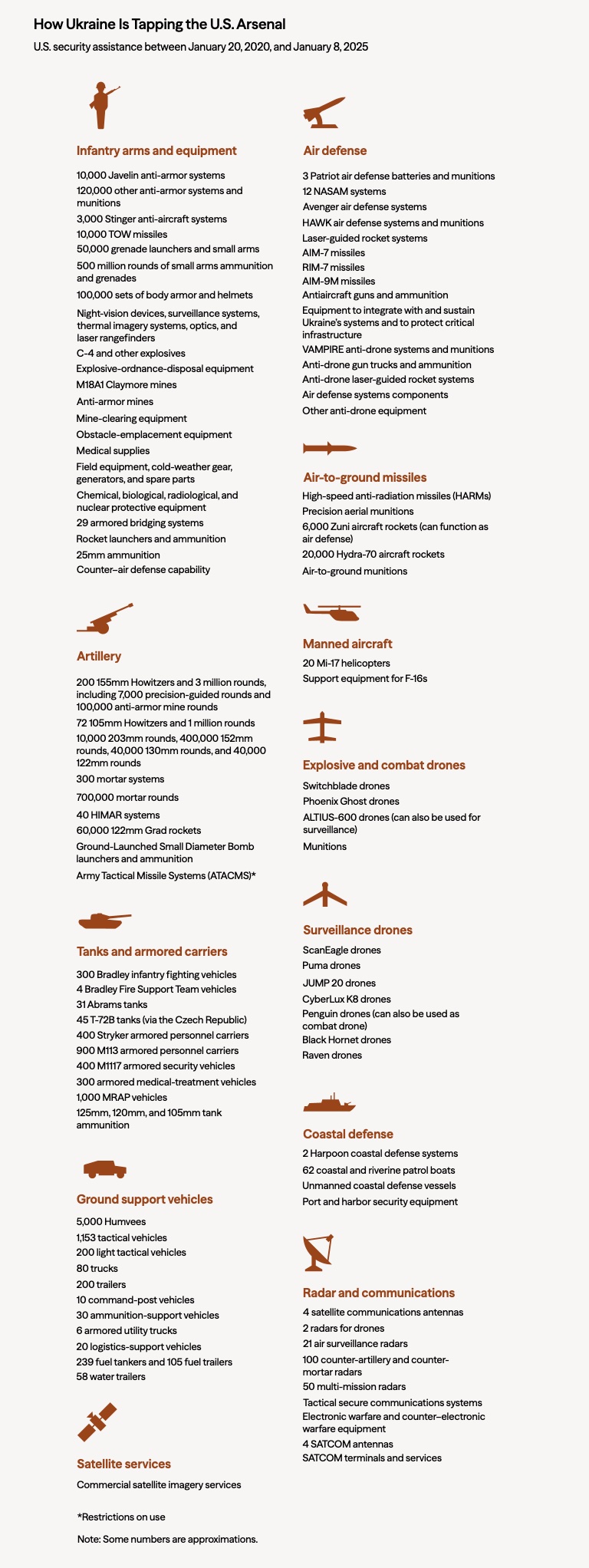
Source: Jonathan Masters and Will Merrow, “Here’s How Much Aid the United States Has Sent Ukraine,” Council on Foreign Relations, 23 February 2026.
Other NATO nations have also sent significant aid to Ukraine. Turkey, for example, provided Baykar Bayraktar TB2 drones to Ukraine, which were crucial in Ukraine’s initial counterstrikes against Russian forces. This material aid gave Ukraine physical means to conduct and prevent strikes. The effectiveness of its HIMARS strikes was widely reported by U.S. media outlets. In terms of preventing Russian attacks, the number of portable air defenses that were given to Ukraine made deep low-altitude sorties dangerous enough for Russian planes and helicopters that they stopped attempting them.[35] This material aid allowed Ukraine to conduct highly successful strikes while assisting in limiting Russia’s abilities.
Without this support, Ukraine would have experienced several problems. First, it would have had significant trouble replacing domestic losses. Second, due to these domestic losses and lack of replacement, Ukraine’s strike capabilities would have become significantly degraded, leading the outcome of the war to have moved far more in favor of Russia.
The United States and NATO were therefore outside actors that initially acted as centers of gravity by providing critical requirements to Ukraine. Though not through direct intervention, this still fits within the framework described in this article for an outside center of gravity. Initially, the Ukrainian government could not achieve its war aims on its own and needed support, fulfilling the first requirement. Second, while possessing a physical force capable of resistance, Ukraine could not deal decisive blows. Third, had the United States and NATO ceased support at the outset of the conflict, Ukraine would have collapsed under the weight of the Russian assault. Outside support was the crucial and initial center of gravity. After this support was received and integrated into the Ukrainian armed forces, the center of gravity shifted back to Ukraine. Ukrainian president Volodymyr Zelenskyy has emphasized the importance of outside support from the United States. Following the U.S. presidential election in 2024, he stated his belief that Ukraine would lose the war in the event of aid suspension.[36] While that statement may not have reflected the reality at the time, it would certainly have been true in 2022, when Ukraine did not possess the necessary critical requirements and therefore did not have the capabilities needed to achieve its objective.
Conclusion
Since World War II, the United States has served as the center of gravity for many of its allies. Many of its foes likewise derived strength from an outside actor that served as their center of gravity. Accurate center of gravity analysis is therefore critical for strategic planning. When considering an ally, the United States must weigh the following: first, whether the United States is its ally’s center of gravity, using the framework provided in this article; second, if the United States is that ally’s center of gravity, whether that arrangement is sustainable in the long term; and third, if the United States is that ally’s center of gravity and that arrangement is not sustainable in the long term, how the war or conflict can be concluded or the center of gravity effectively transitioned back to the ally. When the United States manages this successfully, as done with the United Kingdom, South Korea, and, so far, Ukraine, the United States gains a long-term ally, projects influence, and protects its interests and its ally’s sovereignty.
Endnotes
[1] Joint Planning, Joint Publication 5-0 (Washington, DC: Joint Chiefs of Staff, 2020), GL-5.
[2] Carl von Clausewitz, On War, ed. and trans. Michael Howard and Peter Paret (Princeton, NJ: Princeton University Press, 1984), 485.
[3] Clausewitz, On War, 597.
[4] Clausewitz, On War, 597.
[5] Peter Green, Alexander to Actium: The Historical Evolution of the Hellenistic Age (Berkley: University of California Press, 1990), 230–31.
[6] Plutarch, Lives, vol. 9, Demetrius and Antony, Pyrrhus and Gaius Marius, trans. Bernadotte Perrin (Cambridge, MA: Harvard University Press, 1920), 419.
[7] Plutarch, Demetrius and Antony, Pyrrhus and Gaius Marius, 425.
[8] Dionysius of Halicarnassus, Roman Antiquities, vol. 7, trans. Earnest Cay (Cambridge, MA: Harvard University Press, 1950), 417.
[9] Dio Cassius, Roman History, vol. 10, trans. Earnest Cary (Cambridge, MA: Harvard University Press, 1914), 369.
[10] Alexander Ivanovich Mikhailovsky-Danilevsky, 1806–1807: Tsar Alexander’s Second War with Napoleon: The Russian Official History, trans. Peter Phillips (Warwick, UK: Helion, 2023), 28.
[11] Carl von Clausewitz, Excerpts from Notes on Prussia in Her Grand Catastrophe of 1806, trans. Col Conrad H. Lanza, USA (Fort Leavenworth, KS: General Service Schools Press, 1922), 603.
[12] Mikhailovsky-Danilevsky, 1806–1807, 114.
[13] Mikhailovsky-Danilevsky, 1806–1807, 160.
[14] Mikhailovsky-Danilevsky, 1806–1807, 201.
[15] Thomas A. Hughes, “Battle of the Atlantic,” Encyclopaedia Britannica, 13 June 2026.
[16] Franz Halder, Halder War Diary, 1939–1942, ed. Charles Burton Burdick and Hans Adolf Jacobsen (Novato, CA: Presidio Press, 1988), 400.
[17] Grigore Gafencu, Prelude to the Russian Campaign, from the Moscow Pact (August 21st, 1939) to the Opening of Hostilities in Russia (June 22nd, 1941), trans. Edgar Fletcher-Allen (London: Frederick Muller, 1945), 314.
[18] “Der Führer an das deutsche Volk 22. Juni 1941” [The Führer to the German People, June 22, 1941], in Der großdeutsche Freiheitskampf. Reden Adolf Hitlers [The Greater German Struggle for Freedom: Speeches by Adolf Hitler], ed. Philipp Bouhler, vol. 3 (Munich: Franz Eher, 1942), 51–61.
[19] An Act to Promote the Defense of the United States, Pub. L. 77–11, 55 Stat. 31 (1941), a.k.a. the Lend-Lease Act.
[20] Gerhard L. Weinberg, A World at Arms: A Global History of World War II (New York: Cambridge University Press, 1994), 241–43, https://doi.org/10.1017/CBO9780511818639.
[21] Halder, Halder War Diary, 412–26.
[22] Halder, Halder War Diary, 345.
[23] David M. Glantz and Jonathan M. House, The Battle of Kursk (Lawrence: University Press of Kansas, 1999), 278.
[24] “Resolute Support Mission in Afghanistan,” North Atlantic Treaty Organization, accessed 26 March 2020.
[25] Robert S. McNamara, In Retrospect: The Tragedy and Lessons of Vietnam (New York: Vintage Books, 1996), 244.
[26] Agreement on Ending the War and Restoring Peace in Viet-Nam, signed January 27, 1973, United States, Democratic Republic of Viet-Nam, Republic of Viet-Nam, and Provisional Revolutionary Government of the Republic of South Viet-Nam, United Nations Treaty Series, vol. 935, no. I-13295.
[27] “Obama Pays Tribute to Troops Who Served in Iraq,” Voice of America, 14 December 2011.
[28] Jonathan Schroden, “Afghanistan’s Security Forces Versus the Taliban: A Net Assessment,” CTC Sentinel 14, no.1 (January 2021): 20.
[29] “Agreement for Bringing Peace to Afghanistan between the Islamic Emirate of Afghanistan which Is Not Recognized by the United States as a State and Is Known as the Taliban and the United States of America,” U.S. Department of State, 29 February 2020.
[30] Collapse of the Afghan National Defense and Security Forces: An Assessment of the Factors that Led to Its Demise, SIGAR 22-22-IP Evaluation Report (Washington, DC: Office of the Special Inspector General for Afghanistan Reconstruction, 2022) 6.
[31] Ken Dilanian et al., “U.S. Intel Helped Ukraine Protect Air Defenses, Shoot down Russian Plane Carrying Hundreds of Troops,” NBC News, 26 April 2022.
[32] Julian E. Barnes, Helene Cooper and Eric Schmitt, “U.S. Intelligence Is Helping Ukraine Kill Russian Generals, Officials Say,” New York Times, 5 May 2022.
[33] Ukraine Democracy Defense Lend-Lease Act of 2022, Pub. L. 117–118, 136 Stat. 1184 (2022).
[34] Jonathan Masters and Will Merrow, “Here’s How Much Aid the United States Has Sent Ukraine,” Council on Foreign Relations, 23 February 2026.
[35] Justin Bronk, Nick Reynolds, and Jack Watling, The Russian Air War and Ukrainian Requirements for Air Defence (London: Royal United Services Institute for Defence and Security Studies, 2022), 24.
[36] Gabriela Pomeroy, “Zelensky Says Ukraine Will Lose War if U.S. Cuts Funding,” BBC, 20 November 2024.