Expeditions with MCUP
Floating Red Crosses
An Exploration into the Global Hospital Ship Ecosystem Using Open-Source Data
Jonathan Robinson
11 March 2026
https://doi.org/10.36304/ExpwMCUP.2026.03
PRINTER FRIENDLY PDF
EPUB
AUDIOBOOK
APPENDIX TABLE
Abstract: This article explores the substantial and growing ecosystem of 138 oceangoing and riverine hospital ships that are currently in use around the world today from open sources. Providing a data-driven baseline about the extent of this ecosystem, five key trends emerge: that most active vessels are found in Asia and South America; that most active vessels operate in a single context, while a small number conduct multinational maritime health engagement; that most active vessels operate on rivers or inland waterways; that most active vessels are operated by nonstate entities; and that most active vessels have been developed in the past 25 years.
Keywords: hospital ships, medical ships, floating hospital, maritime health engagement, maritime medical diplomacy, soft power, humanitarian response, Peace Ark, USNS Mercy, USNS Comfort
Introduction
In May 2025, news broke that the People’s Republic of China (PRC) People’s Liberation Army Navy’s (PLAN) third Type 920 hospital ship, Auspicious Ark, had conducted its first official exercise in the Yellow Sea.[1] This vessel comes 15 years after its first sister ship, Peace Ark, conducted its first maritime global health engagement mission in 2010 and a year after its second sister ship, Silk Road Ark, completed its first named mission to PLA positions in the South China Sea in the summer of 2024.[2] This ship now brings the number of hospital ships currently in use by the PLAN to 12 vessels, far exceeding the U.S. Navy’s 2 aging hospital ships commissioned in the mid-1980s, USNS Mercy (T-AH 19) and USNS Comfort (T-AH 20), and the 3 Bethesda-class expeditionary medical ships currently under development.[3]
Much of the recent discourse around hospital ships has focused on the United States’ and PRC’s hospital ships, especially their capacity for supporting military personnel in war, how they have been used to respond to crises, or how effective their global maritime health engagement has been.[4] However, these discussions often overshadow the wider context of a substantial and growing ecosystem of hospital ships in use around the world today in addition to those of the United States and the PRC. This study attempts to address this gap by using publicly available information to provide a data-driven baseline about the extent of state-run and non-governmental organization (NGO)-operated hospital ships currently in use today.
From these open sources, this study found 138 vessels that were active as hospital ships around the world at the time of writing. From this data, five key trends could be identified:
- Most currently active hospital ships in the world are found in Asia and South America.
- Most currently active hospital ships in the world operate in a single context, but a small number conduct multinational maritime health engagement.
- Most currently active hospital ships in the world are riverine vessels.
- Most currently active hospital ships in the world are operated by nonstate entities.
- Most currently active hospital ships in the world have been developed in the past 25 years.
With at least 14 hospital ships under development or in a conceptual phase found during the study, this extensive ecosystem shows no sign of slowing in the near future.
Such an ecosystem continues to raise important questions about the complexity of the future maritime medical operating environment during peacetime and as the world enters an era of strategic competition. Therefore, this article hopes to be of use to both military and civilian medical professionals as well as academics who seek a better knowledge about the current extent of maritime medical platforms present in the world today. To start, this article will outline what hospital ships are before introducing the method used to collect information during this study and then presenting the findings based on the data.
What Are Hospital Ships?
Before this article progresses, it is important to define what hospital ships are, as they occupy a specific legal space compared to other types of warships that have medical capabilities onboard. In peacetime, hospital ships can be defined as any vessel being operated as such as long as its operating entity is in line with relevant peacetime maritime laws and conventions. However, during conflict, there are specific parameters outlined in international law that govern what military and civilian ambulance, hospital, medical, or medical transport ships should look like and how they should operate. This includes declared neutral parties as well as belligerents. These parameters that govern these types of vessels, which will be summarized as hospital ships for the purposes of simplicity for this article, can be summarized as follows:
- All ship exterior surfaces are painted white, with one or more dark red crosses displayed on the sides and horizontal surfaces, and a white flag with a red cross flown at the mainmast.
- The ship is specifically and solely used to assist the wounded, sick, and shipwrecked regardless of nationality.
- The ship may not be used to commit acts harmful to the enemy for the duration of hostilities, even if they cease to be used as hospital ships.
- The ship’s religious, medical, and hospital personnel and their crew shall be respected and protected. They may not be attacked or captured, except under extremely strict conditions.
- The ship’s name and description are notified to all parties to a conflict at least 10 days before they are deployed.[5]
These parameters were first developed in the First Hague Peace Conference of 1899, before being further elaborated in the Hague Convention on Hospital Ships in 1904 and the 10th convention of the Second Hague Peace Conference in 1907.[6] By the Second Geneva Convention of 1949, its additional protocols of 1977, and further iterations of these conventions in the San Remo Manual on International Law Applicable to Armed Conflicts at Sea of 1994, the rules defining and governing what hospital ships are and how they should be used in wartime were codified by almost every nation on earth.[7] However, multiple vessels outlined in this report would not currently conform to these parameters if a conflict were to break out.
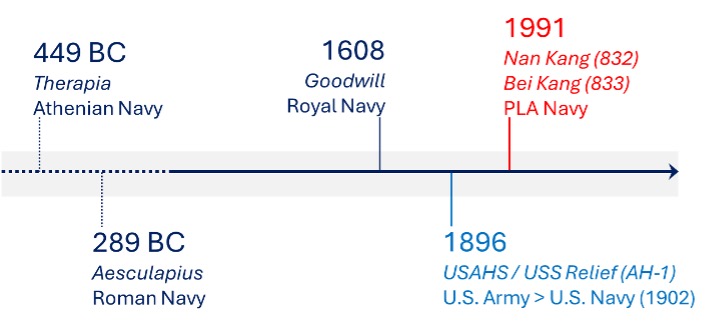
Away from these legal developments, the use of hospital ships has a long history. Records dating back to the Athenian and Roman periods detail the ships Therapia and Aesculapius being used as hospital ships in the third and fourth century BCE.[8] In more recent times, hospital ships were put into service by the English Royal Navy in the seventeenth century with HMS Goodwill in 1608, while in the mid-1800s, USS Red Rover (1859) was used as a medical ship by Union forces during the American Civil War.[9] However, it was not until 1896 that the United States first developed a dedicated hospital ship, the U.S. Army hospital ship (USAHS) Relief, which was soon transferred to the U.S. Navy as USS Relief in 1902.[10] By comparison, the PRC developed its first-ever hospital ships in 1991—Nan Kang (832) and Bei Kang (833)—almost 80 years after the United States did.[11]
Figure 1. Timeline of key dates in the development of hospital ships in history
Source: courtesy of the author.
The Method Used in This Study
The following section will describe the three-step systematic method that was developed for this study to support the gathering of information using publicly available sources about hospital ships currently in use in the world today. The first data collection step was to use The Military Balance 2025 to provide a baseline guide about which countries in the world officially operate hospital ships.[12] Using this credible and authoritative report, a total of 33 vessels currently operated by 10 countries’ armed forces were recorded (table 1). No hospital ships from NGOs were listed.
Table 1. Hospital ships listed in The Military Balance 2025
|
Number of vessels found
|
Number of countries associated with operating hospital ships
|
Specific details
|
|
33 vessels
|
10 countries
|
Bolivia (2 vessels), Brazil (5), Burma (1), Indonesia (4), Peru (5), PRC (9), Russia (3), United Kingdom (1), United States (2), and Vietnam (1)
|
Source: courtesy of the author.
The second data collection step was to conduct a broad unstructured English-language search of online secondary sources for information on hospital ships in use in various countries around the world. To help with systematizing this search, the keyword “hospital ship” was combined with each of the 195 officially recognized countries in the world (e.g., “hospital ship Bolivia”) and inputted into the internet search engine Google.[13] The results that came up were then investigated for references to hospital ships and information about each vessel recorded. Due to time constraints, only records from the first two pages of each Google search were included in this study. The search was conducted between October 2024 and 1 March 2025 from a U.S. location. This step of the method resulted in discovering 173 vessels operated by 70 entities (table 2).
Table 2. Hospital ships found during Google search, 2024–25
|
Number of vessels found
|
Number of countries associated with operating a hospital ship
|
Number of NGOs associated with operating a hospital ship
|
Specific details
|
|
173
|
20
|
40
|
Countries: Bolivia (2 vessels), Brazil (11), Burma (3), Chile (1), India (1), Indonesia (4), Japan (1), Nigeria (1), Peru (14), Philippines (2), Portugal (1), PRC (15), Russia (5), South Korea (6), Spain (2), United Arab Emirates (1), United Kingdom (1), United States (5), Venezuela (1), Vietnam (1).
NGOs: Amazon Medical Ministries (1), Aresa Shipyard (2), Beijing Pinglan Public Welfare Foundation (1), Center for Northeast Studies and Policy (C-NES) (15), Central Brazil Mission (2), DoctorShare NGO (4), Elpis Hospital Ship Association (1), Friendship NGO (8), FXB Myanmar (2), Grandi Navi Veloci (1), Hope for Brazil (1), Impact Foundation (1), Irrawaddy River Doctors (2), Italo-Colombian Foundation of Mount Tabor (1), Karuna Trust (1), Lake Tanganyika Floating Health Clinic (1), Marine Reach Global (1), Medical Ministry International (1), Mercy Ships (5), Mision a Bordo (1), Mission Ship (1), Order of Friars Minor (OFM) Fraternitas Foundation (3), Pacific Reach (3), Pan Entertainment Production Company (1), Peace Winds Japan (2), Project Amanas (1), Rotary Club Egypt (1), Samaritan’s Purse (1), Seacoast Mission (2), Smile Foundation India (1), Sociedade Biblica Do Brazil (3), Southern Health Improvement Samity (SHIS) Foundation (4), St Francis Leprosy Guild (1), United Methodist Church (1), University of Western Para State (1), Vine Trust (4), World Vision International (1), Worldwide Hospitals (2), Yayasan Mega Gotong Royong (1), Youth With a Mission (9).
|
Source: courtesy of the author.
The third step of the method was to corroborate the identified information and to categorize the information for inclusion in the study. This was completed in two stages. If information about a hospital ship was found in both step one and step two, it was included in the study as an active vessel without further investigation, as the information was deemed to have been corroborated, current, and unlikely to have been fabricated given its inclusion in a definitive source, The Military Balance 2025.
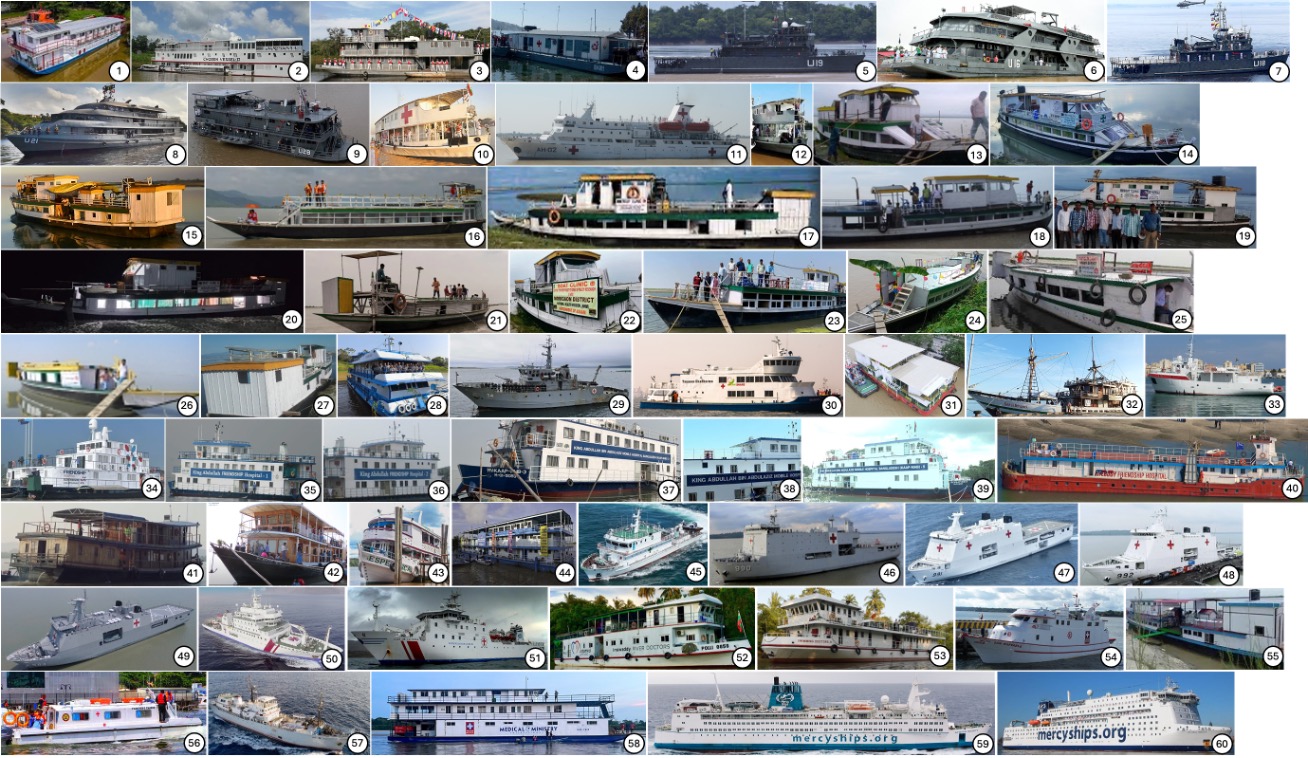
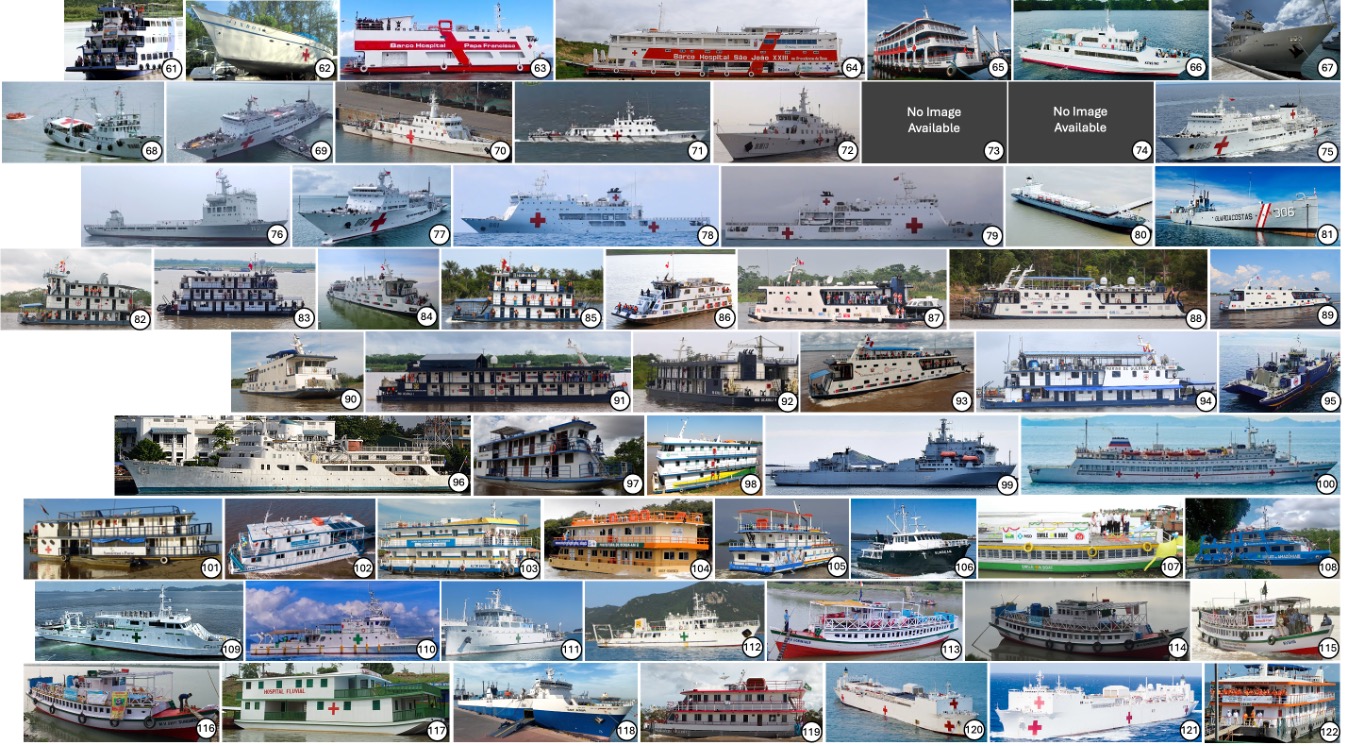
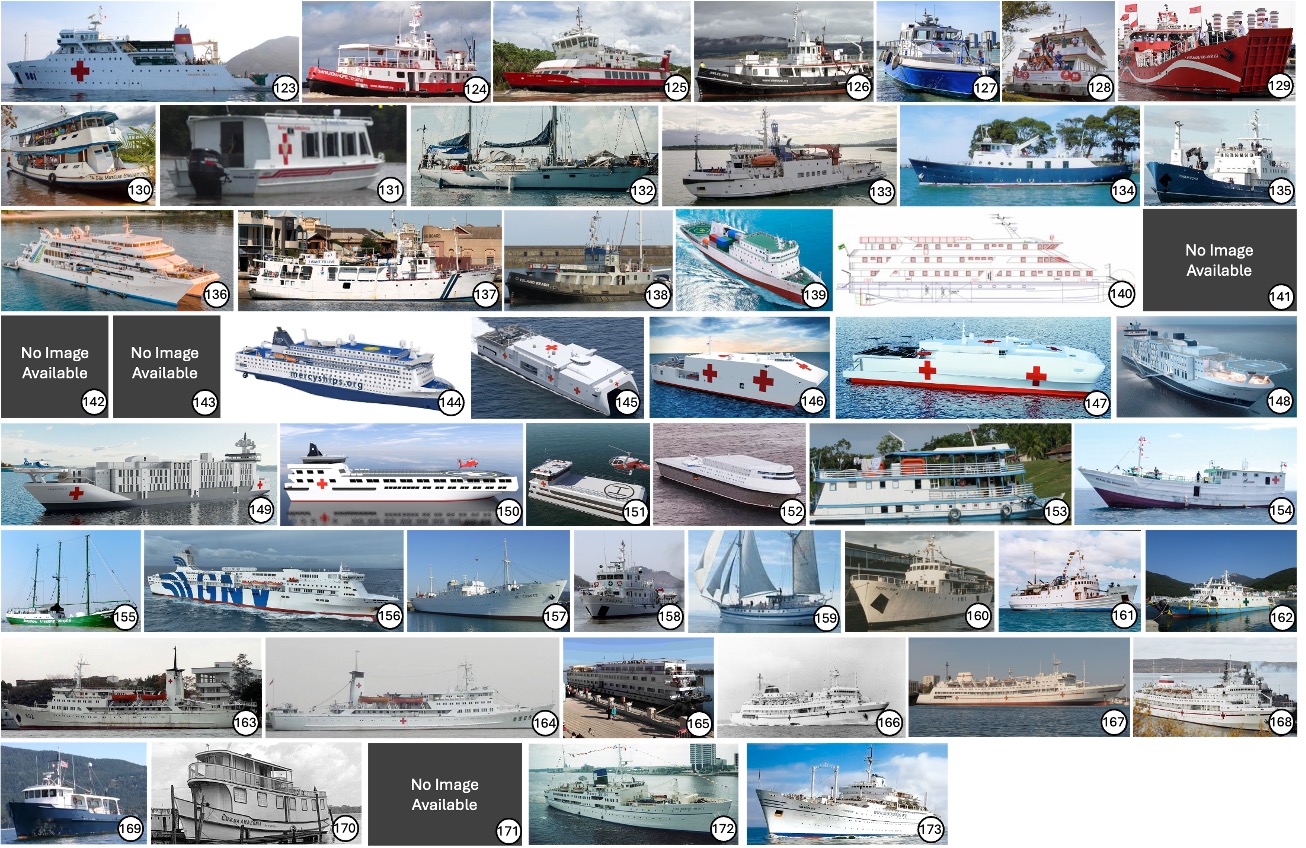
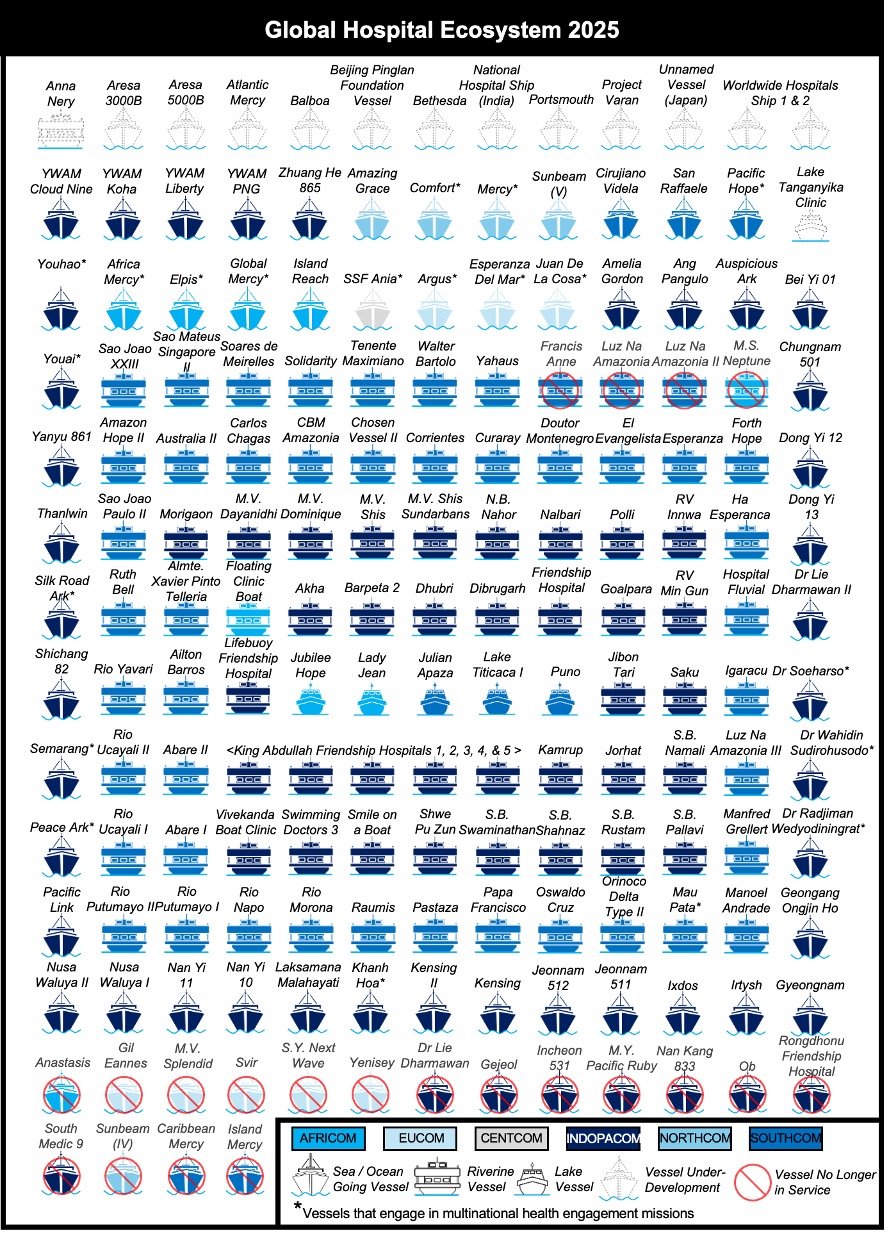
If information on a vessel was found in step two only, a second stage would find additional credible sources detailing whether the vessel was active either from primary sources (i.e., entities that operated the vessel, such as the website of a country’s navy or an NGO) or multiple credible secondary sources about the vessel. As a result of this stage, the 173 vessels that were found from step two were categorized at the time of writing as follows: 138 vessels were active; 21 vessels were no longer in use; and 14 vessels were under development or in a conceptual phase. These vessels, which are depicted in figure 2, correspond with information in table 3, which can be found in the appendix of this article.
Figure 2. Depictions of hospital ships found in this study
Source: courtesy of the author.
Limitations of the Method
It is recognized that this study’s method and findings have limitations. The author acknowledges that significant bias is present when using open sources, such as what information is presented from search engine optimization algorithms or what information an entity wants to present publicly. The location of where the search took place (i.e., a U.S.-based internet search) could also affect what information is found, and additional searches from other locations around the world may result in slightly different findings.
The author recognizes that using English-language searches for vessels and only employing one keyword can also affect what could be found for this study. This study did not try to limit the number of vessels that were found based on a strict naming convention (i.e., only vessels described as a “hospital ship”). Given that in peacetime, hospital ships can be defined as being operated by how an entity sees fit, any medical- or health-focused vessel that was found from the open-source search from the keyword “hospital ship [+ country]” was included regardless of its name or size. As a result, the study found vessels that were described or named 33 different ways and included a range of vessels as small as 52 feet to as large as 894 feet.[14] That said, it is the hope of the author that in the future this study could be improved by using different languages and additional keywords, such as the 33 different ways hospital ships were referred to, to find additional information about hospital ships. This research was always designed to be an initial attempt at mapping hospital ships in use around the world today.
This study also only looked at hospital ships that were defined as primarily or solely being used for medical use. This study did not include dual-use ships that have a primary military role but also have the ability to be converted for use in a secondary medical role.[15] Recent examples of such ships include the French Navy’s landing helicopter deck Dixmude (L9015) and the Italian Navy’s logistic support ship Vulcano (A5335), both of which were converted from their routine military roles to be used as temporary hospitals during the Israel–Gaza conflict in 2023–24.[16] While these vessels can provide an important medical capability in times of war and peace, the investment in such dual-use ships is not primarily for health purposes and so if included in this study they could potentially skew the results. The topic of dual-use vessels and how they augment the existing hospital ship ecosystem or conduct global health engagement missions such as the U.S. Navy’s annual Pacific Partnership deployment could be the focus of a future study.
Finally, this study did not attempt to compare or contrast the medical capabilities of each vessel, as the author is not a military medical specialist. Instead, this study aims to provide a roadmap for readers to understand the context of the current hospital ship ecosystem and identify areas for further investigation. As no study is locked in time, it should be updated in the future to ensure the continued validity of the findings or develop new insights.
Despite the abovementioned limitations, the data produced by this study could still be considered useful because it provides a window into the modern global ecosystem of dedicated hospital ships that are solely or primarily used for medical purposes around the world today.
Trends from the Data
From the collected data, five trends become apparent:
- Most currently active hospital ships in the world are found in Asia and South America.
- Most currently active hospital ships in the world operate in a single context, but a small number conduct multinational maritime health engagement.
- Most currently active hospital ships in the world are riverine vessels.
- Most currently active hospital ships in the world are operated by nonstate entities.
- Most currently active hospital ships in the world have been developed in the past 25 years.
Each of these trends will now be expanded below.
Most Currently Active Hospital Ships in the World Are Found in Asia and South America
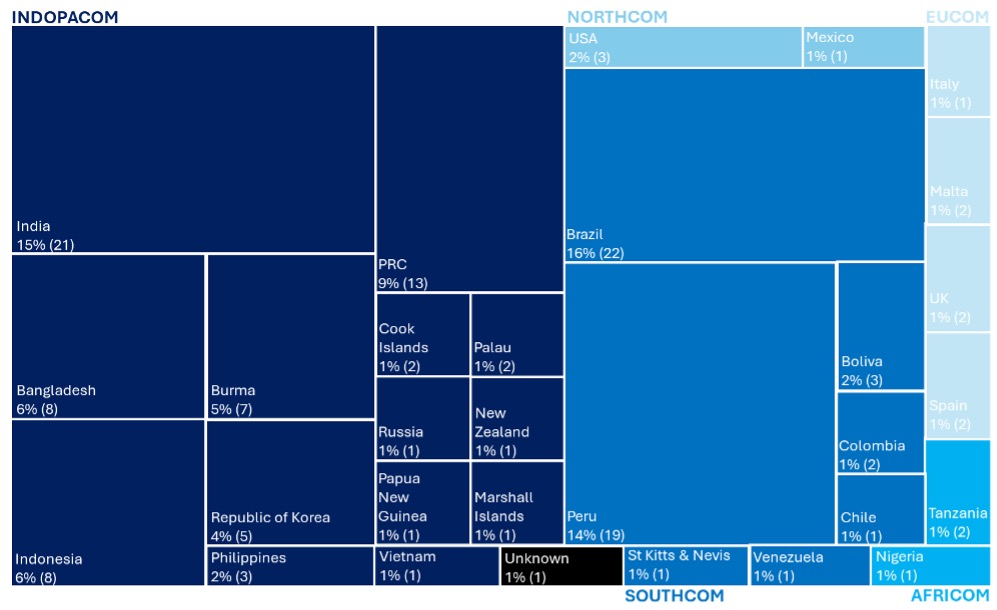
When exploring the data, notable patterns emerge of where hospital ships are in the world. Of the 138 active vessels found for the study, 88 percent (121) operate in the U.S. Indo-Pacific Command (INDOPACOM) (71) or U.S. Southern Command (SOUTHCOM) (40) areas of responsibility. The remaining 12 percent (17) operate in the U.S. Africa Command (AFRICOM) (7), U.S. Europe Command (EUCOM) (2), and U.S. Northern Command (NORTHCOM) (2), or they operate across multiple combatant commands (CCMD) (6).
Exploring this breakdown in more detail, 54 percent (75) of the active hospital ships found for this study operate in just four countries; Brazil, India, Peru, and the PRC. Brazil is the country where the largest number of hospital vessels are flagged and operate, with 22 state and nonstate riverine vessels conducting medical support along tributaries of the Amazon. With the Brazilian Navy developing another vessel—FPSO Anna Nery—this number is likely to increase in the future.[17]
India has 21 flagged nonstate medical clinic boats that operate along rivers and estuaries in the country since 1997, when the Southern Health Improvement Samity’s M. V. Dominique was first put into service. The Indian Navy is also developing an unnamed national hospital ship that would represent the first state-run oceangoing hospital ship in the country.
Peru has 17 flagged state and nonstate medical vessels operating on inland waters in the country, including the Peruvian Coast Guard’s BAP Puno (ABH 306), the oldest functional hospital ship in the world (dating from 1872) that operates on Lake Titicaca.[18]
Finally, the PRC operates 13 medical vessels, 12 operated by the PLAN and one likely operated by the People’s Armed Force Maritime Militia, Yanyu 861. A further unnamed medical rescue ship is being developed by the Beijing Pinglan Public Welfare Foundation, which would be the first NGO vessel operated by the PRC.[19]
A further 20 percent (28) of active vessels found in the study operate or are flagged in four other countries—Bangladesh (8), Indonesia (8), Burma (7), and South Korea (5)—while the remaining 26 percent are flagged to 21 other countries (35) or could not be identified (1). For a summary of the above, see figure 3.
Figure 3. Breakdown of active hospital ships by CCMD based on flag of the vessel
Source: courtesy of the author.
Most Currently Active Hospital Ships in the World Operate in a Single Context, but a Small Number Conduct Multinational Maritime Health Engagement
When exploring the 138 active hospital ships found for this study, the vast majority appear to operate in a single context, with 86 percent (118) routinely focused on serving domestic populations within a specific country. This includes 69 vessels that are run by NGOs and 49 vessels that are state-run, the latter of whose use of medical and social service programs is aimed at reenforcing state authority in remote communities. Examples of these types of vessels include the Brazilian Navy’s five hospital assistance ships (NAsH), the Chilean Navy’s dental medical patrol boat Cirujano Videla (PMD 74), the Peruvian Navy’s 13 itinerant social action platform (PIAS) vessels, and South Korea’s five hospital ships run by four civilian municipal governments.
The remaining 14 percent (20) conducted maritime health engagement across multiple countries in the world. Of these, 16 vessels are state-operated by the Indonesian Navy (4), the PLAN (4), the Spanish Social Institute of the Navy (2), the U.S. Navy (2), the Vietnam People’s Navy (2), the United Arab Emirates’ (UAE) Ministry of Health and Prevention (1), and the British Royal Navy (1). The five remaining vessels are run by five NGOs; the oceangoing Global Mercy and Africa Mercy, operated by Mercy Ships in West and South Africa; the oceangoing Elpis, operated by the Elpis Hospital Ship Association in the Mediterranean, Gambia, and Madagascar; the riverine vessel Mau Pata, operated by the Medical Ministry International between Colombia, Peru, and Brazil; and the Pacific Hope, an oceangoing vessel based in Mexico that has conducted health missions to the Caribbean with Marine Reach Global.
Exploring the state-run vessels that conduct multinational maritime health engagement missions in more detail, a relative newcomer to conducting health missions across multiple countries in the world is the Indonesian Navy, whose four vessels—KRI dr. Soeharso (990), KRI dr. Wahidin Sudirohusodo (991), KRI dr. Radjiman Wedyodiningrat (992), and KRI Semarang (594)—have conducted overseas medical missions to Egypt, Timor Leste, Singapore, Fiji, Papua New Guinea, the Solomon Islands, and Vanuatu in recent years.[20]
The PLAN’s most high-profile hospital ship, Peace Ark, has conducted 10 maritime global health engagement missions around the world since 2010. Through the so-called “Harmonious Missions” and a disaster response to the Philippines in 2013, the vessel has steadily increased its port visits to countries on six of the world’s seven continents in the past 15 years.[21] Three other PLAN hospital ships—Silk Road Ark, You’ai (861), and Youhao (862)—have conducted health engagements closer to home for PLA personnel on the disputed Spratly and Paracel (Nasha and Xisha) islands in the South China Sea.[22]
Spain’s Social Institute of the Navy operates two medical ships on behalf of the country’s Ministry of Inclusion, Social Security, and Migration since the early 2000s. The ships Esperanza Del Mar and Juan De La Cosa are designed to support Spain’s industrial fishing fleets around the Azores, the Canary Islands, and Saharan and Mauritian fishing grounds, as well as the northern Atlantic Ocean.
Another newcomer to multinational maritime health engagement, the UAE converted the roll-on/roll-off container ship SSF Ania for use as a hospital ship during the country’s response to treat civilian casualties of the Israel–Gaza conflict in 2024.[23]
The Royal Navy has operated the Royal Fleet Auxiliary (RFA) Argus (A135) as its primary casualty receiving ship since 1982, when it was deployed during the Falklands War. Since this time, the vessel has supported British military operations in the Middle East, the Adriatic Sea, and Sierra Leone, as well as disaster response operations in the Caribbean and West Africa.[24]
The U.S Navy’s two hospital ships—Mercy and Comfort—have conducted disaster response missions since they were put into service in the mid-1980s.[25] In addition, they have conducted near-annual Continuing Promise and Pacific Partnership global health engagement missions in the SOUTHCOM and INDOPACIFIC areas since 2000.[26]
Finally, similarly to the PLAN’s use of some of its hospital ships, the Vietnam People’s Navy hospital ship Khanh Hoa 01 largely operates in the South China Sea, supporting troops and fishing fleets in the disputed Spratly (Truong Sa) Islands.[27] The vessel also took part in maritime exercises in Indonesia in 2016.[28] For a summary of the above, see figure 4.
Figure 4. Depiction of where state- and NGO-run hospital ships operate in the world
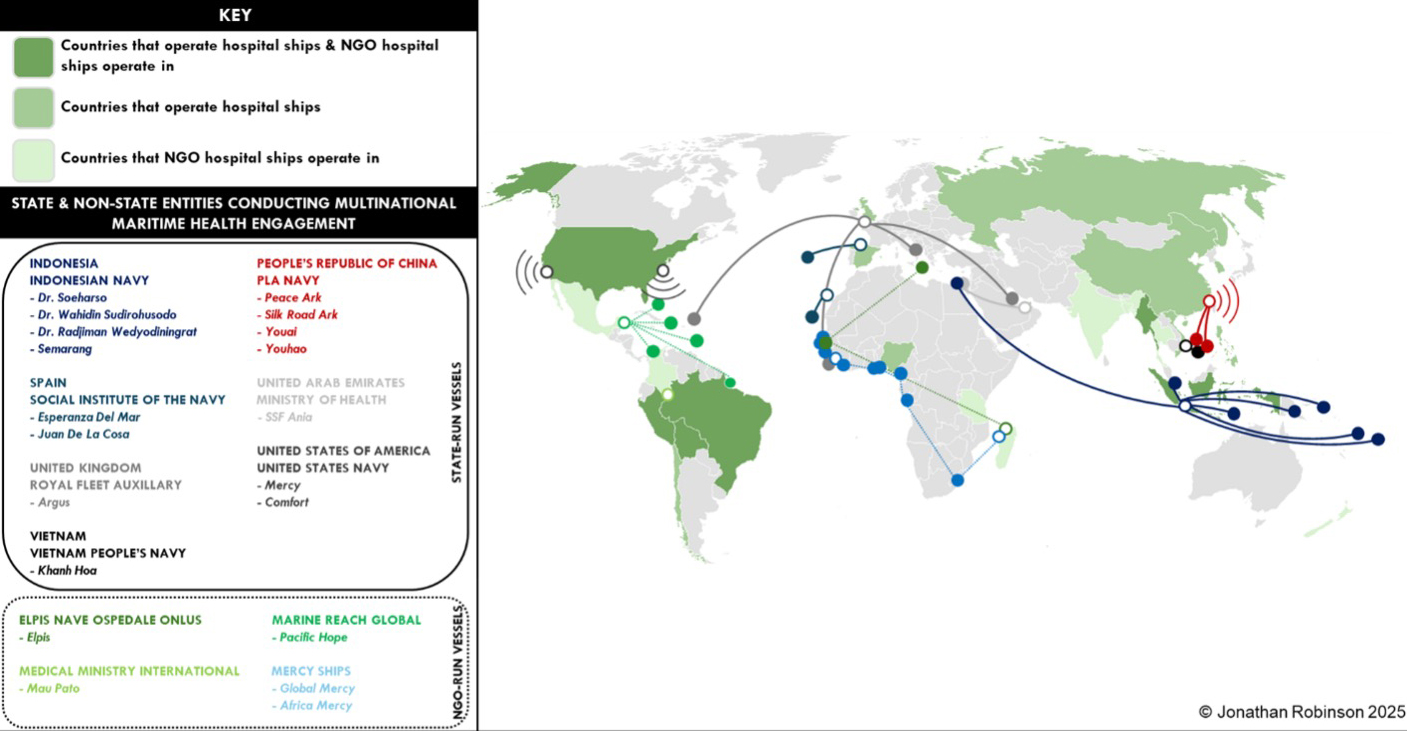
This map also includes entities that conduct multinational maritime health engagement. Note: not all U.S Navy and PLAN maritime global health engagements are shown on the map due to the volume of visits around the world.
Source: courtesy of the author.
Most Currently Active Hospital Ships in the World Are Riverine Vessels
Of the 138 active vessels found for this study, 57 percent (79) were riverine-based hospital ships. A further 39 percent (54) routinely operated at sea, both in territorial waters and across open ocean, while 4 percent (5) operated on two of the world’s largest lakes: Lake Titicaca in South America (3) and Lake Victoria in East Africa (2). Even when looking at the 14 vessels under development or in the conceptual phase for the future, 12 of which will be seagoing or oceangoing vessels, this trend is unlikely to reverse soon. A further two vessels currently under development will operate on inland waterways in Brazil and Lake Tanganyika in East Africa.
Fifty-four percent of the 79 riverine hospital ships are flagged and operate in the SOUTHCOM area (43), while the remaining 46 percent are found in the INDOPACOM (35) and AFRICOM (1) areas. No active riverine vessels were found in the EUCOM, NORTHCOM, or U.S. Central Command (CENTCOM) areas. When exploring the 54 seagoing or oceangoing vessels, this trend is reversed, with 67 percent (36) of vessels flagged and operating in the INDOPACIFIC area. A further 22 percent of seagoing vessels conduct operations in the AFRICOM (4), SOUTHCOM (4), EUCOM (2), and NORTHCOM (2) areas. The remaining 11 percent (6) operate across multiple CCMDs. For a depiction of the above, see figure 5.
Figure 5. Types of active and retired hospital ships found for this study, organized by CCMD
Source: courtesy of the author.
Most Currently Active Hospital Ships in the World Are Operated by Nonstate Entities
Fifty-four percent (74) of the 138 active vessels found for this study were operated by 32 civilian nonstate entities, while the remaining 46 percent (64) were operated by 25 civilian and military state entities. Looking at the future, this trend appears set to continue, as one-half of the 14 vessels currently under development or in a conceptual phase will likely be run by state entities and the other one-half operated by NGOs.
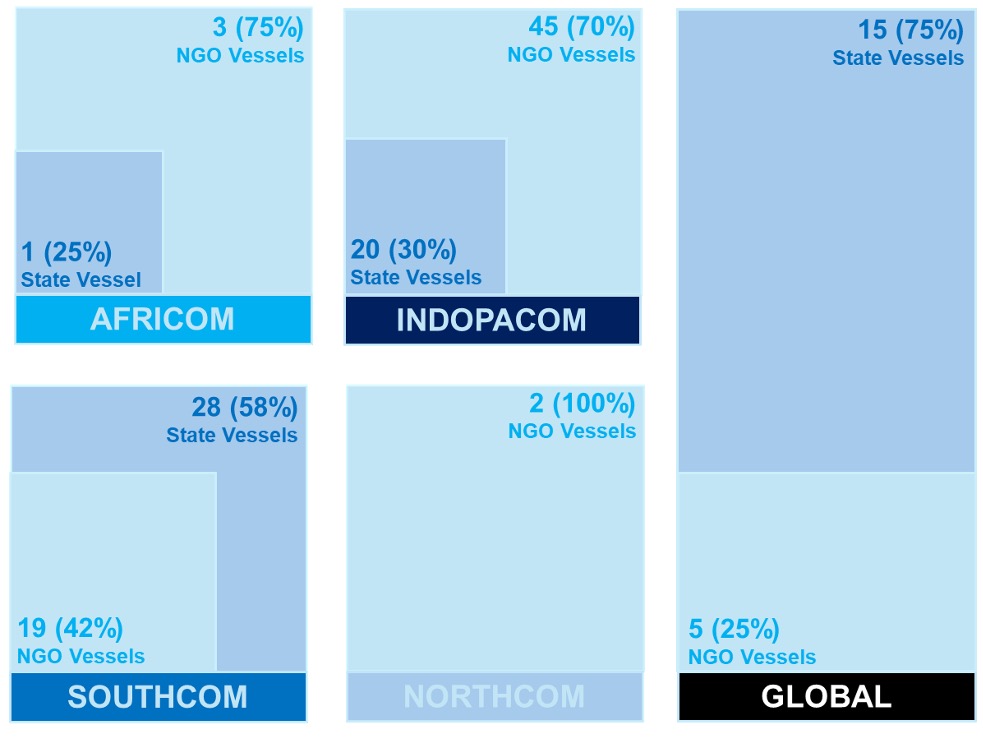
However, when exploring the vessels operating within the different CCMDs, more nuanced details emerge. Of the 65 hospital ships that currently operate in the INDOPACOM area, 70 percent (45) were run by NGOs, while just 30 percent (20) were run by state entities. A similar picture is seen in the AFRICOM and NORTHCOM areas, where five of the six vessels found were operated by NGOs.
In the SOUTHCOM area, this trend is reversed. There, 58 percent (28) of the 45 vessels were state-run, with the remaining 42 percent (19) run by NGOs. This is again mirrored with the 20 vessels that conduct multinational maritime health engagements across multiple countries, with 75 percent (15) of vessels operated by state actors. For a summary of the above, see figure 6.
Figure 6. State-run vs nonstate-run hospital ships in different CCMD areas
Source: courtesy of the author.
Most Currently Active Hospital Ships in the World Have Been Developed in the Past 25 Years
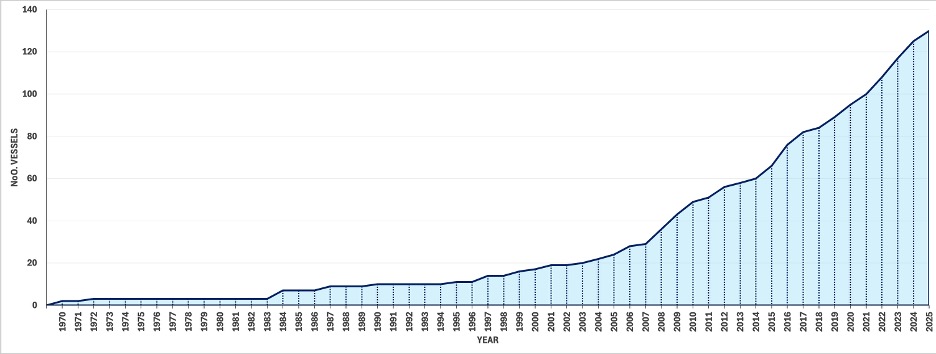
When considering the 130 of 138 active vessels found for this study whose date of commissioning could be identified, 88 percent (114) had been put into service since the year 2000 (figure 7). Even more stark a number, 32 percent (41) of these vessels were made operational in the past five years. These numbers highlight the relative youth of today’s hospital ship ecosystem.
When exploring trends between state- and nonstate-operated vessels, a similar pattern emerges. At least 84 percent (53) of the 63 state-run vessels found for this study whose date of commissioning could be identified were put into service since 2000. For the remaining 67 NGO-operated vessels whose date of commissioning could be identified, 91 percent (61) were put into service since 2000.
Looking at the different flags of vessels and their associated CCMD areas, further nuances emerge. In AFRICOM, two of the three vessels flagged were put into service after 2020, with a similar picture in EUCOM, where five of the seven vessels flagged were commissioned after 2000. In INDOPACOM, 63 of the 68 vessels flagged began operating since 2000, and 35 percent (24) of these since 2020. In SOUTHCOM, 42 of the 48 vessels flagged were put into service since 2000, with 29 percent (14) of these since 2020. Only vessels flagged to NORTHCOM went counter to this trend, with just one of the four vessels found for this study—Youth with a Mission’s Amazing Grace—beginning operations after 2000.
With the development of at least 14 hospital ships underway by state and nonstate entities—including new actors in the maritime medical sector such as India, which is developing a national hospital ship—the use of these specialized vessels for both domestic-focused social services and soft power aboard looks set to continue for the near term.[29]
Figure 7. Cumulative number of hospital ships commissioned since 1970
Source: courtesy of the author.
Conclusion
This article has attempted to provide an initial quantitative baseline about the extent of the world’s active hospital ships. It is an ecosystem that is perhaps larger than people realize, with at least 138 active vessels and 14 more ships under development or in a conceptual phase. This ecosystem has developed considerably in the past 25 years, is heavily active in Asia and South America, and is one that is predominantly riverine-based. It is also a system that this largely operated by nonstate actors and predominantly single-context focused, although a small number of actors conduct multinational maritime health engagements.
In peacetime, having a holistic understanding of this ecosystem could help those coordinating health engagement activities, both civilian and military, to prevent duplication of efforts, enhance existing programs, improve collaboration efforts, and reenforce maritime global health engagement. As the era of strategic and regional competition intensifies, analyzing how some actors use multinational maritime health engagement to project maritime soft power could reveal priorities for shaping influence in key regions before open conflict emerges. In warfare, understanding the extent of various state and nonstate maritime medical platforms in the world could help share the burden of medical needs between partners and allies, as well as for civilians that will inevitably be caught up in the fighting.
If a transition to conflict occurs, several hospital ships identified for this study, both military and civilian, would face challenges in complying with the proper identifications and/or protections governing hospital ships in the Second Geneva Convention and other customary international laws. For example, the Royal Navy’s RFA Argus, which is painted gray and not exclusively used for medical purposes, or Mercy Ship’s Global Mercy, which does not have any red cross markings displayed on its hull, may fall into these categories if conflict were to break out.
Taking a wider view, the large ecosystem of hospital ships operating in the world today raises questions about how much consideration is given to the capabilities of these vessels in scenario planning. For example, what efforts are being made to understand how coordination or interaction would work between military and civilian entities for maritime medical activities? How would these vessels be employed effectively to respond to survivors of convoy attacks that could involve large numbers of casualties, similar to what was seen in the Atlantic Ocean during World War II? How well understood are the legal parameters of what makes a hospital ship a protected vessel under the Second Geneva Convention by military and civilian decision makers at all levels and from all sides? Using hospital ships as a lens through which to explore wider questions related to the conduct of future warfare could help identify gaps in the knowledge of those planning for a challenging future and root solutions in a reality that considers any mariner, regardless of if they are military or civilian.
Appendix 1
Raw Data
The following table provides details about the vessels that were found for this study using open-source data. It lists information that includes each vessel’s name; its area of operation; its operating entity; its flag; its type; the type of cruise it is capable of; the year it was put into service; its length; its displacement; its speed; its full crew complement; the number of patient beds; its stated capabilities; and two sources of information about the vessel.
The table is organized by alphabetical order of the operating entity of the vessel. Acronyms have been used in the stated capabilities section of the table for the purpose of efficiency. These include the following:
CL clinical laboratory
D dentistry
EY ophthalmology
G gynecology
GE geriatrics
IC intensive care
P pharmacy
PE pediatrics
PH primary health care
R radiology
S surgery
SA social assistance
VI optometry
Table 3. List of hospital ships categorized after step three of the method
| NO. |
VESSEL NAME |
HULL NUMBER |
VESSEL FLAG |
OPERATING ENTITY |
OPERATING ENTITY TYPE |
AREA OF OPERATION |
COMBATANT COMMAND AREA OF RESPONSIBILITY |
TYPE OF VESSEL |
CRUISE TYPE |
VESSEL COMMISSIONED |
LENGTH (FEET) |
DISPLACEMENT (TONS) |
SPEED (KNOTS) |
RANGE (NAUTICAL MILES) |
NUMBER OF CREW |
PATIENT BEDS |
STATED CAPBILITIES |
| 1 |
Orinoco Delta Type II |
N/A |
Venezuala |
Amacuro Delta State Ministry Of Health |
State |
Venezuela |
SOUTHCOM |
Specialist River Clinic |
Riverine |
2022 |
N/A |
N/A |
N/A |
N/A |
N/A |
N/A |
PH |
| 2 |
Chosen Vessel II |
N/A |
Peru |
Amazon Medical Ministries |
Nonstate |
Peru |
SOUTHCOM |
Floating Hospital |
Riverine |
2012 |
N/A |
N/A |
N/A |
N/A |
N/A |
N/A |
PH |
| 3 |
Almte. Xavier Pinto Telleria |
BH-01 |
Bolivia |
Bolivian Navy |
State |
Bolivia |
SOUTHCOM |
Hospital Ship |
Riverine |
< 2010 |
N/A |
N/A |
N/A |
N/A |
72 |
N/A |
D, EY, G, PE, PH |
| 4 |
Julian Apaza |
BH-001 |
Bolivia |
Bolivian Navy |
State |
Bolivia |
SOUTHCOM |
Hospital Ship |
Lake |
1972 |
N/A |
N/A |
N/A |
N/A |
N/A |
N/A |
CL, D, P, PH, R, S |
| 5 |
Carlos Chagas |
U-19 |
Brazil |
Brazilian Navy |
State |
Brazil |
SOUTHCOM |
Infirmary Assistance Ship (NASH) |
Riverine |
1984 |
155 |
490 |
12 |
3,000 |
27 |
6 |
CL, D, P, PH, R, S |
| 6 |
Doutor Montenegro |
U-16 |
Brazil |
Brazilian Navy |
State |
Brazil |
SOUTHCOM |
Infirmary Assistance Ship (NASH) |
Riverine |
2000 |
138 |
347 |
10 |
3,200 |
60 |
6 |
CL, D, IC, P, PH, R, S |
| 7 |
Oswaldo Cruz |
U-18 |
Brazil |
Brazilian Navy |
State |
Brazil |
SOUTHCOM |
Infirmary Assistance Ship (NASH) |
Riverine |
1984 |
155 |
490 |
12 |
3,000 |
27 |
6 |
CL, D, P, PH, R, S |
| 8 |
Soares De Meirelles |
U-21 |
Brazil |
Brazilian Navy |
State |
Brazil |
SOUTHCOM |
Infirmary Assistance Ship (NASH) |
Riverine |
2010 |
207 |
1,338 |
12 |
6,000 |
47 |
6 |
CL, D, IC, P, PH, R, S |
| 9 |
Tenente Maximiano |
U-28 |
Brazil |
Brazilian Navy |
State |
Brazil |
SOUTHCOM |
Infirmary Assistance Ship (NASH) |
Riverine |
2009 |
102 |
160 |
12 |
1,100 |
23 |
3 |
CL, D, IC, P, PH, R, S |
| 10 |
Shwe Pu Zun |
N/A |
Burma |
Burmese Navy |
State |
Burma |
INDOPACOM |
River Hospital Ship |
Riverine |
2012 |
N/A |
N/A |
N/A |
N/A |
N/A |
N/A |
D, IC, PH, R, S |
| 11 |
Thanlwin |
AH-02 |
Burma |
Burmese Navy |
State |
Burma |
INDOPACOM |
Hospital Ship |
Ocean/Sea |
2015 |
N/A |
N/A |
N/A |
N/A |
N/A |
N/A |
D, IC, PH, R, S |
| 12 |
Saku |
N/A |
Burma |
Burmese Navy |
State |
Burma |
INDOPACOM |
River Hospital Ship |
Riverine |
2012 |
N/A |
N/A |
N/A |
N/A |
N/A |
N/A |
D, IC, PH, R, S |
| 13 |
S.B. Swaminathan |
N/A |
India |
Center for Northeast Studies and Policy (C-NES) |
Nonstate |
India |
INDOPACOM |
Boat Clinic |
Riverine |
2008 |
N/A |
N/A |
N/A |
N/A |
N/A |
N/A |
CL, P, PH |
| 14 |
N.B. Nahor |
N/A |
India |
Center for Northeast Studies and Policy (C-NES) |
Nonstate |
India |
INDOPACOM |
Boat Clinic |
Riverine |
N/A |
N/A |
N/A |
N/A |
N/A |
N/A |
N/A |
CL, P, PH |
| 15 |
Dibrugarh |
N/A |
India |
Center for Northeast Studies and Policy (C-NES) |
Nonstate |
India |
INDOPACOM |
Boat Clinic |
Riverine |
2008 |
N/A |
N/A |
N/A |
N/A |
12-15 |
N/A |
CL, P, PH |
| 16 |
Akha |
N/A |
India |
Center for Northeast Studies and Policy (C-NES) |
Nonstate |
India |
INDOPACOM |
Boat Clinic |
Riverine |
2005 |
72 |
N/A |
N/A |
N/A |
5 |
N/A |
P, PH |
| 17 |
S.B. Pallavi |
N/A |
India |
Center for Northeast Studies and Policy (C-NES) |
Nonstate |
India |
INDOPACOM |
Boat Clinic |
Riverine |
2023 |
N/A |
N/A |
N/A |
N/A |
N/A |
N/A |
CL, P, PH |
| 18 |
S.B. Rustam |
N/A |
India |
Center for Northeast Studies and Policy (C-NES) |
Nonstate |
India |
INDOPACOM |
Boat Clinic |
Riverine |
2008 |
N/A |
N/A |
N/A |
N/A |
N/A |
N/A |
CL, P, PH |
| 19 |
S.B. Namali |
N/A |
India |
Center for Northeast Studies and Policy (C-NES) |
Nonstate |
India |
INDOPACOM |
Boat Clinic |
Riverine |
2011 |
N/A |
N/A |
N/A |
N/A |
N/A |
N/A |
CL, P, PH |
| 20 |
Jorhat |
N/A |
India |
Center for Northeast Studies and Policy (C-NES) |
Nonstate |
India |
INDOPACOM |
Boat Clinic |
Riverine |
2009 |
N/A |
N/A |
N/A |
N/A |
N/A |
N/A |
CL, P, PH |
| 21 |
Barpeta Unit 2 |
N/A |
India |
Center for Northeast Studies and Policy (C-NES) |
Nonstate |
India |
INDOPACOM |
Boat Clinic |
Riverine |
2009 |
N/A |
N/A |
N/A |
N/A |
N/A |
N/A |
CL, P, PH |
| 22 |
Morigaon |
N/A |
India |
Center for Northeast Studies and Policy (C-NES) |
Nonstate |
India |
INDOPACOM |
Boat Clinic |
Riverine |
2008 |
N/A |
N/A |
N/A |
N/A |
N/A |
N/A |
CL, P, PH |
| 23 |
Kamrup |
N/A |
India |
Center for Northeast Studies and Policy (C-NES) |
Nonstate |
India |
INDOPACOM |
Boat Clinic |
Riverine |
2010 |
N/A |
N/A |
N/A |
N/A |
N/A |
N/A |
CL, P, PH |
| 24 |
Nalbari |
N/A |
India |
Center for Northeast Studies and Policy (C-NES) |
Nonstate |
India |
INDOPACOM |
Boat Clinic |
Riverine |
2009 |
N/A |
N/A |
N/A |
N/A |
N/A |
N/A |
CL, P, PH |
| 25 |
Dhubri |
N/A |
India |
Center for Northeast Studies and Policy (C-NES) |
Nonstate |
India |
INDOPACOM |
Boat Clinic |
Riverine |
2009 |
N/A |
N/A |
N/A |
N/A |
N/A |
N/A |
CL, P, PH |
| 26 |
Goalpara |
N/A |
India |
Center for Northeast Studies and Policy (C-NES) |
Nonstate |
India |
INDOPACOM |
Boat Clinic |
Riverine |
2010 |
N/A |
N/A |
N/A |
N/A |
N/A |
N/A |
CL, P, PH |
| 27 |
S.B. Shahnaz |
N/A |
India |
Center for Northeast Studies and Policy (C-NES) |
Nonstate |
India |
INDOPACOM |
Boat Clinic |
Riverine |
2006 |
N/A |
N/A |
N/A |
N/A |
N/A |
N/A |
CL, P, PH |
| 28 |
CBM Amazonia |
N/A |
Brazil |
Central Brazil Mission |
Nonstate |
Brazil |
SOUTHCOM |
Medical Boat |
Riverine |
2012 |
N/A |
N/A |
N/A |
N/A |
40 |
N/A |
D, P, PH |
| 29 |
Cirujiano Videla |
74 |
Chile |
Chilean Navy |
State |
Chile |
SOUTHCOM |
Dental Medical Patrol Boat (PMD) |
Ocean/Sea |
2006 |
139 |
530 |
16 |
N/A |
N/A |
N/A |
D, PH |
| 30 |
Nusa Waluya I |
N/A |
Indonesia |
DoctorShare NGO |
Nonstate |
Indonesia |
INDOPACOM |
Floating Hospital |
Ocean/Sea |
2015 |
N/A |
N/A |
N/A |
N/A |
28 |
N/A |
D, PH, S |
| 31 |
Nusa Waluya II |
N/A |
Indonesia |
DoctorShare NGO |
Nonstate |
Indonesia |
INDOPACOM |
Floating Hospital Barge |
Ocean/Sea |
2023 |
148 |
N/A |
N/A |
N/A |
35 |
N/A |
CL, D, P, PH, R, S |
| 32 |
Dr Lie Dharmawan II |
N/A |
Indonesia |
DoctorShare NGO |
Nonstate |
Indonesia |
INDOPACOM |
Floating Hospital |
Ocean/Sea |
2022 |
N/A |
N/A |
N/A |
N/A |
N/A |
N/A |
PH |
| 33 |
Elpis |
TP-943D |
Italy |
Elpis Hospital Ship Association |
Nonstate |
Gambia, Italy, Madagascar |
Global |
Hospital Ship |
Ocean/Sea |
2016 |
N/A |
N/A |
N/A |
N/A |
6 |
N/A |
CL, D, PH, R, S |
| 34 |
Friendship Hospital |
N/A |
Bangladesh |
Friendship NGO |
Nonstate |
Bangladesh |
INDOPACOM |
Floating Hospital |
Riverine |
2008 |
N/A |
N/A |
N/A |
N/A |
N/A |
16 |
CL, D, PH, R, S |
| 35 |
King Abdullah Friendship Hospital 1 |
N/A |
Bangladesh |
Friendship NGO |
Nonstate |
Bangladesh |
INDOPACOM |
Floating Hospital |
Riverine |
2020 |
101 |
N/A |
N/A |
N/A |
30 |
16 |
CL, D, PH, R, S |
| 36 |
King Abdullah Friendship Hospital 2 |
N/A |
Bangladesh |
Friendship NGO |
Nonstate |
Bangladesh |
INDOPACOM |
Floating Hospital |
Riverine |
2020 |
82 |
N/A |
N/A |
N/A |
30 |
16 |
CL, D, PH, R, S |
| 37 |
King Abdullah Friendship Hospital 3 |
N/A |
Bangladesh |
Friendship NGO |
Nonstate |
Bangladesh |
INDOPACOM |
Floating Hospital |
Riverine |
2025 |
N/A |
N/A |
N/A |
N/A |
N/A |
N/A |
CL, D, PH, R, S |
| 38 |
King Abdullah Friendship Hospital 4 |
N/A |
Bangladesh |
Friendship NGO |
Nonstate |
Bangladesh |
INDOPACOM |
Floating Hospital |
Riverine |
2025 |
N/A |
N/A |
N/A |
N/A |
N/A |
N/A |
CL, D, PH, R, S |
| 39 |
King Abdullah Friendship Hospital 5 |
N/A |
Bangladesh |
Friendship NGO |
Nonstate |
Bangladesh |
INDOPACOM |
Floating Hospital |
Riverine |
2025 |
N/A |
N/A |
N/A |
N/A |
N/A |
N/A |
CL, D, PH, R, S |
| 40 |
Lifebuoy Friendship Hospital |
M-7170 |
Bangladesh |
Friendship NGO |
Nonstate |
Bangladesh |
INDOPACOM |
Floating Hospital |
Riverine |
2001 |
125 |
N/A |
N/A |
N/A |
N/A |
N/A |
P, PH |
| 41 |
RV Innwa |
N/A |
Burma |
FXB Myanmar |
Nonstate |
Burma |
INDOPACOM |
Floating Clinic |
Riverine |
2021 |
N/A |
N/A |
N/A |
N/A |
N/A |
N/A |
D, EY,G, PH, R, VI |
| 42 |
RV Min Gun |
N/A |
Burma |
FXB Myanmar |
Nonstate |
Burma |
INDOPACOM |
Floating Clinic |
Riverine |
2021 |
N/A |
N/A |
N/A |
N/A |
N/A |
N/A |
D, EY,G, PH, R, VI |
| 43 |
Ha Esperanca |
N/A |
Brazil |
Hope for Brazil |
Nonstate |
Brazil |
SOUTHCOM |
Medical Boat |
Riverine |
2016 |
N/A |
N/A |
N/A |
N/A |
N/A |
N/A |
PH |
| 44 |
Jibon Tari |
0-9765 |
Bangladesh |
Impact Foundation |
Nonstate |
Bangladesh |
INDOPACOM |
Floating Hospital |
Riverine |
1999 |
N/A |
N/A |
N/A |
N/A |
N/A |
N/A |
CL, EY, PH, S, VI |
| 45 |
Geongang Ongjin Ho |
N/A |
Republic of Korea |
Incheon City Government |
State |
Republic of Korea |
INDOPACOM |
Hospital Ship |
Ocean/Sea |
2025 |
155 |
270 |
25 |
N/A |
44 |
N/A |
D, P, PH, R |
| 46 |
Dr Soeharso |
990 |
Indonesia |
Indonesian Navy |
State |
Egypt, Indonesia, Timor Leste |
Global |
Hospital Assistance Ship |
Ocean/Sea |
2008 |
400 |
11,500 |
15 |
8,600 |
177 |
40 |
CL, D, IC, P, PH, R, S |
| 47 |
Dr Wahidin Sudirohusodo |
991 |
Indonesia |
Indonesian Navy |
State |
Egypt, Fiji, Indonesia, Papua New Guinea, Solomon Islands, Vanuatu |
Global |
Hospital Assistance Ship |
Ocean/Sea |
2022 |
407 |
7,290 |
18 |
10,000 |
186 |
159 |
CL, D, IC, P, PH, R, S |
| 48 |
Dr Radjiman Wedyodiningrat |
992 |
Indonesia |
Indonesian Navy |
State |
Egypt, Indonesia |
Global |
Hospital Assistance Ship |
Ocean/Sea |
2023 |
407 |
7,290 |
18 |
10,000 |
186 |
159 |
CL, D, IC, P, PH, R, S |
| 49 |
Semarang |
594 |
Indonesia |
Indonesian Navy |
State |
Indonesia, Singapore |
Global |
Hospital Assistance Ship |
Ocean/Sea |
2019 |
404 |
11,583 |
16 |
9,360 |
121 |
N/A |
CL, D, IC,P, PH, R, S |
| 50 |
Esperanza Del Mar |
N/A |
Spain |
Instituto Social De la Marina |
State |
Spain, Atlantic Ocean around Canary Islands and Saharan/Mauritanian fishing grounds |
Global |
Hospital Ship |
Ocean/Sea |
2001 |
319 |
4,996 |
17 |
7,000 |
38 |
17 |
CL, IC, P, PH, R, S |
| 51 |
Juan De La Cosa |
N/A |
Spain |
Instituto Social De la Marina |
State |
Spain, North Atlantic Ocean, Bay of Biscay and Azores |
Global |
Hospital Ship |
Ocean/Sea |
2006 |
246 |
2,649 |
11 |
N/A |
28 |
22 |
CL, IC, PH, R, S |
| 52 |
Polli |
8858 |
Burma |
Irrawaddy River Doctors |
Nonstate |
Burma |
INDOPACOM |
Floating General Practice Vessel |
Riverine |
2014 |
N/A |
N/A |
N/A |
N/A |
15 |
N/A |
CL, D, G, PE, PH |
| 53 |
Swimming Doctors 3 |
N/A |
Burma |
Irrawaddy River Doctors |
Nonstate |
Burma |
INDOPACOM |
Floating General Practice Vessel |
Riverine |
2016 |
N/A |
N/A |
N/A |
N/A |
15 |
N/A |
CL, D, G, PE, PH |
| 54 |
San Raffaele |
MC-010552 |
Colombia |
Italo-Colombian Foundation Of Mount Tabor |
Nonstate |
Colombia |
SOUTHCOM |
Hospital Ship |
Ocean/Sea |
2009 |
75 |
N/A |
9 |
N/A |
7 |
N/A |
CL, EY, G, P, PE, PH, S, VI |
| 55 |
Vivekanda Boat Clinic |
N/A |
India |
Karuna Trust |
Nonstate |
India |
INDOPACOM |
Boat Clinic |
Riverine |
N/A |
N/A |
N/A |
N/A |
N/A |
N/A |
N/A |
P, PH |
| 56 |
Floating Clinic Boat |
N/A |
Nigeria |
Lagos State Ministry of Health |
State |
Nigeria |
AFRICOM |
Floating Clinic Boat |
Riverine |
2022 |
60 |
N/A |
N/A |
N/A |
4 |
N/A |
PH |
| 57 |
Pacific Hope |
IMO-8221686 |
Cook Islands |
Marine Reach Global |
Nonstate |
Brazil, Bahamas, Colombia, Dominica, Dominican Republic, Fiji, Mexico, New Zealand, Vanuatu |
Global |
Humanitarian Medical Relief Vessel |
Ocean/Sea |
2013 |
168 |
480 |
14 |
20,000 |
60 |
N/A |
EY, D, PH, VI |
| 58 |
Mau Pata |
N/A |
Colombia |
Medical Ministry International |
Nonstate |
Brazil, Colombia, Peru |
Global |
Hospital Boat |
Riverine |
2023 |
N/A |
N/A |
N/A |
N/A |
10 |
10 |
CL, D, EY, P, PH, S, R, VI |
| 59 |
Africa Mercy |
N/A |
Malta |
Mercy Ships |
Nonstate |
Benin, Cameroon, Liberia, Madagascar, Republic of Congo, Republic of Guinea, Senegal, South Africa, Togo |
Global |
Hospital Ship |
Ocean/Sea |
2007 |
499 |
16,500 |
19 |
N/A |
484 |
94 |
CL, D, EY, G, GE, IC, P, PE, PHR, S, VI |
| 60 |
Global Mercy |
N/A |
Malta |
Mercy Ships |
Nonstate |
Senegal, Sierra Leone |
Global |
Hospital Ship |
Ocean/Sea |
2023 |
571 |
37,000 |
12 |
N/A |
600 |
199 |
CL, D, EY, G, GE, IC, P, PE, PHR, S, VI |
| 61 |
El Evangelista |
N/A |
Peru |
Mision a Bordo |
Nonstate |
Peru |
SOUTHCOM |
Medical Boat |
Riverine |
2005 |
98 |
N/A |
N/A |
N/A |
53 |
N/A |
PH |
| 62 |
Ixdos |
N/A |
NA |
Mission Ship |
Nonstate |
Thailand, Indian Ocean |
INDOPACOM |
Medical Ship |
Ocean/Sea |
2019 |
60 |
N/A |
N/A |
N/A |
12 |
N/A |
PH |
| 63 |
Papa Francisco |
N/A |
Brazil |
Order of Friars Minor (OFM) Fraternitas Foundation |
Nonstate |
Brazil |
SOUTHCOM |
Hospital Ship |
Riverine |
2019 |
105 |
N/A |
7 |
N/A |
40 |
30 |
CL, D, P, PH, R, S |
| 64 |
Sao Joao XXIII |
N/A |
Brazil |
Order of Friars Minor (OFM) Fraternitas Foundation |
Nonstate |
Brazil |
SOUTHCOM |
Hospital Ship |
Riverine |
2024 |
157 |
N/A |
N/A |
N/A |
60 |
N/A |
CL, D, P, PH, R, S |
| 65 |
Sao Joao Paulo II |
N/A |
Brazil |
Order of Friars Minor (OFM) Fraternitas Foundation |
Nonstate |
Brazil |
SOUTHCOM |
Hospital Ship |
Riverine |
2021 |
N/A |
N/A |
N/A |
N/A |
N/A |
N/A |
D, PH, R, S |
| 66 |
Kensing |
N/A |
Palau |
Peace Winds Japan |
Nonstate |
Palau |
INDOPACOM |
Health Screening Ship |
Ocean/Sea |
2021 |
112 |
N/A |
N/A |
N/A |
20 |
N/A |
CL, PH |
| 67 |
Kensing II |
N/A |
Palau |
Peace Winds Japan |
Nonstate |
Palau |
INDOPACOM |
Health Screening Ship |
Ocean/Sea |
2024 |
131 |
N/A |
N/A |
N/A |
N/A |
N/A |
CL, PH |
| 68 |
Yanyu |
861 |
People's Republic of China |
People's Armed Forces Maritime Militia (PAFMM) (Likely) |
State |
People's Republic of China |
INDOPACOM |
Hospital Ship |
Ocean/Sea |
N/A |
N/A |
N/A |
N/A |
N/A |
N/A |
N/A |
NA |
| 69 |
Auspicious Ark |
868 |
People's Republic of China |
People's Liberation Army Navy |
State |
People's Republic of China |
INDOPACOM |
Hospital Ship |
Ocean/Sea |
2025 |
591 |
25,750 |
19 |
10,000 |
130 |
300 |
CL, D, EY, IC, P, PH, R, S, VI |
| 70 |
Bei Yi |
1 |
People's Republic of China |
People's Liberation Army Navy |
State |
People's Republic of China |
INDOPACOM |
Ambulatory Transport Craft |
Ocean/Sea |
2015-2018 |
200 |
N/A |
N/A |
N/A |
N/A |
N/A |
NA |
| 71 |
Dong Yi |
12 |
People's Republic of China |
People's Liberation Army Navy |
State |
People's Republic of China |
INDOPACOM |
Ambulatory Transport Craft |
Ocean/Sea |
2015-2018 |
200 |
N/A |
N/A |
N/A |
N/A |
N/A |
NA |
| 72 |
Dong Yi |
13 |
People's Republic of China |
People's Liberation Army Navy |
State |
People's Republic of China |
INDOPACOM |
Ambulatory Transport Craft |
Ocean/Sea |
2015-2018 |
200 |
N/A |
N/A |
N/A |
N/A |
N/A |
NA |
| 73 |
Nan Yi |
10 |
People's Republic of China |
People's Liberation Army Navy |
State |
People's Republic of China |
INDOPACOM |
Ambulatory Transport Craft |
Ocean/Sea |
2015-2018 |
200 |
N/A |
N/A |
N/A |
N/A |
N/A |
NA |
| 74 |
Nan Yi |
11 |
People's Republic of China |
People's Liberation Army Navy |
State |
People's Republic of China |
INDOPACOM |
Ambulatory Transport Craft |
Ocean/Sea |
2015-2018 |
200 |
N/A |
N/A |
N/A |
N/A |
N/A |
NA |
| 75 |
Peace Ark |
866 |
People's Republic of China |
People's Liberation Army Navy |
State |
Global |
Global |
Hospital Ship |
Ocean/Sea |
2008 |
591 |
25,750 |
19 |
10,000 |
130 |
300 |
CL, D, EY, IC, P, PH, R, S, VI |
| 76 |
Shichang |
82 |
People's Republic of China |
People's Liberation Army Navy |
State |
People's Republic of China |
INDOPACOM |
Containerized Hospital Ship |
Ocean/Sea |
1997 |
394 |
11,200 |
18 |
8,000 |
370 |
N/A |
NA |
| 77 |
Silk Road Ark |
867 |
People's Republic of China |
People's Liberation Army Navy |
State |
People's Republic of China, South China Sea |
Global |
Hospital Ship |
Ocean/Sea |
2023 |
591 |
25,750 |
19 |
10,000 |
130 |
300 |
CL, D, EY, IC, P, PH, R, S, VI |
| 78 |
Youai |
861 |
People's Republic of China |
People's Liberation Army Navy |
State |
People's Republic of China, South China Sea |
Global |
Hospital Ship |
Ocean/Sea |
2020 |
361 |
4,000+ |
N/A |
4,000+ |
N/A |
100 |
CL, D, EY, IC, P, PH, R, S, VI |
| 79 |
Youhao |
862 |
People's Republic of China |
People's Liberation Army Navy |
State |
People's Republic of China, South China Sea |
Global |
Hospital Ship |
Ocean/Sea |
2020 |
361 |
4,000+ |
N/A |
4,000+ |
N/A |
100 |
CL, D, EY, IC, P, PH, R, S, VI |
| 80 |
Zhuang He |
865 |
People's Republic of China |
People's Liberation Army Navy |
State |
People's Republic of China |
INDOPACOM |
Medical Evacuation Ship |
Ocean/Sea |
2004 |
200 |
30,000 |
17 |
18,000 |
N/A |
N/A |
CL, D, EY, IC, P, PH, R, S, VI |
| 81 |
Puno |
306 |
Peru |
Peruvian Coastguard |
State |
Peru |
SOUTHCOM |
Hospital Ship |
Lake |
1872 |
100 |
140 |
10 |
N/A |
N/A |
N/A |
PH |
| 82 |
Corrientes |
303 |
Peru |
Peruvian Navy |
State |
Peru |
SOUTHCOM |
Itinerant Social Action Platform (PIAS) |
Riverine |
2017 |
N/A |
N/A |
N/A |
N/A |
N/A |
N/A |
CL, D, PH |
| 83 |
Curaray |
304 |
Peru |
Peruvian Navy |
State |
Peru |
SOUTHCOM |
Itinerant Social Action Platform (PIAS) |
Riverine |
1970 |
138 |
250 |
N/A |
N/A |
21 |
N/A |
CL, D, PH |
| 84 |
Lake Titicaca I |
N/A |
Peru |
Peruvian Navy |
State |
Peru |
SOUTHCOM |
Itinerant Social Action Platform (PIAS) |
Lake |
2017 |
N/A |
N/A |
N/A |
N/A |
N/A |
N/A |
CL, D, PH |
| 85 |
Pastaza |
305 |
Peru |
Peruvian Navy |
State |
Peru |
SOUTHCOM |
Itinerant Social Action Platform (PIAS) |
Riverine |
2017 |
N/A |
N/A |
N/A |
N/A |
N/A |
N/A |
CL, D, PH |
| 86 |
Raumis |
N/A |
Peru |
Peruvian Navy |
State |
Peru |
SOUTHCOM |
Itinerant Social Action Platform (PIAS) |
Riverine |
2021 |
138 |
250 |
N/A |
N/A |
21 |
N/A |
CL, D, PH |
| 87 |
Rio Morona |
N/A |
Peru |
Peruvian Navy |
State |
Peru |
SOUTHCOM |
Itinerant Social Action Platform (PIAS) |
Riverine |
2015 |
138 |
250 |
N/A |
N/A |
21 |
N/A |
CL, D, PH |
| 88 |
Rio Napo |
N/A |
Peru |
Peruvian Navy |
State |
Peru |
SOUTHCOM |
Itinerant Social Action Platform (PIAS) |
Riverine |
2013 |
N/A |
N/A |
N/A |
N/A |
N/A |
N/A |
CL, D, PH |
| 89 |
Rio Putumayo I |
N/A |
Peru |
Peruvian Navy |
State |
Peru |
SOUTHCOM |
Itinerant Social Action Platform (PIAS) |
Riverine |
2015 |
138 |
250 |
N/A |
N/A |
21 |
N/A |
CL, D, PH |
| 90 |
Rio Putumayo II |
N/A |
Peru |
Peruvian Navy |
State |
Peru |
SOUTHCOM |
Itinerant Social Action Platform (PIAS) |
Riverine |
2016 |
138 |
250 |
N/A |
N/A |
21 |
N/A |
CL, D, PH |
| 91 |
Rio Ucayali I |
N/A |
Peru |
Peruvian Navy |
State |
Peru |
SOUTHCOM |
Itinerant Social Action Platform (PIAS) |
Riverine |
2024 |
157 |
N/A |
9 |
N/A |
43 |
N/A |
CL, D, PH |
| 92 |
Rio Ucayali II |
N/A |
Peru |
Peruvian Navy |
State |
Peru |
SOUTHCOM |
Itinerant Social Action Platform (PIAS) |
Riverine |
2024 |
157 |
N/A |
9 |
N/A |
43 |
N/A |
CL, D, PH |
| 93 |
Rio Yavari |
N/A |
Peru |
Peruvian Navy |
State |
Peru |
SOUTHCOM |
Itinerant Social Action Platform (PIAS) |
Riverine |
2024 |
138 |
250 |
N/A |
N/A |
21 |
N/A |
CL, D, PH |
| 94 |
Yahuas |
302 |
Peru |
Peruvian Navy |
State |
Peru |
SOUTHCOM |
Itinerant Social Action Platform (PIAS) |
Riverine |
2015 |
N/A |
N/A |
N/A |
N/A |
N/A |
N/A |
CL, D, PH |
| 95 |
Amelia Gordon |
N/A |
Philippines |
Philippines Coast Guard |
State |
Philippines |
INDOPACOM |
Hospital Ship |
Ocean/Sea |
2017 |
195 |
N/A |
N/A |
N/A |
129 |
N/A |
NA |
| 96 |
Ang Pangulo |
N/A |
Philippines |
Philippines Navy |
State |
Philippines |
INDOPACOM |
Hospital Ship |
Ocean/Sea |
2022 |
253 |
2,200 |
18 |
6,000 |
81 |
28 |
PH |
| 97 |
Esperanza |
N/A |
Peru |
Project Amazonas |
Nonstate |
Peru |
SOUTHCOM |
Medical Expedition Boat |
Riverine |
2010 |
75 |
N/A |
N/A |
N/A |
18 |
N/A |
PH |
| 98 |
Walter Bartolo |
N/A |
Brazil |
Rondonia State Government |
State |
Brazil |
SOUTHCOM |
River Social Health Unit (USSF) |
Riverine |
2016 |
77 |
134 |
N/A |
N/A |
N/A |
N/A |
CL, D, PH, R, S, SA |
| 99 |
Argus |
A135 |
United Kingdom |
Royal Navy's Royal Fleet Auxillary |
State |
UK, Carribean, Medeterrainian, Middle East, West Africa, |
Global |
Primary Casualty Receiving Ship |
Ocean/Sea |
1984 |
575 |
28,080 |
18 |
20,000 |
120 |
100 |
CL, IC, PH, R, S |
| 100 |
Irtysh |
N/A |
Russian Federation |
Russian Navy |
State |
Russia (Pacific Coast) |
INDOPACOM |
Hospital Ship |
Ocean/Sea |
1990 |
478 |
11,300 |
20 |
11,600 |
207 |
N/A |
CL, D, EY, P, PH, R, S, VI |
| 101 |
Ruth Bell |
N/A |
Bolivia |
Samaritan's Purse |
Nonstate |
Bolivia |
SOUTHCOM |
Medical Boat |
Riverine |
2011 |
N/A |
N/A |
N/A |
N/A |
N/A |
N/A |
PH |
| 102 |
Abare II |
N/A |
Brazil |
Santarem City Government |
State |
Brazil |
SOUTHCOM |
Basic River Health Unit (UBSF) |
Riverine |
2022 |
79 |
N/A |
N/A |
N/A |
N/A |
N/A |
CL, D, EY, P, PH, VI |
| 103 |
Ailton Barros |
N/A |
Brazil |
Santarem City Government |
State |
Brazil |
SOUTHCOM |
Basic River Health Unit (UBSF) |
Riverine |
2022 |
N/A |
N/A |
N/A |
N/A |
N/A |
N/A |
CL, D, EY, G, GE, P, PE, PH, VI |
| 104 |
Igaracu |
N/A |
Brazil |
Santarem City Government |
State |
Brazil |
SOUTHCOM |
Basic River Health Unit (UBSF) |
Riverine |
2019 |
79 |
N/A |
N/A |
N/A |
24 |
N/A |
CL, D, P, PH |
| 105 |
Manoel Andrade |
N/A |
Brazil |
Santarem City Government |
State |
Brazil |
SOUTHCOM |
Basic River Health Unit (UBSF) |
Riverine |
2020 |
N/A |
N/A |
N/A |
N/A |
24 |
N/A |
CL, D, P, PH |
| 106 |
Sunbeam |
N/A |
United States |
Sea Coast Mission |
Nonstate |
USA |
NORTHCOM |
Island Health Ship |
Ocean/Sea |
1995 |
74 |
N/A |
10 |
N/A |
N/A |
N/A |
PH |
| 107 |
Smile on Boat |
N/A |
India |
Smile Foundation India |
Nonstate |
India |
INDOPACOM |
Boat Clinic |
Riverine |
2025 |
N/A |
N/A |
N/A |
N/A |
5 |
N/A |
PH |
| 108 |
Luz Na Amazonia III |
N/A |
Brazil |
Sociedade Biblica Do Brazil |
Nonstate |
Brazil |
SOUTHCOM |
Hospital Boat |
Riverine |
1997 |
N/A |
N/A |
N/A |
N/A |
N/A |
N/A |
PH, SA |
| 109 |
Chungnam |
501 |
Republic of Korea |
South Chungcheong Provincial Government |
State |
Republic of Korea |
INDOPACOM |
Hospital Ship |
Ocean/Sea |
2024 |
164 |
320 |
20 |
1,037 |
50 |
N/A |
D, P, PH, R |
| 110 |
Gyeongnam |
511 |
Republic of Korea |
South Gyeongsang Provincial Government |
State |
Republic of Korea |
INDOPACOM |
Hospital Ship |
Ocean/Sea |
2004 |
122 |
162 |
N/A |
N/A |
17 |
N/A |
D, P, PH, R |
| 111 |
Jeonnam |
511 |
Republic of Korea |
South Jeolla Provincial Government |
State |
Republic of Korea |
INDOPACOM |
Hospital Ship |
Ocean/Sea |
2023 |
161 |
390 |
18 |
N/A |
17 |
N/A |
D, P, PH, R |
| 112 |
Jeonnam |
512 |
Republic of Korea |
South Jeolla Provincial Government |
State |
Republic of Korea |
INDOPACOM |
Hospital Ship |
Ocean/Sea |
2003 |
161 |
170 |
N/A |
N/A |
17 |
N/A |
D, P, PH, R |
| 113 |
M.V. Dominique |
N/A |
India |
Southern Health Improvement Samity (SHIS) Foundation |
Nonstate |
India |
INDOPACOM |
Mobile Medical Unit |
Riverine |
1997 |
N/A |
N/A |
N/A |
N/A |
N/A |
N/A |
P, PH |
| 114 |
M.V. Dayanidhi |
N/A |
India |
Southern Health Improvement Samity (SHIS) Foundation |
Nonstate |
India |
INDOPACOM |
Boat Clinic |
Riverine |
N/A |
N/A |
N/A |
N/A |
N/A |
N/A |
N/A |
P, PH |
| 115 |
M.V. Shis |
N/A |
India |
Southern Health Improvement Samity (SHIS) Foundation |
Nonstate |
India |
INDOPACOM |
Boat Clinic |
Riverine |
N/A |
N/A |
N/A |
N/A |
N/A |
N/A |
N/A |
P, PH |
| 116 |
M.V. Shis Sundarbans |
N/A |
India |
Southern Health Improvement Samity (SHIS) Foundation |
Nonstate |
India |
INDOPACOM |
Boat Clinic |
Riverine |
N/A |
N/A |
N/A |
N/A |
N/A |
N/A |
N/A |
P, PH |
| 117 |
Hospital Fluvial |
N/A |
Brazil |
St Francis Leprosy Guild |
Nonstate |
Brazil |
SOUTHCOM |
River Hospital |
Riverine |
2022 |
N/A |
N/A |
N/A |
N/A |
N/A |
N/A |
PH |
| 118 |
SSF Ania |
N/A |
St Kitts and Nevis |
UAE Ministry of Health |
State |
Egypt, United Arab Emirates |
Global |
Floating Hospital |
Ocean/Sea |
2024 |
653 |
23,503 |
13 |
N/A |
100 |
100 |
CL, IC, P, PH, R, S |
| 119 |
Manfred Grellert |
N/A |
Brazil |
United Methodist Church |
Nonstate |
Brazil |
SOUTHCOM |
Medical Boat |
Riverine |
2009 |
N/A |
N/A |
N/A |
N/A |
N/A |
N/A |
D, PH |
| 120 |
USNS Comfort |
N/A |
United States |
United States Navy |
State |
Global |
Global |
Hospital Ship |
Ocean/Sea |
1987 |
894 |
69,360 |
17 |
13,400 |
1,300 |
1,000 |
CL, D, EY, IC, P, PH, R, S, VI |
| 121 |
USNS Mercy |
N/A |
United States |
United States Navy |
State |
Global |
Global |
Hospital Ship |
Ocean/Sea |
1987 |
894 |
69,360 |
17 |
13,400 |
1,300 |
1,000 |
CL, D, EY, IC, P, PH, R, S, VI |
| 122 |
Abare I |
N/A |
Brazil |
University of Western Para State |
Nonstate |
Brazil |
SOUTHCOM |
Basic River Health Unit (UBSF) |
Riverine |
2006 |
N/A |
N/A |
N/A |
N/A |
N/A |
N/A |
CL, D, P, PH, R, S |
| 123 |
Khanh Hoa |
561 |
Vietnam |
Vietnam People's Navy |
State |
Vietnam, Indonesia and Truong Sa (Spratly) archipelago |
Global |
Mobile Sea Hospital |
Ocean/Sea |
2012 |
148 |
2,070 |
18 |
N/A |
200 |
15 |
CL, D, P, PH, R, S |
| 124 |
Amazon Hope II |
210-50242 |
Peru |
Vine Trust |
Nonstate |
Peru |
SOUTHCOM |
Medical Ship |
Riverine |
2018 |
174 |
N/A |
N/A |
N/A |
30 |
N/A |
D, EY, P, PH, VI |
| 125 |
Forth Hope |
N/A |
Peru |
Vine Trust |
Nonstate |
Peru |
SOUTHCOM |
Medical Ship |
Riverine |
2017 |
115 |
320 |
N/A |
N/A |
28 |
N/A |
CL, D, EY, P, PH, VI |
| 126 |
Jubilee Hope |
N/A |
Tanzania |
Vine Trust |
Nonstate |
Tanzania |
AFRICOM |
Medical Ship |
Lake |
2015 |
79 |
160 |
11 |
N/A |
7 |
N/A |
CL, D, EY, PH, S, VI |
| 127 |
Lady Jean |
N/A |
Tanzania |
Vine Trust |
Nonstate |
Tanzania |
AFRICOM |
Medical Ship |
Lake |
2023 |
52 |
N/A |
N/A |
N/A |
N/A |
N/A |
PH |
| 128 |
Solidarity |
N/A |
Brazil |
World Vision International |
Nonstate |
Brazil |
SOUTHCOM |
Hospital Ship |
Riverine |
2020 |
N/A |
N/A |
N/A |
N/A |
N/A |
N/A |
D, PH |
| 129 |
Laksamana Malahayati |
N/A |
Indonesia |
Yayasan Mega Gotong Royong |
Nonstate |
Indonesia |
INDOPACOM |
Floating Hospital |
Ocean/Sea |
2023 |
82 |
N/A |
N/A |
N/A |
21 |
N/A |
CL, EY, PH, R, S, VI |
| 130 |
Sao Mateus Singapore II |
N/A |
Brazil |
Youth with a Mission (YWAM) |
Nonstate |
Brazil |
SOUTHCOM |
Medical Ship |
Riverine |
N/A |
N/A |
N/A |
N/A |
N/A |
N/A |
N/A |
PH |
| 131 |
Australia II |
N/A |
Brazil |
Youth with a Mission (YWAM) |
Nonstate |
Brazil |
SOUTHCOM |
Medical Ship |
Riverine |
N/A |
N/A |
N/A |
N/A |
N/A |
N/A |
N/A |
PH |
| 132 |
YWAM Liberty |
N/A |
Cook Islands |
Youth with a Mission (YWAM) |
Nonstate |
Cook Islands, Papau New Guinea |
INDOPACOM |
Medical Ship |
Ocean/Sea |
2018 |
214 |
1,753 |
14 |
N/A |
50 |
N/A |
D, EY, P, PH, VI |
| 133 |
YWAM Cloud Nine |
N/A |
Marshall Islands |
Youth with a Mission (YWAM) |
Nonstate |
Marshall Islands |
INDOPACOM |
Medical Ship |
Ocean/Sea |
1999 |
57 |
N/A |
N/A |
N/A |
N/A |
N/A |
PH |
| 134 |
Amazing Grace |
N/A |
Mexico |
Youth with a Mission (YWAM) |
Nonstate |
Mexico |
NORTHCOM |
Medical Ship |
Ocean/Sea |
2017 |
101 |
170 |
N/A |
N/A |
27 |
N/A |
D, EY, P, PH, VI |
| 135 |
YWAM Koha |
N/A |
New Zealand |
Youth with a Mission (YWAM) |
Nonstate |
New Zealand |
INDOPACOM |
Medical Ship |
Ocean/Sea |
2019 |
160 |
486 |
14 |
9,000 |
12 |
N/A |
D, EY, P, PH, VI |
| 136 |
YWAM PNG |
N/A |
Papua New Guinea |
Youth with a Mission (YWAM) |
Nonstate |
Papua New Guinea |
INDOPACOM |
Medical Ship |
Ocean/Sea |
2014 |
197 |
1,520 |
N/A |
N/A |
130 |
N/A |
CL, D, EY, P, PH, VI |
| 137 |
Pacific Link |
N/A |
Philippines |
Youth with a Mission (YWAM) |
Nonstate |
Philippines |
INDOPACOM |
Medical Ship |
Ocean/Sea |
2010 |
131 |
282 |
N/A |
N/A |
N/A |
N/A |
PH |
| 138 |
Island Reach |
N/A |
United Kingdom |
Youth with a Mission (YWAM) |
Nonstate |
Madagascar |
AFRICOM |
Medical Ship |
Ocean/Sea |
1984 |
79 |
N/A |
10 |
1,200 |
12 |
6 |
D, P, PH |
| 139 |
Unnamed Vessel |
N/A |
People's Republic of China |
Beijing Pinglan Public Welfare Foundation |
Nonstate |
N/A |
INDOPACOM |
Medical Rescue Ship |
Ocean/Sea |
Under Development |
N/A |
N/A |
N/A |
N/A |
N/A |
N/A |
NA |
| 140 |
Anna Nery |
U-170 |
Brazil |
Brazilian Navy |
State |
Brazil |
SOUTHCOM |
Infirmary Assistance Ship (NASH) |
Riverine |
Under Development |
153 |
N/A |
N/A |
N/A |
N/A |
N/A |
NA |
| 141 |
Unnamed Vessel |
N/A |
India |
Indian Navy |
State |
N/A |
INDOPACOM |
National Hospital Ship |
Ocean/Sea |
Under Development |
175 |
15,000 |
N/A |
N/A |
350 |
117 |
NA |
| 142 |
Unnamed Vessel |
N/A |
Japan |
Japan Maritime Self Defense Forces |
State |
N/A |
INDOPACOM |
Converted RoRo Hospital Ship |
Ocean/Sea |
Under Development |
N/A |
N/A |
N/A |
N/A |
N/A |
N/A |
NA |
| 143 |
Lake Tanganyika Floating Health Clinic |
N/A |
NA |
Lake Tanganyika Floating Health Clinic |
Nonstate |
Burundi, the Democratic Republic of Congo, Tanzania, and Zambia |
AFRICOM |
Floating Hospital |
Lake |
Under Development |
N/A |
N/A |
N/A |
N/A |
N/A |
N/A |
NA |
| 144 |
Atlantic Mercy |
N/A |
NA |
Mercy Ships |
Nonstate |
N/A |
N/A |
Hospital Ship |
Ocean/Sea |
Under Development |
N/A |
N/A |
N/A |
N/A |
N/A |
N/A |
NA |
| 145 |
Bethesda |
N/A |
USA |
United States Navy |
State |
N/A |
N/A |
Expeditionary Medical Ship (EMS) |
Ocean/Sea |
Under Development |
N/A |
N/A |
N/A |
N/A |
N/A |
N/A |
NA |
| 146 |
Balboa |
N/A |
USA |
United States Navy |
State |
N/A |
N/A |
Expeditionary Medical Ship (EMS) |
Ocean/Sea |
Under Development |
N/A |
N/A |
N/A |
N/A |
N/A |
N/A |
NA |
| 147 |
Portsmouth |
N/A |
USA |
United States Navy |
State |
N/A |
N/A |
Expeditionary Medical Ship (EMS) |
Ocean/Sea |
Under Development |
N/A |
N/A |
N/A |
N/A |
N/A |
N/A |
NA |
| 148 |
Unnamed Vessel |
N/A |
NA |
Worldwide Hospitals |
Nonstate |
N/A |
N/A |
Modular Hospital Ship |
Ocean/Sea |
Under Development |
N/A |
N/A |
N/A |
N/A |
N/A |
N/A |
NA |
| 149 |
Unnamed Vessel |
N/A |
NA |
Worldwide Hospitals |
Nonstate |
N/A |
N/A |
Modular Hospital Ship |
Ocean/Sea |
Under Development |
N/A |
N/A |
N/A |
N/A |
N/A |
N/A |
NA |
| 150 |
Aresa 5000B Hospital Ship |
N/A |
NA |
Aresa Shipyard |
Nonstate |
N/A |
EUCOM |
Hospital Ship |
Ocean/Sea |
Concept |
N/A |
N/A |
N/A |
N/A |
N/A |
N/A |
NA |
| 151 |
Aresa 3000B Hospital Ship |
N/A |
NA |
Aresa Shipyard |
Nonstate |
N/A |
EUCOM |
Hospital Ship |
Ocean/Sea |
Concept |
N/A |
N/A |
N/A |
N/A |
N/A |
N/A |
NA |
| 152 |
Project Varan Hospital Ship |
N/A |
Russian Federation |
The Nevsky Design Bureau |
State |
N/A |
EUCOM |
Hospital Ship |
Ocean/Sea |
Concept |
N/A |
N/A |
N/A |
N/A |
N/A |
N/A |
NA |
| 153 |
Francis Anne |
N/A |
Brazil |
Central Brazil Mission |
Nonstate |
Brazil |
SOUTHCOM |
Medical Boat |
Riverine |
2000 |
N/A |
N/A |
N/A |
N/A |
N/A |
N/A |
NA |
| 154 |
Dr Lie Dharmawan |
N/A |
Indonesia |
DoctorShare NGO |
Nonstate |
Indonesia |
INDOPACOM |
Floating Hospital (RSA) |
Ocean/Sea |
2013 |
74 |
N/A |
N/A |
N/A |
22 |
10 |
NA |
| 155 |
Rongdhonu Friendship Hospital |
N/A |
Bangladesh |
Friendship NGO |
Nonstate |
Bangladesh |
INDOPACOM |
Hospital Ship |
Ocean/Sea |
2013 |
181 |
555 |
13 |
N/A |
N/A |
N/A |
PH |
| 156 |
M.V. Splendid |
N/A |
Italy |
Grandi Navi Veloci (GNV) |
Nonstate |
Italy |
EUCOM |
Hospital Ship |
Ocean/Sea |
2020 |
216 |
39,139 |
21 |
N/A |
N/A |
N/A |
25 |
| 157 |
Gil Eannes |
N/A |
Portugal |
Grémio dos Armadores de Navios da Pesca do Bacalhau |
State |
Portugal, Altanic Ocean |
EUCOM |
Hospital Ship |
Ocean/Sea |
1955 |
323 |
3,467 |
13 |
N/A |
N/A |
N/A |
NA |
| 158 |
Incheon |
531 |
Republic of Korea |
Incheon City Government |
State |
Republic of Korea |
INDOPACOM |
Hospital Ship |
Ocean/Sea |
1999 |
N/A |
108 |
N/A |
N/A |
17 |
8 |
NA |
| 159 |
S.Y. Next Wave |
N/A |
United Kingdom |
Pacific Reach |
Nonstate |
Medeterrainian |
EUCOM |
Hospital Ship |
Ocean/Sea |
2004 |
N/A |
N/A |
N/A |
N/A |
N/A |
N/A |
PH |
| 160 |
M.Y. Pacific Ruby |
N/A |
New Zealand |
Pacific Reach |
Nonstate |
Pacific Ocean |
INDOPACOM |
Medical Ship |
Ocean/Sea |
2005 |
N/A |
381 |
N/A |
N/A |
N/A |
N/A |
PH |
| 161 |
M.V. Island Mercy |
N/A |
Panama |
Pacific Reach |
Nonstate |
Carribean, Central and South America |
SOUTHCOM |
Medical Ship |
Ocean/Sea |
1983 |
173 |
998 |
N/A |
N/A |
80 |
N/A |
PH |
| 162 |
Gejeol |
505 |
Republic of Korea |
Pan Entertainment Production Company |
Nonstate |
Republic of Korea |
INDOPACOM |
Prop Hospital Ship Set |
Ocean/Sea |
N/A |
N/A |
N/A |
N/A |
N/A |
N/A |
N/A |
NA |
| 163 |
Nan Kang |
833 |
People's Republic of China |
People's Liberation Army Navy |
State |
People's Republic of China, South China Sea |
INDOPACOM |
Ambulatory Transport Craft |
Ocean/Sea |
1991 |
282 |
2,409 |
16 |
3,000 |
59 |
100 |
NA |
| 164 |
South Medic |
9 |
People's Republic of China |
People's Liberation Army Navy |
State |
People's Republic of China, South China Sea |
INDOPACOM |
Ambulatory Transport Craft |
Ocean/Sea |
1991 |
282 |
2,409 |
16 |
3,000 |
59 |
100 |
NA |
| 165 |
M.S. Neptune |
N/A |
Egypt |
Rotary Club Egypt |
Nonstate |
Egypt |
AFRICOM |
Hospital Ship |
Riverine |
2019 |
74 |
N/A |
N/A |
N/A |
N/A |
29 |
NA |
| 166 |
Ob |
N/A |
Russian Federation |
Russian Navy |
State |
Russia (Pacific Coast) |
INDOPACOM |
Hospital Ship |
Ocean/Sea |
1980 |
478 |
11,300 |
20 |
11,600 |
207 |
300-450 |
NA |
| 167 |
Yenisey |
N/A |
Russian Federation |
Russian Navy |
State |
Russia (Black Sea) |
EUCOM |
Hospital Ship |
Ocean/Sea |
1981 |
478 |
11,300 |
20 |
11,600 |
207 |
300-450 |
NA |
| 168 |
Svir |
N/A |
Russian Federation |
Russian Navy |
State |
Russia (North Sea) |
EUCOM |
Hospital Ship |
Ocean/Sea |
1981 |
478 |
11,300 |
20 |
11,600 |
207 |
300-450 |
NA |
| 169 |
Sunbeam |
N/A |
USA |
Sea Coast Mission |
Nonstate |
USA |
NORTHCOM |
Island Health Ship |
Ocean/Sea |
1964 |
65 |
N/A |
N/A |
N/A |
N/A |
N/A |
NA |
| 170 |
Luz Na Amazonia |
N/A |
Brazil |
Sociedade Biblica Do Brazil |
Nonstate |
Brazil |
SOUTHCOM |
Hospital Boat |
Riverine |
1962 |
N/A |
N/A |
N/A |
N/A |
N/A |
N/A |
NA |
| 171 |
Luz Na Amazonia II |
N/A |
Brazil |
Sociedade Biblica Do Brazil |
Nonstate |
Brazil |
SOUTHCOM |
Hospital Boat |
Riverine |
1990 |
N/A |
N/A |
N/A |
N/A |
N/A |
N/A |
NA |
| 172 |
Carribbean Mercy |
N/A |
Panama |
Mercy Ships |
Nonstate |
18 countries within Caribbean and Central America: Dominican Republic, Haiti, Nicaragua, Guatemala, El Salvador, Russia, Korea, China, Philippines, Colombia, Puerto Rico, Honduras, and Belize |
Global |
Hospital Ship |
Ocean/Sea |
1994 |
262 |
2,125 |
N/A |
N/A |
87 |
N/A |
CL, D, EY, P, PH, R, S, VI |
| 173 |
Anastasis |
N/A |
Malta |
Mercy Ships |
Nonstate |
275 ports in 23 nations around the world in Central and South America, the Caribbean, the Baltic coast, and Sub-Saharan Africa |
Global |
Hospital Ship |
Ocean/Sea |
1978 |
522 |
11,701 |
N/A |
N/A |
420 |
N/A |
CL, D, EY, P, PH, R, S, VI |
Source: courtesy of the author.
Endnotes
[1] Guo Yuandan, Liang Rui, and Liu Xuanzun, “PLA Navy Unveils Third 10,000-ton-class Hospital Ship,” Global Times, 19 May 2025.
[2] Wang Zhenjiang, Dai Zongfeng, and Cui Xinwen, “ ‘Peace Ark’ Hospital Ship to Visit Latin America,” Liberation Army Daily, 16 September 2011; and Zheng Caixong, “Navy’s Hospital Ship Heads out for Rescue Drills, Medical Aid in South China Sea,” China Daily, 11 July 2024.
[3] For more information on the PLAN’s hospital ship ecosystem compared to that of the U.S. Navy, see Jonathan Robinson, China Maritime Report No. 45: The PLA Navy’s Hospital Ship Fleet: Concerns, Developments, and Future Prospects, CMSI China Maritime Report no. 45 (Newport, RI: U.S. Naval War College, 2025).
[4] For example, see Eileen Natuzzi, “Military Hospital Ships from China and the U.S. Are Plying across Pacific Islands: But This Growing Competition Can Do More Harm than Good,” Interpreter, 10 July 2023; and Leah Averitt, “China’s Growing Maritime HA/DR Capabilities,” Jamestown Foundation China Brief 10, no. 12 (11 July 2010): 5–7.
[5] “Hospital Ship,” International Committee of the Red Cross, accessed 27 February 2026. In the Second Geneva Convention of 1949, a hospital ship, medical ship, and medical transport were defined as “a ship built, converted, or equipped specially or solely with a view to assisting, treating, and transporting the wounded, sick, and shipwrecked. In case of international armed conflict, its name and description must be notified to the parties to the conflict ten days before it is employed. It may not be attacked or captured and must be respected and protected. The religious and medical personnel and crew of hospital ships have a right to the same protection. The distinctive sign for the protection of hospital ships is the emblem of the red cross, red crescent, or red crystal on a white ground. The lifeboats and coastal lifeboats of hospital ships are treated in the same way as hospital ships. So, as far as possible, are the sick bays of a warship. Hospital ships are bound to afford relief and assistance to the wounded, sick and shipwrecked without distinction of nationality. The parties to the conflict have the right to stop and visit hospital ships in accordance with precise regulations. Any warship belonging to a belligerent may demand, on certain conditions, that sick, wounded, or shipwrecked persons on board a hospital ship shall be handed over.” For further information on how the protected status of a hospital ship can be lost, see Articles 34 and 35 of the Convention for the Amelioration of the Condition of Wounded, Sick and Shipwrecked Members of Armed Forces at Sea (12 August 1949); Article 23 (3) of the Protocol Additional to the Geneva Conventions of 12 August 1949, and Relating to the Protection of Victims of International Armed Conflicts (Protocol I) (8 June 1977); and paragraphs 48–51 and 137 of the San Reno Manual on International Law Applicable to Armed Conflicts at Sea (12 June 1994), hereafter San Reno Manual.
[6] Convention (III) for the Adaptation to Maritime Warfare of the Principles of the Geneva Convention of 22 August 1864 (29 July 1899); Convention for the Exemption of Hospital Ships, in Time of War, from the Payment of All Dues and Taxes Imposed for the Benefit of the State (21 December 1904); and Convention (X) for the Adaptation to Maritime Warfare of the Principles of the Geneva Convention (18 October 1907).
[7] Convention (II) for the Amelioration of the Condition of Wounded, Sick and Shipwrecked Members of Armed Forces at Sea (12 August 1949); Protocol Additional to the Geneva Conventions of 12 August 1949 and relating to the Protection of Victims of International Armed Conflicts (Protocol I) (8 June 1977); Protocol Additional to the Geneva Conventions of 12 August 1949 and relating to the Protection of Victims of Non-International Armed Conflicts (Protocol II) (8 June 1977); and San Remo Manual.
[8] Barrett Tillman, “Mercy Afloat,” Naval History 34, no. 4 (August 2020).
[9] For more on the Royal Navy’s development of hospital ships, see Sougat Ray, “Navy Hospital Ships in History,” Journal of Marine Medical Society 19, no. 1 (January–June 2017): 63–65, https://doi.org/10.4103/jmms.jmms_43_17. For more on the USS Red Rover, see Sebastian Kevany et al., “In Support of Hospital Ships: A Need for Reform, Not Rejection,” Daniel K. Inouye Asia-Pacific Center for Security Studies Security Nexus 23 (March 2022): 1–9.
[10] “United States Naval Hospital Ships,” Naval History and Heritage Command, 23 August 2017.
[11] Robinson, “The PLA Navy’s Hospital Ship Fleet.”
[12] Military Balance 2025 (London: International Institute for Strategic Studies, 2025). The Military Balance is produced by the International Institute for Strategic Studies as an annual authoritative assessment of military capabilities and defense economics worldwide. Detailed alphabetical entries list each country’s military organization, personnel members, equipment inventories, and relevant economic and demographic data.
[13] For example, the keyword “hospital ship” would be combined with “United States of America” to become “hospital ship United States of America,” which would be inputted in the search bar in Google.
[14] The vessels found were named or described by the following terms: ambulatory transport craft; basic river health unit; boat clinic; clinic ship; containerized hospital ship; converted roll off-roll on cargo hospital ship; dental medical patrol boat; expeditionary medical ship; floating clinic; floating clinic boat; floating general practice vessel; floating hospital; floating hospital barge; health screening ship; hospital assistance ship; hospital boat; hospital ship; humanitarian medical relief vessel; infirmary assistance ship; island health ship; itinerant social action platform; medical boat; medical evacuation ship; medical expedition boat; medical rescue ship; medical ship; mobile medical unit; mobile sea hospital; modular hospital ship; national hospital ship; primary casualty receiving ship; river hospital; river hospital ship; river social health unit; and specialist river clinic.
[15] However, if the ship had a dual role but its primary role was defined as being medical, it was included in the study. An example of this is the Royal Navy’s Royal Fleet Auxiliary (RFA) Argus, which is designated as a primary casualty receiving ship but also has a dual role for other military uses. For more, see “Organisation: Units and Squadrons: RFA Argus (A135),” Royal Navy, accessed 18 April 2025.
[16] For more on Dixmude, see “French Warship Treats around 1,000 Injured Gazans off Egyptian Shore,” Times of Israel, 22 January 2024. For more on Vulcano, see “Defense Ministry–Crosetto: Vulcano Navy Ship Is Coming Back with Palestinian Children Onboard,” Italian Ministry of Defense, 31 January 2024.
[17] For more on Anna Nery, see “NAsH ‘Anna Nery’,” Brazilian Navy, accessed 27 February 2026.
[18] For more on these vessels, see Edward Lundquist, “World Navy Report: Peru,” Marine Link, 23 April 2019.
[19] This is in addition to at least three other hospital ships that were built or are in development in PRC shipyards for foreign clients, including two for the German NGO Worldwide Hospitals and one for the U.S. NGO Mercy Ships.
[20] Gusty Da Costa, “Indonesian Navy’s Goodwill Mission Strengthens Ties with South Pacific Nations,” Indo-Pacific Defense Forum, 14 November 2024.
[21] Robinson, “The PLA Navy’s Hospital Ship Fleet.”
[22] It is acknowledged that international law, courts, and conventions have not recognized the PRC’s claims to islands in the South China Sea, many of which are within other countries’ exclusive economic zones. Because of this, PLAN hospital ship activities in this area have been classified for this study as international health engagements rather than domestic health engagements.
[23] “UAE Floating Hospital Sets Sail to Treat Gaza Patients,” National, 8 February 2024.
[25] “USNS Comfort,” U.S. Navy Military Sealift Command, accessed 15 August 2025; and “USNS Mercy,” U.S. Navy Military Sealift Command, accessed 15 August 2025.
[26] “Continuing Promise 2025: Hospital Ship Mission to Central America, South America and the Caribbean,” U.S. Southern Command, accessed 15 August 2025; and “Pacific Partnership,” Commander Logistics Group Western Pacific, accessed 15 August 2025.
[27] Similar to the PRC, international law, courts, and conventions have not recognized Vietnam’s claims to islands in the South China Sea. Because of this, Khanh Hoa’s activities in this area have been classified for this study as international health engagements rather than domestic health engagements. For more on the vessel’s visits to the Spratly Islands, see Thong Hai, “A Mobile Hospital at Sea,” Vietnam Pictorial, 25 March 2020.
[28] “Vietnam’s Ship Leaves for Naval Exercise in Indonesia,” VietnamNet Global, 4 April 2016.
[29] “Defence Ministry Plans to Procure National Hospital Ship for Indian Navy,” Defence Watch, 23 May 2022.