China Military Studies Review
Weishe on the Water
The Role of the People’s Liberation Army Navy within Systemic Coercion
Major Lonnie W. Carraway Jr., USMC
4 June 2026
https://doi.org/10.33411/cmsr2026.02.004
PRINTER FRIENDLY PDF
EPUB
AUDIOBOOK
Abstract: This article argues that the People’s Liberation Army Navy (PLAN) serves as a principal instrument of the PRC’s holistic concept of weishe by operationalizing conventional military coercion in support of systemic coercion. It contrasts Western deterrence-compellence theory with Chinese strategic thought, mapping PLAN activities across key coercive categories, including advanced weapons displays, naval exercises, naval deployments, and maritime restriction operations. Focusing on Taiwan and the South China Sea, the article shows how naval modernization, signaling, and coordination with other Chinese maritime capabilities advance Beijing’s sovereignty claims, shape regional perceptions, and expand coercive options short of major war.
Keywords: conventional deterrence, compellence, systemic coercion, strategic signaling, weishe, People’s Republic of China, PRC, People’s Liberation Army, PLA, People’s Liberation Army Navy, PLAN, maritime militia, gray-zone warfare, naval modernization, South China Sea, East China Sea, Taiwan, Philippines, Vietnam, First Island Chain
Introduction
Deterrence is a longstanding aspect of the analysis and taxonomy of security studies. The Western concept of deterrence is generally bifurcated into deterrence and compellence whereas the People’s Republic of China (PRC) and the Chinese Communist Party (CCP) view deterrence holistically, calling the concept weishe. Weishe includes various aspects of Western deterrence theory and broadly seeks to achieve systemic coercion at the strategic level, also known as strategic coercion.[1] At the operational level, the Chinese concept of strategic coercion can be broken down into multiple categories of coercion, one of which is conventional military coercion. Conventional military coercion, as the name suggests, is the application of conventional military forces (non-nuclear) for coercive purposes across the different warfighting domains. For the maritime domain, the People’s Liberation Army Navy (PLAN) executes conventional military coercion across a variety of operational areas with varying methods. As a leading force in the PLA, the PLAN’s coercive activities are associated with some of the People’s Republic of China’s main problem sets and their relevant geographies, such as Taiwan and the South China Sea. The most pertinent geographic area for the Taiwan problem set is the East China Sea (ECS) with the PLA’s Eastern Theater Command (ETC) managing the area. The existential problem set here involves a competition of wills between the PRC and Taiwan for sovereignty and future unification with the mainland. The second most important geographic area is the South China Sea (SCS), under control of the Southern Theater Command (STC). The main issue at hand in the SCS is for control over the area and the ability to claim maritime rights. This fight is borne out in competing sovereignty claims across various nations and through exercising international freedom of navigation operations.
Within both the East China Sea and South China Sea, coercive activities provide a shaping and sustaining capability in the PRC’s attempt to achieve its political objectives. The research presented here seeks to classify the activities of the PLAN within the Chinese concept of coercion and will primarily focus on formal PLAN activities; however, the research will discuss certain elements of China Coast Guard (CCG) and the People’s Armed Forces Maritime Militia (PAFMM) activities as they relate to coercion.[2] Each of the three armed forces—the PLAN, the CCG and the PAFMM—contribute specific capabilities across the Chinese maritime domain at the tactical, operational, and strategic levels of war. A deep dive on conventional military coercion in the maritime domain is necessary to inform a U.S. counterstrategy short of violent escalation or major combat operations for mitigation, disruption, and exploitation of these PLAN activities. Areas of further analysis in the study of strategic coercion would include: the extension of coercion to PRC allies or partners; geographically expanding coercive activities; access, basing, and overflight related to coercion; unique impacts of maritime security dyads on the use of coercion; operational limitations of coercive activities; and coercion supporting the nine/ten-dash line claim provide a number of case studies to develop effective naval campaign plans for the future.[3]
The Western Conventional Deterrence-Compellence Model
The roots of conventional deterrence theory run deep throughout twentieth-century scholarship before and after the advent of nuclear weapons. Pre-World War II theorists and practitioners such as Bernard Brodie and Thomas C. Schelling, John J. Mearsheimer during the Cold War, and modern theorist Michael J. Mazarr all contributed to the academic concept of deterrence and its practical application for influencing adversary decision-making. During the nuclear age and in the context of the Cold War, Schelling penned Arms and Influence, a seminal work for conventional deterrence focused on credible threats, communication, and cost-benefit analysis.[4] Building on these theories, Michael Mazarr at Rand expanded on the idea of deterrence: “Deterrence is the practice of discouraging or restraining someone . . . from taking unwanted actions, such as an armed attack. It involves an effort to stop or prevent an action, as opposed to the closely related but distinct concept of ‘compellence,’ which is an effort to force an actor to do something.”[5] These two lines of thinking form the foundation for Western theory on the subject that considers two types of deterrence: denial and punishment. As Mazarr defines the former, “deterrence by denial strategies seek to deter an action by making it infeasible or unlikely to succeed, thus denying a potential aggressor confidence in attaining its objectives.”[6] Deterrence by denial is the more straightforward concept that can be directly, although not exclusively, associated with military balances and relative combat power assessments. Deterrence by punishment presents an alternative that can include elements of horizontal or vertical escalation and fundamentally “threatens severe penalties, such as nuclear escalation or severe economic sanctions if an attack occurs.”[7] Deterrence by punishment may be seen as a more flexible application of deterrence across the domains of comprehensive national power within the context of strategic competition.
Deterrence can be applied either individually, by one country against another, or through the collective strength of multiple nations against a singular adversary. These two different methods are called direct and extended deterrence, respectively. Direct deterrence may be understood as the first line of deterrence of a polity to “prevent attacks on its own territory.” Extended deterrence incorporates allies and partners, effectively “discouraging attacks on third parties.” From a temporal perspective, the length of time during which deterrence is undertaken can be defined by two types of deterrence: general and immediate.[8] General deterrence is more a function of routine interaction with a competitor or adversary across a longer time period resulting in a “persistent effort to prevent unwanted actions . . . in noncrisis situations.” As the category suggests, immediate deterrence carries a stronger sense of urgency within a more limited time horizon and a focus “to prevent a specific, imminent attack” that frequently characterizes crisis situations.[9] The focus in Western theory on affecting adversary decision-making is primarily based on the deterrence model versus the less often discussed efforts at compellence. This generally means that Western security professionals use a holistically different framework in the application of military power to affect adversary decision-making from the progressive escalation of the Chinese model of strategic coercion.
Signaling and Strategic Goals of the People’s Republic of China
The discussion of deterrence, compellence, or the PRC’s strategic coercion is indelibly wrapped in the concept of signaling. Signaling in foreign policy is a matter of routine but must be distinguished from rhetoric.[10] Using a basic model from signaling, there is a signaler and receiver; in this case, we will generally focus on the PRC as the signaler and the United States as the receiver.[11] Applied to PRC efforts via the People’s Liberation Army (PLA) and more specifically the PLAN, there are three criteria that indicate an objective outcome for its activities: cost, intentionality, and publicity.[12] Within the military domain, especially when considering the potential for loss of human life, the use of signaling tends to meet the criteria of cost, whether in development sunk costs or risk. Intentionality is another persistent feature of PRC signaling, that of seeking a change in behavior, which is fundamental to systemic coercion.[13] The publicity is frequently provided through CCP publications or the ubiquitous international media, admittedly with an assumption it will reach the desired decisionmaker (intentionality and publicity related to varying target audiences will be addressed in the conclusion). With this basic model for signaling laid out, we now turn to the specific objectives to be achieved by this signaling.
A comprehensive review of the PRC’s grand strategy in the twenty-first century by Dr. Rush Doshi describes a multipronged diplomatic, economic, and military effort in PRC development, one of which included a new phase of building a global order to include a “world-class army.”[14] Furthermore, the 20th Party Congress report, published in late 2022, firmly ties the PLA’s 2027 centenary goal with the CCP’s second centenary goal in the PLA achieving “world-class standards.”[15] Through the application of the systemic coercion model below, the PRC seeks to communicate that it has achieved these goals and fields combat-credible forces to “manage crises and conflicts, and win local wars.”[16] Another element to this messaging is, Xi Jinping’s singular focus on enhancing the PLA’s combat readiness “for the new era.”[17] Effectively signaling that the PLA can achieve relative control within PRC spheres of influence in the First Island Chain and discourage interference by other powers (primarily the United States), especially in any local conflicts. With an understanding that the intended message of the PLA is one of a world-class military, we can then turn to the operational-level military framework of weishe as codified by current PLA thinking to understand how the PLAN is being employed to support this message.
The PRC Systemic Coercion Model
Overview
The concept of weishe is illuminated within the seminal PLA text Science of Military Strategy (SMS) that captures the PRC’s evolving conception of military strategy over time.[18] The SMS is immensely useful in observing trends in PLA strategic thinking, such as in higher echelons of professional military education as well as that which shapes the advisement of senior PLA officers to the upper strata of the CCP, namely the Politburo Standing Committee and the Central Military Commission.[19] Within the widely available English translation of the 2020 edition of the SMS, the word weishe is generally translated as deterrence but sometimes translated as coercion.[20] In the original Chinese, the term weishe refers to both concepts. As such, Western military analysts accept that weishe includes aspects of deterrence, compellence, and coercion.[21] Strategic weishe, that is coercive actions with strategic consequences, is thus viewed as strategic-level capabilities pursuant to forcing an adversary to accede to the will of the CCP.[22] Within the 2020 SMS, there are five categories of capabilities and domains: conventional military, nuclear, space, information, and People’s War.[23] The focus of this discussion will be on conventional military coercion. According to the 2020 SMS, “Conventional military [coercion] is highly controllable and less risky, and generally does not lead to devastating disasters like nuclear war. It is convenient to achieve political goals and becomes a credible [coercion] method.”[24] A modified listing of conventional military coercion activities escalating from peace to war by phase of conflict and from low to high intensity of activity is illustrated in figure 1.
Figure 1. Spectrum of conventional military weishe activities
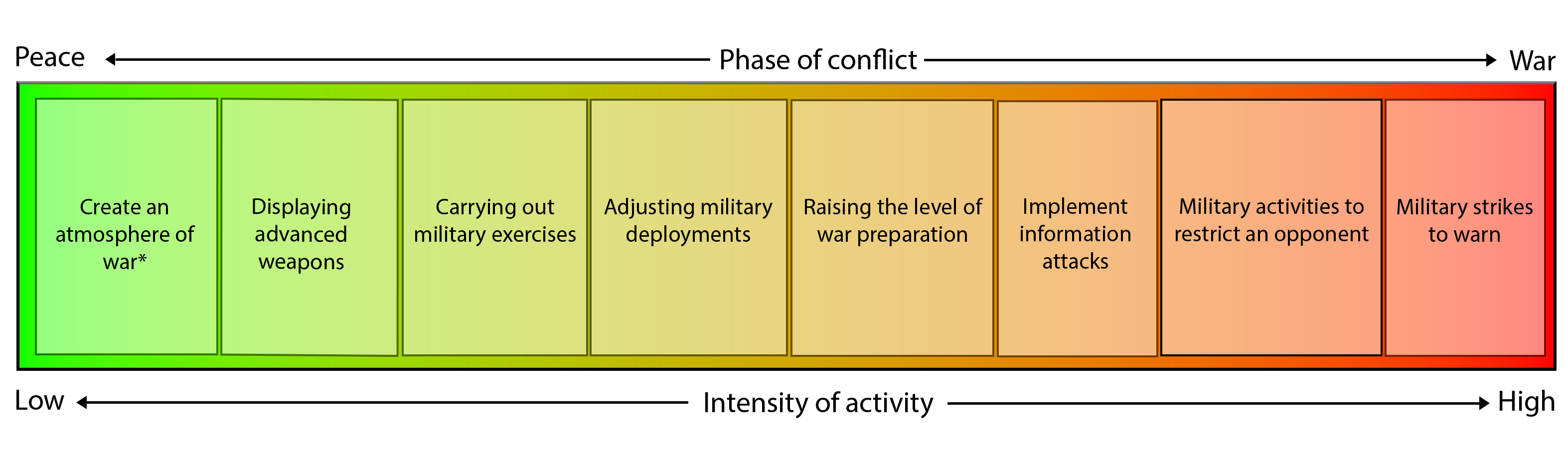
Source: Daniel C. Rice, “Understanding Weishe: China’s System of Strategic Coercion,” China Military Studies Review 1 (21 August 2025): 22, https://doi.org/10.33411/cmsr2025.01.001.
The discussion below attempts to define and scope conventional military activities specifically applied to the PLAN in its support to strategic coercion. Additionally, the inclusion of creating an atmosphere of war is largely in reference to the People’s War domain of coercion and thus will not be separately addressed in PLAN activities supporting strategic coercion.[25]
Showing Advanced Weapons
The 2020 SMS describes showing advanced weapons as:
The advanced weapon display can be used for general display of military power without a specific target, or it can be implemented in a purposeful and planned manner for a specific threat object; it can be displayed publicly, or it can be processed with ambiguity, leaving the opponent with speculation and imagination. It can be combined with demonstrations of major military operations such as weapon testing, force deployment, and military exercises.[26]
For PLAN analysis, showing advanced weapons will be twofold: modernization trends for the whole PLAN seeking to develop more advanced capabilities and the demonstration of certain advanced capabilities in specific operational contexts. The category of showing advanced weapons will be applied to the development of PLAN platforms in general. This discussion will focus on those offensive- and power projection-type capabilities that support greater regional objectives to influence adversarial forces and thus better enable the overarching goal of systemic coercion with the basic building blocks of combat power within the First Island Chain and greater Asia-Pacific.
Holding Military Exercises
Holding military exercises will be addressed in two parts: regional exercises in a combined exercise construct with various partners and unilateral exercises. Unilateral exercises carry a more robust indicator for systemic coercion efforts, but this is not without exception as will be discussed below. For coercive purposes, exercises will seek to demonstrate operational reach, massing naval power, and timely maneuver that would influence potential adversarial naval powers, specifically PLAN capability and credibility in any sort of high-end conflict or major combat operations. There has been a noticeable evolution of the PRC’s perception in the use of military exercises from the 2013 edition of the SMS to the 2020 edition, to include a larger emphasis on the signaling strength of military exercises.[27] The development of military exercises within the panoply of strategic coercion identifies the demonstration of various capabilities, sowing doubt in strategic intentions, or simply creating a feeling of panic in the target audience to achieve the desired effects of coercion.[28]
Military Activities to Restrict an Opponent
The 2020 SMS provides clear guidance and expectations on the potential for the PLAN’s role in military activities to restrict an opponent by “adoption of forcible control measures” to “squeeze the opponent’s operating space and restrict the opponents’ movement [such as] . . . implement control and isolation of local sea areas and airspaces; organize ships and aircraft to implement oppressive close reconnaissance and patrol, and interfere with the other party’s routine military activities.”[29] While this article’s discussion is limited to the use of PLAN assets specifically and not the greater maritime inventory of the CCG and PAFMM, application of the so-called cabbage strategy and frequent use of notice to airmen (NOTAM) are some of the more significant examples of PLAN military activities to restrict an opponent that will be addressed further below.
Adjusting Military Deployments
The 2020 SMS is broad in defining the adjustment of military deployments to include “military forces . . . maneuvering and gathering in a specific direction . . . increasing deployment of new combat warships . . . implementing large-scale forces forward . . . and even campaign deployment to form a combat configuration.” New combat warships as referenced include aircraft carriers as well as “new-style” destroyers/cruisers/frigates. Additionally, the adjustment of deployments includes real and fake information, adding another layer of military deception to the mix.[30] The concept of naval deployments can be coupled with military exercises such as the activities described below; however, for the purposes of this analysis, a PLAN military deployment will primarily be limited to the dispatch of naval platforms from the near seas for standing operational requirements. This will avoid the obfuscatory scope of ships leaving port for operational purposes constituting a naval deployment. Another potential ambiguous area for this taxonomy includes joint patrols with various PLAN partners that tend to encroach in adjacent economic exclusion zones (EEZ) for coercive purposes. Generally, the deployment of PLAN hospital ships will not be considered for analysis in this category as far as the discussion of coercion is concerned, acknowledging that these deployments serve specific purposes in diplomacy and international signaling.
Raising the Level of War Preparation
A more readily understandable descriptor for this category is increasing combat readiness. The 2020 SMS describes preparation as “being coordinated with actions such as adjusting deployment of troops . . . strengthening intelligence reconnaissance, and patrolling vigilance.” This includes aspects of mobilization.[31] Raising the level of war preparation regarding PLAN ties more directly to the adjustment of military deployments as described above instead of a standalone category of activity along with an increase in near seas patrolling efforts. Due to the nature of civil-military fusion within the PRC, this could also be more closely aligned to the activation of various reserves associated with naval elements or maritime militia mobilization ultimately subordinate to the CCP’s Central Military Commission.[32]
Military Strikes to Warn
The 2020 SMS defines this category as “a small-scale strike against a specific target with a small number of selected troops in response to the enemy’s serious provocative behavior.”[33] The purpose of conventional coercion here is to “show the ability to strike and the determination to strike when necessary.”[34] Being at the far end of the spectrum for conventional coercion, this is a category the PLAN does not typically employ when an opponent employs their formal military forces. However, the PLAN in conjunction with the CCG and supported by the PAFMM, has demonstrated its willingness to utilize this strategy against affiliated civilian actors. An example is the ramming of civilian commercial vessels in vicinity of disputed island groups. Historically, the Johnson South Reef naval skirmish in March 1988 demonstrates a limited coercive effort to gain control of SCS territory at the cost of roughly 70 Vietnamese deaths and two sunken Vietnamese vessels.[35]
Applying the PRC Systemic Coercion Model to PLAN Operations and Activities
Showing Advanced Weapons
Chinese naval modernization and expansion entered a major inflection point between 2019 and 2021. As of late 2024 and early 2025, major aspects of this modernization include indigenous carrier development; expansion of its cruiser/destroyer surface combatants; amphibious platforms; ship-based fires; and an expansion of its land-based Coastal Defense Missile Force (CDMF). While the PLAN’s Coastal Defense Force in general has become increasingly obsolete, the subordinate CDMF has consistently upgraded its capabilities and is envisioned to play an important role on the periphery of the PRC especially as an antiaccess/area-denial (A2/AD) capability.[36] Additionally, the PRC seeks opportunities to reveal new capabilities in mass media events such as the recent national military parade in September 2025. This venue is generally the preferred area to brandish a variety of land-based capabilities, especially its long-range A2/AD capabilities with the DF-21 and DF-26 26 ballistic missile variants. This year, the PRC revealed updates to the HHQ-9C and HHQ-16C surface-to-air defense capabilities on smaller PLAN platforms.[37] There was also a more detailed look at an experimental weapon, the LY-1, intended to be a laser-based directed energy weapon, indicating the potential advancement into formal and in-depth PLAN evaluation for service.[38] While just a few of the weapon systems were shown at the parade, the demonstration of advanced capabilities at work is arguably more compelling as with the PLAN’s nascent carrier platforms.
The development of aircraft carrier capabilities by the PLAN since 2012 is particularly important. While the first carrier was a foreign purchase adapted for PLAN service in 2012 as the Type 001 CNS Liaoning, its first indigenous carrier was launched in 2017 as the Type 002 CNS Shandong then commissioned in 2019.[39] While the launch of its third carrier Type 003 CNS Fujian in 2022 and subsequent initiation of sea trials in 2024 is not a significant milestone in and of itself, it is the first carrier that is closer to the size and flight deck configuration of current U.S. Navy carriers.[40] Completion of its final set of sea trials eight iterations later led to its formal commissioning on 5 November 2025 and official slating for service in the PLA’s STC.[41] The PRC has reportedly begun building its fourth aircraft carrier, but there is not enough information available to assess how its design will compare with the current U.S. inventory.[42] More details are anticipated in 2026.[43] Of note, an aircraft carrier may be under development in the Jiangsu Dayang Marine shipyard; a more remote shipyard known for building target barges and drone motherships on the Yangtze River.[44] With a design smaller than regular carriers (both U.S. and PLAN super carriers), its flight deck could still operate drones with a wingspan of approximately 20 meters, generally meaning large Group 4 or 5 unmanned aerial systems like the U.S. MQ-1 Predator.[45] While it would be cheaper to operate drones from shore, and the observed design does not appear to support high operational tempo activities, it is possible this is meant to facilitate experimentation for the “develop[ment of] drone operations at sea.”[46]
Figure 2. The assessed drone carrier (A) is longer but narrower than two drone motherships (C, D) built at the same yard. There are also several high-tech target barges (B, F), including one which mimics an aircraft carrier (E)
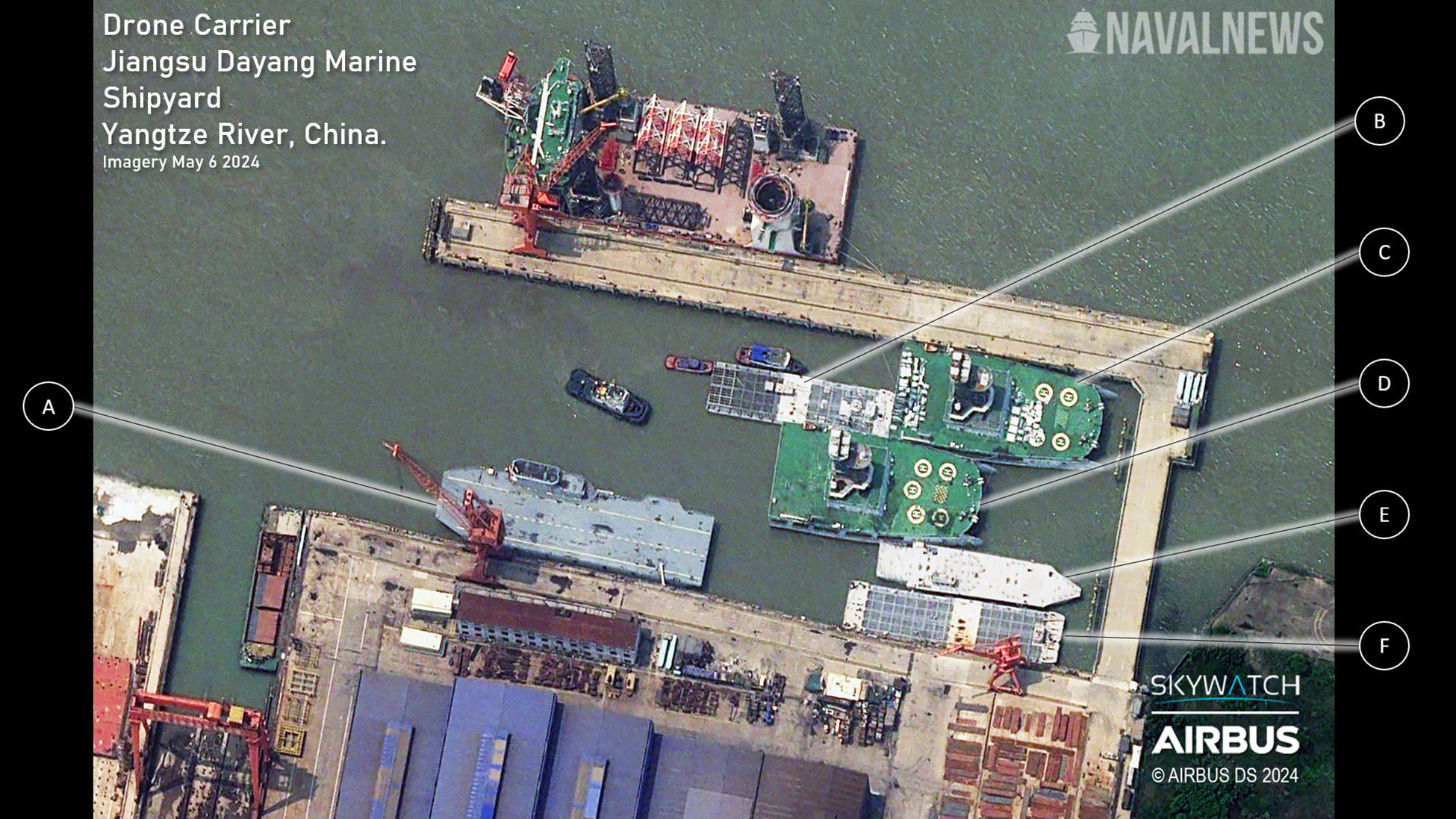
Source: H. I. Sutton, “China Builds World’s First Dedicated Drone Carrier,” Naval News, 15 May 2024, adapted by MCUP.
The PLAN is even more aggressive in building more capable and advanced surface combatants, specifically within its cruiser and destroyer inventories. The first of these platforms is the Type 055 Renhai cruiser, also described as a large destroyer (舰艇). The Renhai’s total displacement is about 20 percent more than the U.S. Navy’s Ticonderoga and Arleigh Burke cruiser and destroyer classes, respectively. The first Renhai was reportedly commissioned in early 2020 with the 10th commissioned in mid-2024. Specific capabilities include 112-cell vertical launch systems (VLS) with a variety of fire capabilities including antiship cruise missiles (ASCM), surface-to-air missiles, torpedoes, land-attack cruise missiles, and antiship ballistic missiles. The PLAN’s destroyer inventory includes the Type 052D Luyang III and, more recently, the Luyang III MOD. The Luyang III has remained in production since the 2010s and is approaching approximately 30 platforms, which includes upward of five in various stages of development as of mid-2023. The use of modern phased array radars and missile VLS demonstrate similar capabilities to the current U.S. inventory.[47] At 64 VLS cells, the Type 052D Luyang III has a smaller quantity VLS compared to the Type 055 Renhai.[48] Of note, the PLAN tested its first ship-launched antiship ballistic missile from a Type 055 Renhai in April 2022, ostensibly similar to its PLA Rocket Force maintained DF-21D medium-range ballistic missile.[49] The PLAN’s ship-launched antiship ballistic missile is reported to have a range of 540 nautical miles, about one-third of the land-based DF-21D with the potential to be employed on Type 052D Luyang III and Luyang III MOD platforms when fully operational.[50] The Type 055 Renhai and Type 052D Luyang share the same style VLS, and therefore missile capabilities are similar. While PLAN frigates are not a cornerstone of combat power, the PLAN is modernizing its current class of Type 054 Jiangkai frigates with the launch of the first Type 054B Jiangkai III in January 2025.[51] Despite the new variant, the VLS has remained the same with a 32-cell system forward of the bridge.[52]
The development of PLAN amphibious platforms carries a similar trajectory to its efforts in carrier development, specifically focusing on the inception of its Type 075 and 076 amphibious assault ships. In April 2021, the PLAN inaugurated its Type 075 Yushen with a displacement ranging from approximately 80–85 percent of the U.S. Navy’s landing helicopter dock/land helicopter assault (LHA/LHD) amphibious assault ships. The PRC has reportedly incorporated five total Type 075 amphibious assault ships into its inventory up to January 2025.[53] However, it only recently unveiled its fourth platform in the Type 075 family on 1 August 2025 with the CNS Hubei. The unveiling of this platform is noteworthy as it took place on the 98th anniversary of the founding of the PLA during a training exercise in the SCS. This vessel is also reportedly meant for service in the PLA STC.[54] As of 2021, according to the deputy commander for the 6th Landing Ship Flotilla (the amphibious force subordinate to the STC), the amphibious capabilities provided by the Type 075 must provide “projection in distant oceans [and] far-seas maneuver for deterrence and control.”[55]
The new amphibious assault ship class, Type 076 Yulan, may have been “put into the water for the final stages of construction” in December 2024. With a displacement of 50,000 tons, it is approximately 10 percent larger than the U.S. America-class LHD, making it the largest amphibious assault ship in the world.[56] The Yulan boasts other technological advancements to include an electromagnetic aircraft catapult reportedly for use in launching fixed wing aircraft (unmanned drones and potentially manned)—an almost unheard of capability for amphibious ships outside of vertical/short takeoff and landing platforms.[57] The future operational Type 076 is intended to serve as a multifunctional platform that is “capable of conducting air operations, launching amphibious landings, and providing joint command and control for broader amphibious forces.”[58] While the PLAN Marine Corps still has limited combat power and mass, it is a marked increase in power projection capabilities.
For ship-based maritime fires, one of the most concerning developments is the inception of a Chinese containerized missile that could be used across a variety of platforms to include Chinese state-owned enterprises such as China Ocean Shipping Company (COSCO).[59] In 2022, the PRC unveiled this capability as the Container-type Sea Defense Combat System at the Zhuhai Airshow and it appears very similar to the Russian Club-K container missile.[60] According to the China Aerospace Science and Industry Corporation (CASIC), its manufacturer, it can employ a number of missile variants to include “the YJ-12E supersonic [ASCM], YJ-83 medium range subsonic ASCM, the YJ-62 long-range subsonic ASCM, the PL-16 anti-radiation CM, and the YJ-18E supersonic ASCM.”[61] Most recently, a similar containerized capability has been shown configured on a cargo ship with explicit labeling as modular weapons systems in a Shanghai berthing.[62] While the PRC is not unique in its development of this concept, the appearance of a robust demonstration ship with quality sensor configurations is a much more advanced step in maturing this concept.
Figures 3 and 4. Images reported from the 2022 Zhuhai Air Show of the containerized ship-based missile capabilities. The use of English under Mandarin characters highlights the intention to communicate with an English-speaking target audience
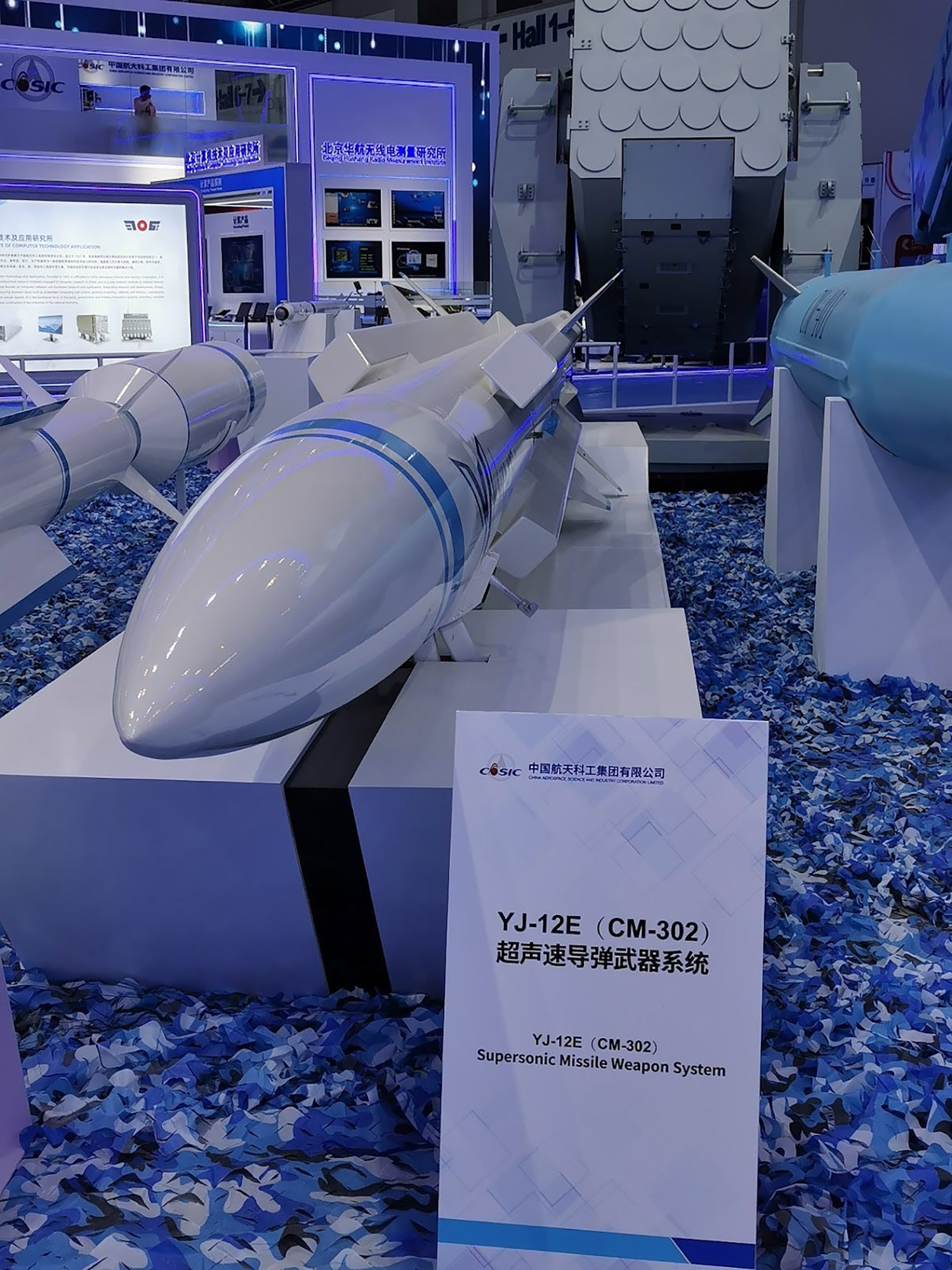
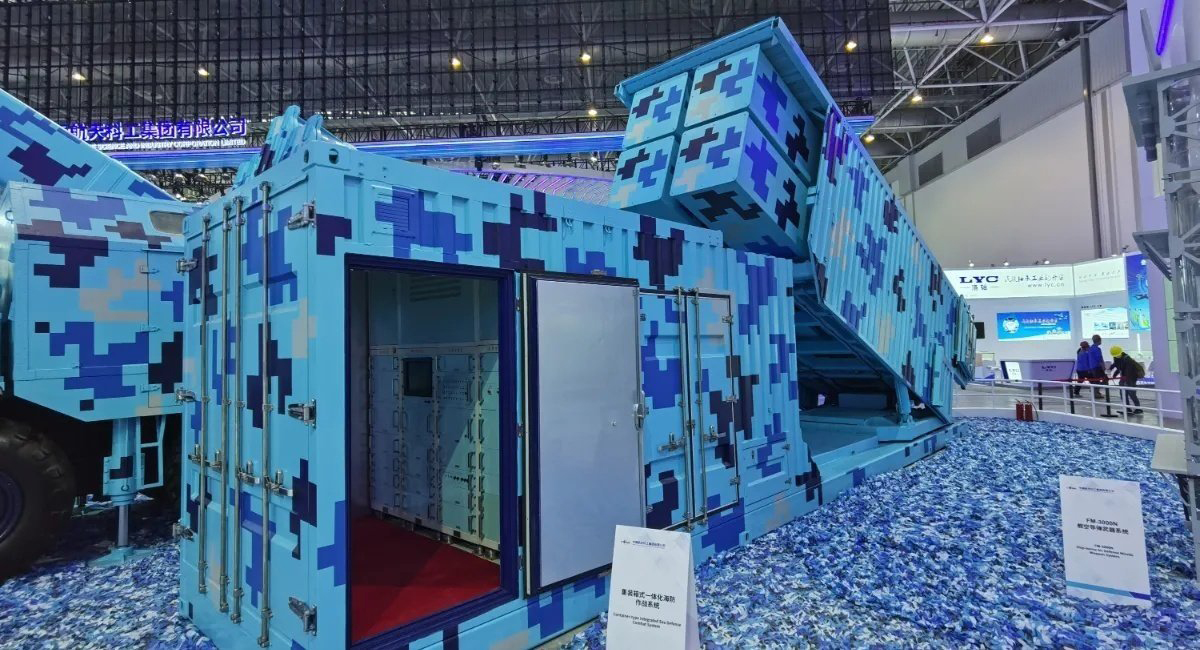
Source: #36 – China’s Container-launched Cruise Missiles,” Vermilion China, 23 February 2023, adapted by MCUP.
The addition of this asset to the PLAN’s inventory is more so a matter of novel application rather than nuanced capability. By creating a modular weapons system that could be ambiguously employed within the legion of maritime craft of its international shipping enterprises, it distinctly increases the opportunity for surprise through deception and ambiguity. The ability to advantageously place and employ such capabilities within sea lines of communication without preemptive tracking or identification of such a threat drastically increases the potential weishe to coerce or deter a number of target audiences within the ECS and SCS. This includes raising the specter of miscalculation by any opposing naval power that may be willing to escalate with kinetic actions in the maritime domain. Combining a nuanced ship-based fires capability with the previously described highly capable combat and power projection platforms gives the PLAN a range of options to achieve its coercion objectives depending on the situation.
Holding Military Exercises
There are two major aspects to explore for the PRC holding military exercises: long-term trends during the previous 10–15 years and specific points of divergence in recent history. Regarding long-term trends, the PRC conducted approximately 10 percent of the number of regional exercises from 2003 to 2022 that the United States did during the same period—128 compared to 1,113, respectively.[63] This can be seen as a somewhat misleading statistic if we focus on the development of PRC exercises in the 2010s and the expansion from “four institutionalized combined-military exercises in 2010 to 12 in 2020.”[64] Moreover, this only examines combined exercises and not unilateral exercises.
Two exercises within the previous year warrant discussion in the escalation of coercion activities for systemic coercion. First, in early December 2024, the PRC held its largest naval exercise in decades, surpassing in some respects the scale of operations during the third Taiwan Strait crisis of 1995–96.[65] With no advanced notice to countries adjacent to the PLAN operational areas, the PRC established seven airspace exclusion zones within the Yellow Sea, Taiwan Strait, and SCS. Generally, the use of any exclusion zones would bleed into the subsequent category of coercion for military activities to restrict an opponent, but they are included here to demonstrate the various aspects of a PLAN exercise. What some analysts thought would be the third installment of PRC reactions to Taiwanese political developments was never formally acknowledged or given a name compared to the previous Joint Sword series of exercises (2023–24).[66] All three PLAN carriers remained in port for the exercise, but the use of 90 naval vessels (approximately two-thirds being PLAN platforms) simulated envelopment of Taiwan forming two lines east of the island into the Western Pacific, indicating a rehearsal to prevent interference from third parties in any major conflict scenario. The western boundary of these enveloping forces east of Taiwan were on the edge of Taiwan’s air defense identification zone.[67] While it was not declared as a part of the Joint Sword series of exercises, it was a clear escalation. With perceived Taiwanese separatism, this escalation is a method of PRC signaling and PLAN coercion.
Map 1. Depiction of the PLA disposition in vicinity of Taiwan during its unannounced naval exercise, 9–11 December 2024
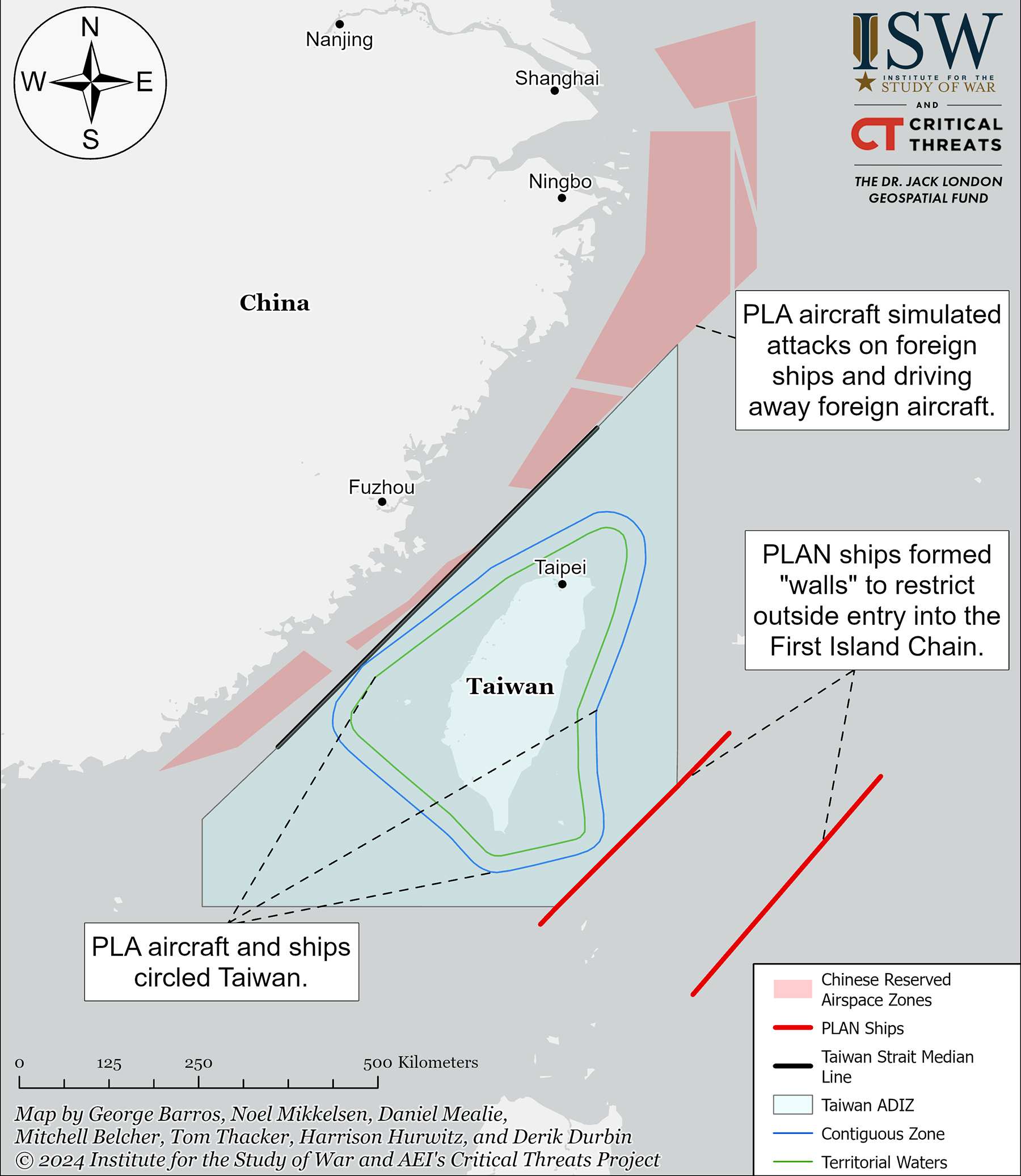
Source: Matthew Sperzel et al., “The China-Taiwan Weekly Update, December 12, 2024,” Institute for the Study of War, data as of 11 December 2024, 6, adapted by MCUP.
Another unprecedented application of military exercises for coercive purposes is the concurrent naval exercises the PLAN conducted for 21–27 February 2025. These were executed across four disparate areas within the Western and Southern Pacific: between Australia and New Zealand in the Tasman Sea, in the Gulf of Tonkin, off the southwestern coast of Taiwan, and various sorties in the ECS and Philippine Sea. The PLAN conducted a naval drill east of Eden, Australia, including live-fire drills, with no notification that resulted in commercial air traffic being rerouted. Within the Gulf of Tonkin, the PRC announced live-fire naval exercises southeast of Beihai on the Chinese side of the gulf. Off the southwestern coast of Taiwan near Kaohsiung, the Taiwanese military identified a significant number of PLA aircraft and naval platforms conducting an exercise that was unannounced, although it is unclear if live fire was employed. For the final event, the PLA employed a number of manned and unmanned sorties within the ECS and Philippine Sea, violating Japanese airspace and invoking a Japanese Air Self-Defense Force (JASDF) response.[68] The power projection of PLAN platforms in the Tasman Sea represents the farthest PLAN voyage south since 1985. On the heels of the PLAN’s December 2024 operation described above, this may be the second clearest effort of PLAN military demonstration, with Chinese sources acknowledging “that the transit of the naval force and live-fire exercises were intended to signal the beginning of the ‘normalization of the deployment’ . . . in the South Pacific.”[69]
Map 2. Traveled and assessed path of PLAN Naval Task Group 107, which conducted the live-fire exercises in the Tasman Sea
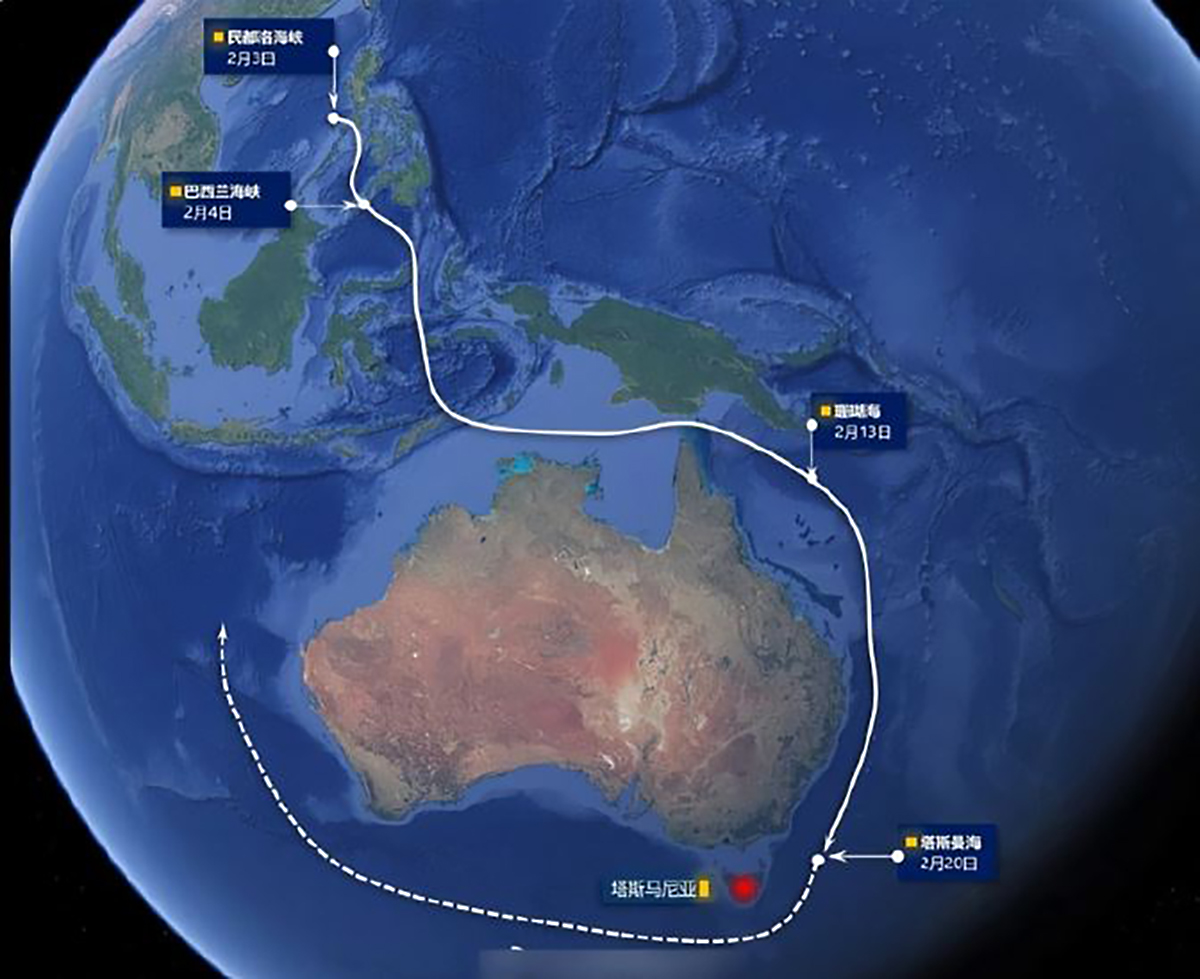
Source: Anne-Marie Brady, “A Shot Across the Bow: China Signals New Era of Sea Power in the Southwest Pacific,” Diplomat, 27 February 2025, adapted by MCUP.
The actions in the vicinity of Taiwan, while consistent with routine PLAN activities for general intimidation, may be linked to Taiwanese seizure of a cargo ship a few days prior, allegedly connected to undersea cable sabotage. The PLAN activities in the Gulf of Tonkin may be loosely connected to the Vietnamese submission of new nautical charts and baseline coordinates for the Gulf of Tonkin in February 2025 as a reaction to the PRC’s declaration in 2024, but there are few specific maritime disputes between the two surrounding the Gulf of Tonkin in particular compared to the SCS in general.[70] For the various manned and unmanned sorties that eventually violated Japanese airspace, it may be the first time the JASDF have identified a Chinese Wing Loong II reconnaissance/attack unmanned aerial vehicle associated with an intrusion into Japanese airspace.[71]
Military Activities to Restrict an Opponent
There are two major aspects of PLAN maritime activities that restrict an opponent, the first of which is operational and the second tactical. At the operational level, one of the most notable military activities undertaken by the PRC that indirectly affects the PLAN is land reclamation and the development of military outposts within the SCS, primarily around the Paracel and Spratly Islands. Despite the persistent efforts by the United States to conduct freedom of navigation operations, the development of these military outposts naturally impacts sea and air lines of communication between PLAN patrols and air sorties, in addition to ubiquitous ground-based radar with accompanying surface-to-air missile and coastal defense cruise missile capabilities. This includes CDMF positions on Woody Island, Subi Reef, Fiery Cross Reef, and Mischief Reef.[72] The forward placement of these modular and mobile capabilities on reclaimed island outposts in the SCS provide a range of coercive options for offensive and defensive naval campaigning, especially interdiction of sea lines of communication.[73] Apart from these controversial island features that provide fixed sites as base units of maritime operation, the PRC’s maritime forces employ at the tactical level what has been called the “cabbage” strategy. The cabbage strategy is generally employed within areas subject to maritime disputes, specifically those in the SCS due to the number of claimants and competing claims initiated by the PRC. PRC maritime forces employ the strategy through use of concentric circles similar to maritime cordons—the PAFMM usually comprises the innermost layer, followed by the CCG, and the final concentric circle includes PLAN platforms to provide general overwatch.[74] The use of the PLAN in this manner is twofold. By making up the outermost layer, it prevents the interference by any other state’s maritime platforms, naval or otherwise due to its combat capabilities as well as inherent aspect of escalation if attacked. Alternatively, if significant issues arise during PAFMM or CCG efforts to deal with foreign vessels in its inner cordon, the PLAN can provide additional support with its greater capabilities. This is the purest example of localized sea supremacy in PLAN operations pursuant to gray-zone warfare. The complementarity of these forces has been borne repeatedly, including ramming various Vietnamese (e.g., March 2019 and April 2020) or Filipino (e.g., June 2019, June 2024, August 2024) vessels.
In addition to the physical presence of these vessels, the PRC has made semiregular use of formal mechanisms such as NOTAM and notice to mariners (NOTMAR) that restrict use of air and sea space to other nations that consistently, but not always, coincide with military exercises. The large exercise in December 2024 discussed above included extensive NOTAM submissions; however, they did not technically come from the PLA but from a PRC civil aviation authority.[75] There was also a swath of airspace denial the month before the exercise that mostly overlapped with subsequent exercise areas. It is possible the PRC was rehearsing for the more provocative action taken in December as well as experimenting with airspace denial in general.[76] The PRC also conducted another large-scale exercise in December 2025 named Justice Mission 2025. In protest of U.S. arms sales to Taiwan, the PRC disseminated NOTAMs for seven areas that would be used for live-fire exercises that occurred the following day with the understanding that several international and domestic Taiwan flights would be affected.[77] Furthermore, in early 2026, the PRC issued a NOTAM affecting a large block of airspace from 27 March to 6 May that would end roughly a week prior to the scheduled visit of President Donald J. Trump—possibly an effort to reserve maximum flexibility for the PLA prior to this significant diplomatic engagement.[78] While NOTAMs in this particular instance do not leverage a direct relationship with PLA or PLAN activities, it does generally support the PRC’s strategy of gray-zone warfare with the potential for sensitizing the international community to frequent control of airspace adjacent to its territorial waters.
Adjusting Military Deployments
The primary deployment rotation, and arguably only one, that PLAN analysts have observed in the previous 18 years has been the Gulf of Aden counterpiracy task forces. Beginning in 2008 as the inaugural conduct of PLAN out-of-area operations, the Gulf of Aden rotation up until 2024 generally saw the dispatch of three task forces per year on approximately four-month intervals.[79] Both the 45th and 46th naval escort task force rotations were extended to a five-month period from late 2023 to mid-2024.[80] It appears with the 47th task force’s departure from the PRC in mid-December 2024 may be the continuation of this trend for three rotations now.[81] With the extended deployments of these three rotations, it is reasonable to assess an adjustment of the PLAN’s task force rotations to the Gulf of Aden theater for counterpiracy operations. If this is the case, the “prolonged time on station would require fewer ships on average per year, but would also decrease the number of days when two task forces are in the Indian Ocean region” between time on station and in transit. Such an adjustment could possibly result from a PLAN need for more ships in the near seas for “more pressing missions . . . due to its other ongoing operational missions in the Taiwan Strait, [SCS], [ECS], and Philippine Sea.”[82] The wider availability of naval assets in the aforementioned areas of operation would increase options for PLAN coercive activities, even more so with a possible confrontational position with the second Trump administration.
For its carrier deployments, the PLAN typically sends both the Liaoning and Shandong for operations beyond the First Island Chain with a locus in the Philippine Sea. This was observed in late September 2024 with a deployment transiting from the ECS to the Philippine Sea and southward to reenter the SCS from the Celebes Sea (map 3).[83]
Map 3. Depiction of the September 2024 Liaoning carrier group movements
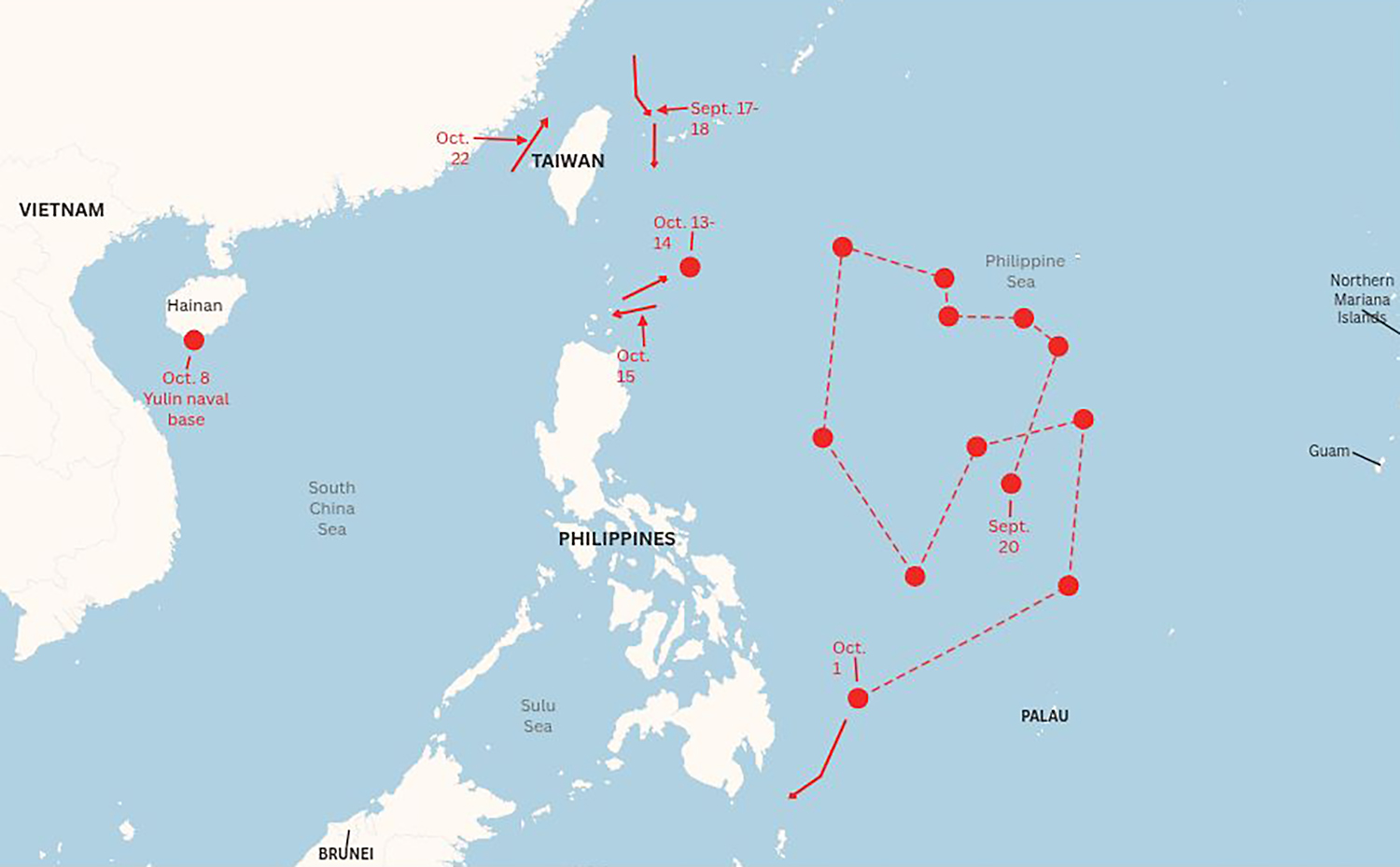
Source: Ryan Chan, “Map Shows Chinese Aircraft Carrier’s Movements in Pacific,” Newsweek, 3 October 2024, adapted by MCUP.
The Liaoning would later take part in naval drills in vicinity of Taiwan in late October 2024.[84] Deployment of the Shandong in April 2025 is a better example of adjusting deployments here. While it deployed twice in that month, its first deployment in early April was focused on the conduct of “drills against Taiwan,” the timing of the second deployment generally coincided with the start of joint U.S.-Philippines drills within Exercise Balikatan.[85] The deployment was accompanied by two “rare” transits by the Shandong north of the Philippines within a week during the conduct of the exercise.[86] For context, the Shandong has been relatively active since 2023 with three deployments in that year during April, September, and October/November for a total of 36 days at sea. In 2024, it deployed to the Philippine Sea in July and August to roughly the same operational areas east of Luzon.[87]
The summer of 2025 saw significant points of departure where Chinese naval activities are concerned, specifically for its carriers. Between late May and mid-June 2025, the PLAN carriers Liaoning and Shandong were deployed simultaneously in the Western Pacific beyond the First Island Chain. The Liaoning carrier group also sailed beyond the Second Island Chain for the first time operating southwest of Minamitori Shima, northeast of Guam. The simultaneous operation of these carriers in these areas is likely indicative of force-on-force training in the latter part of the deployment to include analysis of the sortie rate of carrier-based aviation. With overlapping deployments of these two carriers and their associated carrier groups, the PLAN also achieved its longest duration of carrier operations beyond the First Island Chain for a total of 27 days—neither the Shandong or Liaoning operated longer than it had previously on other deployments.[88] Map 4 offers an overlay of carrier operations for 2024–25.
Map 4. Comparison of Chinese aircraft carrier deployments in the Western Pacific, 2024–25
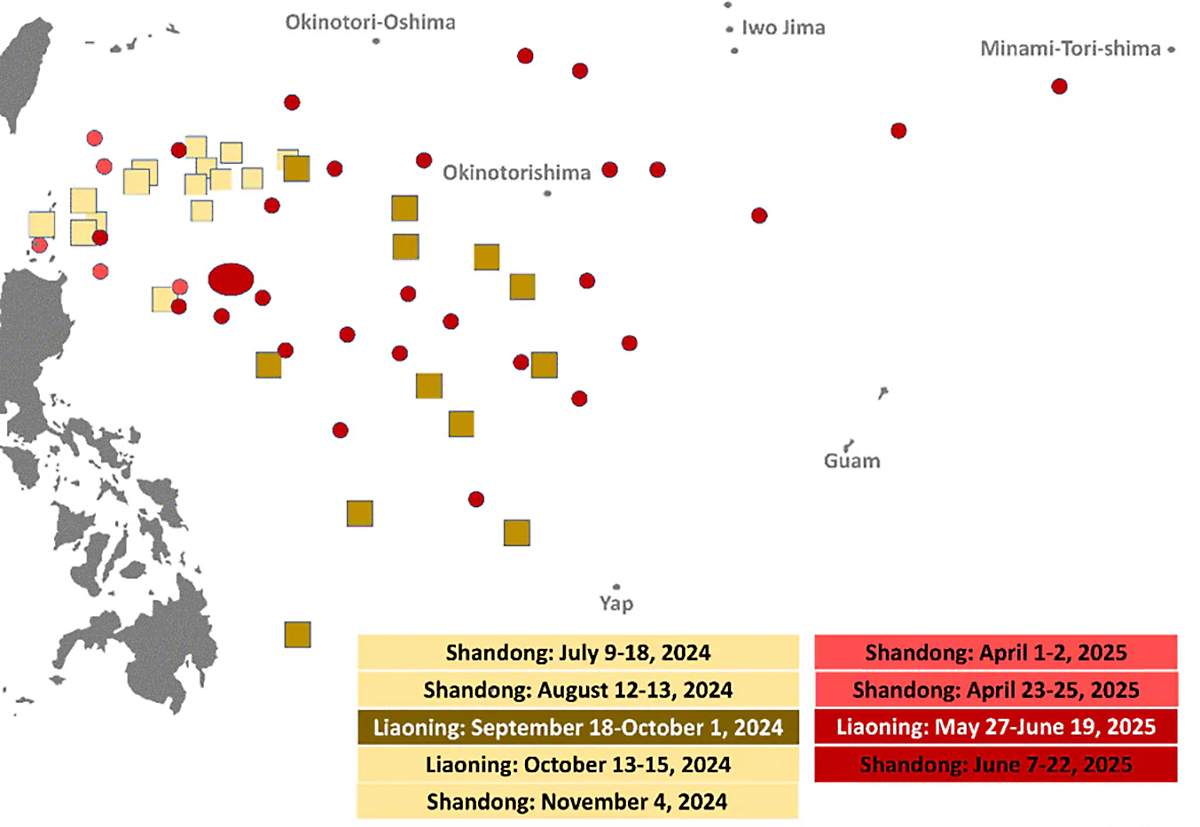
Source: Yu-cheng Chen and K. Tristan Tang, “PLA Navy Shifts Training Focus from Near-Shore to Blue-Water Operations,” China Brief 25, no. 14 (25 July 2025), adapted by MCUP.
Outside of the more restrictive definition used above, the described operations of Naval Task Group 107 in February 2025 can also be considered an adjustment to military deployments. With specific PRC verbiage referencing the “normalization” of such a “deployment,” the adjustment demonstrates the operational reach of a small group of surface combatants. Additionally, in an escalation of messaging from the PRC, recent reporting in late April 2025 from the Chinese Global Times and China Central Television indicated the deployment of Type 022 Houbei fast-attack missile craft to the SCS.[89] While there are fewer details on the number and it is not necessarily an advanced capability, it introduces ambiguity to adversarial forces in the area of operations with its high mobility, moderate stealth, and asymmetric firepower on par with a larger frigate class platform. The introduction of this platform with its eight YJ-83 ASCM and a more diversified operational profile that includes “littoral patrols, escort missions, surveillance, and joint operations with [CCG] units to assert maritime claims,” could be seen as PLAN activities bleeding more into the subsequent category for war preparation.[90]
For the most recent example, the PRC increased its naval presence in the SCS to coincide with the 2026 iteration of the U.S.-Philippines Exercise Balikatan. These vessels include the Liaoning carrier strike group that has been operating in the area since the beginning of the exercise. Additionally, the PLAN deployed a combat readiness patrol of two frigates and a corvette accompanied with antiship bombers (Xian H-6s) in vicinity of Scarborough Shoal—or Huangyan Island as the PRC refers to it.[91] A more significant PLAN signal is the deployment of a surface action group east of Luzon shortly after the initiation of the exercise that included a Type 055 Renhai, 052D Luyang III, and an older model frigate. These actions are noteworthy in the context of U.S. military planners increasingly looking to the eastern portions of the Philippines for any logistical and reinforcement purposes due to the lethal saturation of PRC A2/AD capabilities within the SCS.[92] Furthermore, coercive PLAN activities around Scarborough Shoal are amplified within the context of other PRC activities to include the September 2025 declaration of a national nature reserve around Huangyan Island (Scarborough Shoal).[93] Thus, we see PLAN coercive activities supporting PRC sovereignty claims via gray-zone warfare within the priority region of the SCS.
Raising the Level of War Preparation
As defined above, the PLAN has not necessarily been conducting activities that raise the level of war preparation outside of its routine operations for conduct of patrols, exercises, and drills. The three major exercises described earlier in December 2024, February 2025, and December 2025 may be the most significant recent events that could arguably be categorized as increasing combat readiness, two of which were specifically for the Taiwan problem set. Focusing on the SCS, a discussion of the Chinese maritime militia may provide a more indirect indicator. According to the U.S. Department of Defense, “the CCG and CMM [Chinese Maritime Militia] supported the PLA’s efforts to enhance its force posture and expand its patrolling and reaction locations in foreign countries’ EEZ in the [First Island Chain]” throughout 2024, including areas within both the ECS and SCS.[94] Additionally, “in 2023, the CCG continued to increase its duration in the Senkaku Islands’ contiguous zone with a record of 352 days, compared to 336 days in 2022.”[95] With a general focus on the SCS, “the number of CMM vessels . . . increased by approximately 35% with an average of 195 vessels observed per day.”[96] With the influx of the total number of maritime militia vessels in recent years as described above, it stands to reason that this raises the level of war preparation, “strengthening intelligence reconnaissance” across the maritime domain since “collecting and reporting maritime intelligence is a core mission” of the maritime militia.[97]
Military Strikes to Warn
The PLAN has not demonstrated the conduct of military strikes to warn as of April 2026. Although some PRC maritime elements, almost exclusively the CCG and PAFMM, have rammed other vessels in disputed areas, these cannot be considered targeted strikes on specific combat platforms such as formal navy warships, U.S. or otherwise.
Potential Perception of Coercive Activities
In the aforementioned signaling model that underlies any PRC effort at systemic coercion, the receiver of the signal is a critical component. It may be too bold to say that every signal the PRC sends in the First Island Chain equally communicates with the United States and its allies and partners. However, with the number of treaty allies of the United States in the FIC, there are numerous signals to Japan and the Philippines that simultaneously serve as a signal to America and vice versa. Other partners, such as Taiwan, bear the same relationship. This is especially so since, as Johannes Plagemann describes, “public signals exclusively for one type of addressee are hardly feasible in today’s media environment.”[98] The U.S. perception of the range of signals via PLAN coercive activities, and especially U.S. military forces within the FIC, is of a regional power attempting to flex its military might similar to the nineteenth- and twentieth-century geopolitical realities of spheres of influence. The United States’ longstanding role as a security guarantor of its allies in the region post-WWII and after the end of the Cold War is consistently at odds with a willingness to respond to persistent PRC revisionism in its desire to undermine the Western liberal order. If nothing else, the U.S. perception, and that of its allies and partners, sees the PRC as an increasingly capable military power on their doorstep resulting in the potential for a security dilemma or willingness to respond in kind. With the systemic application by the PRC via the PLAN, and a penchant for gray-zone activities, the United States has yet to determine an effective counterstrategy.
Further Analysis and Conclusion
The scope of the above activities is far reaching across PLAN coercive efforts. With the variety of application and implementation, there is not necessarily a predictable progression for each specific military problem set, dyadic relationship, and/or theater of operations. There are several areas of research and analysis that would add to the current body of knowledge in the PRC’s application of weishe and coercion via the PLAN in the maritime domain that would impact a variety of strategic questions and military problem sets. Similar to the discussion of extended deterrence above, it begs the question if there is the possibility of extended Chinese coercion via partnering with other powers, such as the Russian Federation. While the First Island Chain is generally the principal area of concern when analyzing PLA activities, the possibility of expansion and impact for coercive activities into the Western Pacific and Second Island Chain bear separate challenges for the United States as a Pacific nation. Similar to its Belt and Road Initiative, there are questions regarding the role of future access, basing, and overflight for PLA conventional military coercion efforts, especially if combined with expansion of activities into the Western Pacific. Analysis of those efforts would have to determine the role of Chinese weishe dyads, as briefly mentioned in the section above on intended recipients of coercive signals, to determine nuances and novelties of actions toward the United States, Japan, the Philippines, and Vietnam. Lastly, understanding the PLA’s operational limitations of coercion in the maritime domain within the ETC and STC will have impacts on strategic and operational-level planning for U.S. Indo-Pacific Command.
Conventional military weishe, also known as coercion, is implemented in the maritime domain by the PLAN to support overarching CCP strategic goals. While maritime coercive activities address multiple audiences at once, the spectrum of coercive activities allows for their adaptation depending on the primary target audience. This is one of the limitations of the generalized examination above. It provides useful baseline data on the application of systemic coercion at the operational level by the PLAN, but it still needs to be applied across specific dyads to present more nuanced utility within a particular problem set. Simply put, one needs to isolate the set of coercive activities that the PLA takes against a specific actor and analyze whether they have induced a change of behavior in the recipient. Another limitation here is the general lack of transparency in the elite-level conversations that occur in the upper strata of the CCP, forcing the use of sources that are molded for foreign consumption instead of providing the best indicators of decision-making process and authenticity. However, this does not undermine the overall consistency in strategic-level signaling of highly capable military forces bolstered by operational-level PLAN coercive activities. As demonstrated in the study of each category of maritime coercion activities above, it is not a linear progression within each theater and is employed episodically with naval modernization being the primary point of consistency for general conventional military coercion, similar to general deterrence described at the beginning of this article. The nature of PRC communication with its centrally controlled state media apparatus may provide a surprisingly utilitarian vector for conventional military coercion analysis as some of the current literature indicates. The recency of some of the discussed cases reveals that the PLAN in particular and PRC in general are active on the far left and center of the conventional military coercion spectrum. Additional study and analysis are required to identify useful nuances and novelties of Chinese weishe to prevent military miscalculation within the First Island Chain as well as identify opportunities for effective mitigation, operational disruption, and strategic exploitation by the United States and its Pacific allies and partners.