PRINTER FRIENDLY PDF
EPUB
AUDIOBOOK
Introduction
Fought during the Korean War from 27 November to 11 December 1950, the famed Battle of the Chosin Reservoir pitted 12 Chinese divisions (more than 120,000 men) against a vastly outnumbered force of U.S. Marines and Army soldiers, British commandos, and South Korean troops under the United Nations command of General Douglas MacArthur. Surrounded in the mountains of North Korea by an enemy determined to annihilate them, the men of the 1st Marine Division fought for 15 days in arctic-like cold to escape the Communist trap. To mark the 75th anniversary of that epic breakout, former Marine staff sergeant Frank Kerr shares his life-changing experience as a young combat photographer chronicling one of the most storied engagements in U.S. military history.
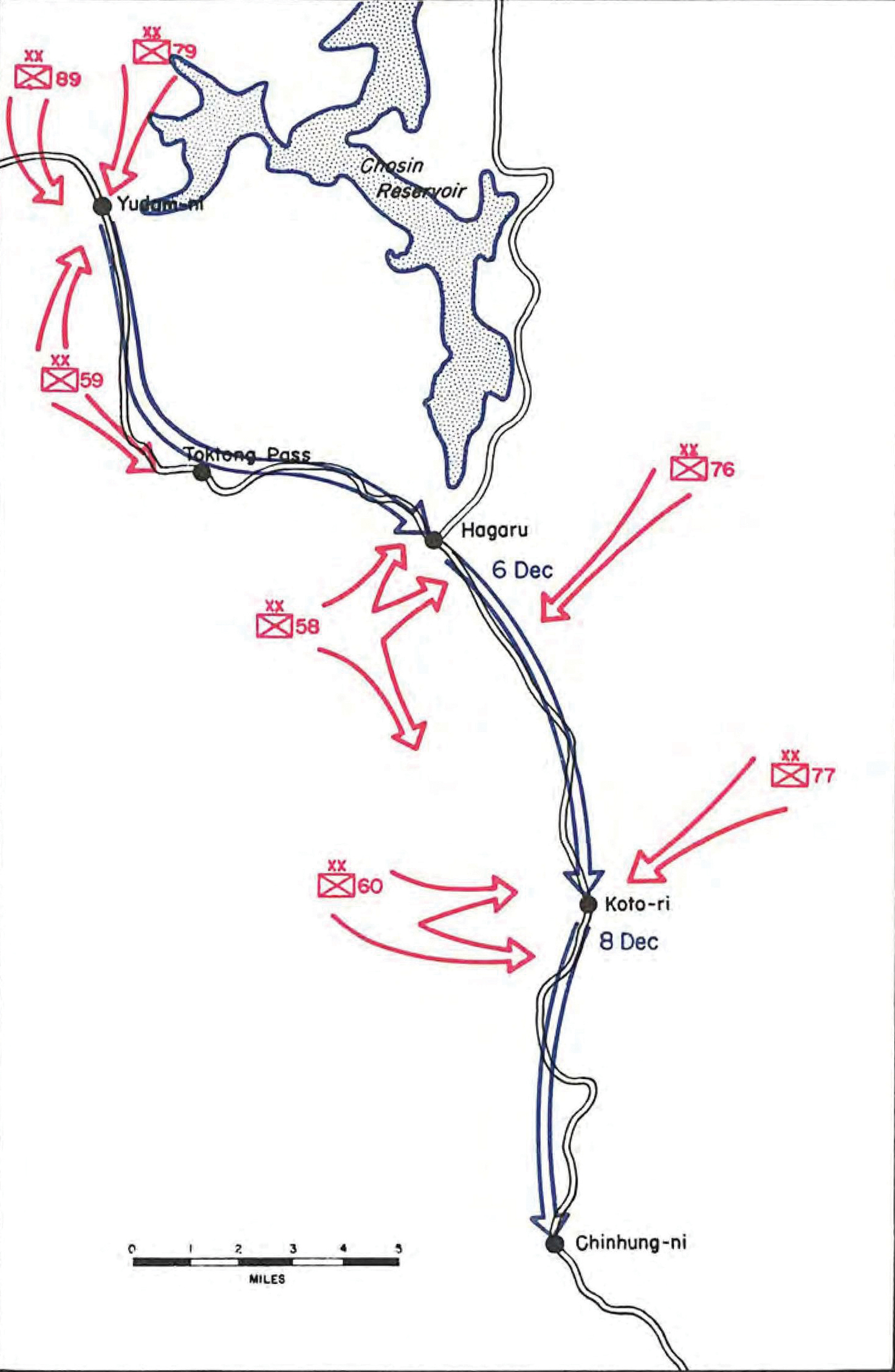
1st Marine Division’s route of withdrawal from the Chosin Reservoir, indicating Chinese Army points of attack, 27 November–11 December 1950.
From Lynn Montross and Capt Nicholas A. Canzona, U.S. Operations in Korea, 1950–1953, vol. 3, The Chosin Reservoir Campaign (Washington, DC: Historical Branch, G-3, Headquarters Marine Corps, 1957), ii
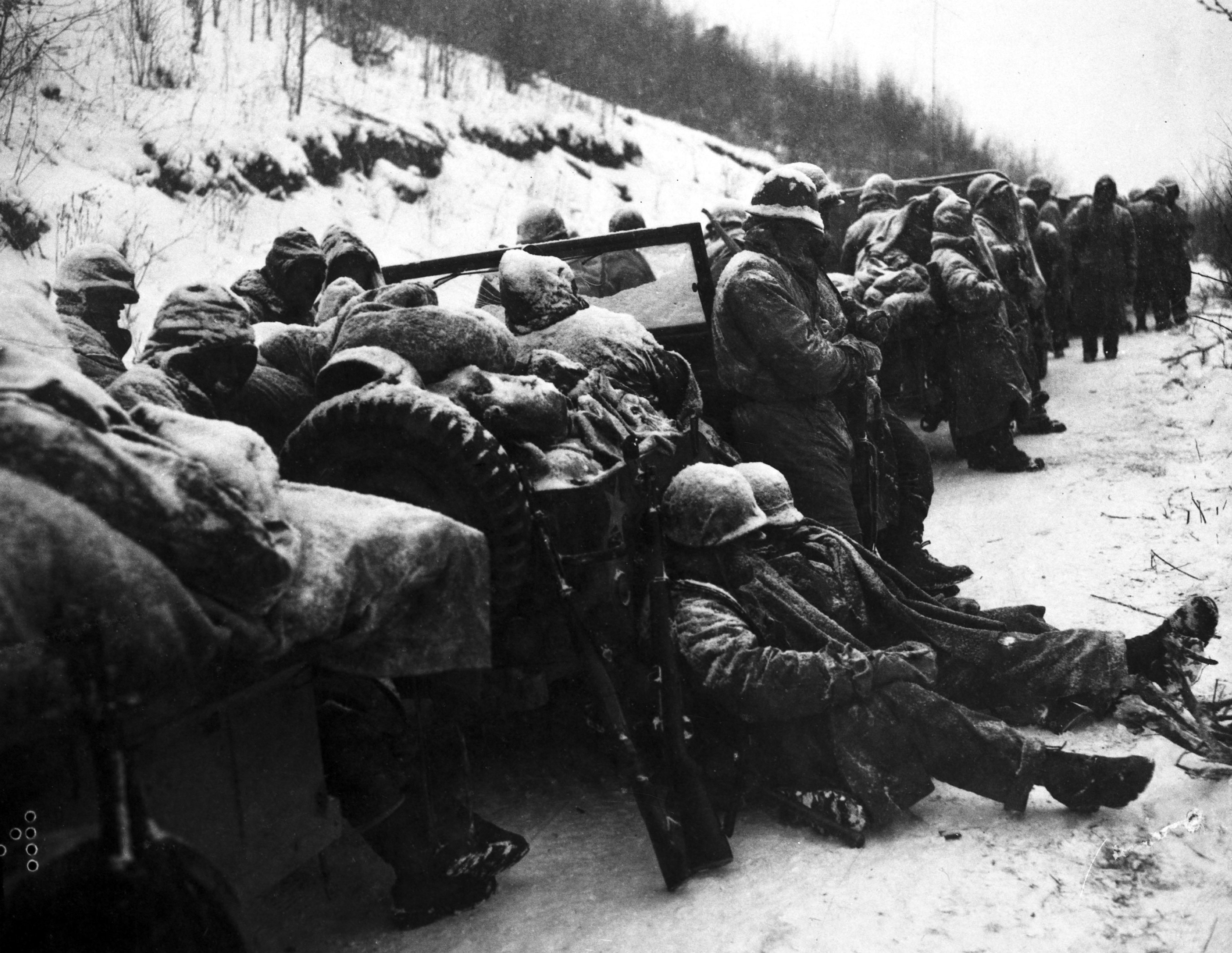
Battle-weary men of the 1st Marine Division endured subzero temperatures and relentless combat as they withdrew from the Chosin Reservoir in North Korea, December 1950.
Photo by Sgt Frank C. Kerr
Prelude to Battle
Winter had come early to the North Korean high country. As our regiment pushed deeper into the mountains along an unpaved, ice-encrusted road, the temperature hovered near zero and would soon plunge lower. I was a 20-year-old Marine combat photographer when I carried my camera into that frozen hell. Some of what I experienced during the coming days would be captured on film, but how do you capture the horror of watching men die, or fighting in weather so brutally cold that breath freezes and flesh turns black, or seeing an enemy soldier come screaming from the night as you try to reload your rifle before he does? You can’t. Not really. To truly understand is to have been there in the late fall of 1950, at a cold and forbidding place known to history as the Chosin Reservoir.
When I quit school to join the Marine Corps in 1948, fighting a war in some godforsaken landscape on the other side of the world was the furthest thought from my mind. But after Communist North Korea invaded the South in June 1950 and the United Nations (UN) voted to send troops to drive them out, I was deployed as a combat photographer with the 1st Provisional Marine Brigade, organized as a placeholder while the 1st Marine Division—demobilized after World War II—was hastily reassembled. The brigade’s mission in those early days of the war was straightforward; reinforce beleaguered UN troops, including the U.S. Eighth Army, under siege by the North Koreans at the southeastern tip of the peninsula—a 225-kilometer-long defensive position known as the Pusan Perimeter.
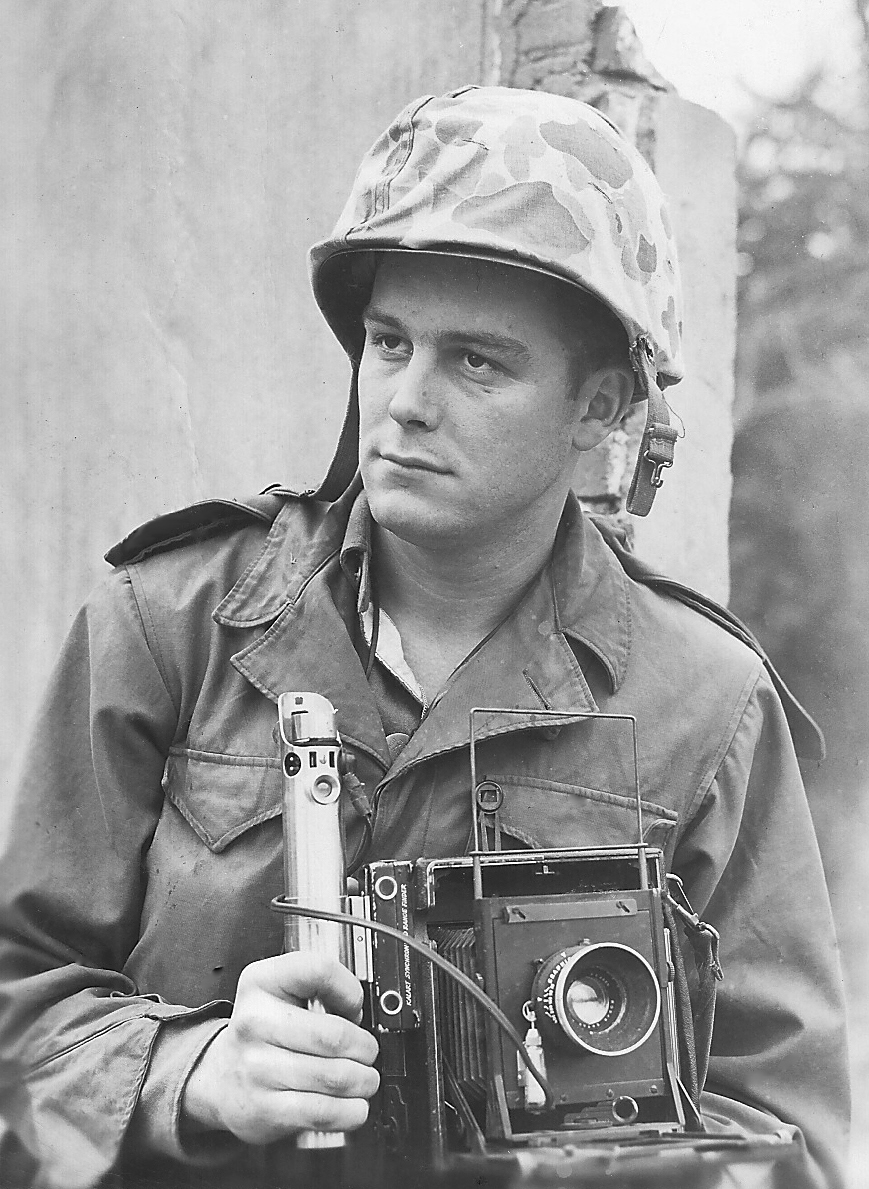
Sgt Frank C. Kerr holding the Graflex 4x5 Speed Graphic camera used during his wartime service in Korea.
Photo by Sgt James Powers
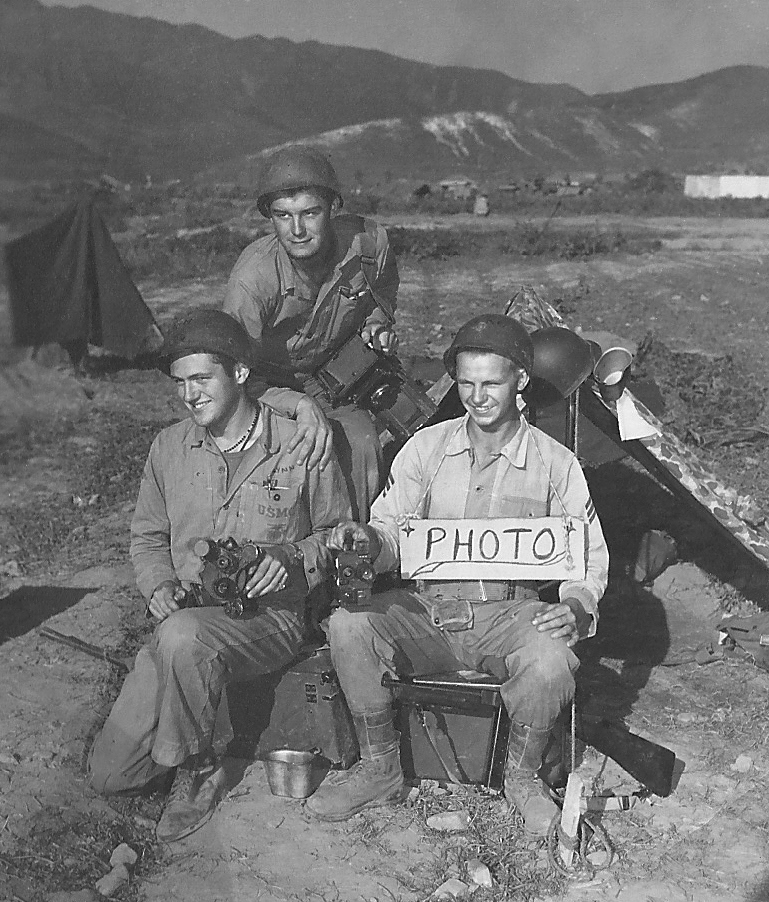
The first three Marines to capture the Korean War on film. Left to right: combat cameraman Cpl John Flynn, combat photographer Sgt Frank C. Kerr, and combat cameraman Cpl Jake McKay.
From the collection of Sgt Frank C. Kerr
It was during combat at Pusan that I discovered how surprisingly difficult war is to photograph—not because of the danger involved, but because even the most savage firefight can appear tame in a picture. The key to capturing combat, I would learn, was to freeze in time those moments that declare, without question, that this is war; from infantrymen passing a burning building to taking enemy prisoners at gunpoint.
When the brigade was folded into the reactivated 1st Marine Division and inserted behind the Communist lines at Inchon, I applied those lessons on Wolmi-do, a heavily fortified island in Inchon Harbor that our ground forces captured after a merciless bombardment from the air and sea. With the Marines now sweeping inland from Inchon to retake the South Korean capital of Seoul, and the Eighth Army finally breaking free of the Pusan Perimeter, the decimated and demoralized North Korean Army fled north, chased by UN forces toward the Yalu River on the Manchurian border.
What our commander-in-chief, General Douglas MacArthur, failed to realize (or decided to ignore) was how the Communist Chinese would respond to allied troops knocking at their door. We would soon find out.
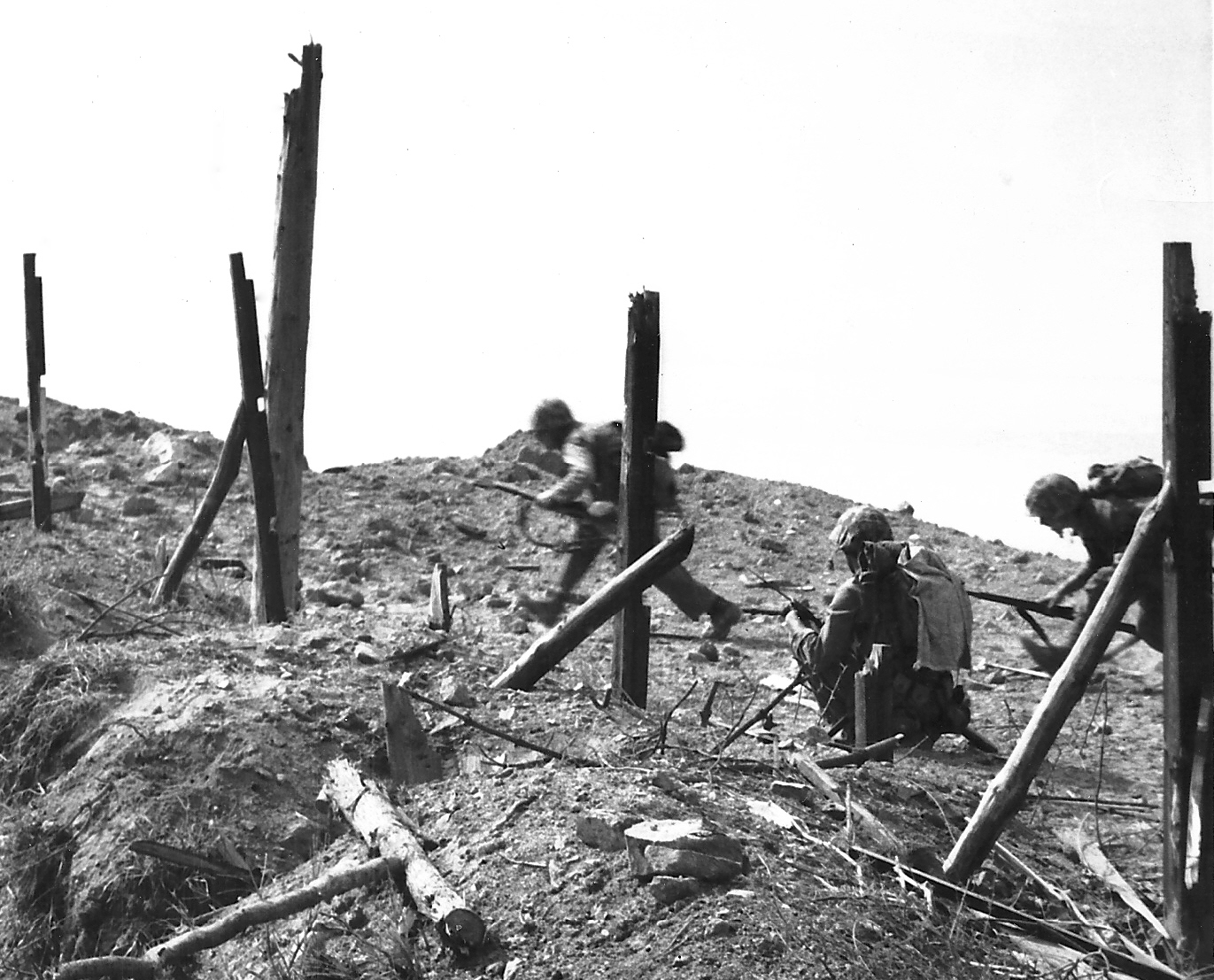
Pusan Perimeter, ca. August–September 1950. Marines advance under heavy small-arms and machine-gun fire during action against the North Korean Army.
Photo by Sgt Frank C. Kerr
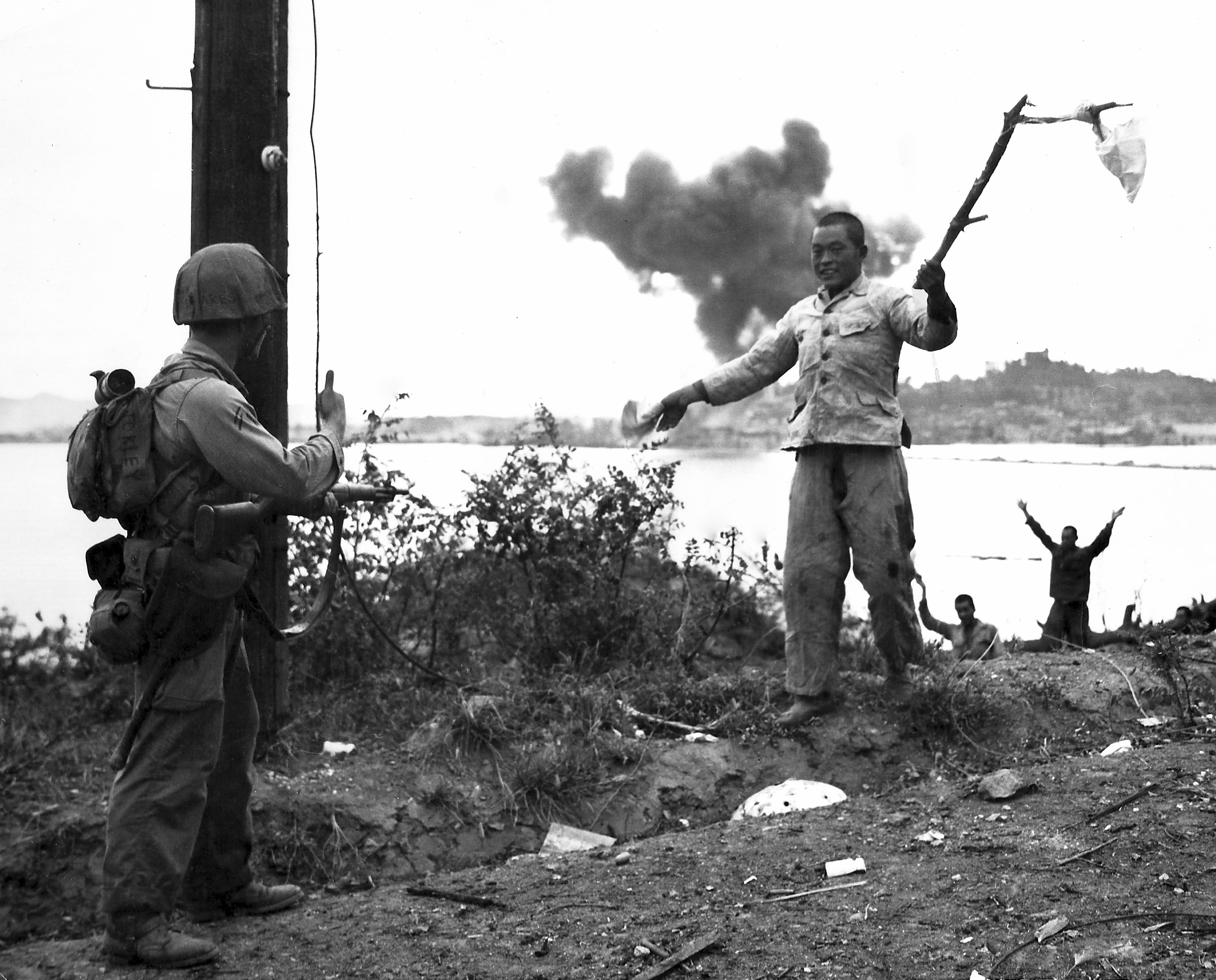
A North Korean soldier waves a white cloth of surrender as he leads his companions into the custody of U.S. Marines on Wolmi-do Island, gateway to Inchon, 15 September 1950.
Photo by Sgt Frank C. Kerr
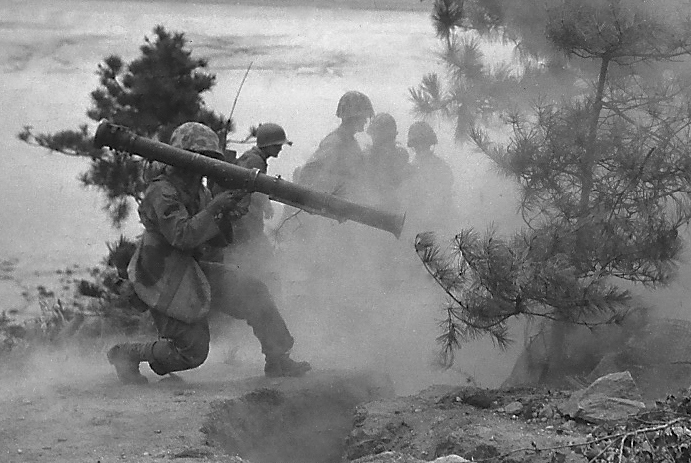
Marine infantry stand by while their bazookaman fires a round into an enemy bunker on Wolmi-do.
Photo by Sgt Frank C. Kerr
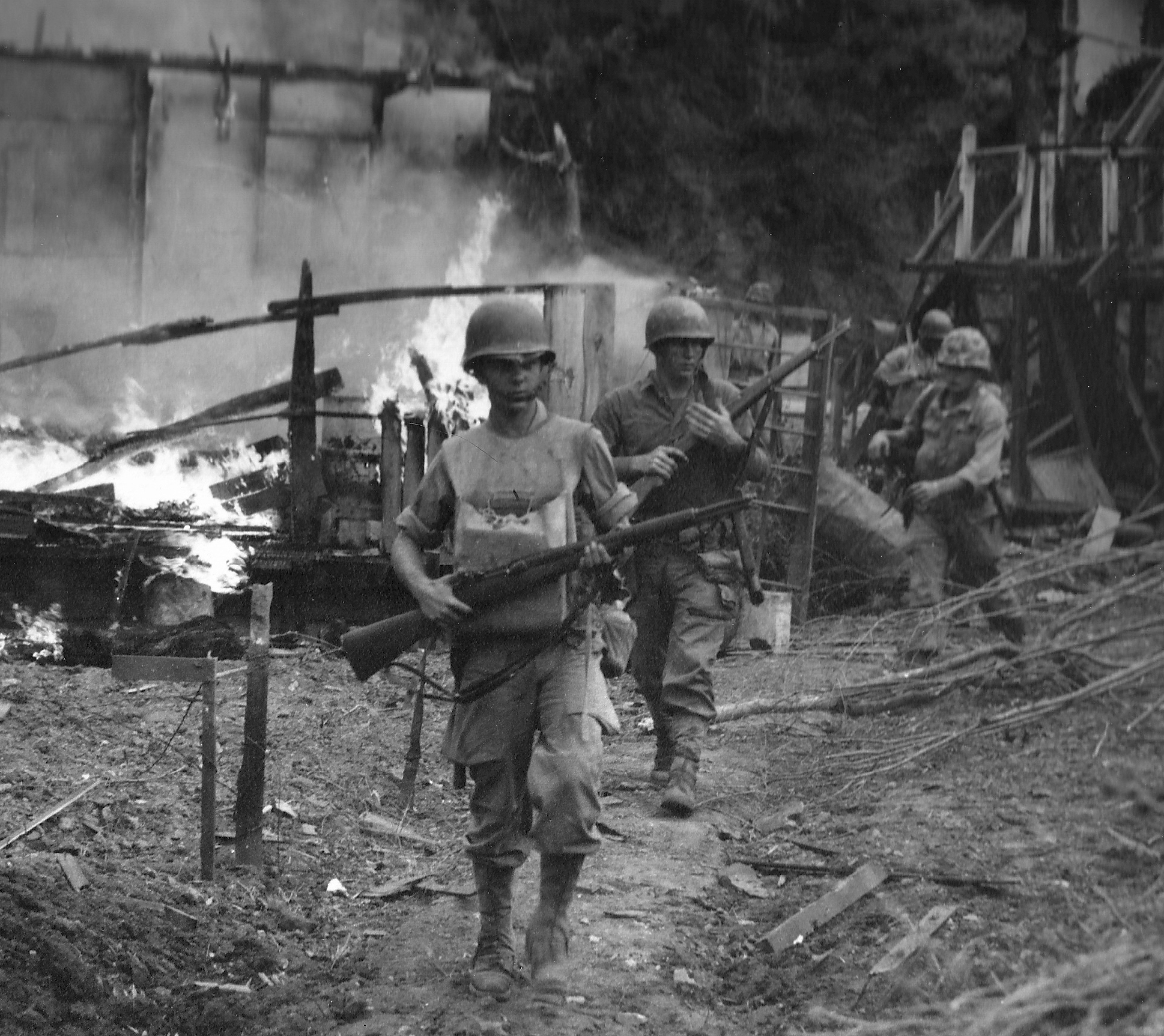
A leatherneck patrol moves past destroyed buildings during mop-up of Wolmi-do Island. Note the canvas leggings on the lead Marine, which would bleach out and yellow over time. North Korean prisoners of war told interrogators the “yellow legs” were the adversary their army feared most.
Photo by Sgt Frank C. Kerr
Yudam-ni
Tucked behind mountain ridges and rocky foothills on the northwestern fork of the Chosin Reservoir lies the remote North Korean village of Yudam-ni. Like every man who marched with the 1st Marine Division in late November 1950, I arrived there with hopes of seeing the Communists driven from the Korean Peninsula, putting an end to the war, and getting back to the states before Christmas. Kilometers behind us along the same perilous route we had come, allied troops were digging in and establishing supply depots at Hagaru-ri and Koto-ri. To our north, behind a veil of rugged mountains, lay the Yalu River and communist China, where the retreating North Korean Army had taken refuge.
As I entered Yudam-ni’s perimeter with the 3d Battalion, 5th Marine Regiment, fires were burning on one of the surrounding hills, the result of a napalm strike earlier that afternoon. Inside the encampment, men of the 7th Marines, who had arrived just ahead of us, huddled for warmth against the biting Manchurian cold. Although most were quiet, alone with their thoughts, there was also an undercurrent of tension in camp, with hard fighting still ahead and a nagging suspicion that Red China was drawing our forces into a trap.
As night fell on 27 November and the temperature began to plummet, I ducked into an abandoned schoolhouse to escape the cold and get some sleep, only to discover scores of other Marines had beaten me to it. I cleared some space, removed my heavy boots and climbed into a sleeping bag with my clothes on. But just as I was drifting off, a frantic voice bellowed from the schoolhouse door, “Get the hell up, the Chinese are attacking!”
Like every Marine in that room, I was immediately back in my boots and grabbing my weapon. When shit hit the fan (like it was that night at Yudam-ni) I served the Corps as a rifleman first and photographer second, so it was my trusty M1 Garand I took with me into the fight, not my camera. Back in the Pusan Perimeter, our military-issue carbine had a nasty habit of jamming at all the wrong times, and the damn thing flat-out refused to budge in the cold of Chosin, so I had traded it for the bolt-action M1. That rifle only fired one round at a time, but at least it worked in a pinch.
The battle was growing in intensity as I broke from the schoolhouse and headed for cover. Small arms and machine gun fire echoed from the foothills and tracer bullets streaked through the dark, making bizarre patterns against the night sky. As the Chinese pressed closer to the camp’s perimeter, alarming reports began coming in from our units fighting in the hills. The 2d Battalion radioed that the enemy had overrun their positions and was headed our way. We hastily organized a firing line to meet them, but a Marine infantry company formed in front of us and counterattacked, driving the Communists back into the hills.
Following a pattern that would repeat during the coming days, the Chinese broke off their assault before dawn, leaving behind a scene of heartbreak and desolation. Our first aid stations were jammed with injured men and still they kept coming; some walking, others carried, many on stretchers. As I moved among them with my camera, a wounded Marine asked with a grin, “How ’bout a picture, Sarge?” before another called out, “You should have been with us last night, Sarge.” I’m no coward, but I was grateful I hadn’t been in the hills with those infantrymen that night. They shared hair-raising stories of ferocious combat; how they had fought until they ran out of bullets, grenades, and men; how they had clubbed the enemy with rifle butts and entrenching tools and finally with their fists, when all else failed.
In one corner of the aid station, I came on a dazed, red-eyed platoon sergeant with a shattered arm and ice-encrusted beard, cursing the Chinese and himself through bitter tears. His platoon had been decimated during the fight, and in his crushing grief the sergeant was blaming himself for the loss of his men. Two wounded survivors of the battle were doing their best to comfort him, but the man was inconsolable. At that moment, my every instinct as a photographer screamed take the picture! To this day, I’m certain it would have made one of the great photographs of the Korean War. Instead, I turned away and moved on. I just didn’t have the heart to take it.
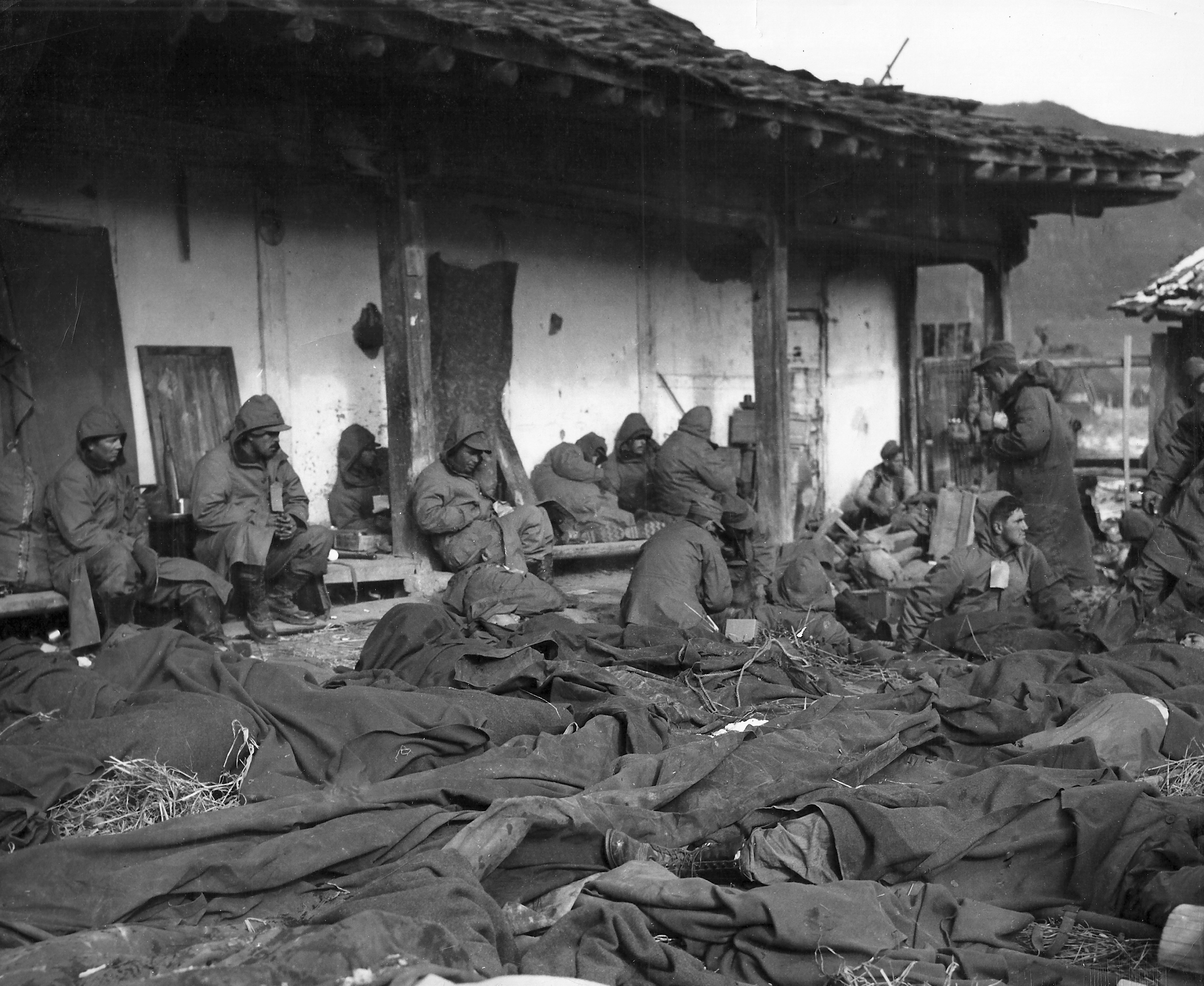
U.S. Marine casualties assemble at Yudam-ni for medical aid and evacuation to hospitals behind the fighting fronts, 28 November 1950.
Photo by Sgt Frank C. Kerr
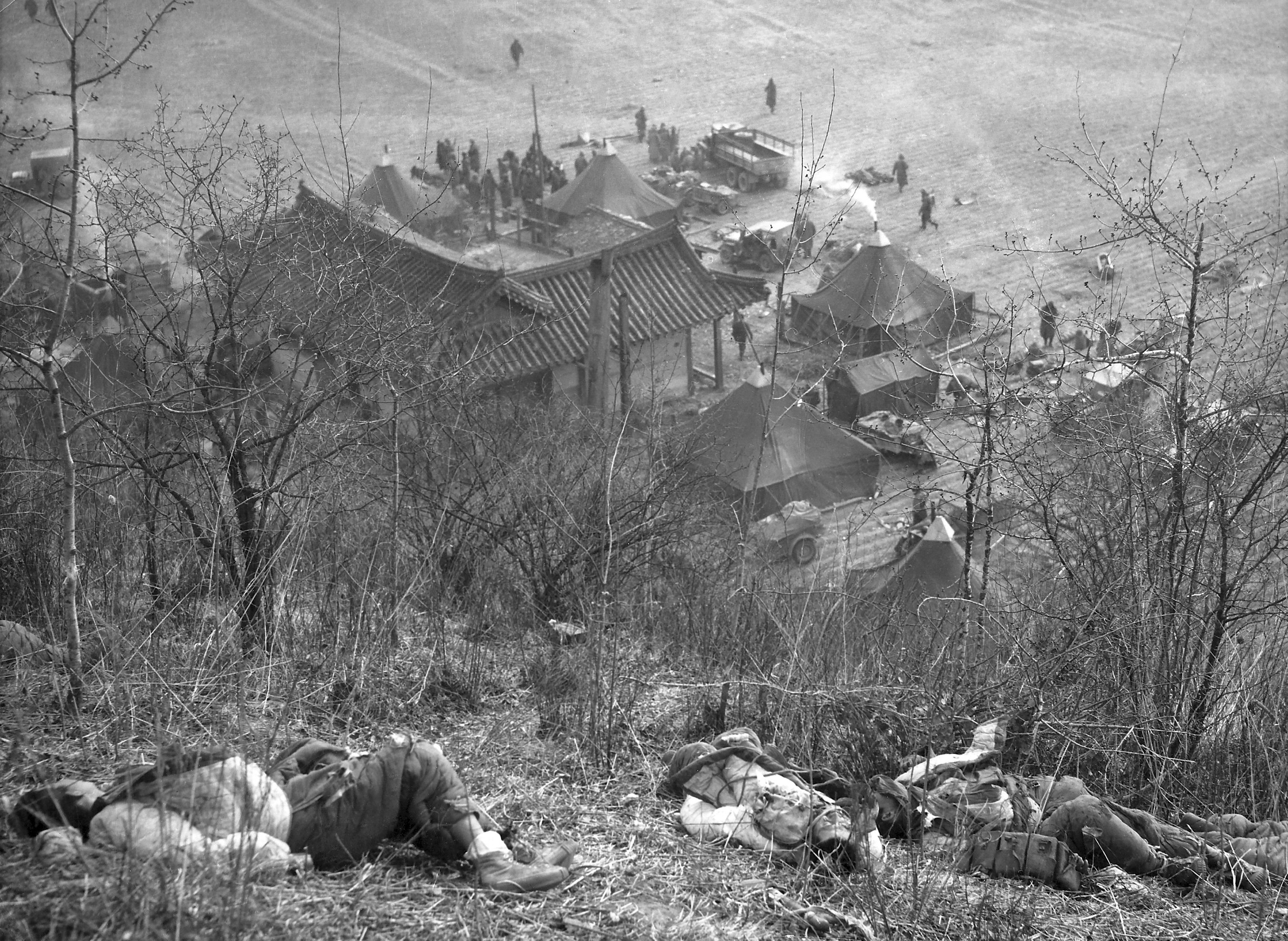
Following a night of fierce fighting, Chinese soldiers lay frozen in death on the hills overlooking the Marine camp at Yudam-ni.
Photo by Sgt Frank C. Kerr
With daylight fading and our troops bracing for another night attack, every able-bodied man in camp armed himself, regardless of rank or position. Even our wounded were asking for weapons. I joined two Marines in their machine-gun nest on the perimeter, helping fill sandbags and gathering extra grenades and ammunition before settling in for a tense night keeping watch.
As the evening grew longer and the air turned colder, my eyes began playing tricks on me. Shapes moved in the dark where there were none, and trees transformed into enemy soldiers then back into trees again. By the small hours of the morning, my brain was numb and so were my extremities as the temperature kept plunging—by some accounts as much as 35 below zero. I stomped my feet to keep the blood moving and thought of anything warm: hot coffee, the beaches of Southern California, even those miserably hot August days in the Pusan Perimeter. But mind over matter was no defense against such weather. Ask any man who lived through the Chosin campaign and he’ll tell you that once the Manchurian cold got inside you, it was there to stay.
The feared assault never happened that night, but with China fully committed to war, the military situation in Korea had been turned on its head. The 1st Marine Division was encircled at Yudam-ni, Hagaru-ri, and Koto-ri by a massive force of more than 100,000 enemy soldiers, and it didn’t take a genius to realize that General MacArthur’s grand plan to drive the Communists from the Korean Peninsula before Christmas was now just a pipe dream. Instead of celebrating the holidays at home, we would be punching our way out of a Communist trap—marching 23 hard kilometers along a single-lane dirt road through rugged terrain, arctic-like cold, and enemy lines to reach the nearest supply depot at Hagaru-ri on the southernmost tip of the reservoir.
While the brass was drawing up plans to withdraw from Chosin, the Chinese were making our lives miserable with constant mortar barrages that drove us into overcrowded bunkers, and snipers who roamed the hills picking men off from the high ground. Back at Pusan, a World War II veteran told me to ditch the flashgun on my Graflex camera, concerned its shiny reflector would attract North Korean sharpshooters. I had seen more than a few Marines felled by that hidden enemy since then, but it never felt personal until one of those sneaky bastards put me in his crosshairs at Yudam-ni. I was crossing a frozen rice paddy, minding my own business, when a bullet struck the ground a few feet in front of me. For a brief moment, I thought it might be a stray round, until the next one hit even closer. That was my cue, and I took off running with bullets kicking at my heels. There are a few undeniable truths one learns in war, not the least of which is: it’s no fun when someone is trying to kill you.
On 30 November, another bitterly cold day at the reservoir, preparations were well underway for abandoning Yudam-ni, which our fed-up and frostbitten troops were now calling “You-damn-me.” As ordered, we burned our excess gear, needing all our strength to carry ammunition and food on the difficult march ahead. In addition to my camera and rifle, I packed two extra bandoliers of ammunition, a couple of hand grenades, my sleeping bag, an extra pair of socks, and a .45-caliber pistol, which I shoved in my pocket for use as a last resort. Then I pulled on dry clothes and burned all the rest. Nothing was to be left for the Chinese.
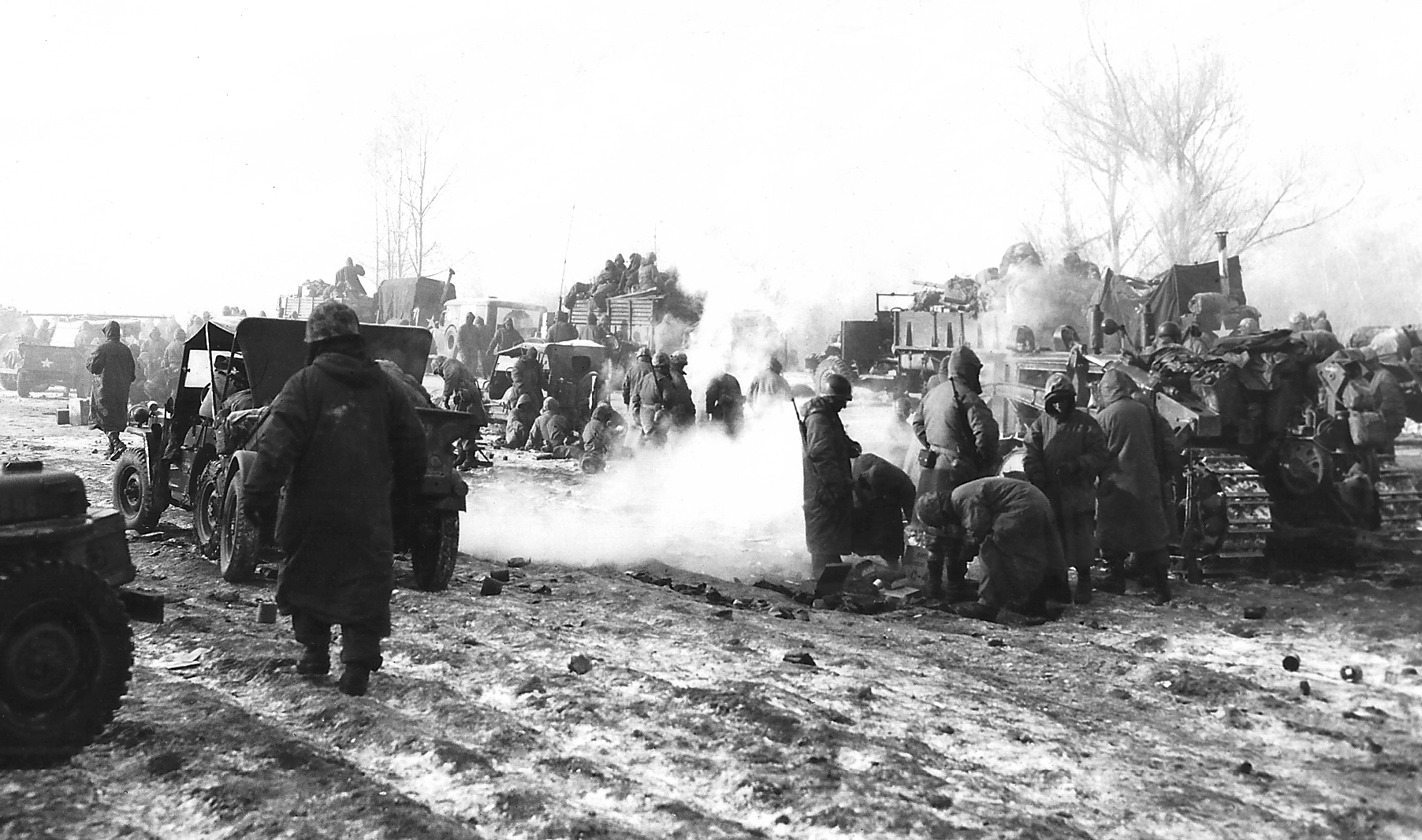
After fighting off three Chinese divisions, men of the 5th and 7th Marine Regiments burn their surplus gear and prepare to withdraw from Yudam-ni and the Chosin Reservoir on 30 November 1950.
Photo by Sgt Frank C. Kerr
Strange as this might sound, the bigger concern among most Marines in camp was not the Chinese Army, but how the world and those who served would view our withdrawal from Chosin. It is a point of great pride that U.S. Marines never turn from a fight, and by pulling up stakes and heading south, the men worried they were tarnishing the Corps’ long and proud heritage. It hardly mattered that more Chinese would be in front of us than behind, or that the division’s commanding officer, General Oliver P. Smith, insisted we were merely “attacking in a different direction.” On a rational level, perhaps that made sense, but it sure didn’t make the boys feel any better. Sitting around a Coleman burner, eating rations on our last day at Yudam-ni, one grizzled leatherneck snarled, “If I get out of here and anyone says we retreated, I’ll let him have it.”
Watching the 1st Marine Division begin its epic withdrawal from the Chosin Reservoir on 1 December 1950 still moves me in ways I can’t explain. Weeks earlier, I had witnessed the spectacular preinvasion bombardment of Inchon, but what I saw that morning at Yudam-ni struck a different kind of emotional chord. Beneath a thick haze of smoke from burning clothes and equipment, a seemingly endless column of men and military vehicles began the long trek south. Sick and injured Marines were piled onto trucks and jeeps, while alongside them trudged the walking wounded—men with bandaged heads, bullet-shattered arms, and frostbitten hands incapable of working a rifle.
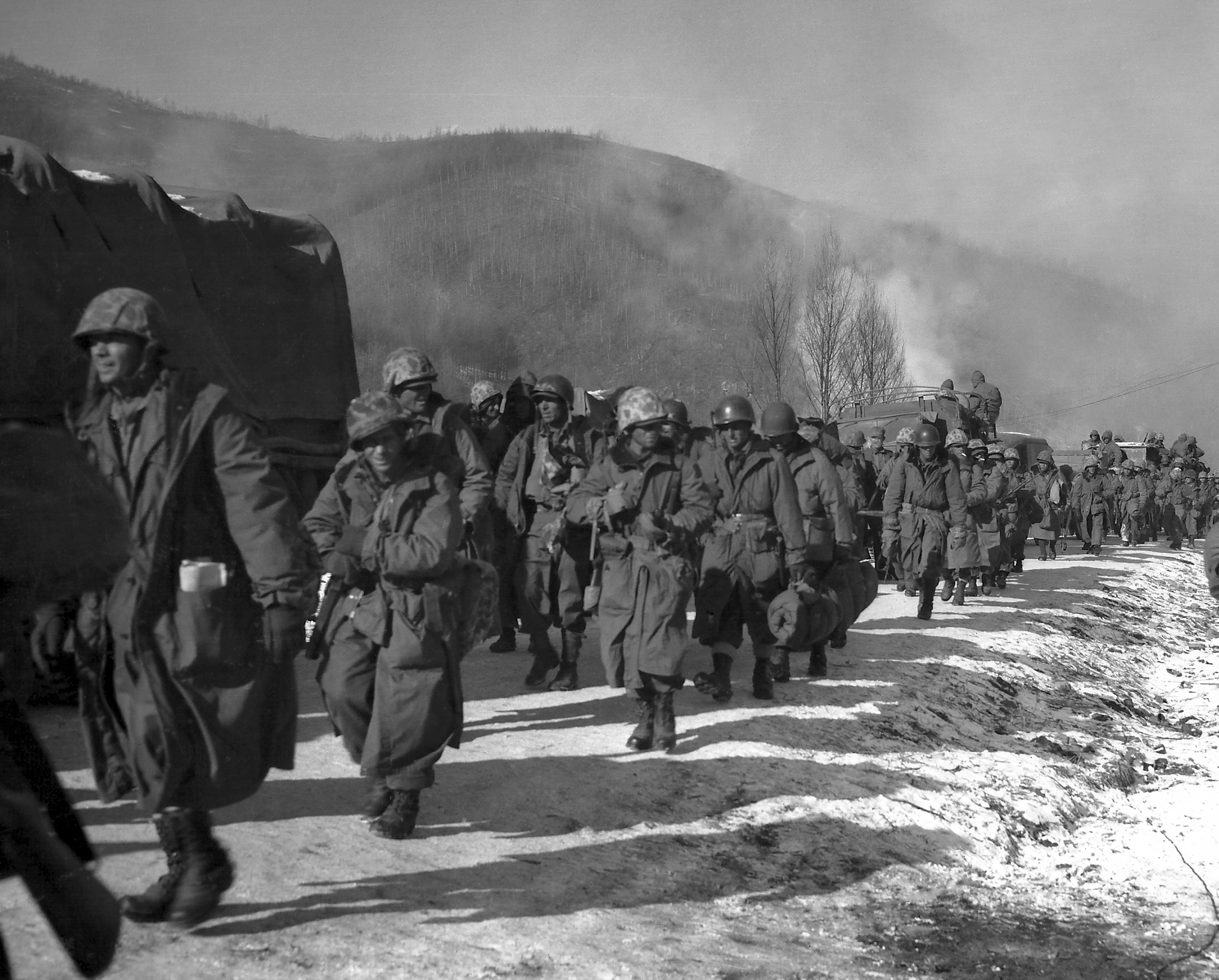
Yudam-ni, 1 December 1950. Taking their wounded and their equipment, 5th and 7th Marines begin their long march toward Hagaru-ri.
Photo by Sgt Frank C. Kerr
The division’s only tank at Yudam-ni rumbled toward the head of the convoy as the 5th Marines’ regimental commander, Lieutenant Colonel Raymond L. Murray, strode the line shouting directions and offering encouragement. His marching orders were to keep the train moving, but progress was painfully slow. It seemed another enemy roadblock was always around the next bend, and our vehicles were constantly breaking down, their batteries drained and motor oil turned to sludge by subzero temperatures. Sometime in the late afternoon, as a biting Manchurian wind whistled through the mountains, one truck lost control, swerved off the narrow, ice-covered road, and rolled over the bank, crushing and trapping the men inside. As the convoy came to a halt, exhausted Marines jammed their rifles, bayonet first, into the frozen earth and leaned against them to rest. Occasionally they fell asleep standing up, which seems impossible until you have witnessed a man utterly worn out by the rigors of combat, constant marching, and bone-numbing cold.
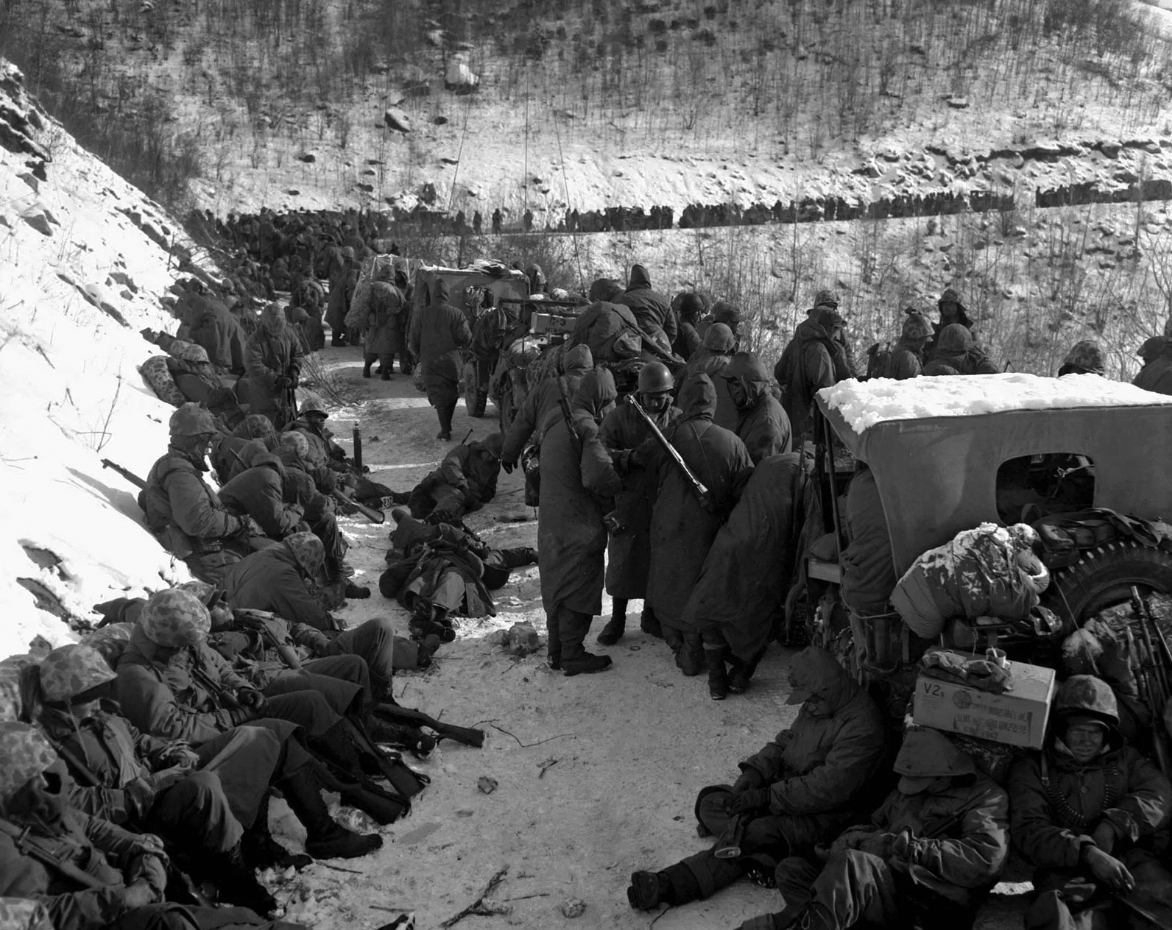
Chosin Reservoir, ca. December 1950. Marines of the 5th and 7th Regiments halt on the main supply route between Yudam-ni and Hagaru-ri, while lead units clear the ridges of enemy soldiers.
Photo by Sgt Frank C. Kerr
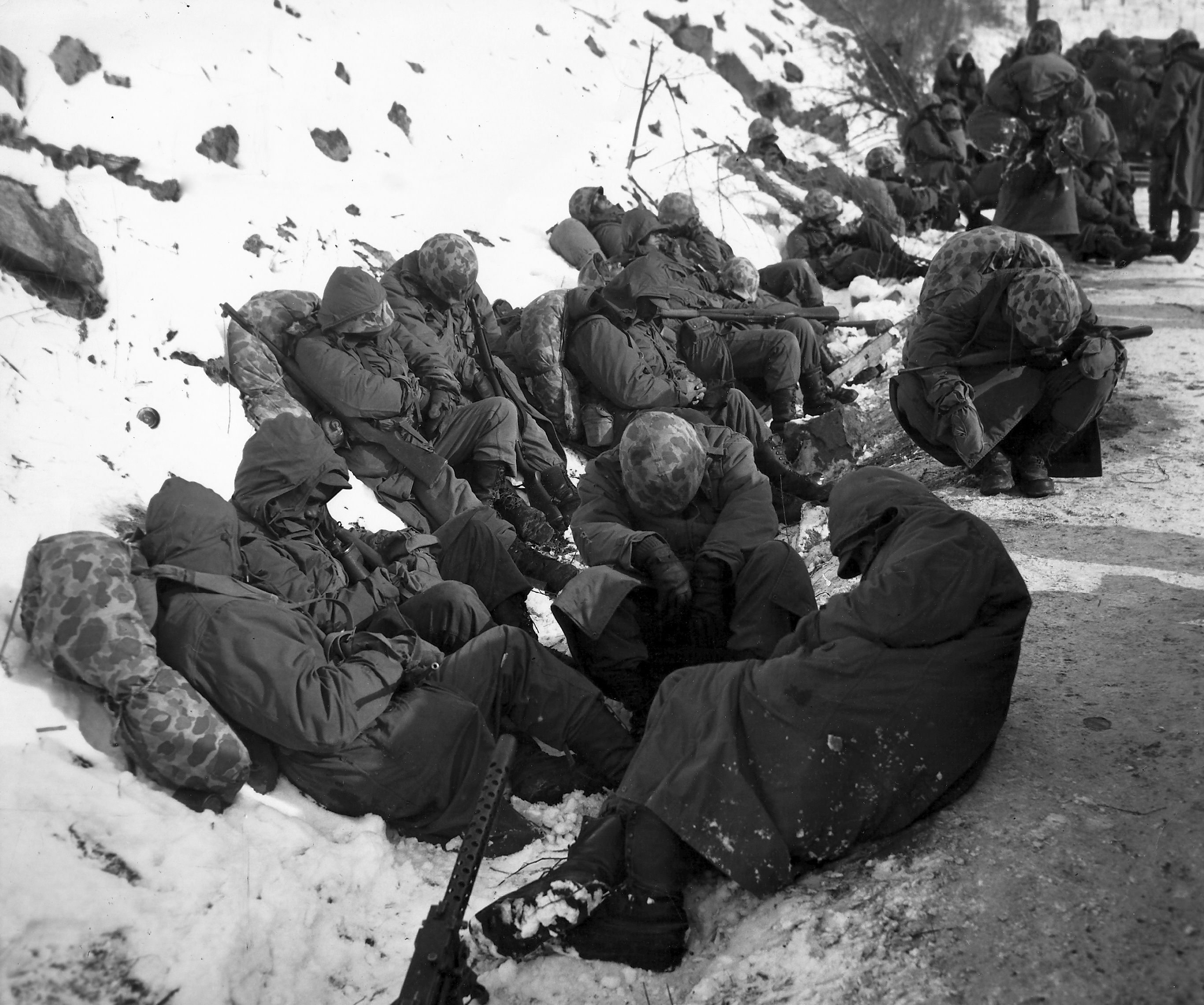
Enduring bitter cold and relentless combat, leathernecks of the 7th Marines take a break during their withdrawal from the Chosin Reservoir.
Photo by Sgt Frank C. Kerr
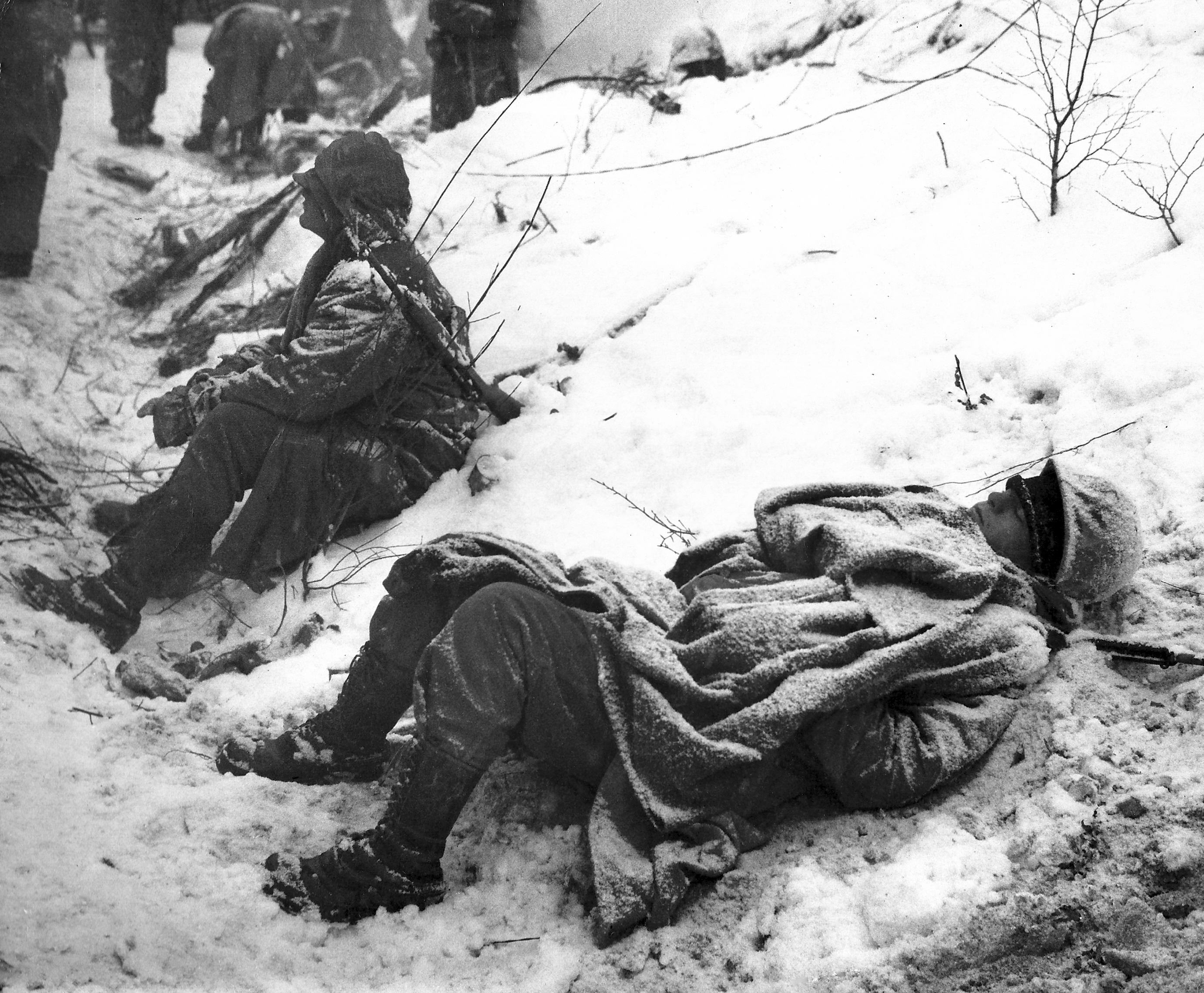
Exhausted Marines take advantage of a lull in the fighting to catch some much-needed rest. The cold at Chosin was so intense that a man could lie down, fall asleep, and freeze to death.
Photo by William R. Keating, USMC, Record Group 127, N-A5458, National Archives and Records Administration
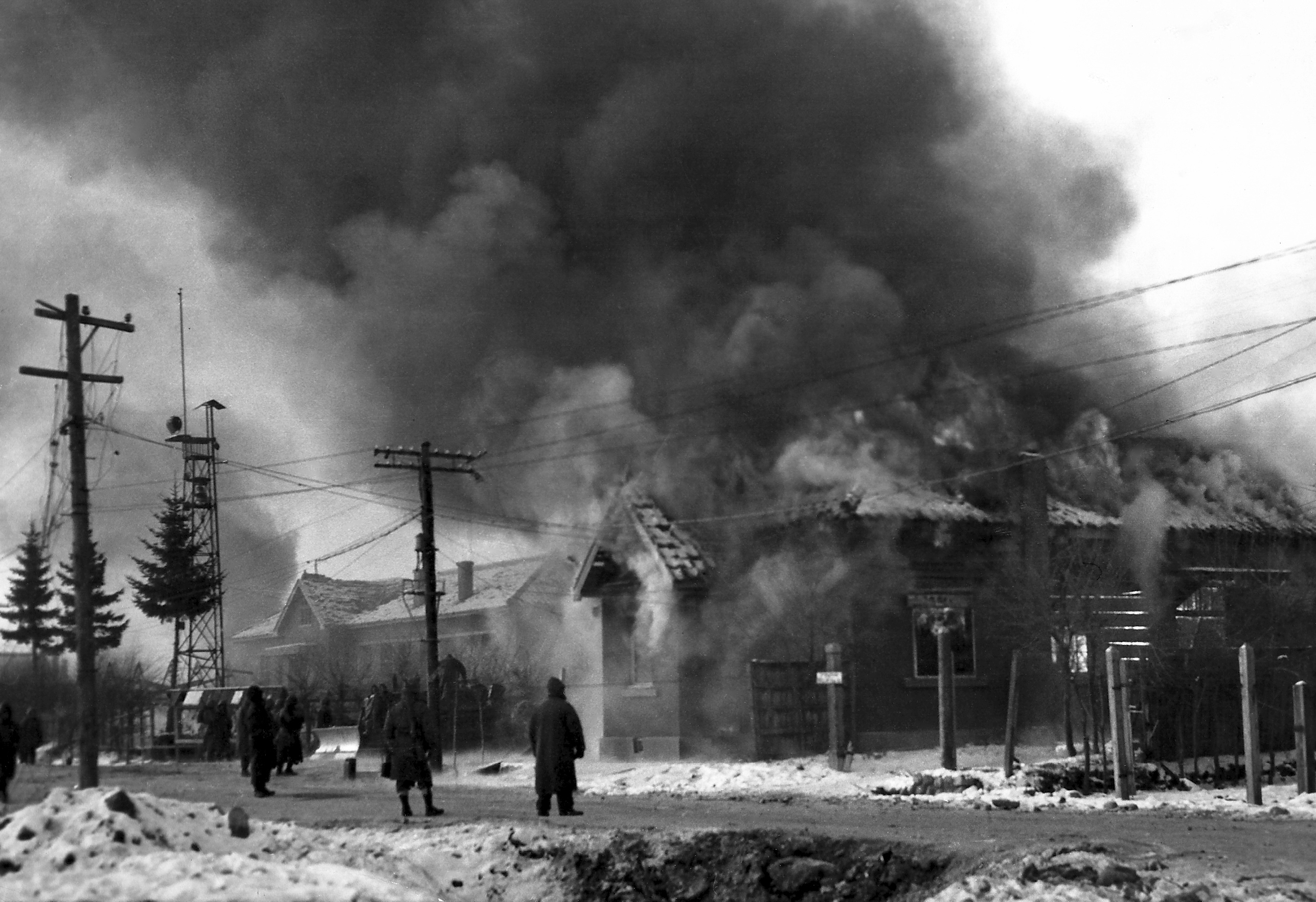
Before withdrawing, men of the 1st Marine Division burn anything that might be of value to Communist forces in the North Korean town of Hagaru.
Photo by Sgt Frank C. Kerr
In fits and starts, the column continued its snail’s pace toward Hagaru-ri, while our troops cleared enemy roadblocks, trudged through windblown drifts, along rocky chasms, and past hillsides scorched by napalm and littered with the charred bodies of Chinese dead. In our haste to escape the reservoir, we marched through the night, moving quietly in the mountain dark save for the clank of rifles against canteens and the crunch of our boots in snow. Even the wounded stayed silent, gritting their teeth against the pain and trusting their fellow Marines to get them through. When there was important news to share, it traveled by word of mouth, spreading in hushed voices along the column. “Seventy-fives to the front,” one man would whisper to the next, “and stay clear of the ditches, they’re mined.”[1]
As morning broke on 3 December, and with a light snow falling over the North Korean high country, I ran into Corporal Walter Six, a combat cameraman from Sharonville, Ohio, who had trained with me in the Reproduction and Photographic Service Section at Camp Pendleton. Together we walked the column, focusing our cameras on the snaking line of haggard, unshaven men. It was hard to believe these were the same Marines who had marched so confidently into North Korea just a few weeks before. Helmets were pierced and parkas torn by bullets and shrapnel, and the strain of combat was etched deep in every dead-eyed, wind-burned face. I swear, in seven days those boys had aged seven years.
With dusk creeping over the reservoir and with it the threat of another nighttime attack, the column’s pace quickened toward Hagaru-ri. When we reached the outskirts of town, and without orders being given, our weary troops set exhaustion aside, closed ranks, and marched square-shouldered and proud through the camp’s perimeter. It was a stirring sight to see, and more than a few battle-hardened men had tears in their eyes and lumps in their throats watching those “magnificent bastards” march into Hagaru-ri that night.
Hagaru-ri
Off the road and clear of the Chinese Army—at least for now—Walter Six and I found ourselves in a hut with hot coffee, plenty of rations, and a glowing stove that filled the room with glorious heat. It was there that I reconnected with my good friend and fellow still photographer, Corporal Peter MacDonald, who sat us both near the stove, removed our boots, and rubbed our frostbitten feet until the blood was flowing again. After pouring coffee, Pete shared the latest news from the war. None of it was good.
The Chinese had surrounded Hagaru-ri and cut off Koto-ri, our next supply depot 18 kilometers farther south. And if that wasn’t enough of a gut-punch, the U.S. Eighth Army was in full retreat from North Korea, while three Army battalions on the reservoir’s east side had been overrun and chopped to pieces. Just a few weeks earlier, those same GIs had relieved our regiment and we had tossed the usual wisecracks at each other, as soldiers and Marines often do. Now, a lot of those boys would never see home again.
It was astounding how quickly the war had turned. With its numerically superior army, China was out to exterminate the 1st Marine Division piecemeal, denying it the supplies and reinforcements necessary to reach its ultimate destination, the port city of Hungnam, where preparations were underway to evacuate our troops by ship. The situation looked bleak, but I still had a job to do.
With fresh film in my camera, I wandered through camp looking for photographs to take and eventually came on a group of Marines warming themselves by a fire. A few had set canteens close to the heat to melt the ice inside, while another was so fatigued, and his feet so numbed by frostbite, that he didn’t realize his boot was burning until a sleepy-eyed Marine beside him said, “Hey, pal. Your foot’s on fire.”
As the boot was snuffed out, a visibly shaken combat engineer joined the circle. The man had spent a hard week helping build a runway at Hagaru-ri while under enemy fire and his nerves were shot. “We’ll never make it out of here,” he muttered anxiously. “They’ll slaughter us.” Without lifting his eyes, a bearded Marine growled back, “Shut the hell up.” Message delivered; that engineer never spoke another word.
During the predawn hours of 6 December, U.S. Marines, British commandos, and remnants of the Army’s 31st and 32d Infantry, 7th Division, began burning extra gear, rations, and clothing in preparation for departure from Hagaru-ri. Elsewhere, teams of men got busy putting the town’s huts and buildings to the torch, burning anything that might give shelter to the Chinese once we moved out. Forced from their homes, North Korean civilians poured into the streets to join the allied withdrawal, taking whatever possessions they could carry.
Witnessing such abject human misery was nothing new to those of us who served in the war. On a September afternoon during the Second Battle of Naktong, the platoon I was shadowing came on a river of fleeing South Korean refugees; mostly women, children, and babies. Some of those wretched souls were wounded, all of them were traumatized. More heart-wrenching still was the sight of civilians hopelessly trapped in the crossfire of battle, not knowing what to do or where to turn, frozen like deer in headlights until they were finally gunned down. It is a sad fact of war that innocents get hurt and innocents die, but that doesn’t make it any easier to swallow.
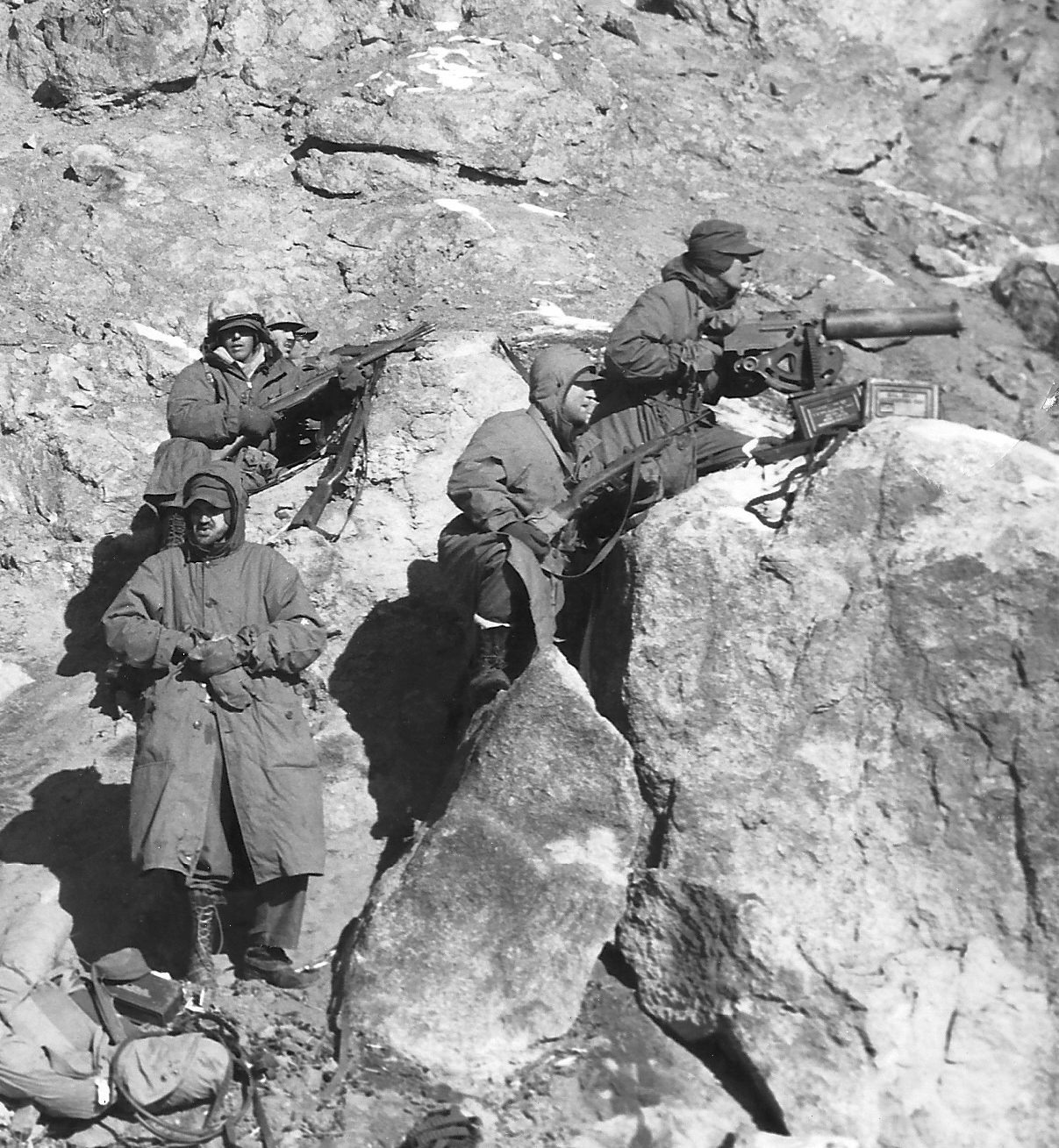
The infantrymen of 1st Marine Division take to a rugged hillside to engage Chinese troops who have set up a roadblock on the road from Hagaru-ri to Koto-ri, 6 December 1950.
Photo by Sgt Frank C. Kerr
On 6 December, a kilometers-long convoy of some 10,000 allied troops began evacuating Hagaru-ri along a dangerous stretch of road christened “Hell Fire Valley,” a name bestowed by British commandos following a deadly ambush there just days before. In short order, our advance units began making enemy contact, and Walter Six and I hurried forward to capture the action. At the head of the column, we found Marine infantry engaged in a furious firefight with Chinese entrenched on a rocky hillside. Flushed from their hiding places, the Communists began clawing their way up the slope to escape, but most never made it. As our troops picked them off one by one, a Marine Corsair came swooping in and blasted the hill with napalm—a particularly vicious weapon of war and a godawful way for men to die.
Having delivered its lethal payload, the Corsair buzzed low over the tactical air controller’s jeep where Corporal Six and I were standing, then disappeared over the hills. Within seconds, I heard the distinct chatter of a machine gun and felt the sting of a bullet as it grazed my face. Another round clipped Walter and a third went through the cheek of a Marine standing between us. As I was helping the injured man find cover, another spray of bullets peppered the jeep and the ground around us, prompting that wounded Marine to spit blood and rage toward the hills, “Damn it! If you’re going to kill me, kill me, but stop trying to scare me to death!”
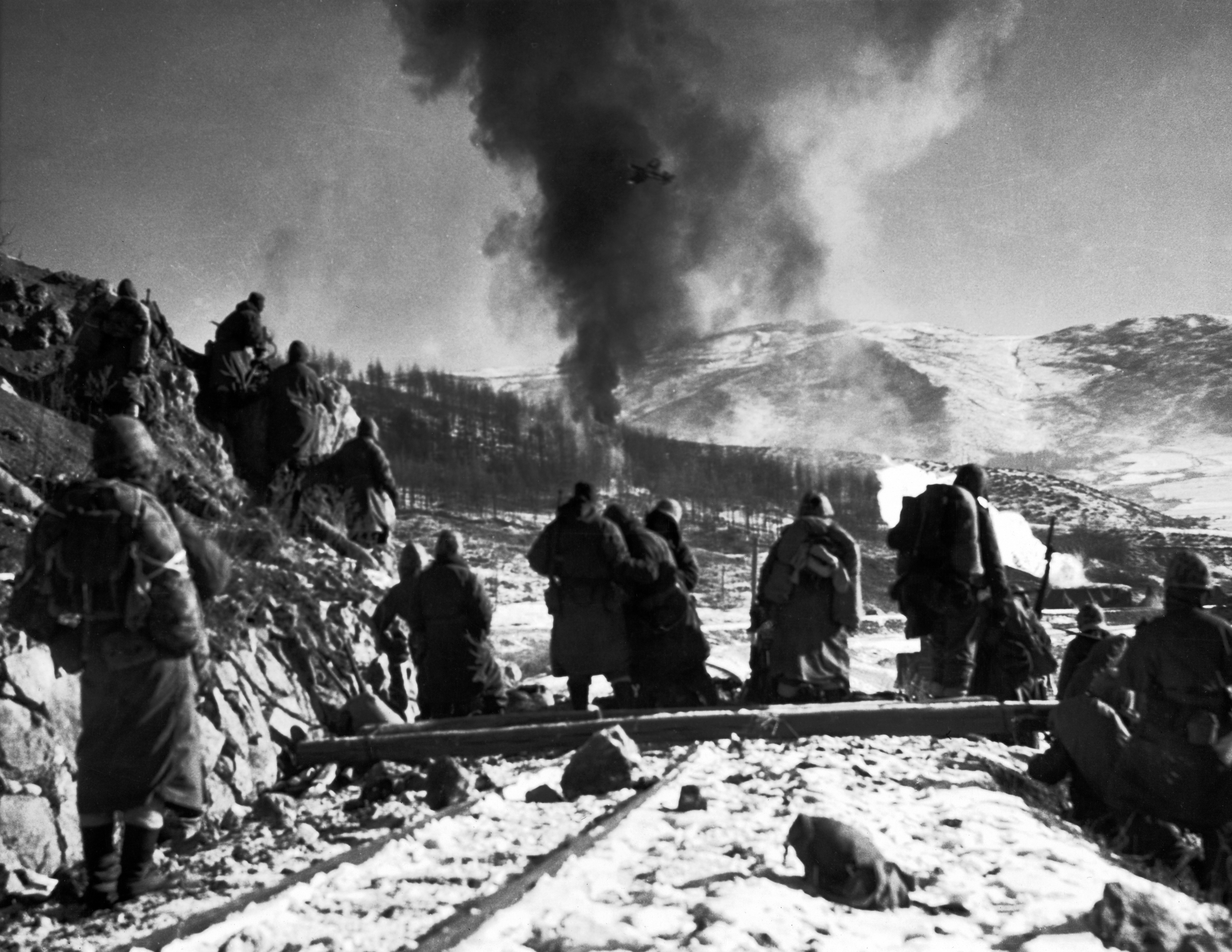
A Marine Corsair (partially obscured by smoke) offers close air support to ground units, dropping napalm on an enemy roadblock that was delaying the allied advance toward Koto-ri.
Photo by Sgt Frank C. Kerr
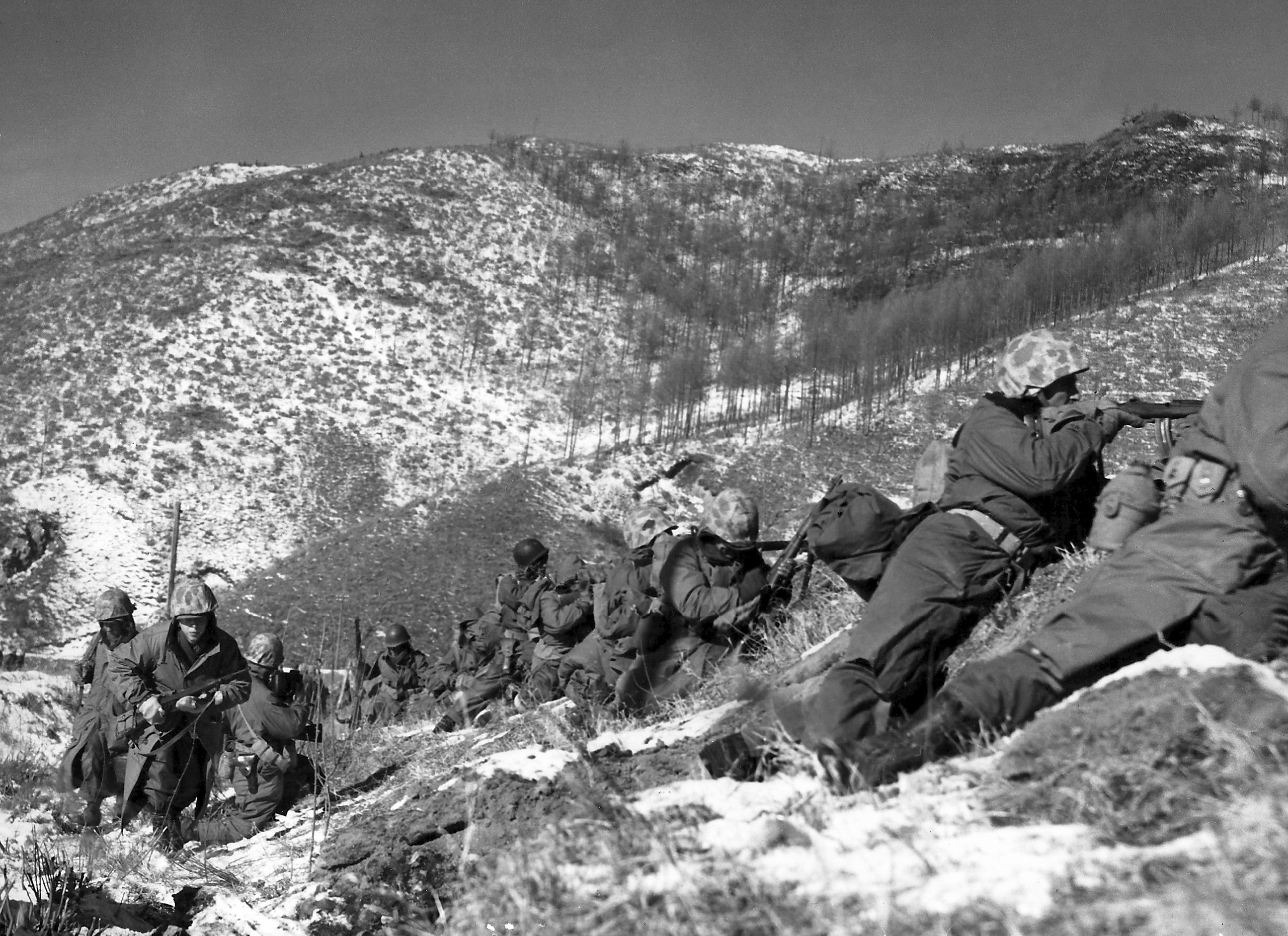
U.S. Marine infantrymen engage enemy forces attempting to stop the allied withdrawal from Hagaru-ri to Koto-ri.
Photo by Sgt Frank C. Kerr
As combat cameramen, Corporal Six and I held one decided advantage over the infantry: carte blanche to move whenever and wherever we wanted. And at that moment, what we wanted was to move our butts back to the middle of the column where the action wasn’t quite so warm. As it turned out, the middle was exactly where the Chinese decided to strike next. Sticking to their playbook, the assault came at night, announced with a flurry of hand grenades followed by a series of bugles and whistles—signals from their officers directing the attack. Suddenly, the enemy was everywhere, ghostly shapes in quilted winter uniforms, firing rifles and burp guns, hurling grenades, and screaming like men possessed.
Walter and I threw ourselves into a roadside ditch and returned fire, but bullets were coming in so thick and fast you could barely lift your head for fear of getting it blown off. Our outnumbered infantry battled furiously, but each time an enemy wave was beaten back, another would come rushing down from the hills. The number of Chinese soldiers was staggering, and it wasn’t long before the fighting on that narrow stretch of dirt road was fixed bayonets and hand-to-hand.
Amid this battle frenzy, I became aware of someone setting up a machine gun behind me, but the action was so close and confused I couldn’t be certain if he was friend or foe. “Are you a Marine!?” I called in the dark. The man never answered, but his weapon commenced firing in the enemy’s direction so I figured he must be one of the good guys. When the Chinese broke off the ground assault, their mortars took over. As shells began raining down, I spotted one of their soldiers rushing my position and rose to take a shot. At that instant came the zip of an incoming mortar round, followed by a deafening blast that showered me in frozen dirt. A dying moan came from the machine gunner behind me. Hit by shrapnel, he was gone before I could reach him.
In time, Walter and I realized we were the only able-bodied Marines left defending that bloody patch of turf. The bodies of dead Americans and Chinese lay piled in front of our ditch like sandbags, catching the bullets meant for us, and with our ammunition running low, we figured it was time to make a dash for the opposite side of the road. My feet were like blocks of ice, and I stumbled rather than dashed across, but we both managed to find cover and hunker down for the next assault.
Fortunately for us that assault never came. Instead, the gray dawn revealed a remarkable sight almost too surreal to be believed. Across the blood-soaked snow, where the frozen dead lay twisted into grotesque shapes and the wounded begged for help, survivors from both sides wandered the battlefield in a daze, observing some strange, unspoken truce dictated by pure exhaustion. It was dreamlike and fascinating to watch, and the spell remained unbroken until a Marine bulldozer arrived to clear our destroyed vehicles from the road. As the enemy melted back into the hills, the wounded they left behind eyeballed us warily, expecting to be executed at any moment. But we were so preoccupied with our own casualties that we ignored them, not even bothering to confiscate their weapons until our somber work was done. Before long the wounded were secured, the dead cataloged, and our battered column was rolling again toward Koto-ri—one step closer to the sea.
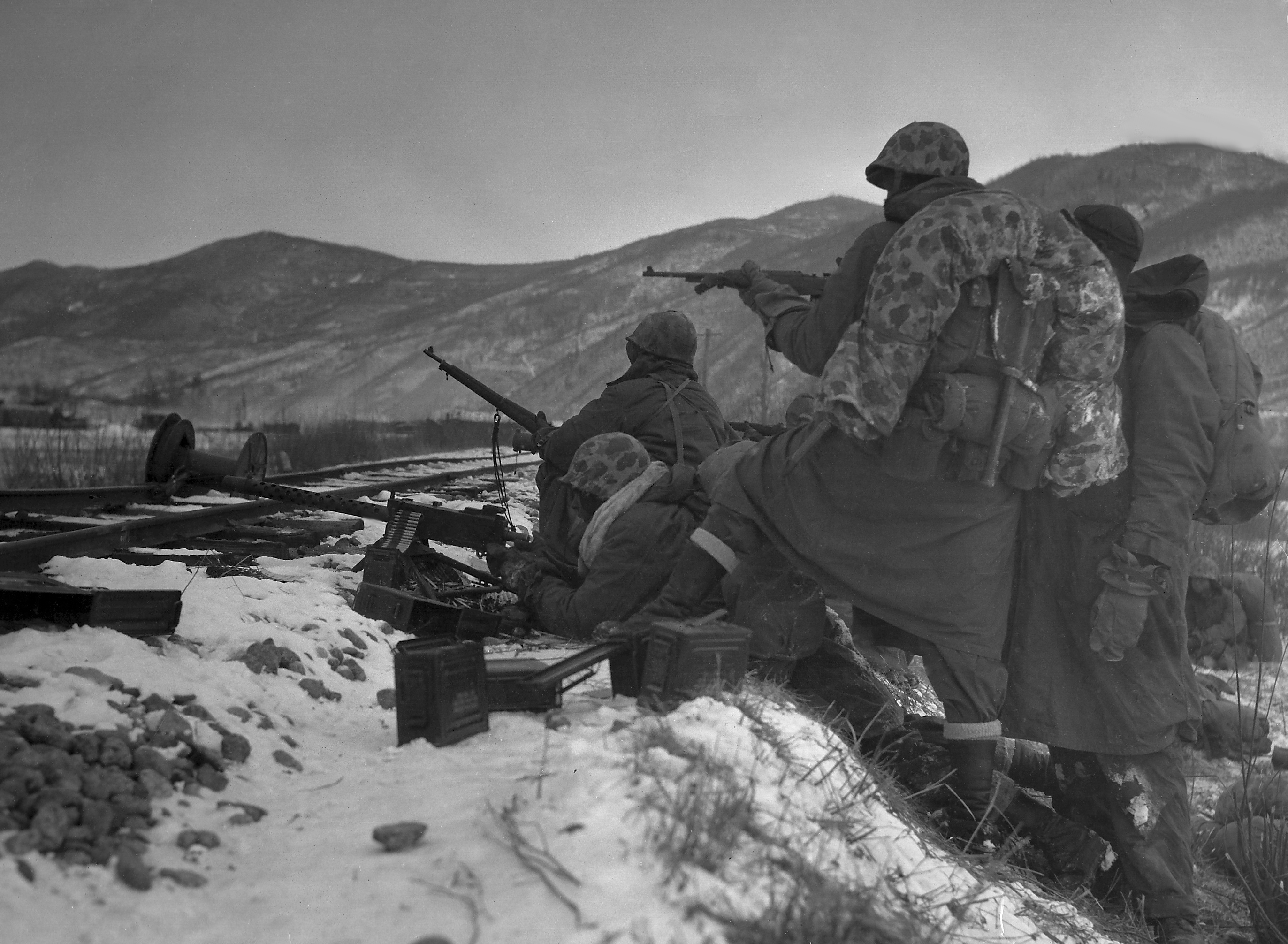
Leathernecks counter fire with fire when attacked by well-entrenched Chinese Communists during the breakout from Chosin.
Photo by Sgt Frank C. Kerr
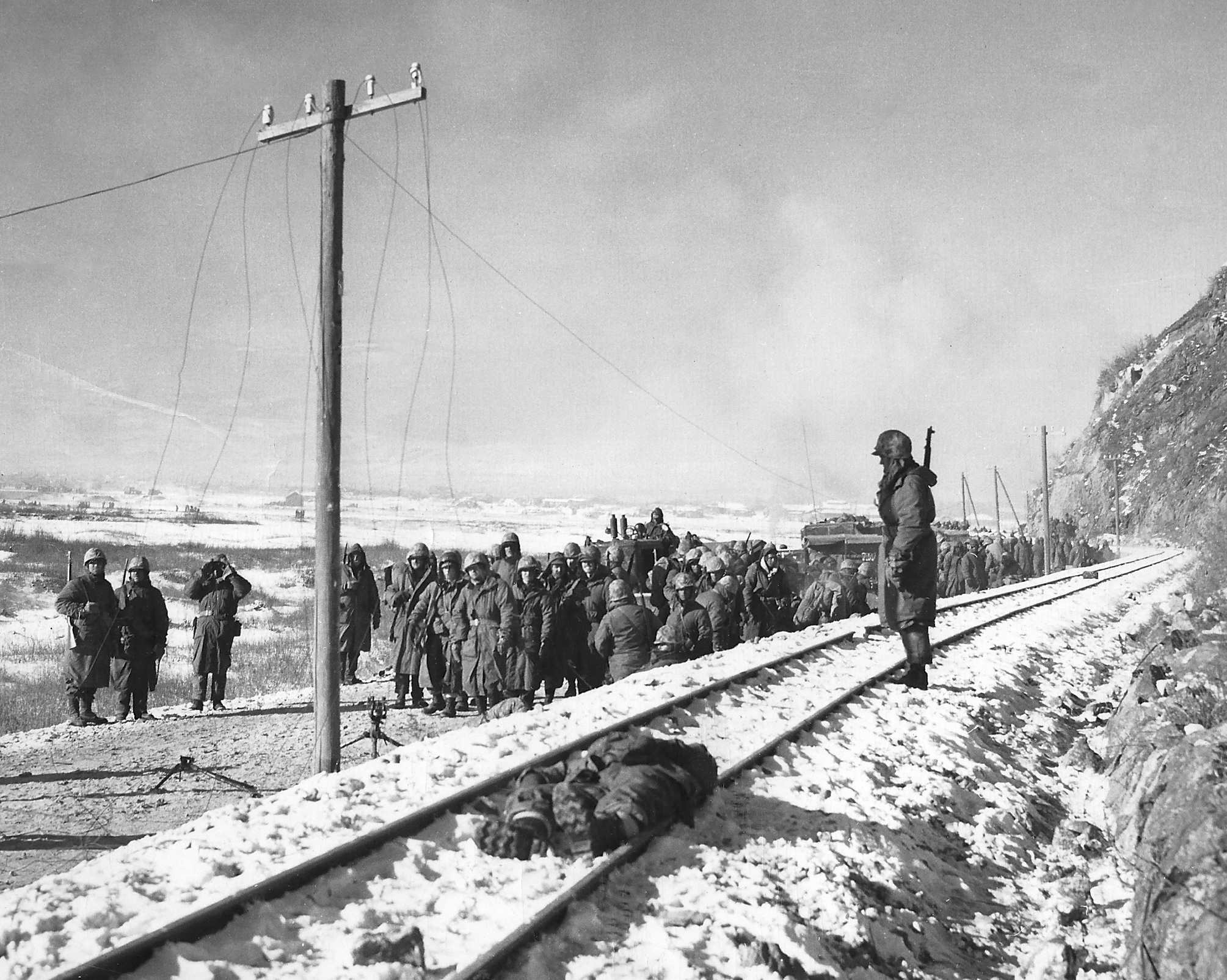
On the road to Koto-ri, leathernecks of the 1st Marine Division halt temporarily near the body of one of their own, 6 December 1950.
Photo by Sgt Frank C. Kerr
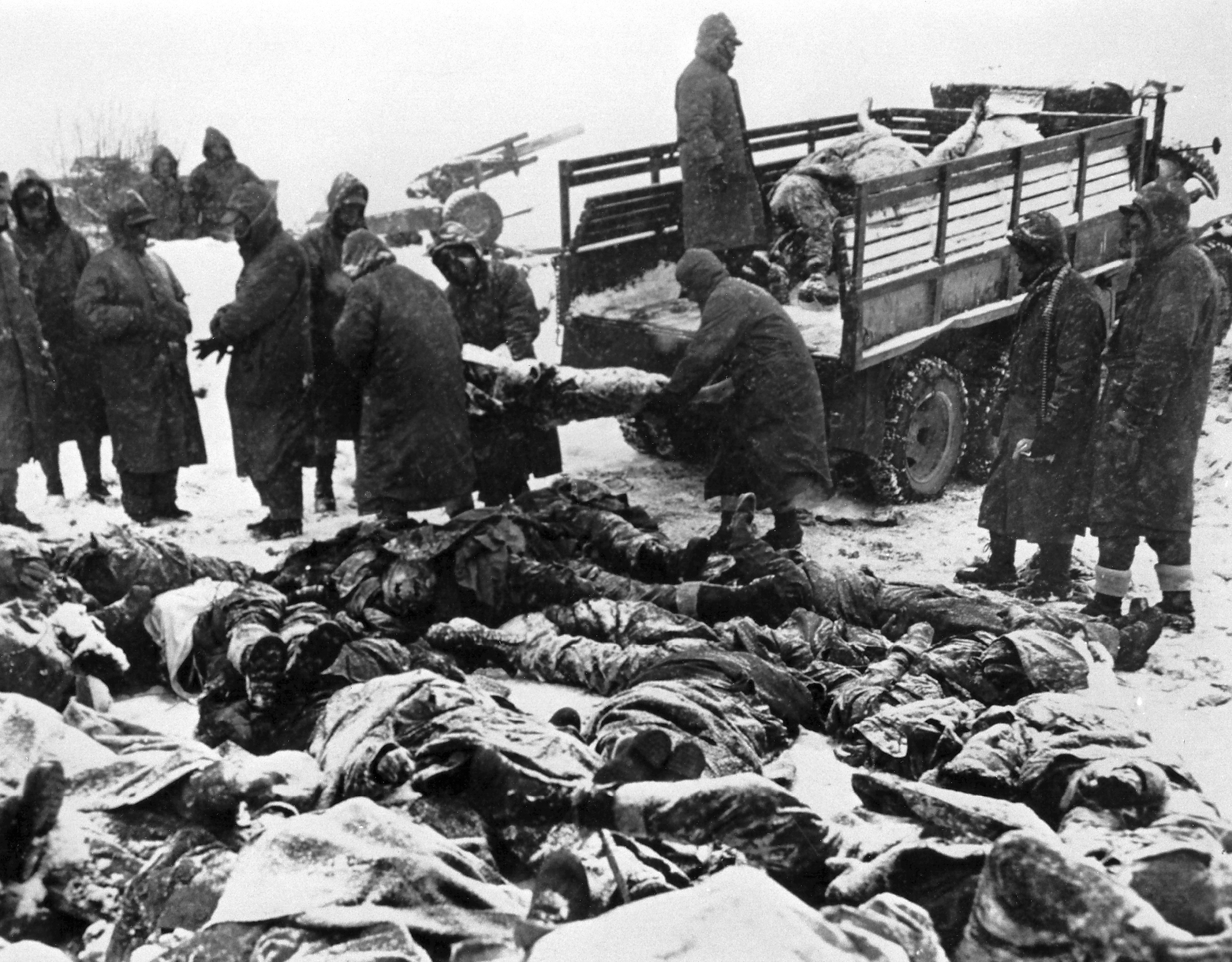
A mass burial of allied dead at Koto-ri, 8 December 1950.
Photo by Sgt Frank C. Kerr
Koto-ri
My first night in the hamlet of Koto-ri was spent in a tent with Marine correspondents, infantrymen, and a handful of British commandos. I was too tired for conversation and fell into a deep sleep until awakened by sporadic gunfire and a howling snowstorm blowing through the valley. This was bad news for all of us. Until the weather cleared, our troops would be deprived of critical air support and the ability to evacuate our wounded.
Around midmorning I left the tent and walked the camp’s perimeter, taking pictures of burial parties going about their grim business in the storm, unloading the frozen corpses of allied dead from trucks and stacking them for burial. When night returned, I took shelter with other Marines in a North Korean hut whose owner planned to evacuate with UN forces come morning and start a new life in the south. The man was all smiles as he tore planks from his home and burned them to keep us warm.
By sunup the weather had cleared and I went into the hills at Funchilin Pass to photograph an infantry company guarding a bridge the Communists had blown to keep the division trapped at Chosin. The Chinese had done a thorough job of it, leaving our combat engineers the herculean task of constructing a new crossing. I lingered awhile, took a few more pictures, then fell in with a Marine lieutenant who was taking his patrol south to make contact with a relief force coming north.
The patrol had not gone far before encountering a squad of Chinese soldiers who must have had their fill of war because they sent out a lone volunteer to surrender. The Marines were understandably wary, having learned from hard experience it might be an enemy trick, but when the rest of those Chinese saw their buddy was not shot, they left their weapons and emerged with hands in the air and nervous smiles on their faces.
Farther down the road, after brief firefights, still more Communists surrendered and were sent to the rear to join their comrades. For a time, it seemed that Marine patrol would capture the whole damn Chinese Army, until they bumped into an enemy concentration more stubborn than the rest. These soldiers were well emplaced and opened up with machine-gun and small-arms fire from two directions, wounding a couple of our men and sending the rest of us scurrying for cover.
At dusk, the patrol managed to slip away from the ambush and cut across the valley floor to the opposite slope, where we expended our last bit of energy clawing over snow-and-ice-covered rocks while the prisoners carried our wounded. Darkness had settled by the time we reached the windswept hilltop and shook hands with a rescue team sent to find us. They informed the lieutenant we were the first Marines to break out of the reservoir and that the road ahead was clear all the way to the coast. For us, it seemed, the worst of Chosin was finally behind us.
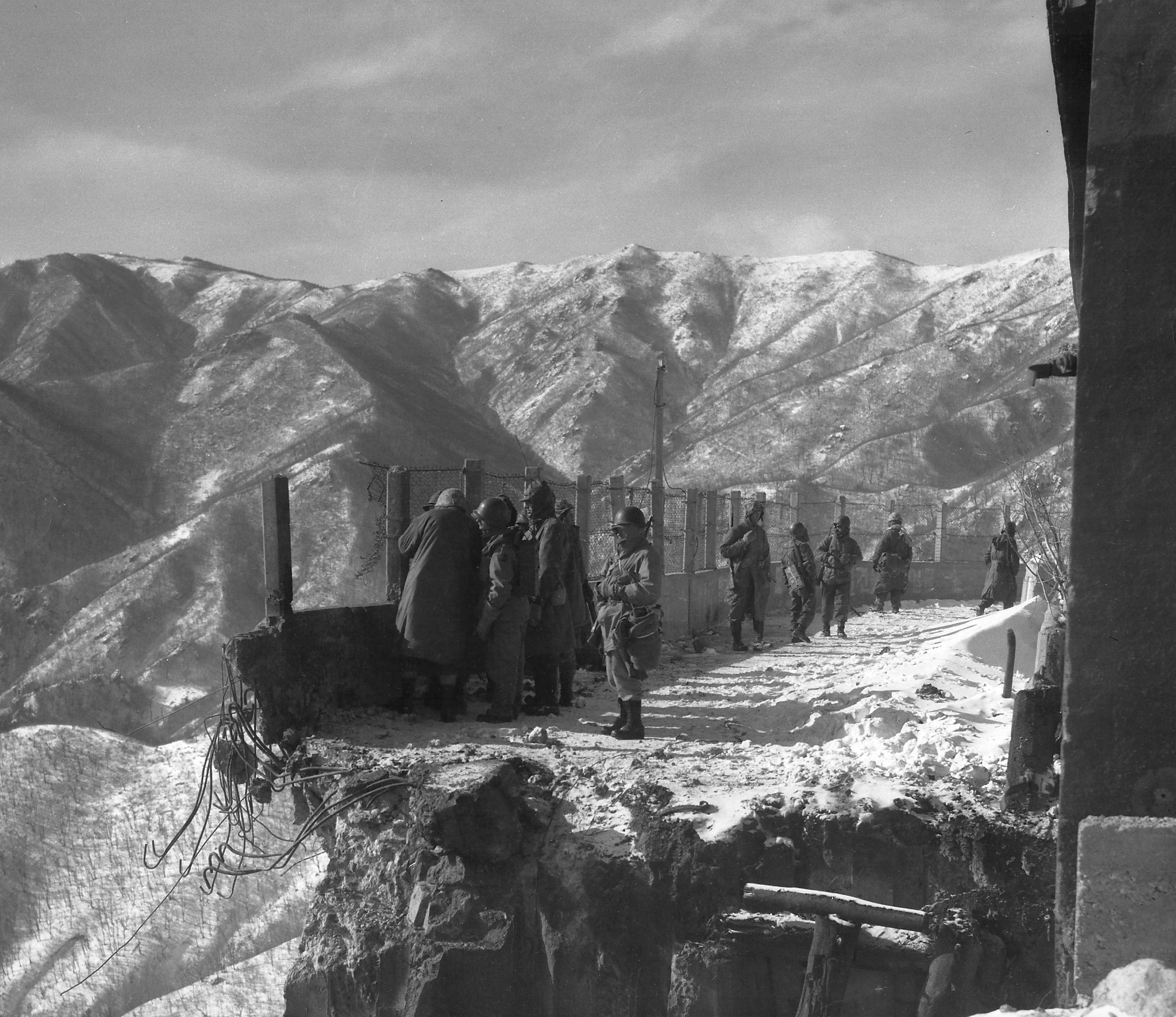
Men of the 7th Marines stand guard over a destroyed bridge at Funchilin Pass, which temporarily halted the division’s withdrawal from Koto-ri, 9 December 1950.
Photo by Sgt Frank C. Kerr
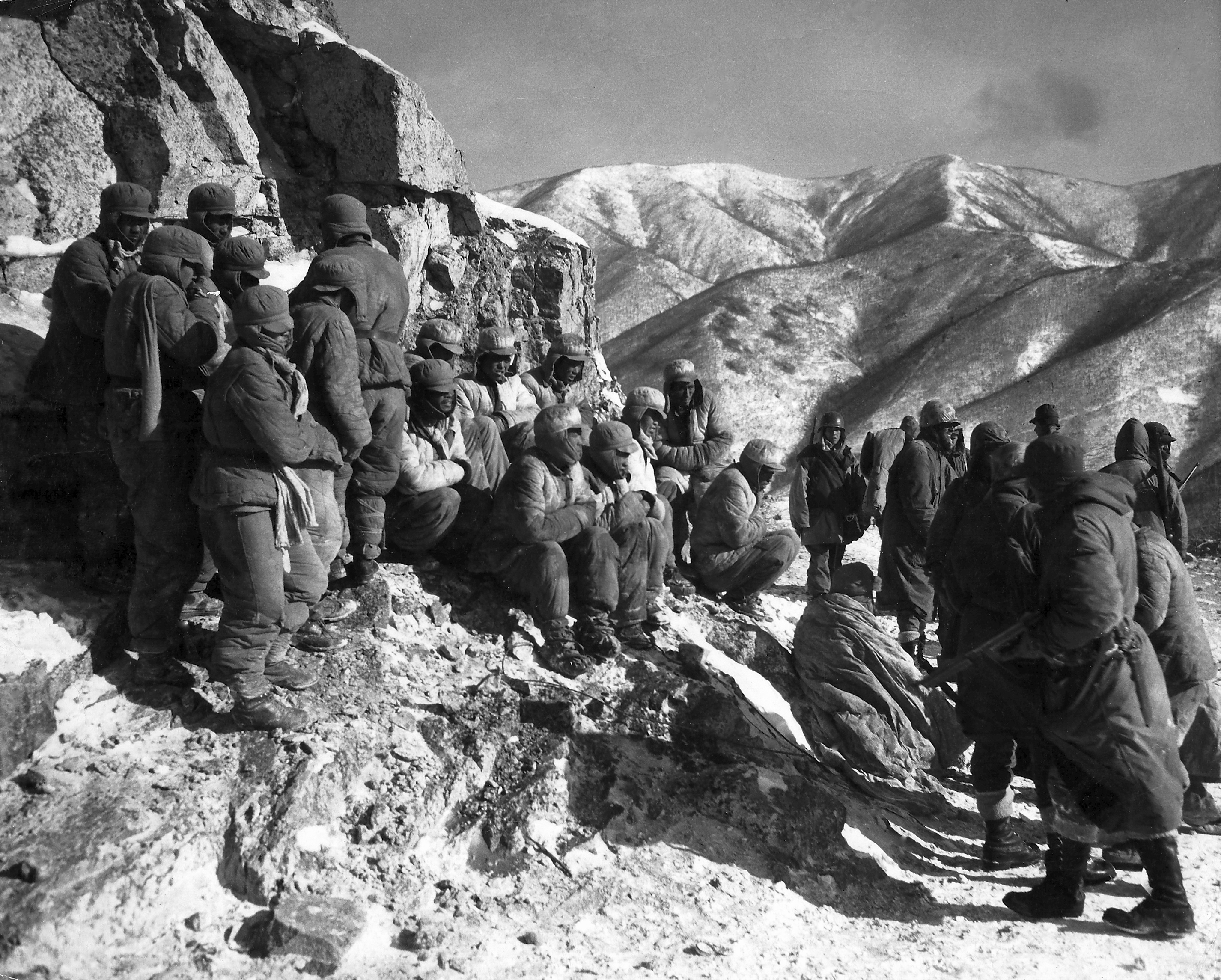
Captured Chinese troops wearing sneakers, rags, and American footgear, wait for instructions from their captors after surrendering to Charlie Company, 7th Marines, south of Koto-ri.
Photo by Sgt Frank C. Kerr
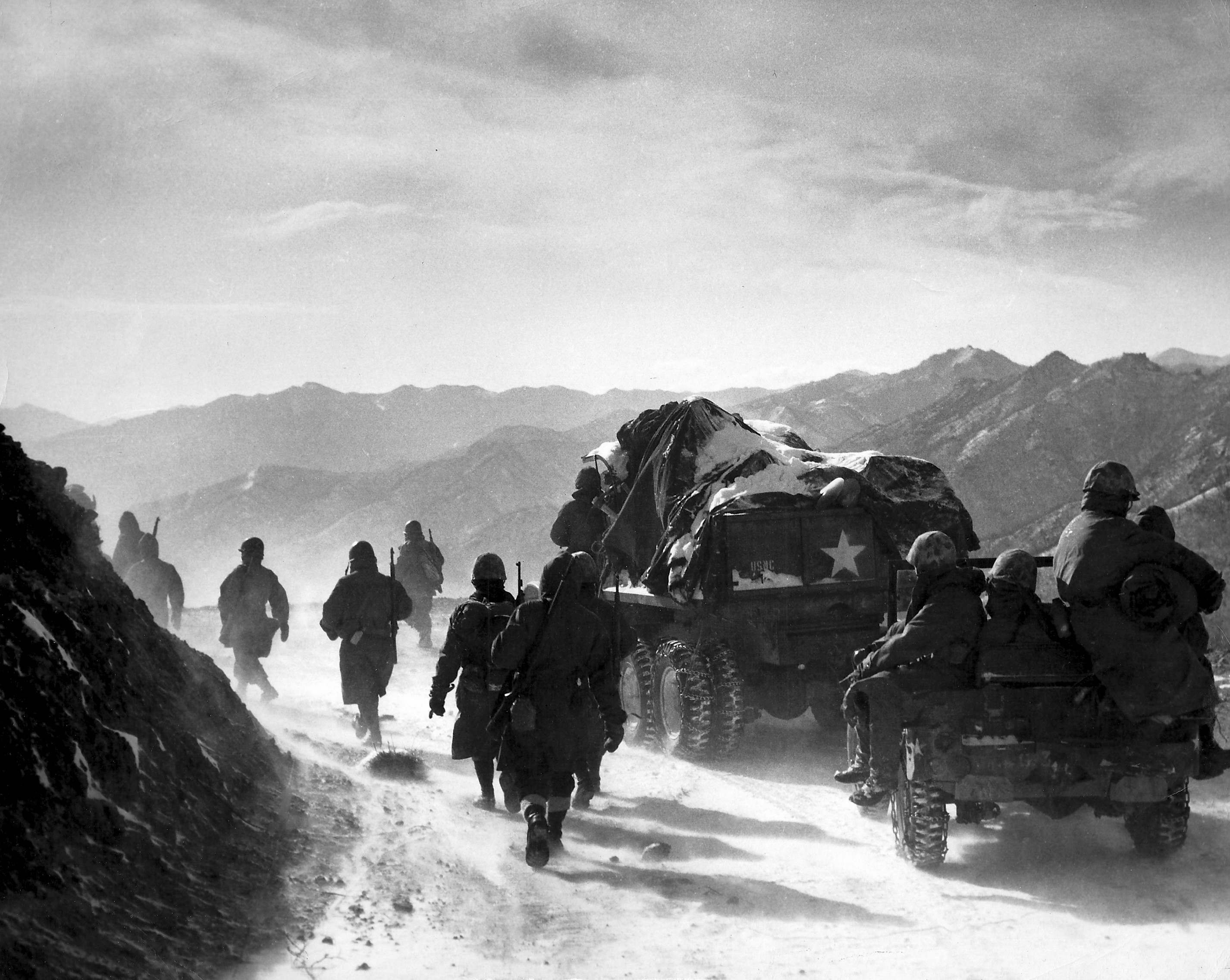
A mountain gale lashes U.S. Marines with subzero temperatures as they march from Koto-ri on their return to the sea, ca. December 1950.
Photo by Sgt Frank C. Kerr
Hungnam
There would be more hard fighting in the days ahead, but I would not be there to photograph it. On 11 December, I was trucked with other UN troops into the port city of Hungnam, passing through an Army perimeter that was like entering another world. Photographers and war correspondents were everywhere, taking pictures and slapping the backs of unshaven, bone-tired men like they were conquering heroes. By nightfall, the rest of the division was safely inside the perimeter and awaiting evacuation, having traveled the final 37 kilometers without food or sleep. Four days later, the last of our troops would be safely aboard ships bound for Pusan in South Korea, along with tens of thousands of North Korean refugees.
The 1st Marine Division’s epic breakout from the Chosin Reservoir was over, and so was my assignment covering that extraordinary campaign. At the photo lab, I turned in the last of my exposed film then went looking for a bed. It had been two weeks of hardships and heartache almost impossible to imagine, yet through grit, discipline and esprit de corps, the division had survived to fight another day.
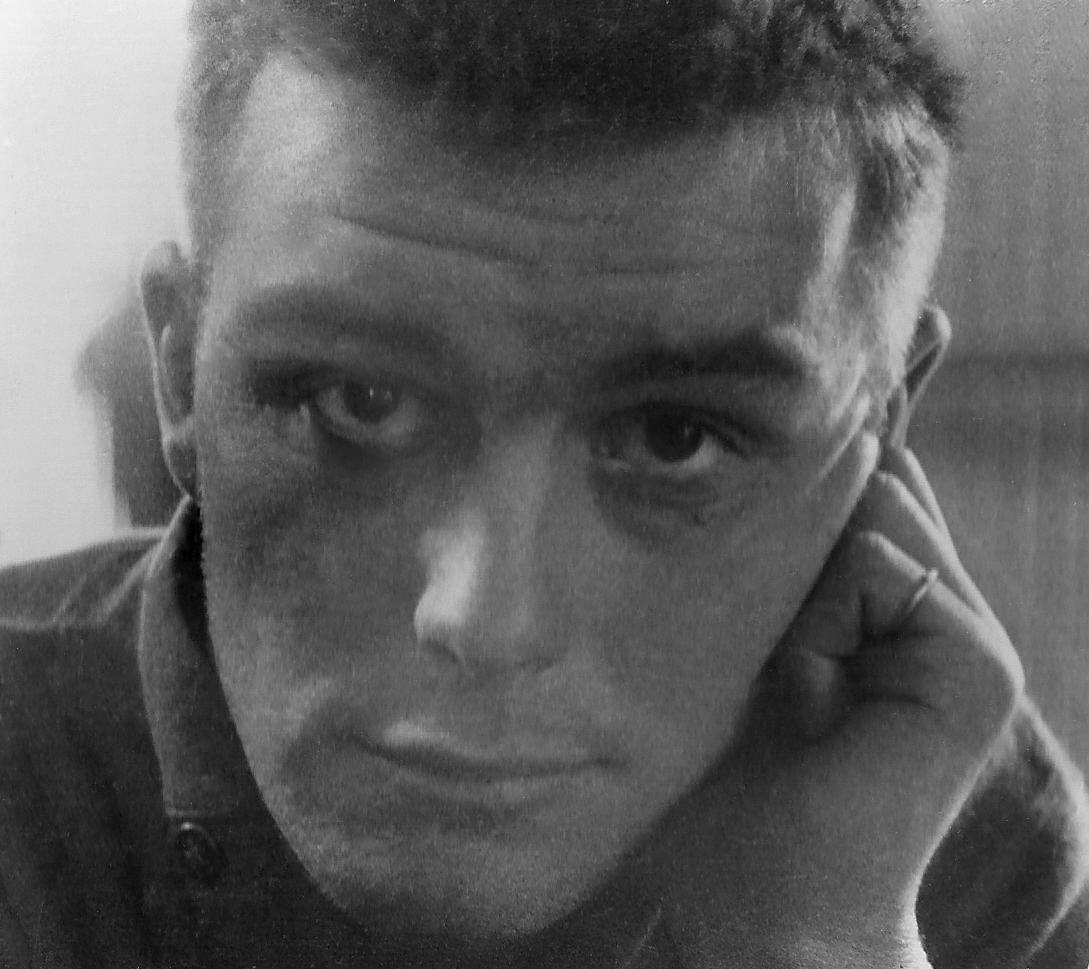
The strain of war. Sgt Frank Kerr in Korea, ca. 1950.
Photo by Sgt Frank C. Kerr
As I write this, the memories of a time and place that profoundly shaped my life are so thick that it is hard to sort them all. Some I hope to forget, others I never will. I will forever remember a quiet, pristine night in the mountains of North Korea, taking comfort knowing the stars were shining over places on Earth where people were not cold, tired, and hurting. I will remember the worn photograph of a smiling young family and wondering what kind of husband and father that dead Chinese soldier had been to his wife and kids. And I will remember a Marine machine gunner whose face I barely saw and whose name I will never know, but who fought beside me one black night in a roadside ditch, and for the briefest moment before he was killed became my brother. We who were fortunate enough to return from that war will never forget those who died there. And though some may think it impossible, the men who fought at Chosin would tell you this: once upon a time, Hell did indeed freeze over . . . and we were there.
•1775•
About the Author
Frank C. Kerr enlisted with the U.S. Marine Corps in 1948 and went to war in 1950 as a combat photographer with the 1st Marine Division in Korea, where he was awarded the Bronze Star and Navy Commendation Medal for valor and recognized by the commanding general, Oliver P. Smith, as the “ablest military photographer of the Korean theater.” His photographs can be found in books, magazines, documentary films, and on the walls of the National Museum of the Marine Corps in Triangle, VA. He was cofounder of The Chosin Few, an international organization of veterans who served at the Chosin Reservoir, and led a three-man delegation to North Korea in 1991, seeking cooperation in recovering the bodies of American servicemen missing since the Korean War. He died in Massachusetts at age 76 from the long-term health effects of a Cold War injury suffered during the Chosin campaign.
This photographic essay is excerpted with permission from SSgt Kerr’s memoir When Hell Froze: A Marine Combat Photographer at the Chosin Reservoir, posthumously self-published by his family. It has been lightly edited to conform to MCUP’s editorial style preferences.