PRINTER FRIENDLY PDF
EPUB
AUDIOBOOK
Abstract: The First World War’s Belleau Wood battlefield is an epicenter of pilgrimages for the U.S. Marine Corps. These pilgrimages now include visits to the “Devil Dog” fountain, a small shrine inside the village of Belleau, France, that, until the 1980s, had no historical connection to Marines. As collective memory of the war has evolved, the fountain has risen in significance, and current practices mirror the pilgrimage practices of other water shrines or holy wells. This article provides a historical overview of the fountain, links the fountain to other sacred wells, and provides evidence of the dog’s artistic connection to the Chienne et ses petits sculpture by the French sculptor Pierre Louis Rouillard. In addition, the author discusses the psychological significance of the dog head within its artistic context, explores the deeper psychological reasons for the fountain’s magnetism, and asserts that the fountain is a site for psychological integration.
Keywords: World War I, Belleau Wood, French sculpture, sacred well, pilgrimage, identity, archetypes, myth, Pierre Louis Rouillard, hellhound, Devil Dog fountain
Introduction[1]
The Marine Corps released a photograph in June 2016 that was part of a series of images from Memorial Day events in Belleau Wood, France. The photograph captured a profoundly human moment: Commandant of the Marine Corps Robert B. Neller gazing contemplatively at a stream of water pouring from the mouth of a dog. His right hand was encircled by a memorial bracelet, an indication that he was carrying with him the memory of someone significant. From the view of an outside observer, it is evident that Neller was engaging in some type of ritual at this fountain, presumably tied to his status as a Marine. However, from the perspective of a pilgrimage researcher, not only was the nation’s top Marine receiving water from the mouth of a dog at a fountain in Northern France, he was also the embodiment of a pilgrim at a holy well. The image was so evocative that it launched a years-long quest to understand the significance of the Commandant’s visit and the parallel with pilgrims at other sacred wells.
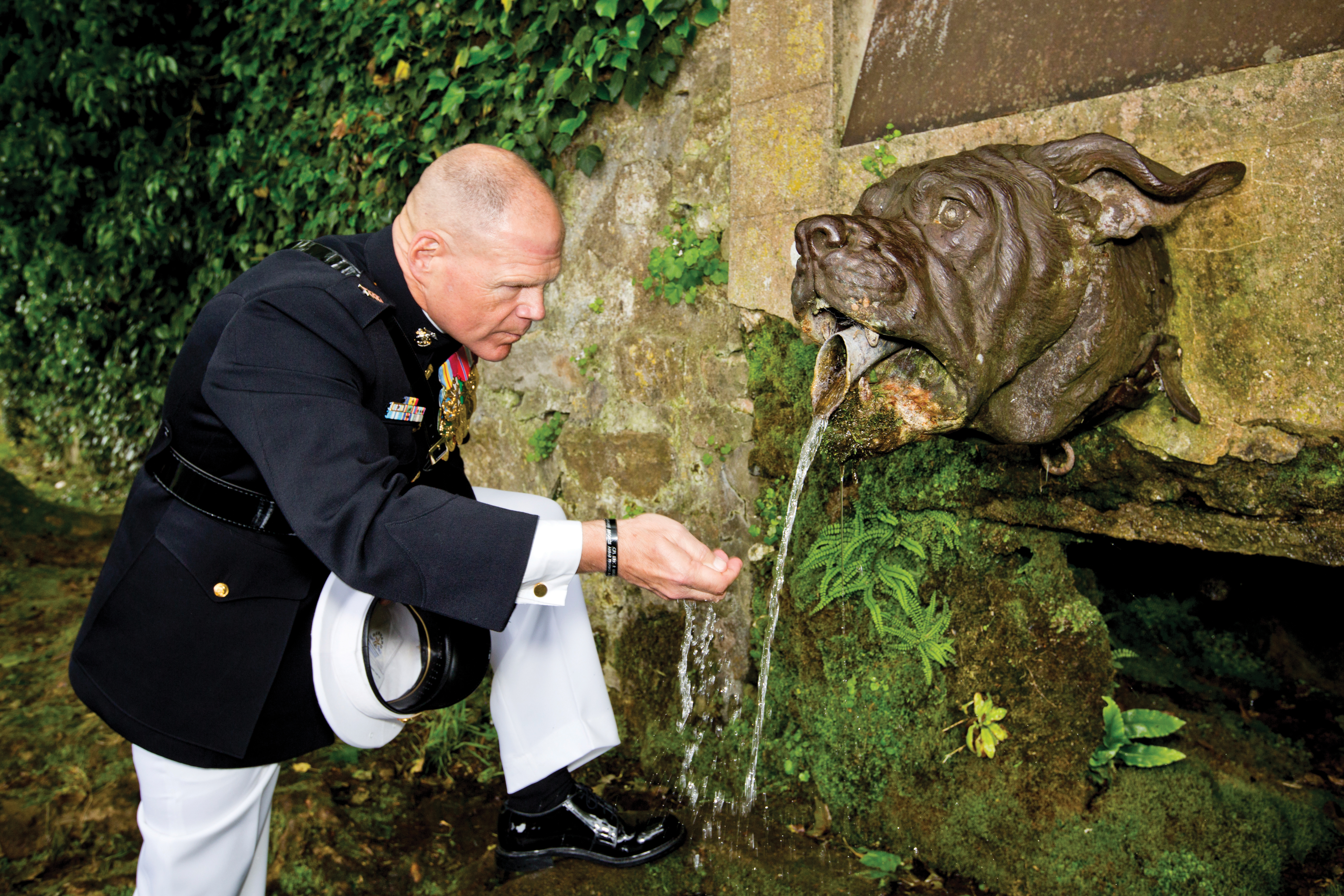
Commandant of the Marine Corps Gen Robert B. Neller at the fountain, 29 May 2016, after the American Memorial Day ceremony at the Aisne-Marne American Memorial Cemetery, Belleau Wood, France. Each Memorial Day weekend, U.S. Marines, French servicemembers, family members, and locals gather to honor the memory of the Marines killed during the battle of Belleau Wood.
Photo by SSgt Gabriela Garcia, U.S. Marine Corps
This article is the result of long-term research focused on pilgrimages to Belleau Wood and the Devil Dog fountain. The author argues that the Devil Dog fountain’s power as a pilgrimage site derives from four converging forces: a) the significance of the Devil Dog moniker within the Marine Corps; b) the fountain’s resonance with ancient myths linking dogs to sacred wells and liminal spaces; c) the fountain’s material connection to a nineteenth-century sculpture; and d) its capacity to serve as a site of psychological integration. By tracing the fountain’s artistic provenance to Pierre Louis Rouillard’s sculpture Chienne et ses petits (Dog and her pups) and situating it within Indo-European hellhound mythology, Gestalt psychology, and Jungian archetypal psychology, this analysis reveals how material object, myth, and ritual practice converge to create sacred space. The discovery that the fountain’s dog head is, in fact, taken from a complete sculpture of a nursing canine mother rather than a ferocious male warrior adds profound complexity to its symbolic resonance and opens possibilities for understanding Marine pilgrimage practices as sites of integration and inclusion, rather than mere commemoration. The article concludes with a discussion of how the fountain functions as a site where Marines can confront questions of lethality and vulnerability, institutional masculinity, and moral injury, ultimately suggesting that the newly revealed maternal identity of the fountainhead may deepen its capacity to serve as a space of healing and transformation.
Methodological Note
This article employs Jungian archetypal psychology alongside material history, comparative mythology, ethnographic observation, and applied psychological insights. While archetypal approaches have fallen from favor in some academic disciplines (particularly within literary studies), they remain valuable for analyzing pilgrimage sites precisely because pilgrimages operate in the realm of symbol, ritual, and collective meaning-making rather than purely rational discourse. Jung’s framework for understanding how humans project psychological content onto sacred objects and spaces offers analytical tools particularly suited to explaining why certain sites exert powerful attraction across generations despite, or perhaps because of, their symbolic ambiguity. This article employs Jungian concepts not as empirical truth claims but as hermeneutic tools for interpreting how Marines engage with the fountain as a meaningful object. The analysis treats archetypes as recurring patterns in human meaning-making rather than as metaphysical realities, recognizing that such frameworks complement rather than replace historical and material analysis.
The Devil Dog in Marine Corps Culture and Iconography
To understand why Marines in the late 1980s would transform an obscure fountain in rural France into a central pilgrimage site requires an understanding of the profound importance of the Devil Dog identity within Marine Corps culture. The Devil Dog is not merely a nickname or mascot; it is central to how Marines understand themselves as warriors, brothers and sisters, and members of a military institution that values ferocity, loyalty, and an almost supernatural tenacity.
The visual culture of the Marine Corps is saturated with bulldog imagery. The official mascot lineage, from Jiggs to the current Chesty, features English bulldogs that embody the qualities Marines aspire to: stocky power, fierce determination, an imposing presence despite compact size, and an unwillingness to surrender. Individual Marine bases have historically maintained their own bulldog mascots, creating a distributed network of living symbols. A walk through any Marine Corps installation reflects bulldog imagery on unit insignia, building murals, challenge coins, and memorial stones. Most tellingly, a survey of tattooed Marines across generations reveals countless bulldogs wearing World War I doughboy helmets, often accompanied by the Eagle, Globe, and Anchor. These tattoos represent permanent bodily inscriptions of Devil Dog identity, worn as both a badge of honor and as psychological armor.
The linguistic culture of the Corps reinforces this identity daily. Marines routinely address each other as Devil or Devil Dog in casual conversation, turning what was allegedly a World War I German epithet of fear—reputedly originating at the Battle of Belleau Wood—into a term of affection and solidarity. This everyday usage transforms the Devil Dog from historical reference into lived identity. To be called Devil Dog by another Marine is to be recognized as belonging, as sharing in a collective identity that transcends individual service records.
Popular culture has also shaped how Marines envision the Devil Dog, creating a bridge between ancient warrior archetypes and contemporary American imagination. Mid-twentieth century animation, particularly Warner Brothers cartoons and the persistent bulldog characters in Tom and Jerry, presented bulldogs as simultaneously comical and fierce, loyal yet stubborn, domestic yet dangerous.[2] These cartoon bulldogs often appeared as guards, protectors of territory, and defenders of the weak, roles that resonate deeply with Marine Corps values. For Marines who grew up watching these cartoons, the bulldog was already a familiar symbol of a particular kind of masculine virtue before they ever encountered official Corps iconography. This cultural preparation made the Devil Dog identity feel natural rather than imposed.[3]
Moreover, the Global War on Terrorism (GWOT) introduced additional canine metaphors that reinforced Devil Dog symbolism. The “sheepdog” concept, which was popularized by U.S. Army lieutenant colonel Dave Grossman and others, presented warriors as protectors standing between innocent “sheep” and predatory “wolves.” While distinct from the Devil Dog imagery, the sheepdog metaphor primed GWOT-era Marines to see themselves in canine terms: vigilant, protective, capable of controlled violence, and operating at the threshold between civilization and chaos.[4]
The Marine Corps as an institution has deliberately cultivated this Devil Dog identity, while maintaining its characteristic flexibility about historical accuracy. Entry-level training openly acknowledges that some cherished Marine traditions, such as the origin of blood stripes on dress blue trousers or the quatrefoil on officers’ barracks covers, are rooted in stories that are not factually correct but are nonetheless embraced for what might be called their truth value. The Corps understands that myths and rituals need not be historically accurate to be functionally important. This institutional comfort with symbolic truth over literal fact creates an environment where a fountain discovered decades after World War I can be seamlessly integrated into the origin narrative of the modern Marine Corps.
Given this saturation of Devil Dog imagery in Marine culture—visual, linguistic, material, and psychological—the discovery of a fountain featuring a dog’s head in Belleau, the village adjacent to the woods where Marines believe their modern identity was forged, represented not a random coincidence but a kind of inevitable recognition. The fountain simply externalized what was already internal, providing a physical site where the symbolic and material could converge.
The Devil Dog Fountain: Site and Practices
Holy wells, fountains, or shrines are fusion points where the material world meets the otherworld. They are communal gathering places that form the backdrop for rites of passage (formalized rituals marking transitions in social status or identity) and rituals, and locations where collective identity is reinforced and reinvigorated. They are also focal points onto which humans project their deepest questions and hopes for healing, transformation, or divine intervention. The sacred, those spaces set apart from ordinary life, where encounters with transcendent meaning become possible, manifests at such sites not through official designation but through accumulated practice and shared recognition. Ultimately, shrines are sacred places where meaning is made and grand narratives are constructed, and narratives that evolve and deepen as pilgrims share their stories with others.
For Marines, the shrine known as the Devil Dog fountain has become central to pilgrimages to Belleau Wood. The Marine Corps has long understood the power of place and the importance of inculcating connection to hallowed ground. Servicemembers of all branches maintain ties to particular locations, but Marines are collectively bound to the same sacred places: Belleau Wood, Iwo Jima, Chosin Reservoir, Khe Sahn, Fallujah. The Devil Dog fountain now occupies a prominent position within this constellation of Marine sacred geography, having become virtually synonymous with Belleau Wood. Yet remarkably, because Marines never occupied this precise location during the 1918 battle, the site’s sacralization cannot be attributed to historical military action. Instead, its emergence as a pilgrimage destination resulted from the confluence of geographic proximity to the battlefield, the potency of the Devil Dog identity, the establishment of ritual practices, and the operations of collective memory. The fountain exemplifies how seemingly insignificant places can evolve into pilgrimage sites through the symbiotic relationship between pilgrims and sacred space.
Location and Historical Context
The fountain sits within the village of Belleau on private property, formerly the site of a sixteenth-century château constructed for the Graimberg family. The current owners descend from Alphonse Paillet, who purchased the château and most of the hunting preserve known as Belleau Wood in 1842. Paillet’s heirs sold the woodland to the Belleau Wood Memorial Association in 1923, when it was dedicated as a shrine to the American Expeditionary Forces, but the family retained the château ruins. These landowners have played an integral role in facilitating the growth of Marine pilgrimages to the fountain, maintaining access to the site and participating in commemorative activities. The fountain draws from a spring-fed aquifer that supplies water throughout the area. What distinguishes this particular water source is its passage through the mouth of a dog’s head. While often identified as a bulldog, the sculpture more accurately represents a Dogue de Bordeaux, a hunting breed that gained popularity in France during the mid to late nineteenth century. Originally serving utilitarian purposes within the château’s agricultural courtyard, this unremarkable fountain seemed an unlikely candidate for sacred status. Yet, its proximity to the hallowed battlefield and the symbolic resonance of the canine figure coalesced to birth a Marine Corps shrine.
The Historical Silence: 1918–1980s
Until the 1980s, the fountain was relatively obscure and so unremarkable that it was rarely, if ever, photographed or written about by those who visited the area. This historical silence regarding the Devil Dog fountain is conspicuous given its current prominence within Marine pilgrimage practices. The absence of documentation becomes particularly striking when considered against the backdrop of numerous fountains and memorials established by Americans throughout the region following World War I. On Belleau’s main thoroughfare, for instance, stands a fountain dedicated to Pennsylvania soldiers who perished in Belleau Wood. Had the current Devil Dog fountain possessed significance during the interwar period, it would likely have received similar commemoration or at least photographic documentation.
The silence extends through several major commemorative events. The 1923 dedication ceremony for Belleau Wood as a memorial shrine similarly omits any reference to it.[5] When the village church was reconstructed in 1929 as the U.S. Army 26th “Yankee” Division Memorial, Army major general James Harbord, who had commanded the Marines at Belleau Wood, vociferously objected to this Army memorial in what he considered Marine territory. His public statements asserting Marine primacy in Belleau Wood would have provided an ideal opportunity to reference any Marine connection to the village fountain, yet no such mention appears. The Gold Star Mothers’ pilgrimages of 1930–33, funded by the U.S. government to bring grieving mothers to their sons’ graves in France, included visits to Belleau Wood. Yet, neither written accounts nor photographs from these emotional journeys document any engagement with the fountain.[6]
Post–World War II commemorative activities likewise ignored the fountain. When the village church required repairs in 1953, Yankee Division veterans again funded its restoration and rededication. Commandant Lemuel C. Shepherd Jr. visited during this period, concerned that the Marine Corps’ contributions at Belleau Wood were fading from public consciousness. He initiated plans for a Marine memorial, dedicated in 1955. Given Shepherd’s interest in preserving Marine heritage at Belleau Wood, his apparent lack of engagement with the fountain suggests no established Marine connection to the site existed at that time.[7] Throughout the following decades, the fountain remained absent from Marine Corps narratives about Belleau Wood.
The 1980s Emergence
But in the late 1980s, this changed, and the fountain emerged out of obscurity.[8] Within the gates of an agricultural courtyard, Marines discovered a fountain with water passing through the mouth of a dog. And, in it, they saw themselves. According to villagers, the first instance of Marines visiting the fountain was in November 1988 when the remains of a World War I-era American servicemember were reinterred at the Aisne-Marne American Cemetery in Belleau. The remains were attributed to a Marine, and a number of Marines attended the reinternment ceremony.[9] During this period, Marines began incorporating the village of Belleau and its fountain into Belleau Wood itineraries, extending their pilgrimages beyond the woodland battlefield.
The timing of this “discovery” in the late 1980s is significant and worthy of speculation. Why did Marines not claim this fountain in the 1920s, 1950s, or 1960s? Several factors may have contributed to its emergence as a pilgrimage site specifically in this era. First, the late 1980s marked a period of renewed institutional pride for the Marine Corps following the difficult years of Vietnam and its aftermath. The Ronald W. Reagan-era military buildup had restored funding, prestige, and public respect for the military generally and the Marines particularly. This cultural moment may have created space for renewed engagement with World War I heritage as the Corps sought to reconnect with its triumphant past. Second, enough generational distance had passed since 1918 to allow full mythologization of Belleau Wood without the complicating presence of actual veterans who might resist romantic interpretations. By the late 1980s, most of the last World War I Marines were gone, freeing the battlefield to become infused with symbol. Third, the growth of battlefield tourism generally in this period, which was facilitated by cheaper transatlantic travel and increased American interest in heritage tourism, meant more Marines were visiting France. Finally, the reinternment ceremony of November 1988 brought a critical mass of Marines to the village at once, creating the social conditions for discovery and the immediate establishment of practice through group witness.
Contemporary accounts from this period reveal how Marines began constructing historical narratives to justify their connection to the fountain and village. In the November 1988 issue of the Marine Corps Gazette, Agostino von Hassell described Marines visiting the Devil Dog fountain and offered an intriguing origin story: Germans occupying Belleau in 1914 had allegedly encountered “Hounds of Belleau” (the aristocratic owner’s fierce hunting hounds) within the château, and when Marines attacked the area in June 1918, the Germans recalled this earlier encounter, thus originating the Devil Dog moniker.[10] In July 1990, Boston Globe sportswriter Bud Collins claimed that Marines had bivouacked in the château’s farmyard during the war, a claim published, notably, on dates corresponding to when the Yankee Division (not Marines) had actually liberated the village in 1918.[11] Despite their historical inaccuracies, these accounts illustrate how fragmentary information was being integrated into a coherent narrative framework. From this point forward, the village of Belleau became subsumed into the Belleau Wood narrative, the two locations fusing in collective memory into a single sacred landscape. This conflation became so complete that even Marines who had visited both locations sometimes forgot they were geographically separate, their individual memories merging with the collective mythology of an undifferentiated Belleau Wood battlescape.
Institutional Sacralization: The Krulak Visits
While Belleau Wood had been hallowed ground since 1918, the incorporation of the village fountain into Marine Corps sacred geography was cemented during Commandant Charles C. Krulak’s visits in 1997 and 1998. His visits sacralized the unity of the Belleau landscape in four significant ways. First, he filmed the 222d Marine Corps Birthday message from the battlefield, standing in a wheat field with one arm reaching metaphorically back to World War I Marines and the other extended toward future generations. In this prophetic performance, Krulak spoke passionately of continuity, identity, and shared vision across Marine generations. He deployed water as a connective metaphor, asserting that Belleau Wood was “like a river that runs through all Marines and all Frenchmen . . . rippling through our souls, renewing us, sustaining us and fortifying us for the trials to come.”[12] This aquatic imagery explicitly linked the battlefield with the fountain, merging them into a unified sacred waterscape.
Second, Krulak was photographed at the Devil Dog fountain drinking directly from the dog’s mouth, providing a powerful visual template for how future generations of Marines would engage with the site. This image of the Commandant, the highest-ranking Marine, performing this act legitimized and institutionalized the practice. Third, Krulak explicitly framed his time at Belleau Wood as a “pilgrimage of great personal meaning,” using religious terminology that elevated the visit from military tourism to sacred journey.[13] He emphasized the importance of reenacting the journey of 1918 Marines, positioning contemporary visits as participation in sacred history rather than mere commemoration of it. Finally, Krulak presented the fountain’s landowners with a certificate of appreciation, a gesture that formally acknowledged the site’s importance to the Marine Corps and established institutional relationship with those who controlled access to the sacred space.
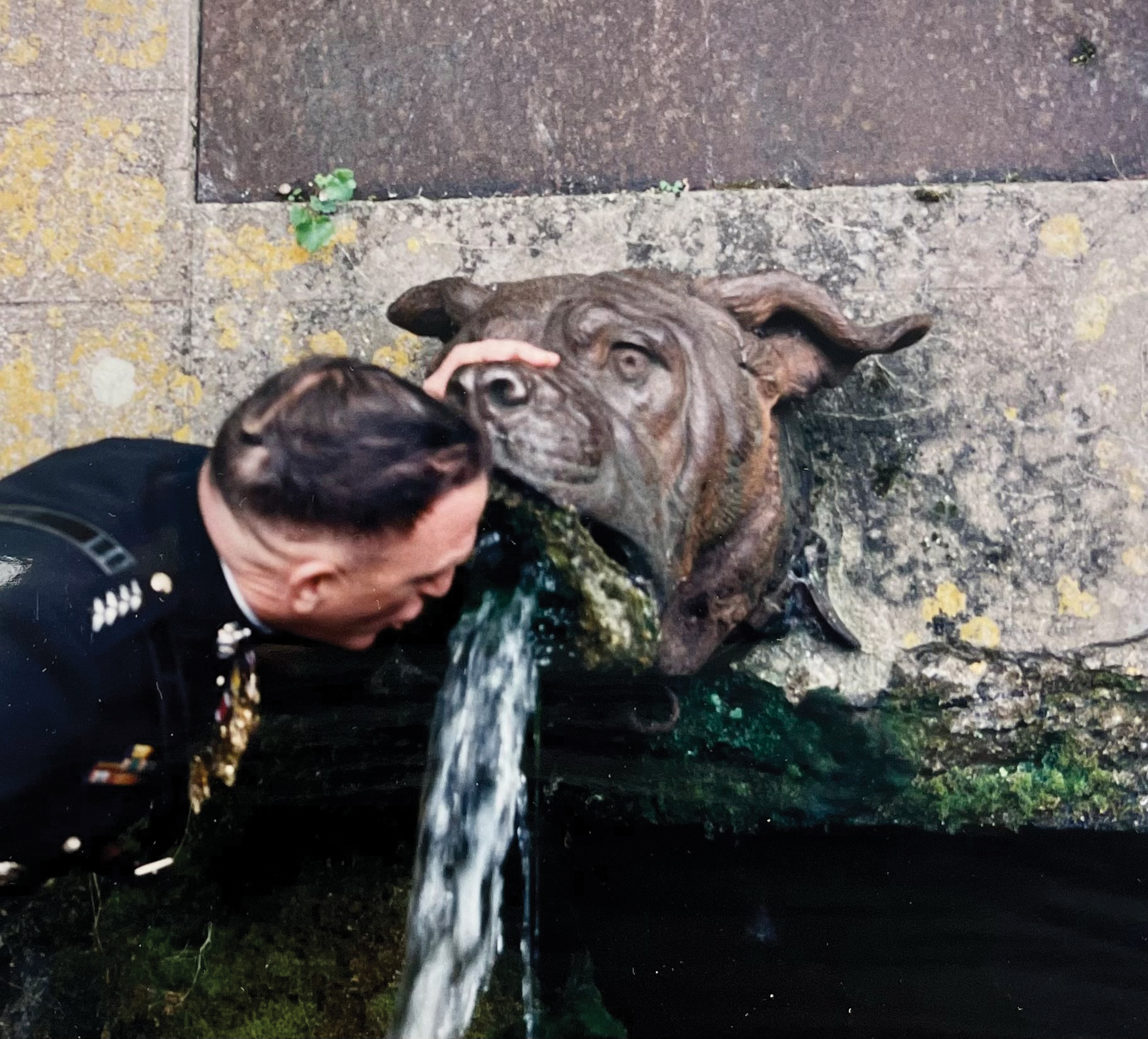
Gen Charles C. Krulak drinking from the fountain during American Memorial Day ceremonies in 1998.
Courtesy of Archives, Marine Corps Historical Division
From a pilgrimage standpoint, the fountain’s rise in prominence is noteworthy and tracks with the global rise in pilgrimages over the past several decades. The evolution of Marines’ practices at the fountain is also notable as these practices mirror those at other sacred sites, particularly those at holy wells. As part of a larger research agenda focused on battlefield pilgrimages, this article is based on fieldwork in Belleau Wood and the Devil Dog fountain between the years 2021 and 2024. During this era, the author was an invited researcher at the University of Lille, and a France Fulbright Scholar, with research focused on post–World War I pilgrimages to Belleau and Belleau Wood. The research methods for the current study included archival research in French and American archives, field observations, and interviews with visitors and pilgrims, which spanned approximately 30 visits to the fountain. This fieldwork occurred across the entirety of the Belleau Wood battlescape, which not only includes the geographic terrain of the woods, but also the Aisne-Marne American Cemetery, several villages including Belleau and Bouresches, and a number of farms and fields where military actions occurred during World War I.[14]
Contemporary Accessibility and Ritual Practice
Understanding the fountain’s importance requires examining not only its symbolic resonance but also its practical accessibility to contemporary Marines. While Belleau Wood is geographically distant from most Marine Corps installations, several pathways enable regular engagement with the site. Marine Expeditionary Units (MEUs) training in Europe and the Mediterranean region occasionally incorporate visits to Belleau Wood into their training schedules, particularly when operating in Northern France or preparing for commemorative events. Individual Marines and veterans visit during leave, on post-deployment vacations, or during organized heritage tours. The museum across the street from the fountain now sells glass bottles designed for water collection that deliberately resemble medieval ampullae used by Christian pilgrims, suggesting both commercial recognition of the practice and institutional support for it.
The fountain’s significance is particularly remarkable given the absence of prior water-based rituals within Marine Corps tradition. Unlike religious pilgrimage traditions with established practices of holy well veneration, or even other military services with historic connections to specific water sources, the Marine Corps had no precedent for fountain devotion before the Devil Dog fountain’s emergence in the late 1980s. While training areas like Case Springs at Camp Pendleton exist, they function primarily as geographic features rather than ritual sites. The Devil Dog fountain thus represents not only the extension of peripherally related traditions but the spontaneous generation of an entirely new form of Marine Corps ritual practice. This rapid adoption and institutionalization suggest the fountain filled a latent need within Marine culture—a need for a physical, tangible site where the abstract concepts of rebirth, renewal, and connection to institutional origins could be enacted through ritual engagement with water.
More significantly, the fountain’s influence extends far beyond those who physically visit. Water collected from the fountain is transported to ceremonies conducted elsewhere, at Marine Corps bases, veteran gatherings, and memorial services, where it is used in reenlistment ceremonies, poured on memorial stones, or distributed to Marines who cannot travel to France. Social media has amplified the fountain’s significance exponentially. Marines post photographs and videos of their fountain visits, creating a digital archive of pilgrimages that instructs future visitors on proper ritual practice while simultaneously allowing distant Marines to participate vicariously. Hashtags like #DevilDogFountain and #BelleauWood circulate these images through Marine social networks, creating a sense of shared experience even among those who have never traveled to France. The fountain appears increasingly important to younger Marines, particularly those who served in Iraq and Afghanistan. For GWOT veterans, the fountain offers connection to a clear victory and unambiguous heroism in an era when such clarity feels elusive. The generational transmission of fountain practices occurs both formally (senior Marines bringing junior Marines to the site) and informally (through social media and storytelling). However, the fountain’s significance is not limited to any single generation; Marines across age cohorts express similar reverence for the site, suggesting that its power transcends specific historical experiences and taps into something more enduring about Marine identity.
Material Description and Observations
Relevant to the layered meaning(s) of the fountain is that beneath the surface of the battlescape is an aquifer, likely the impetus for human settlement in the area. The village’s name of Belleau may also be connected to this spring water as belleau means beautiful water. Moreover, the medieval-era church in Belleau was near the fountain, located here presumably due to the presence of a natural spring. The fountain is inside a gated courtyard on private property. It is slightly obscured when viewed from the road, but is clearly seen when one enters the metal gate. The fountain sits on the left side of the courtyard and has an arched stone frame with a similarly shaped metal door above the dog’s head. The head, approximately three feet from the ground, seems suspended on the wall, almost as a liminal portal between 1918 and the present. The head of the dog is nearly black in color and appears to be bronze, but is cast iron. At the base of the neck is a thick collar that fuses the head to the stone and one can sense that the dog’s head is missing its body. The stream of water that flows through a pipe in the mouth is like saliva spouting from somewhere beyond the head. The water exits into a moss-covered basin, an important feature that affords a structure on which to step to lean into the dog’s head. Below the head is a cavernous space that disappears into the stone wall and prompts curiosity about where it might lead, perhaps a gateway into the past or an otherworldly place. The dog head seamlessly merges into the Belleau Wood narrative and battlefield, which was a place of brutal violence, but also the scene of a grand origin story: Belleau Wood gave birth to the Devil Dogs. This birth narrative is triple: the battle birthed the modern institution of the Marine Corps; individual Marines, who fought or died in the battle, birthed “the exemplar Marine”; and the woods, as an earthen womb, birthed immortality.
The Devil Dog Fountain and the Coole Holy Well
One of the first observations noted by the author was the visual similarities between the Devil Dog fountain and other holy wells, particularly those in England, Ireland, and Wales. The Coole Holy Well in North Cork, Ireland, for example, is one such similarity. Both the Devil Dog fountain and the Coole Holy Well are fed by a natural spring and the structures are surrounded by stones arranged in an arch. The wells sit among other natural elements, such as trees, and are adorned with evergreen and moss. Both sites are near medieval churches and cemeteries, likely established there because of the water source.
In addition, the current practices at the Devil Dog fountain resemble the pilgrimage practices at the Coole Holy Well. Both sites attract pilgrims and travelers who visit the site to drink the water and to engage in particular rituals. The water is treated with reverence. At both fountains, visitors and pilgrims drink directly from the water source or fill a vessel to take the water away from the site. This water is viewed as life-giving, metaphorically and literally. For Marines, the fountain water is believed to extend one’s career in the Marine Corps or even extend one’s biological life. Both fountains are also the backdrop for rites of passage. In the Marine Corps’ case, these lifecycle events include reenlistment, promotion, and retirement ceremonies.
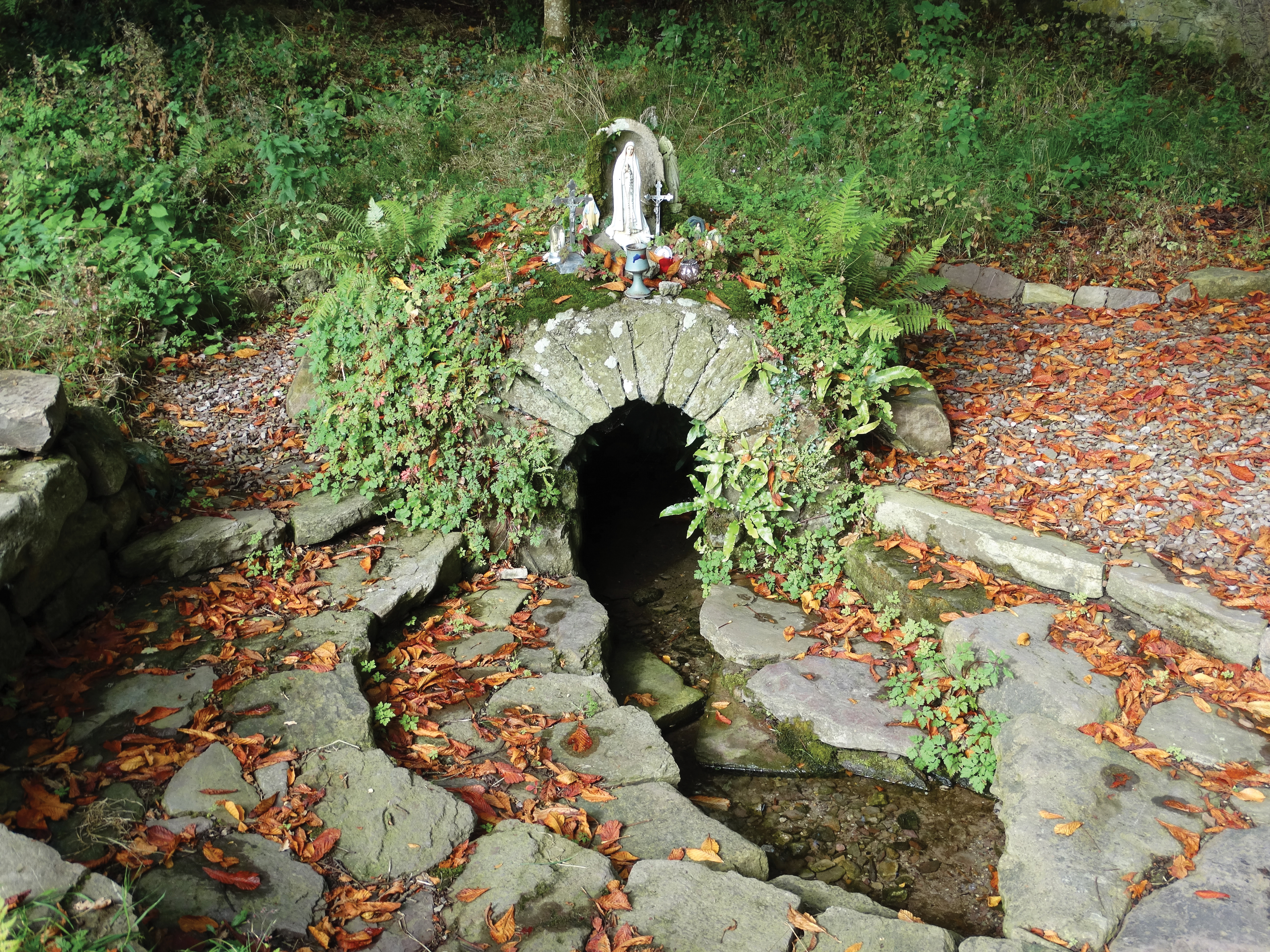
Holy Well, Coole Upper Churches, North Cork, England, photographed in 2014.
Courtesy of the Speckled Bird, Wikimedia Commons
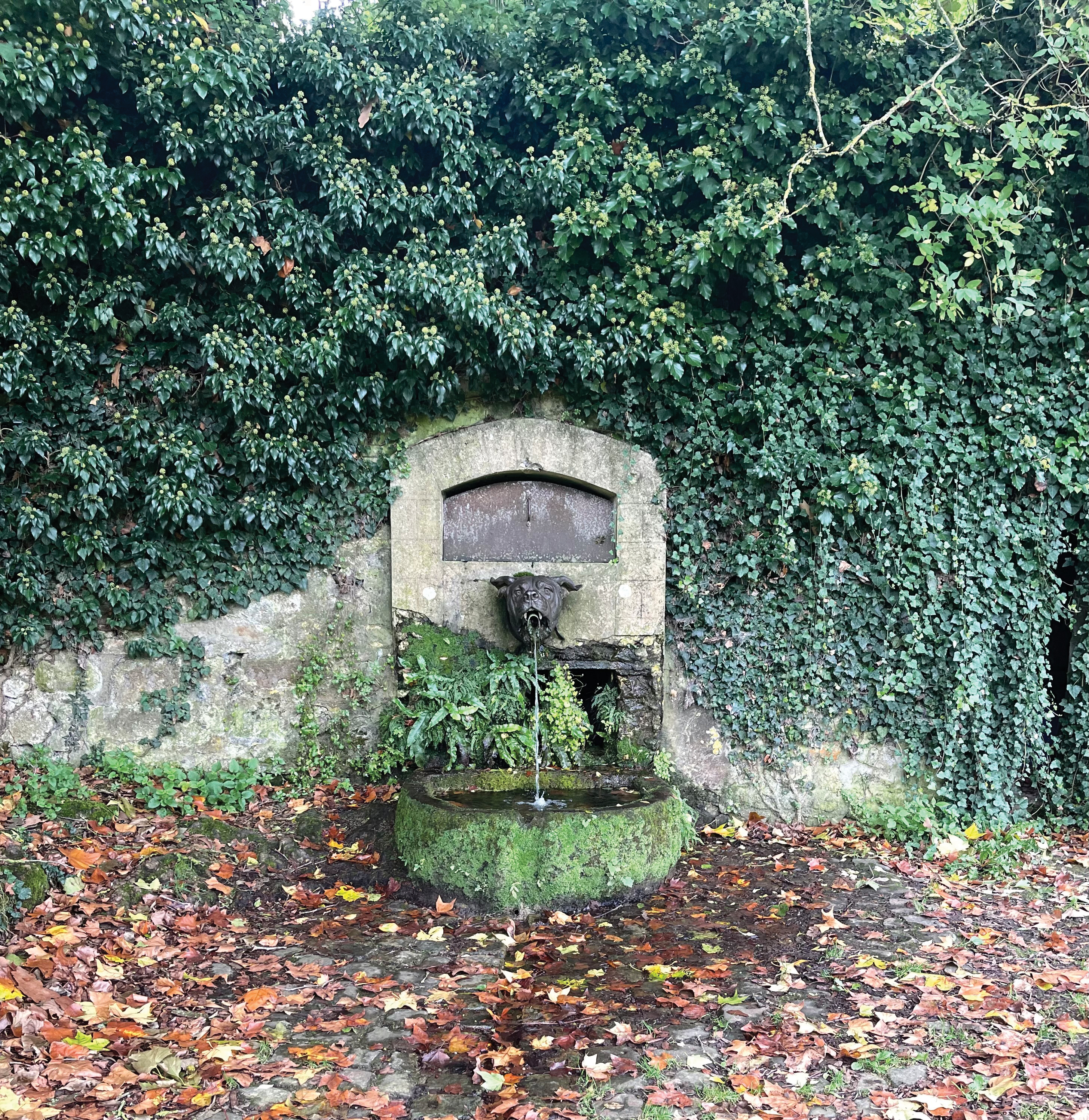
The Devil Dog fountain in the village of Belleau, France.
Courtesy of Heather A. Warfield
Another shared characteristic between these sites is the focus on healing or transformation. In the historical context of World War I, the Devil Dog fountain was an actual place of healing (albeit not viewed as a sacred healing site). Behind the fountain wall, in the caves under the château, was a German first aid station, well positioned in this location due to the presence of clean water. For contemporary pilgrims to the fountain, the healing that is sought often pertains to the invisible wounds of war. Both the Coole well and the Devil Dog fountain have prescribed ways of interacting with the water depending on group affiliation, and such knowledge is passed from pilgrim to pilgrim. For example, Marines visiting the fountain take cues from others who have previously visited (e.g., those who post on social media) or even ask Marines in their group how to engage the fountain (i.e., “How do I lean in?” or “Did you actually drink the water?”). As seen in the images, the wells are places of devotion where pilgrims leave votives and other objects behind, such as candles, pieces of cloth (above) or uniform insignia (see below). The object of devotion for the Coole Holy Well is a statue of the Virgin Mary, who stands guard over the opening of the well. Likewise, the object of devotion at the Devil Dog fountain is the dog itself. Interestingly, the Virgin Mary is fully embodied, but the Devil Dog is only the head, at least on the surface.
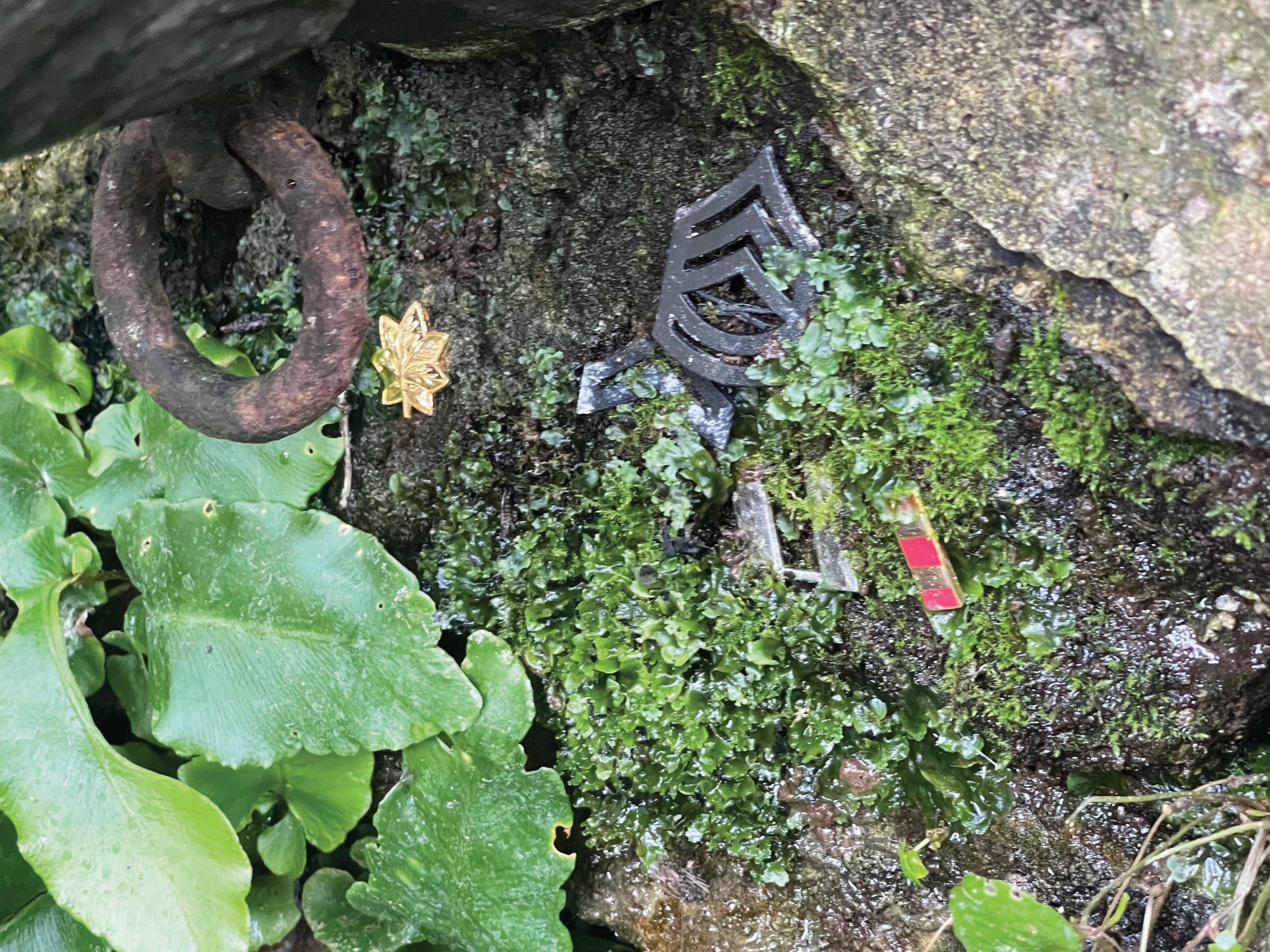
Uniform insignia left at the Devil Dog fountain by Marines.
Courtesy of Heather A. Warfield
Beyond the similarities between the Devil Dog fountain and the Coole Holy Well, the magnetism of these sites can be understood through the interplay of historical fact, myth, and archetype. The historical facts pertaining to the Battle of Belleau Wood are outside the scope of this article, and have been substantively addressed by military historians. However, it is important to note the synthesis of historical facts and myth within the grand narrative of the Marine Corps’ (Devil Dogs’) birth in Belleau Wood, a point that will be revisited later. Moreover, the significance of the Devil Dog fountain echoes adjacent historical connections between dogs and sacred wells, as well as the hellhound myth reflected across Indo-European linguistic and cultural traditions. Both topics scaffold the understanding of the wider historical, mythological, and psychological milieu of the Devil Dog fountain and are explored below.
The Connection between Dogs and Sacred Wells
Concurrent to the deep connections between the Devil Dog and the Marine Corps is the strong historical precedent for the existence of dogs at sacred sites, particularly those sites focused on water. For millennia, dogs have held symbolic and spiritual significance across cultures and the connection between dogs and sacred wells can be found in folklore, religious symbolism, healing traditions, and cult practices, particularly in Celtic, Greco-Roman, and early Christian contexts. These associations illuminate the deep-rooted human fascination with dogs not only as companions but as spiritual intermediaries, protectors, and guides.
In Celtic mythology, sacred wells were often associated with healing, prophecy, and the divine feminine.[15] Dogs, particularly in Irish and Welsh traditions, were linked to the otherworld and to healing deities such as Dian Cécht, the Celtic god of medicine, and Nodens, a Romano-British healing god frequently depicted with dogs.[16] Dogs were believed to have keen senses that could perceive spirits and subtle energies, making them natural guardians of sacred spaces like wells, which were seen as portals between the physical and spiritual realms. At some sites, dogs were believed to lap at the waters of the well, imbuing them with healing power, or served as omens or guides for those seeking cures or visions.[17]
The Greco-Roman world also held dogs in high regard in healing contexts, most notably in the cult of Asklepios, the god of medicine and healing. Penny Hill addresses this in depth in her article, “The Healing Power of Dogs.”[18] Hill asserts that Asklepian sanctuaries, such as those at Epidaurus and Pergamon, were renowned healing centers where dogs played a sacred role. Moreover, dogs roamed the sanctuaries and were often believed to assist in cures by licking the wounds of the afflicted, which was an act believed to be both symbolic and medicinal. The presence of dogs in Asklepian sanctuaries mirrors their symbolic function in Celtic traditions, thus reinforcing their association with healing and sacred liminality (the state of existing at thresholds or boundaries between categories). Inscriptions and votive offerings from these sites often depict dogs alongside serpents, another key symbol of Asklepios, which emphasizes their importance within the sacred therapeutic environment.[19]
In early Christian hagiographies, dogs also appear in the lives of saints associated with healing. One notable example is Saint Roch, a fourteenth-century saint often depicted with a dog that is believed to have brought him bread and licked his plague-inflicted wounds.[20] Further, at sites such as Lydney Park in Gloucestershire, dedicated to the healing god Nodens, archaeological excavations have uncovered canine remains, possibly indicating ritual sacrifice or spiritual companionship.[21] Lastly, in many cultural traditions, dogs have been understood as psychopomps, or guides of souls, which is a role that aligns with their presence at sacred wells.
The Indo-European Hellhound Myth
In addition to the historical precedent pertaining to the connection between dogs and sacred wells, or between dogs and healing, the Devil Dog fountain’s allure can be positioned within the Indo-European myth of the hellhound. Without the dog head adornment, it is unlikely that Marines would visit this particular fountain, and certainly not as part of pilgrimages to Belleau Wood. The connection of the Devil Dog moniker to the Battle of Belleau Wood has been amply documented and, despite newspaper articles indicating the term was used prior to June 1918, the accepted fact by Marines is that it was ascribed to them by the Germans because of their ferocity during the battle.[22] The notion of warriors as devil dogs predates World War I and is derived from Indo-European traditions of what is collectively known as the myth of the hellhound. Bruce Lincoln, in Death, War, and Sacrifice: Studies in Ideology and Practice, explores how Indo-European mythologies include a recurring motif of a monstrous dog which is found in “Greek, Indic, Celtic, Germanic, Latin, Armenian, and Iranian sources.”[23] He cites Bern-fried Schlerath’s work in which Schlerath concluded that within these traditions existed the presence of two dogs: one being a dog of death and the other being a dog of life, or a black dog and a white dog.[24] In the Germanic tradition, the hellhound or dog of death is described as a monstrous, ravenous dog characterized by its bark and its appetite.[25]
Bruce Lincoln also notes that the hellhound is a sleepless guardian, watcher of the path or entrance, and exists in an intermediary position between life and death and good and evil.[26] As such, the hellhound enforces the boundaries between realms and ensures that only those properly prepared may pass. In this capacity, dogs have been artistically depicted at portals in places such as cemeteries, wells, and gates that symbolically exist in liminal spaces. Lincoln further asserts:
The growl of the hellhound is yet another expression of this liminal position, for the growl is a halfway station between articulate speech and silence. It is a speech filled with emotion and power, but utterly lacking in reason. Like death itself, the hellhound speaks, but does not listen; acts, but never reflects or reconsiders. Driven by hunger and greed, he is insatiable and his growl is eternal in duration. In the last analysis, the hellhound is the moment of death, the great crossing over, the ultimate turning point.[27]
Even without an overt connection to this Indo-European hellhound myth, the Marine Corps has adopted the identity of the hellhound, the Devil Dog, and deeply integrated it into the institutional ethos. Therefore, the Devil Dog fountain becomes the object of projection. It also becomes the nexus point of the primal myth of the hellhound and the historical presence of dogs at sacred wells. It reflects life-giving myths and visionary narratives in which the fountain is not simply a serene or hidden place of transformation but the spot where the life-giving force pours from the mouth of a monstrous dog. This imagery profoundly intensifies the symbolic terrain.
The water, which is traditionally associated with cleansing, fertility, and grace, now emerges from the mouth of a guardian of death. The fusion of sacred flow and monstrous source echoes the paradox at the heart of transformation: to be healed, one must confront what is most feared. The hellhound-as-fountainhead may symbolize the truth that healing and rebirth do not come from avoidance of death, shadow, or pain, but through them. As Carl Jung wrote, “People will do anything, no matter how absurd, in order to avoid facing their own souls. One does not become enlightened by imagining figures of light, but by making the darkness conscious.”[28] The monstrous dog, the black dog, is the emphasis of this commentary. However, as Lincoln notes, the hellhound myth is the fusion of the dog of death and the dog of life. Perhaps the Devil Dog fountain is positioned to reflect not only the dog of death but also the dog of life, and this paradox is part of the fountain’s allure.
Moreover, the layering of canine identities, ranging from ancient hellhound, World War I Devil Dog, cartoon bulldog, and contemporary sheepdog, has created a rich symbolic environment in which a fountain featuring a dog’s head could operate on multiple registers simultaneously. The fountain is not merely a historical artifact; it is a node where these various cultural and mythological strands converge, allowing Marines to see in the dog’s head whatever version of canine warrior identity most speaks to their own experience.
The Devil Dog Fountain in Its Artistic Context
The Devil Dog fountain is significant because it is the Devil Dog fountain. Without the head, the fountain would have remained in obscurity and disconnected from contemporary pilgrimages to Belleau Wood. However, as is the case with all pilgrimage sites, there is always more to the story than what is seen on the surface, and the head’s origins seem pertinent to a fuller understanding of the fountain as a place of pilgrimage. A 2022 interview with Belleau Wood battlefield guide Gilles Lagin provided the launch point into discovering a possible artistic connection between the Devil Dog fountainhead and Pierre Louis Rouillard’s Chienne et ses petits sculpture. To investigate and establish the connection, the author utilized public domain sources, art databases, French archives, American archives, and in-person examinations during the year 2024.
Pierre Louis Rouillard was born in Paris on 16 January 1820.[29] As a promising young artist, he attended the School of Fine Arts where he studied under Jean-Pierre Cortot. His first piece was a lioness that was entered into the 1837 Paris exhibition, and a number of animal sculptures followed.[30] After a successful career spanning years and across many countries, he was awarded the Legion of Honor in 1866, and died on 2 June 1881 in Paris.[31] Rouillard partnered with Antoine Durenne to cast his sculptural designs. Durenne was the owner of a foundry in Sommevoire beginning in the mid-nineteenth century, which was one of two major foundries of art castings during this era. His foundry produced a variety of religious sculptures, cast iron animals, fountains, and garden ornaments throughout the nineteenth-century and up to the present.[32] In late 1850, Durenne purchased the rights to Rouillard’s Chienne et ses petits design, which he created using cast iron, and which is the sculpture from which the Devil Dog fountainhead derives.
Sculpture Images Located in Archives
One aim of this research was to locate images or other documentation related to the sculpture or fountain. The author found a number of images, which were housed in the Durenne Foundry Archives. The first image (see photo above) is from Durenne’s exhibition stand in London in 1862, followed by an image in the Durenne catalogue from 1867 (see below). In addition, the two postcard images (see below) are from the 1907 International Maritime Exposition in Bordeaux.
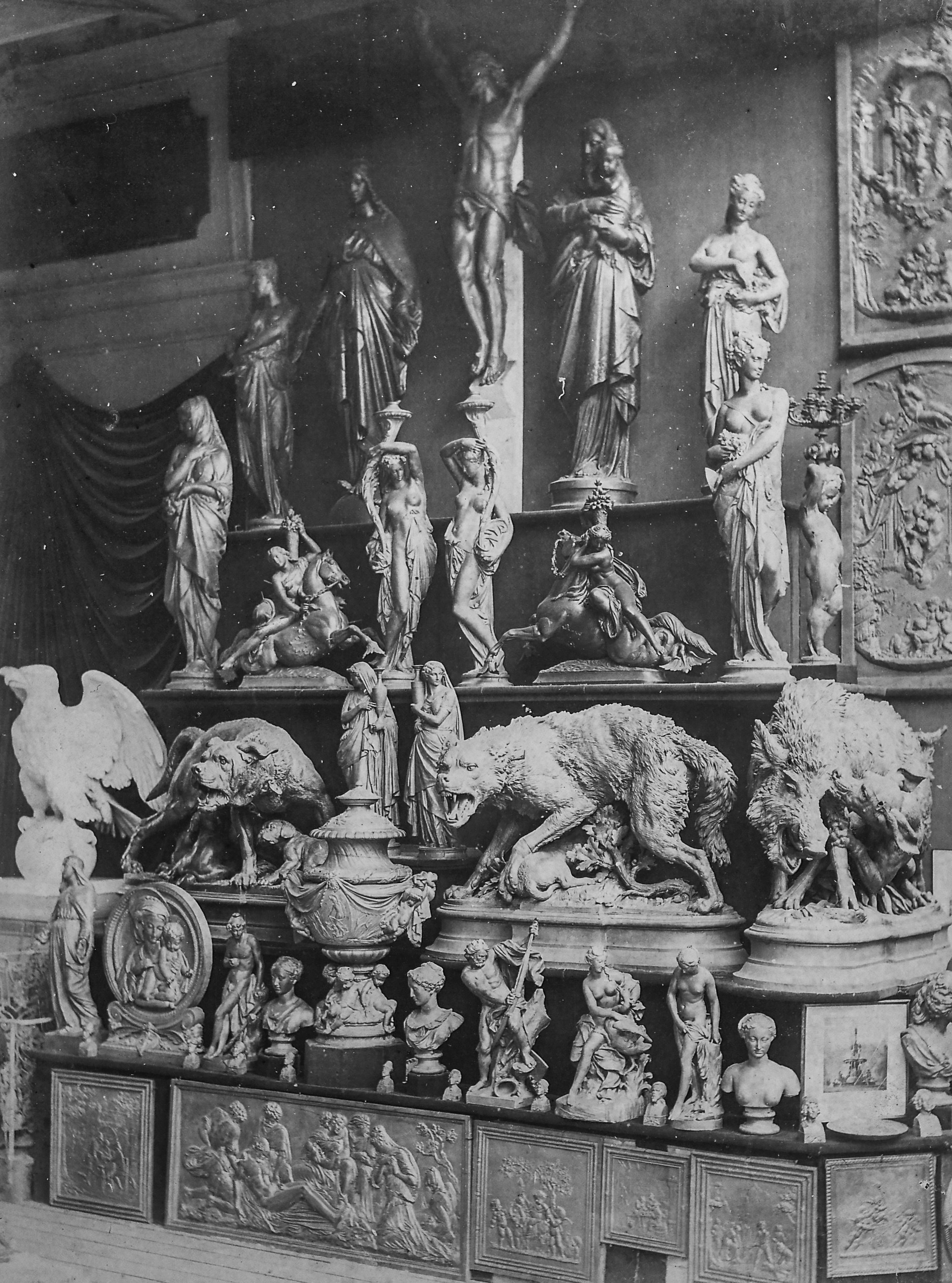
Antoine Durenne’s exhibition stand in London, 1862, displaying sculptures, including Pierre Louis Rouillard’s Chienne et ses petits (left).
Courtesy of Durenne Foundry Archives
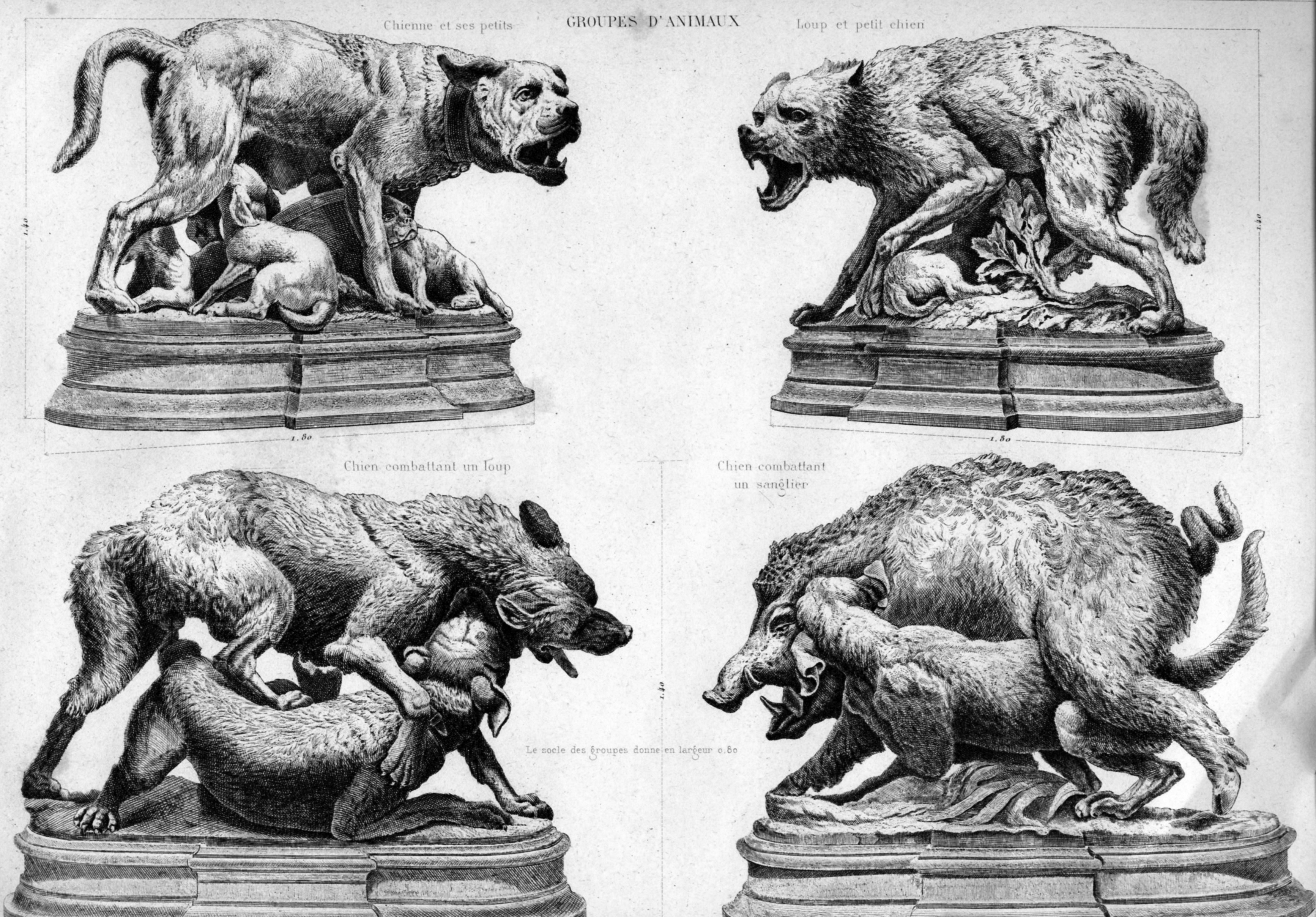
Groupes d’Animaux, 1867, showing an illustration of the sculpture Chienne et ses petits (top left), along with others.
Courtesy of Durenne Foundry Archives
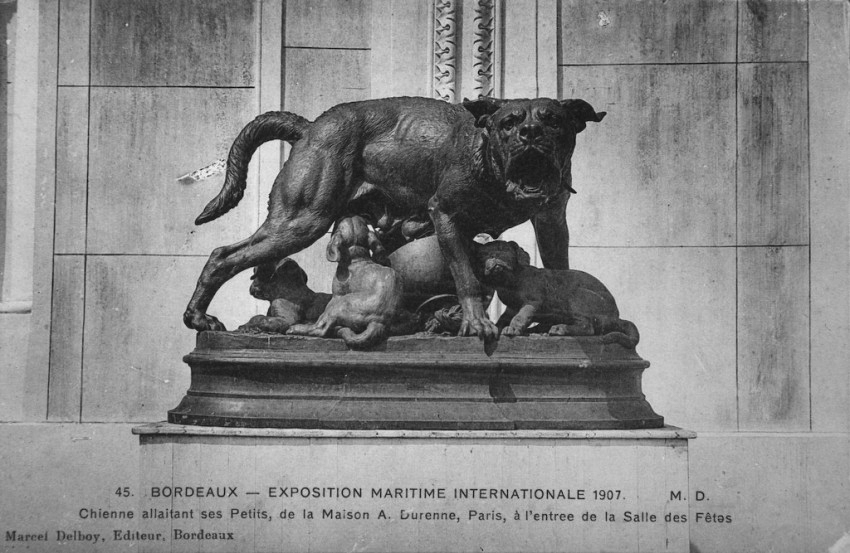
An exhibition postcard of Durenne’s Chienne et ses petits, reading: Bordeaux — Exposition Maritime Internationale, 1907.
Courtesy of e-Monumen.net
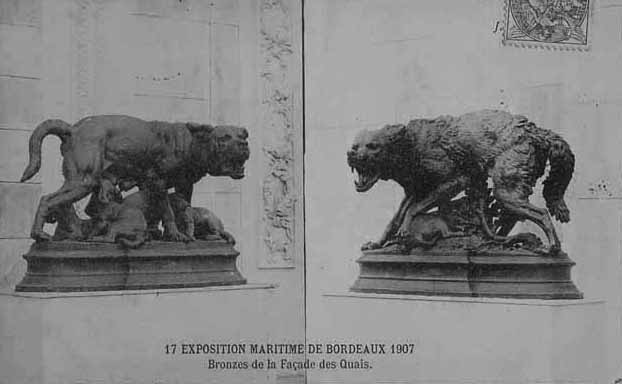
A promotional postcard displaying two Antoine Durenne sculptures, including Chienne et ses petits, 1907.
Courtesy of Durenne Foundry Archives
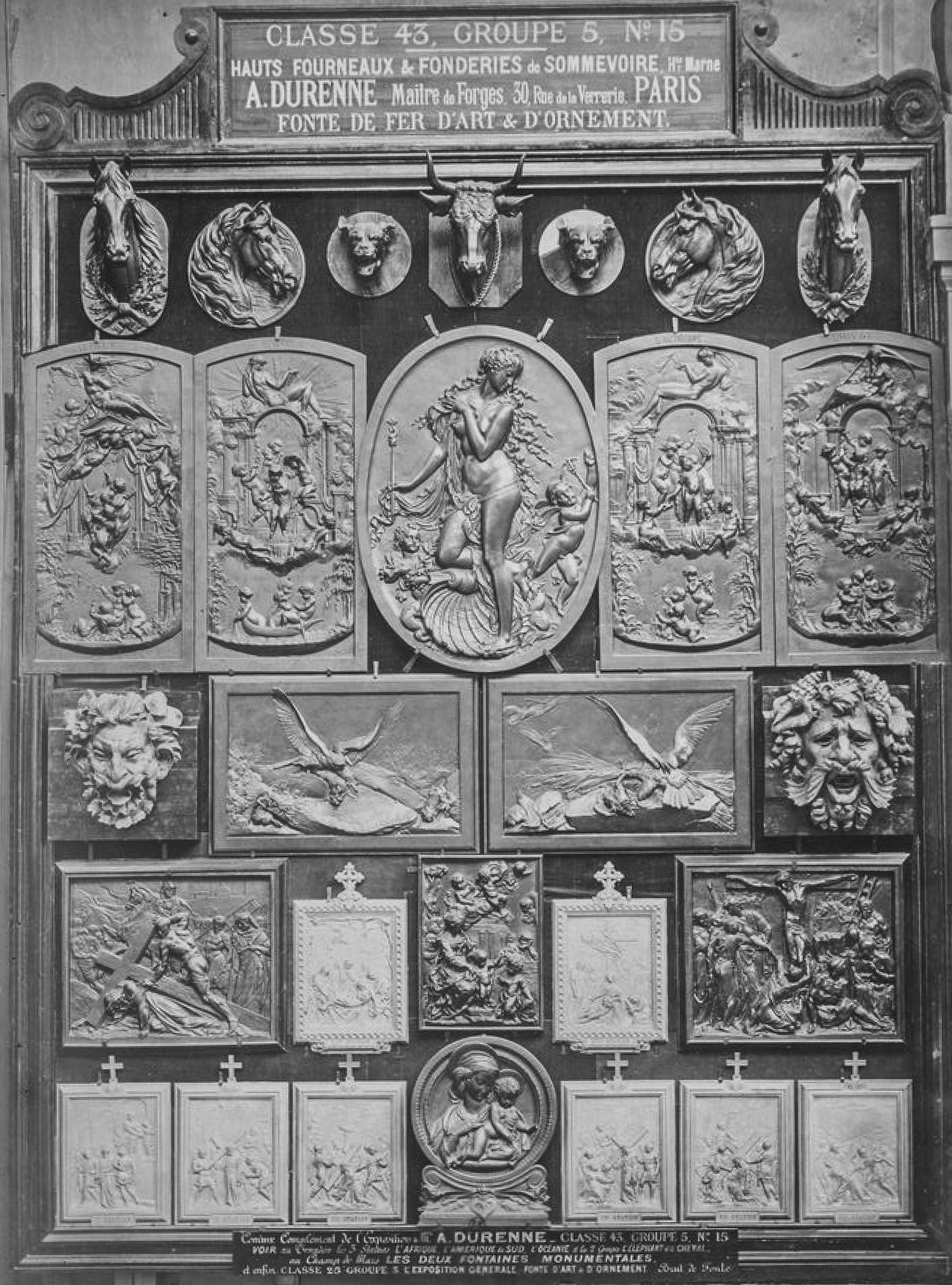
Antoine Durenne’s exhibition stand at the Exposition Universelle Internationale de 1878, displaying cast-iron fountainheads, including the head of Chienne et ses petits (top row).
Courtesy of Durenne Foundry Archives
The photograph above is the only known image of the dog head detached from the body, and it is cast as a fountain adornment. This image, from the 1878 Durenne foundry catalog, clearly indicates that the piece was available for purchase specifically as a fountainhead (the entire exhibition stand is for fountain adornments).
Chienne et ses petits Sculptures
Locating existing sculptures was another objective of the author’s research. Four known sculptures were located. The first is at the Louvre, the second is in the main courtyard of Dorfold Hall in England, the third is in Toulouse, and the fourth is in a public garden in Champigny-sur-Marne.
Louvre
After Durenne purchased the rights to Rouillard’s Chienne et ses petits, the sculpture, commissioned by Napoléon III, was installed at the base of the staircase of the former imperial stables at the Louvre in 1859.[33] On 29 September 2024, the author photographed the original sculpture that was placed in 1859. It is not in the main Louvre collection, but rather a courtyard in which visitors are prohibited. Photographs of the sculpture were taken from the windows of the Denon Wing on two separate levels. The images depict the sculpture from different angles, with water spraying out of the mouth into a basin. This is the only sculpture in the series that acts as a fountain, and confirms that the design was such that a pipe could be inserted through the head.
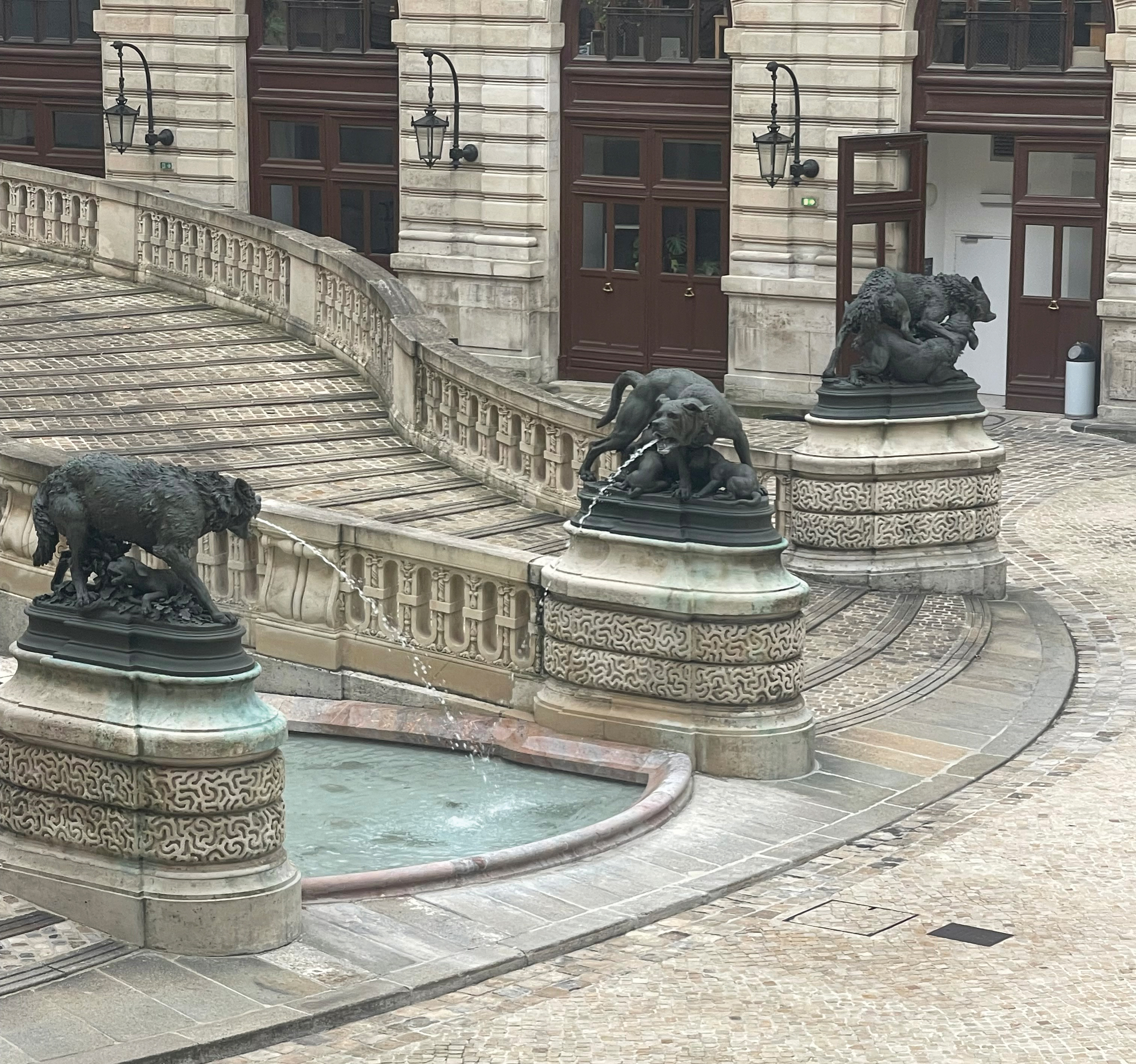
Chienne et ses petits (at right), opposite the sculpture Loup et petit chien (wolf and pup), at the Louvre, photographed in 2024.
Courtesy of Heather A. Warfield
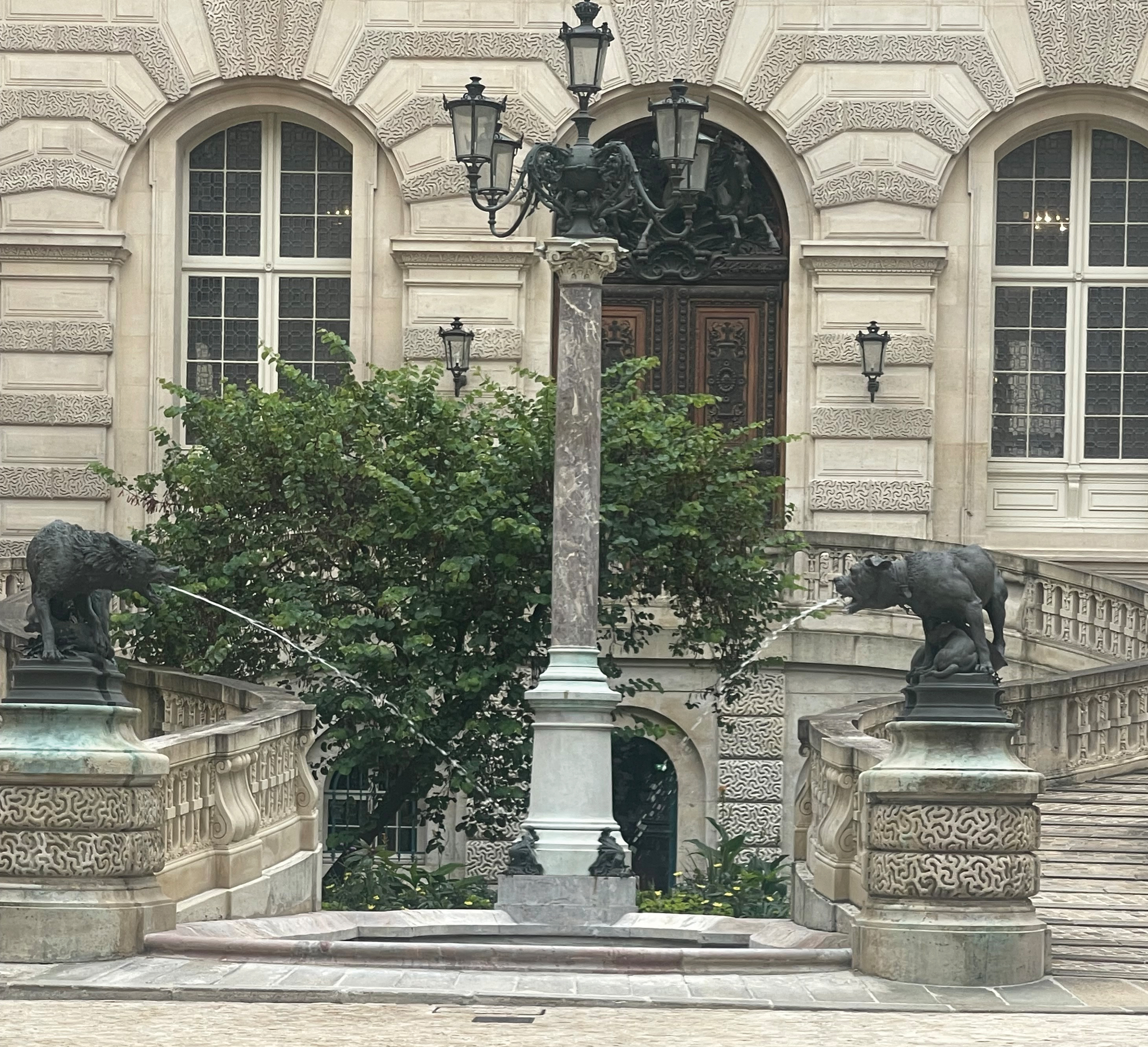
Another view of Chienne et ses petits at the Louvre.
Courtesy of Heather A. Warfield
Dorfold Hall Estate
The Instagram site for the Dorfold Hall Estate in Cheshire, United Kingdom, refers to the sculpture as “The Dog Statue” (see below) and indicates that the sculpture was placed in the courtyard in 1862.[34] Given the fact that a similar dog sculpture was exhibited as part of Durenne’s work in London in 1862, it is likely that the sculpture in the Dorfold Hall courtyard is the same as the one pictured here.
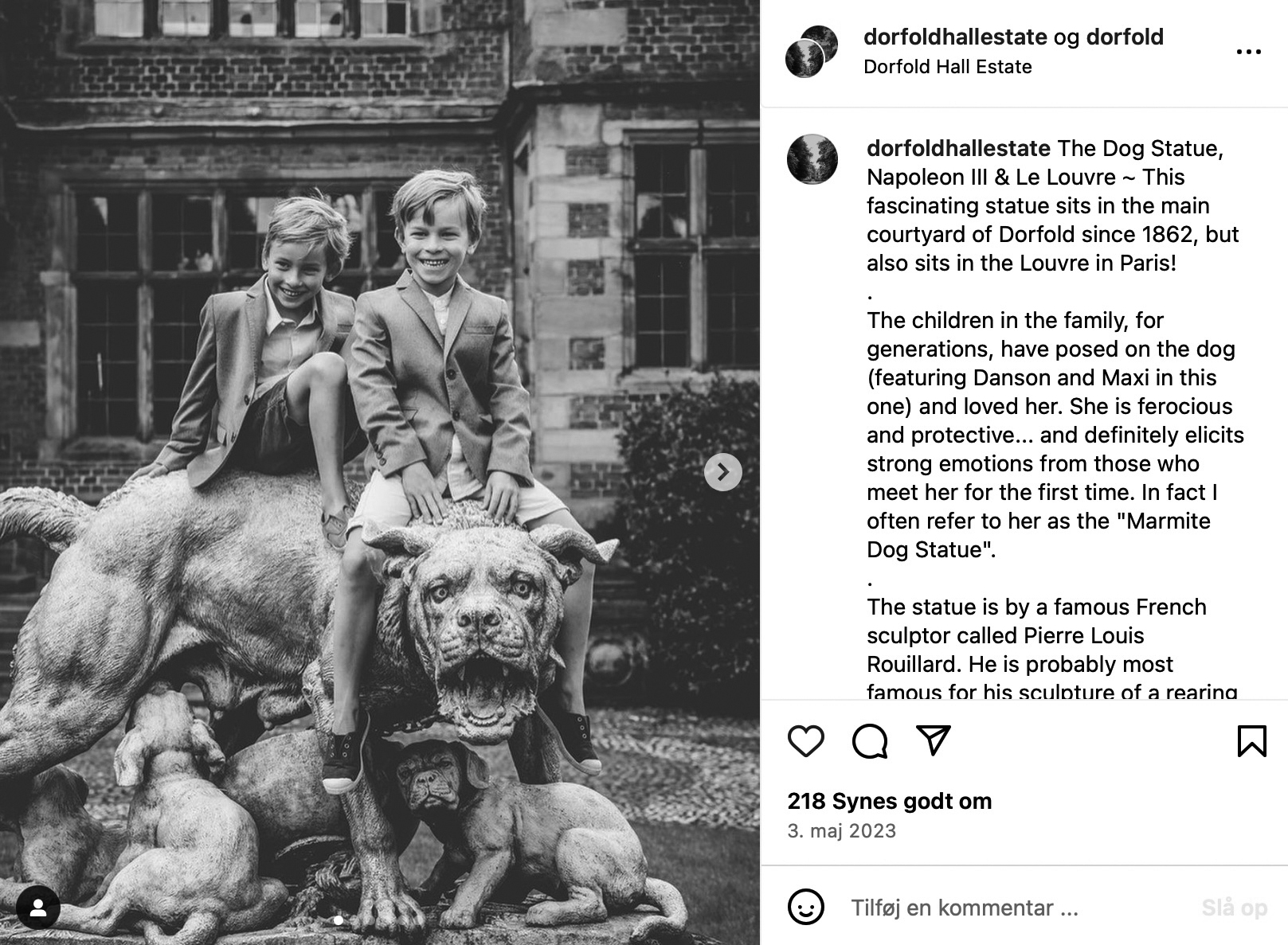
The Dog Statue at Dorfold Hall Estate, as published by the estate’s Instagram account on 3 May 2023.
Courtesy of Dorfold Hall Estate
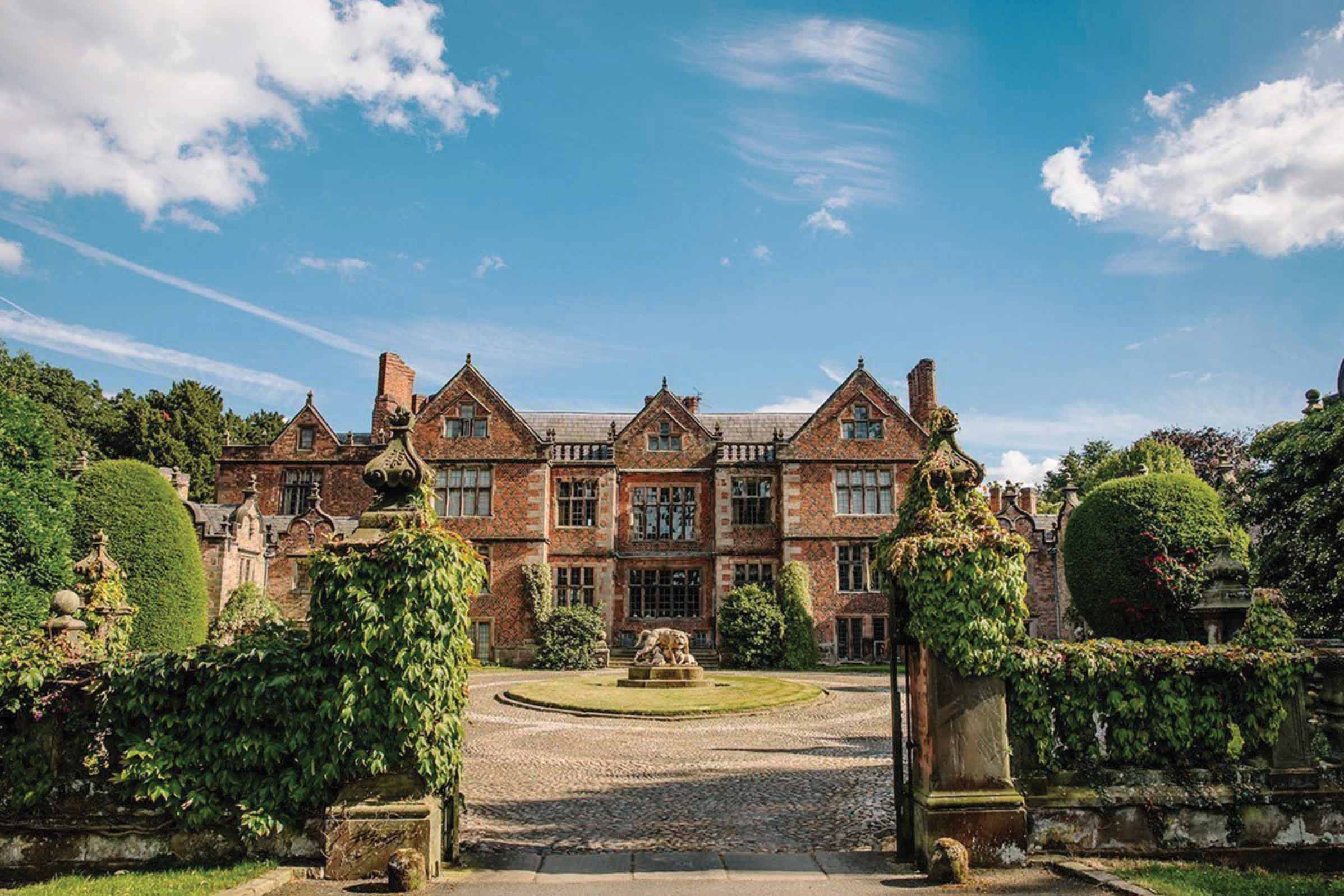
A view of Chienne et ses petits in Dorfold Hall Estate’s courtyard.
Courtesy of Dorfold Hall Estate
Toulouse
The statue was placed in the Toulouse park for an 1865 exposition of fine arts and industry (see below).[35] The sculpture description in the online database A Nos Grand Hommes attributes the sculpture to Rouillard and the Durenne foundry in Sommevoire and states that the sculpture is made from cast iron.[36]
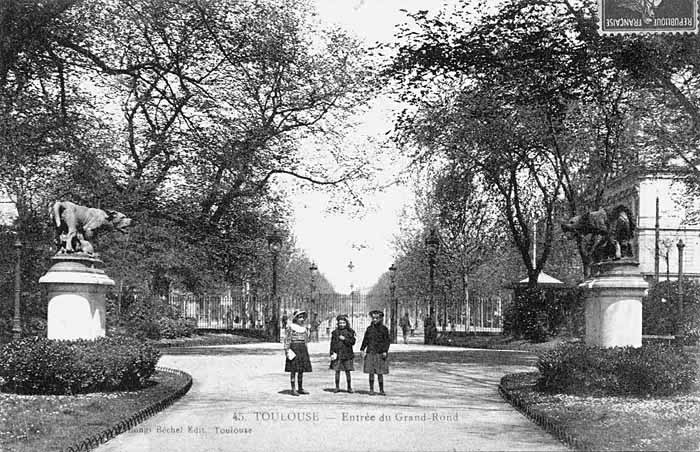
A postcard of the Toulouse Grand Rond park entrance shows Chienne et ses petits opposite the sculpture Loup et petit chien, 1893.
Courtesy of e-Monumen.net
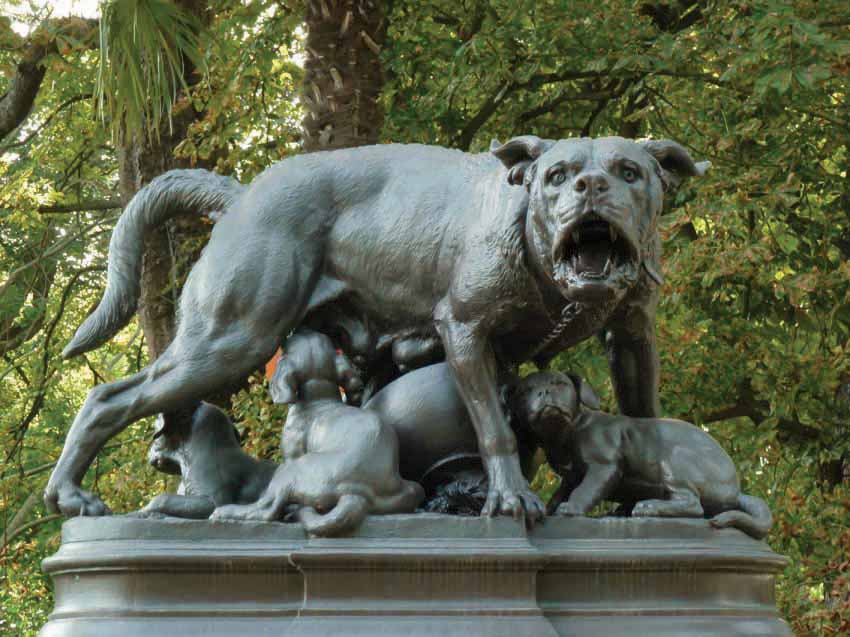
Chienne et ses petits in the Grand Rond park at Toulouse, France.
Courtesy of e-Monumen.net
Champigny-sur-Marne
This sculpture was most useful for linking the Devil Dog fountain head to Rouillard and Durenne. The park is easily accessible from Paris and the sculpture could be examined up close. On 24 May 2024, the author traveled to the park, which is in the middle of a roundabout. There is an interpretive sign that confirms the sculpture was done by Rouillard and is a copy of the one at the Louvre. The sculpture was installed at this location by the City of Paris when Champigny belonged to the Seine Department. The author took detailed measurements of every aspect of the dog’s head so they could be compared with the fountain head in Belleau. In addition to the head, the sides and back of the sculpture were photographed and reveal three nursing puppies and a bowl into which the mother’s milk is dripping onto stalks of wheat.
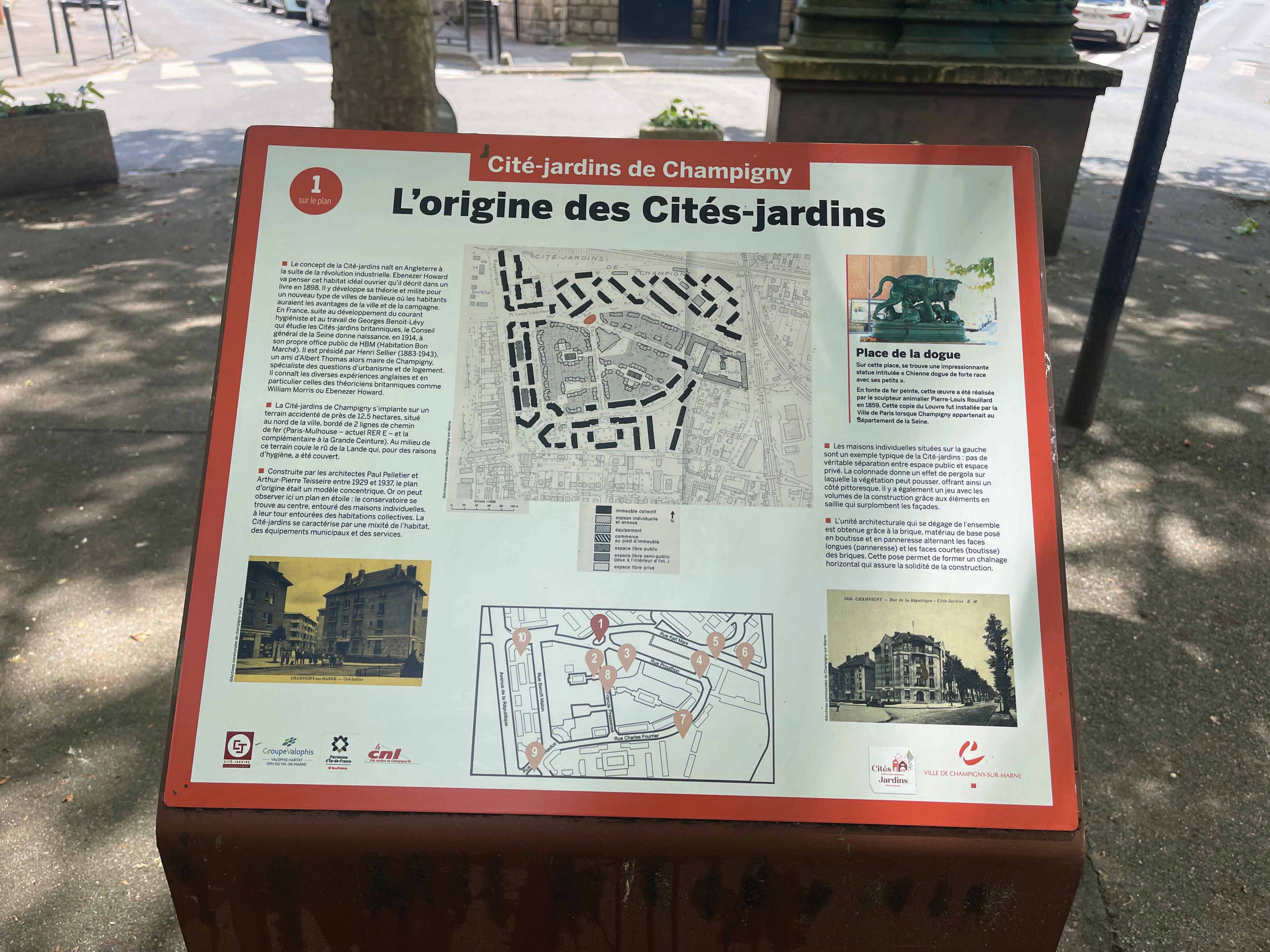
City park signage explaining the Chienne sculpture at Place de la Dogue, a small park in a traffic circle in Champigny, France.
Courtesy of Heather A. Warfield
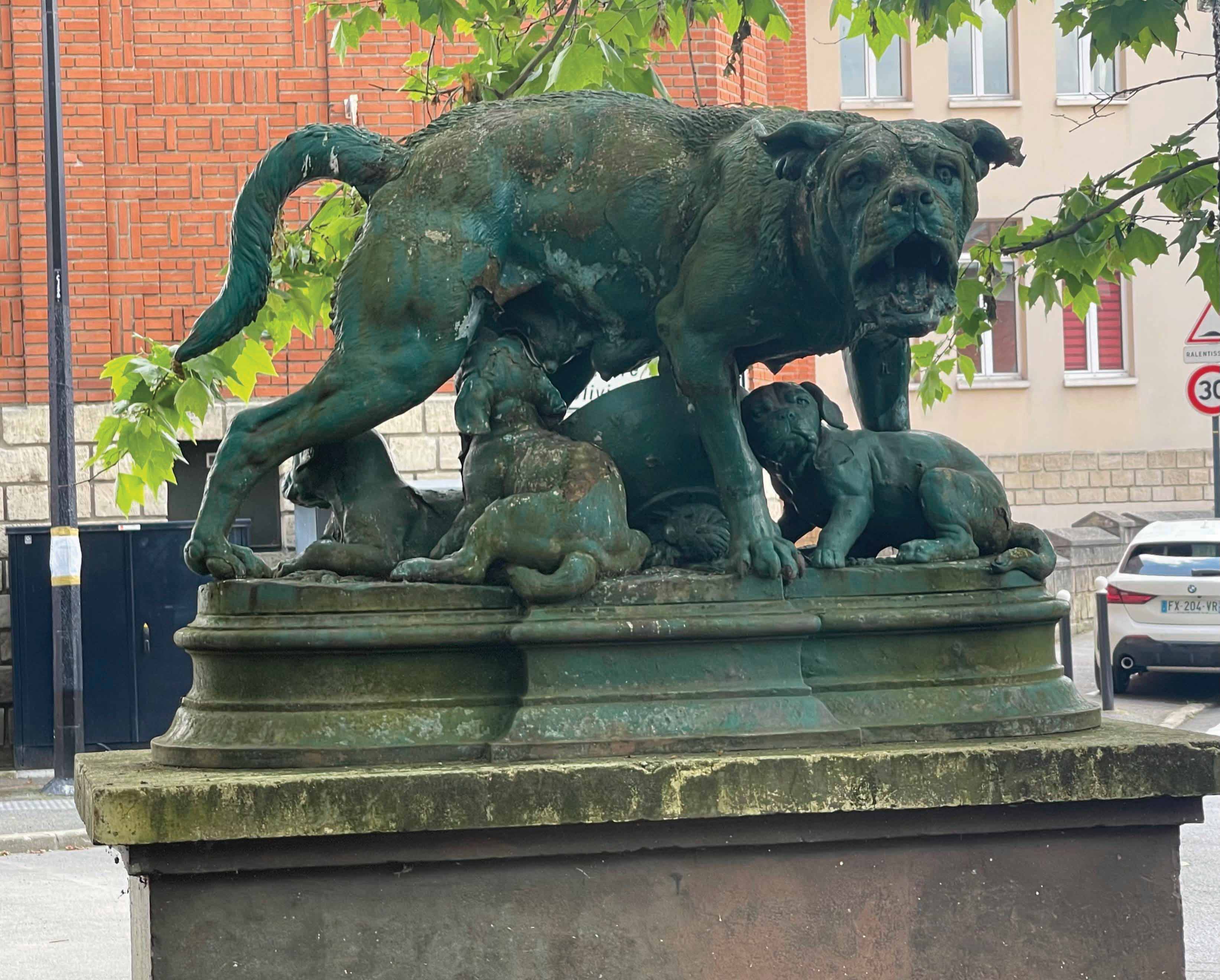
The Chienne sculpture at Place de la Dogue, Champigny.
Courtesy of Heather A. Warfield
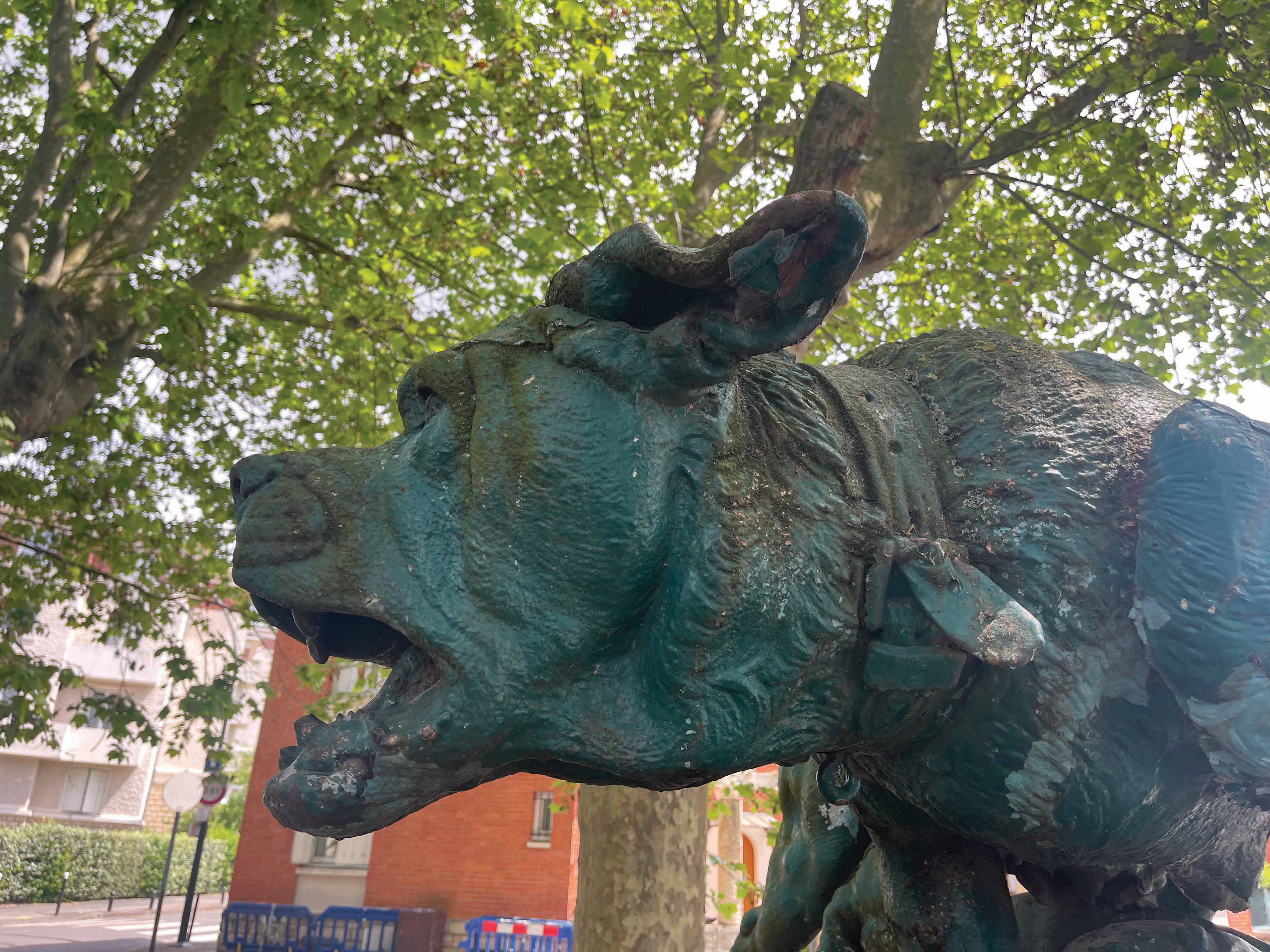
Another closeup view of Chienne’s head at Place de la Dogue, Champigny.
Courtesy of Heather A. Warfield
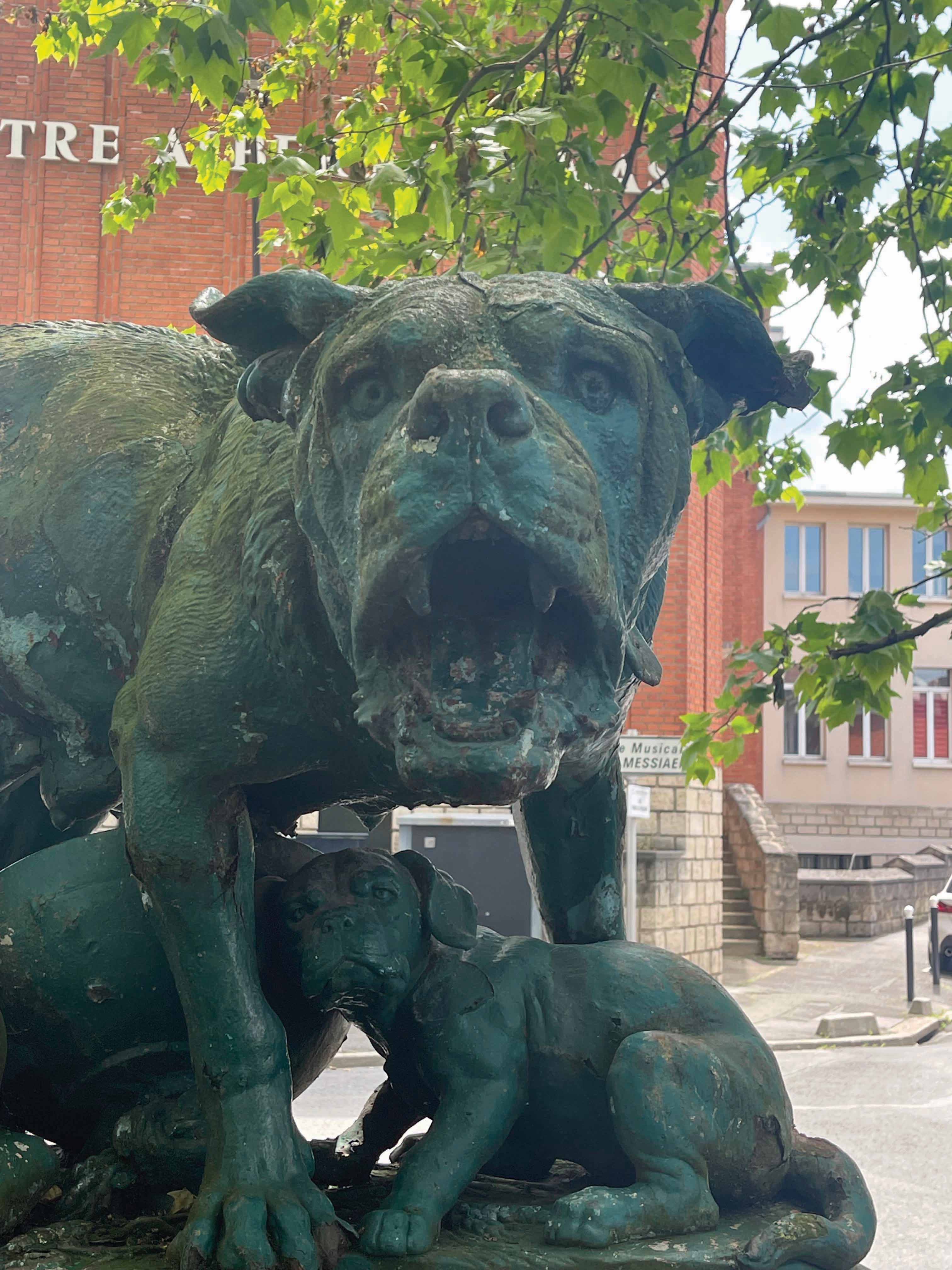
It is easy to see that Chienne’s head at Place de la Dogue, Champigny, is the same as that of the Devil Dog fountain.
Courtesy of Heather A. Warfield
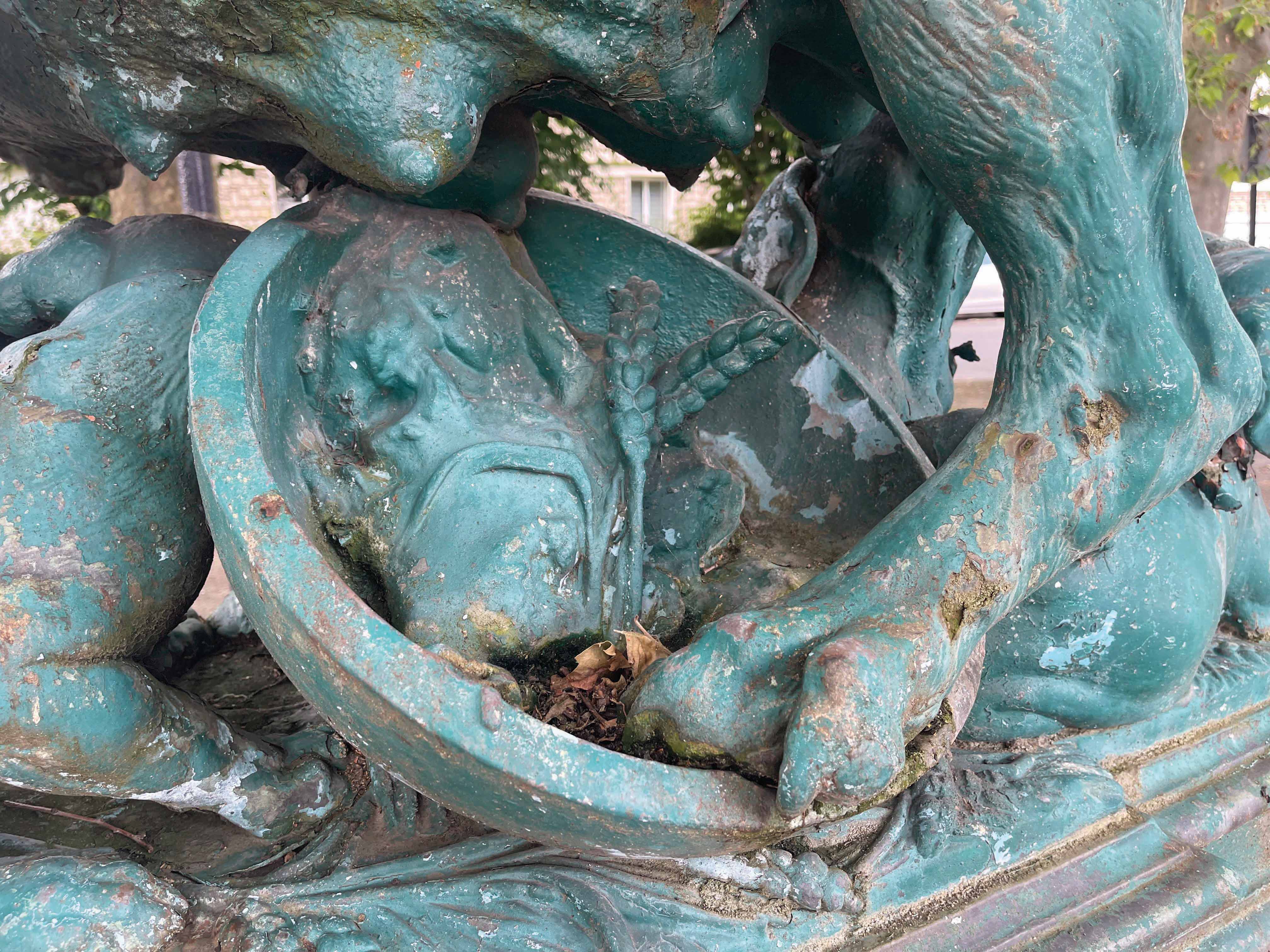
Mother’s milk dripping onto wheat in the bowl at Chienne’s feet at Place de la Dogue, Champigny.
Courtesy of Heather A. Warfield
Comparisons with the Devil Dog Fountain
The final step of the material analysis was to compare the detailed measurements from the Champigny-sur-Marne sculpture with the fountainhead in Belleau. The measurements are exact, which validates the hypothesis that this head was designed by Pierre Louis Rouillard and cast at the Durenne foundry. It is possible to approximate the date that it was installed in Belleau based on two images. The Durenne exhibition stand 1878 (see above), which is the only known display of fountainheads, is the first anchor point.[37] The second anchor point, an image from 1895 (see below), depicts that fountainhead at its present location. Given these reference points, it is likely that the Devil Dog fountainhead was installed between 1878 and 1895.
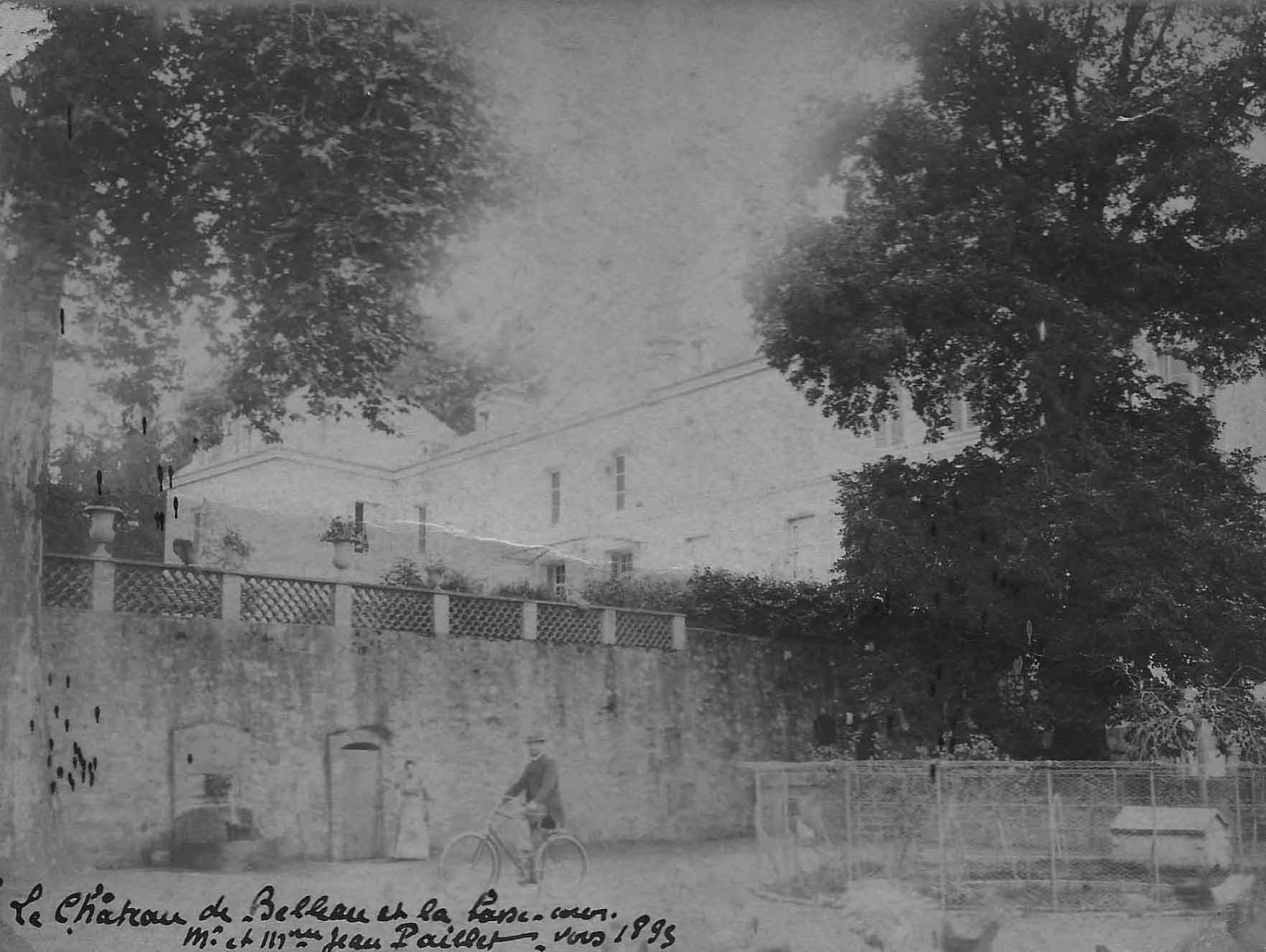
The Devil Dog fountain at Chateau de Belleau in 1895, seen in the lower left quadrant of the photograph.
Courtesy of Mr. Eric Verhulst
Positioned within Artistic Context
Positioned within the artistic context, the Devil Dog fountainhead is, in fact, the head of a female dog that is nursing her three puppies. The tense jaw, vicious face, and snarl indicate she is protecting her offspring during a moment of threat. Her milk, a literal and symbolic sign of sustenance, combines with the wheat sheaves (symbols of the life cycle and immortality), suggesting that she is the life source for the next generation and, ultimately, the guardian of immortality.
Theoretical Frameworks for Understanding the Fountain’s Magnetism
On the surface, the fountain’s magnetism for Marines is the connection to the Devil Dog moniker and the fountain’s proximity to the Belleau Wood battlefield. However, the fountain seems to possess an energetic pull that exists beyond the battlefield connection. Many Marines interviewed for this research speak of the fountain in more endearing terms than the battlefield itself. Furthermore, despite the absence of the head’s artistic referent, many pilgrims and visitors engage with the fountain as if they intuitively know there is more to the fountain than what is seen. There are a number of psychological explanations for why this intuitive sense exists and why Marines could be projecting wholeness onto a dog head, fragmented from its body, fastened to a stone wall (beyond the head representing the Devil Dog). The first explanation is grounded in the concept of Gestalt and the second pertains to the Great Mother archetype, as described by Carl Jung.
Gestalt: Perceiving Wholeness in Fragments
The concept of Gestalt, rooted in early twentieth-century psychology, emphasizes the human tendency to perceive patterns and wholes rather than disparate parts. This principle, developed by German psychologists such as Max Wertheimer, Wolfgang Köhler, and Kurt Koffka, suggests that the whole is greater, or other, than the sum of its parts.[38] Gestalt theory fundamentally contends that perception is an active, constructive process, wherein the mind organizes sensory input into meaningful forms. This framework becomes especially salient in the realm of visual arts, particularly sculpture, when an object is partially absent or intentionally incomplete. For example, when viewing a sculpture that is missing a piece, such as a fragment of the body or a limb, the viewer does not typically register the absence as mere lack. Instead, the perceptual system fills in the missing components, drawing from past experiences, cultural archetypes, and visual expectations to form a cohesive whole. This phenomenon aligns with Gestalt principles such as closure, continuity, and figure-ground organization. Closure, in particular, refers to the mind’s inclination to perceive a complete, unified shape even when parts are missing. For example, a headless or limbless statue may still be perceived as a “complete” human figure because the mind projects the absent elements to maintain continuity and narrative coherence. The Venus de Milo is a prime illustration of this Gestalt response. Although the sculpture is famously armless, it continues to be interpreted as a complete representation of idealized female beauty. The missing limbs have invited speculation, artistic reimagination, and scholarly interpretation, all of which underscore how absence fosters imaginative projection rather than perceptual rupture. In this example, the Gestalt perception does not merely “repair” the image; it enriches it with narrative and emotional depth.
From a psychological standpoint, this process of perceptual completion engages the viewer’s cognitive and emotional faculties. According to Rudolf Arnheim, a prominent figure in applying Gestalt theory to art, visual perception is not passive reception but an active grasping of structural features.[39] When faced with an incomplete sculpture, the observer participates in its aesthetic and symbolic construction, thus becoming a cocreator of meaning. Moreover, the phenomenon of projection onto incomplete forms taps into broader existential and philosophical themes. The incompleteness of the sculpture mirrors the fragmentary nature of memory, identity, and history. In this way, Gestalt principles do more than explain perceptual mechanics; they articulate how humans find coherence amid disjunction and beauty amid absence. The missing piece becomes a site of invitation, asking the viewer to engage with what is not there as much as with what is.
In the specific context of martial conflict, war has long been a force of both literal and symbolic fragmentation. Sculptures defaced or destroyed in conflict zones become powerful testimonies to collective trauma. The fractured object serves as a visual metaphor for the psychological and societal disintegration wrought by violence. In this sense, Gestalt not only explains how viewers perceive broken forms but also provides a framework for understanding how we psychologically cope with rupture. As external victims of war, such sculptures represent deep psychological lacerations. In such contexts, the Gestalt tendency to integrate fragments into a whole is not just perceptual, it is reparative. Viewers may unconsciously attempt to complete a damaged or fragmented sculpture as a way to assert order over chaos, beauty over destruction. The very act of perceiving wholeness in brokenness becomes an aesthetic and psychological response to trauma. While the Devil Dog fountainhead was not fractured during war, this Gestalt approach does inform current interactions with the site as individual Marines, and the institution, have been impacted by war and other conflicts. Many Marines interviewed for this research describe an inner fragmentation as a result of war. As the shrine is a point of projection, the inner fragmentation is projected onto the fountainhead. Moreover, for Marines encountering the fountain, the missing body is not an absence but an invitation. The psychological tendency to complete the fragment allows each viewer to project their own understanding of what the whole Devil Dog represents, whether the ferocious warrior, the protective guardian, or, as the sculpture’s actual origins reveal, the nurturing mother. This perceptual flexibility may paradoxically enhance rather than diminish the fountain’s power. The head operates as what might be called a symbolic fragment that is perpetually open to reinterpretation, capable of holding multiple meanings simultaneously. In this sense, the incompleteness is not a deficiency but a feature that allows the fountain to serve different psychological needs for different Marines at different moments in their lives.
Great Mother Archetype
In addition to highlighting the concept of Gestalt as a way to frame the magnetism of the Devil Dog fountain, Carl Jung’s work on the topic of archetypes is relevant to a psychological understanding of the fountain. Of particular note is Jung’s conceptualization of the Great Mother. Jung situates the Great Mother archetype as one of the most primordial figures of the collective unconscious. She is both nurturing and devouring, the source of life and the abyss of death.[40] Moreover, Jung suggests that the mother is found in sites that arouse increased devotion or awe and include the woods, a spring, or a deep well (all of which exist in the Belleau Wood battlescape).[41] The water symbolizes the unconscious and its depths reflect the mysteries of origin, fertility, and the maternal womb.[42] Belleau Wood pilgrims and visitors also encounter the cemetery as part of the battlescape, a site which represents a descent back to the mother, and the cycle of life. As such, the entire setting is “a place of magical transformation and rebirth, together with the underworld and its inhabitants . . . [a place] presided over by the mother.”[43] The practices that occur at Belleau Wood further underscore the subconscious encounter with the Great Mother. They are thematically linked to a return to the birthplace, initiation and lifecycle rites of passage, and symbolic healing and transformation.
Visiting the Birth Place
Marines visiting Belleau Wood frame the experience as visiting, or returning to, the birthplace of the Marine Corps. From a psychological perspective, visiting the place of one’s birth holds profound significance. Such visits can evoke a deep sense of identity, belonging, and continuity, and can reconnect individuals with foundational aspects of the self. According to Erik H. Erikson’s theory of psychosocial development, such visits may reinforce a sense of ego integrity, particularly in later life, when individuals seek to reconcile their past with their present.[44] From an emotional standpoint, the visits may stir nostalgia, trigger buried memories, or initiate healing. In addition, a birthplace visit can symbolically complete a psychological circle, fostering coherence in the personal narrative.
Initiation and Life Cycle Rites of Passage
Historically, sacred wells have been sites where initiation and rites of passage occur, so it is unsurprising that the Devil Dog fountain has become such a prominent place within the Marine Corps. The rituals and rites of passage that occur here are those symbolically focused on rebirth, renewal, and repair. Marines visit the site to reaffirm their commitment to the Corps and to immerse in the evolving rituals that occur. The rituals are related to the life cycle of a Marine and include reenlistment, promotion, or retirement ceremonies. In addition, the water itself is significant and Marines either drink directly from the head or fill a vessel with the water, which is also often taken to other Marines. The more recent practice of placing uniform insignia into the stone around the dog head, perhaps for devotional purposes, further highlights the ritual attraction to the site as well as its role as a nexus point for identity congruence between the Marine and the Devil Dog.
Healing and Transformation
Jung’s archetype of the Great Mother is both generative and destructive, representing the totality of nature’s rhythms, birth, death, decay, and rebirth.[45] In the context of battlefield pilgrimages, a holy well becomes a vessel through which the pilgrim reconnects with this deep archetypal force. To drink from or bathe in the water is to symbolically reenter the womb of transformation, a return to origins where psychological integration can begin. The liminal space of the well, guarded by symbolic dangers and imbued with maternal power, demands that pilgrims undergo a rite of passage in which they confront mortality, seek healing, and emerge transformed. Conversely, the Great Mother is not merely a figure of comfort but also of judgment and transformation. Pilgrims are not only healed but also initiated through contact with her symbolic domain. The well’s depths echo the maternal womb and the grave, making it a symbol of both origin and return. The pilgrim, in approaching the holy well, symbolically reenters the domain of the Great Mother, seeking rebirth or renewal.
During pilgrimages to Belleau Wood, questions about one’s military service are often pondered and, for some, the answers are found through the act of redevoting oneself to the Marine Corps through reenlisting or promoting to the next rank. For others, the answers are found in recalling the memory of Marines from 1918 who, through the act of commemoration, are brought back to life. And, for many, the answers are found in framing their lives through an apparatus of meaning tied to identity, rituals, stories, and a grand narrative of perceiving the world through the eyes of being a Marine. All are examples of the types of inner transformation that can, and do, result from engagement with the fountain.
The Devil Dog Fountain as Site of Psychological Integration
The fountain’s hellhound-as-fountainhead is not a deterrent, but a beacon for those ready to face the deep. Pilgrimages to this site are dances with paradox: the healing waters flow not from purity, but from the jaws of the shadow. It is this rich mythic contradiction that gives the fountain its power, drawing the seeker inward and downward, toward healing that is also an initiation into the fullness of being. The journey to the fountain involves not just physical movement but psychological and spiritual descent. Yet, the presence of the threshold guardian, the Devil Dog, signals that this transformation is not without risk. It becomes the scene for an encounter with paradox and a setting where many truths can coexist at the same time.
Pilgrims can take cues from the setting itself. Despite its violent history, the entire Belleau Wood battlescape is now a serene landscape, and the paradox is that the tranquility now experienced within the site is precisely because of the historical violence.[46] An encounter with this paradox fuses with Belleau Wood’s facts, myths, and archetypes and can be viewed as an invitation to engage in psychological integration, an important component of pilgrimages.[47] In the case of this particular site, it seems that the new information about the fountainhead’s artistic context could provoke integration opportunities focused around such themes as lethality and vulnerability, institutional masculinity and manhood, and moral injury. It is important to note that Marines are already fusing many of these elements during pilgrimages to Belleau Wood and the purpose of this discussion is to highlight a number of paradoxical themes that coalesce at this battlescape, in general, and the fountain, in particular.
Lethality and Vulnerability
When Marines visit Belleau Wood, the site of their collective birth, they are visiting the geographic landscape that has formed the backdrop for such elements as physical training, identity formation, and character development, to include the characteristics that lead to the “ideal Marine.” It is also interesting to note the comments Marines leave in the pages of the Aisne-Marne American Cemetery visitor registry during these visits, particularly because they are strikingly different than those left by other visitors, who write remarks about the serenity and beauty of the cemetery. However, en masse, Marines write comments such as “Kill!” or “Get some!” Not only are these comments seemingly incongruent with the setting, which is a site of death and destruction, the words are incongruent with the remarks written in the registry in the 1920s by Marines who actually fought at Belleau Wood. These World War I Marines’ comments focused on the place being “hell” and on their desire for peace.[48]
The contemporary cemetery registry comments are reflections of how Marines are trained and who they see themselves to be. However, there is clearly a level of cognitive dissonance occurring during the visits to Belleau Wood, which leads to writing, “Kill!” in the middle of a battlefield cemetery. In this context, Marines are not there to kill and yet the words are evidence of group affiliation and also provide documentation to future visitors that Marines were in this precise location, a metaphorical devil dog marking its territory, and the embodiment of the aforementioned dog of death. However, as Lincoln noted, the hellhound myth is not merely the dog of death, the black dog, but also a dog of life. The life-giving nature of the white dog does not diminish the lethality of the black dog; both can coexist in the same body. Evidence of the embodiment of the white dog are the practices around vulnerability, self-reflection, tolerance, peacemaking, alliance-building, and repair, all of which can coexist with discipline, honor, and bravery, and all of which are observed at Belleau Wood. This is a place where peace is valued, alliances are renewed, and there is an institutional sanctioning of public displays of vulnerability (see photo of General Neller, top of page).
The revelation that the fountainhead depicts a nursing mother intensifies this potential for integration. The fierce expression that Marines have interpreted as warrior ferocity is, in its original context, maternal protection. The mother dog is not snarling in bloodlust but in defense of her vulnerable young. This reframing does not negate the ferocity; maternal protection can be as fierce as any warrior’s rage, but it situates that ferocity within a framework of care rather than pure aggression. For Marines grappling with the tension between their capacity for violence and their desire to protect, the nursing mother offers a powerful symbol: one can be simultaneously lethal and nurturing, fierce and tender, dangerous and life-giving.
Manhood and Masculinity
In addition to the plethora of lessons extrapolated from World War I, the Marine Corps traces much of its institutional culture back to this era. A pervasive factor in this institutional culture pertains to manhood and what constitutes an ideal Marine. Mark Folse asserts, “A gendered analysis of the Marine Corps during the Great War era reveals that white manhood and manliness formed the basis of its identity and institutional culture, the veterans of which valued honor, bravery, self-restraint, and discipline . . . and promoted their own form of martial manliness that placed even greater emphasis on the above characteristics and added efficiency, combat prowess, and readiness into the mix.”[49] Moreover, Heather Venable suggests that the Marine Corps has historically reinforced one type of masculinity and manhood.[50] This not only speaks to the challenges around the inclusion of women in the Marine Corps, but how the institutional culture impacts all Marines, and, within the context of the Devil Dog fountain, the extent to which Marines are projecting this culture onto the fountain.
Given that the dog head in its sculptural configuration is that of a female hound, there are opportunities to ponder what could exist in an integrated Devil Dog motif, one that overtly merges the dog of death with the dog of life. There is profound symbolism reflected in the elements of the Chienne et ses petits sculpture, especially around sustenance, the lifecycle, immortality, and, ultimately, the archetype of the Great Mother. How might the institutional culture of the Marine Corps adapt to the reality that the Devil Dog fountainhead is that of a nursing mother?
This question becomes particularly salient given the Marine Corps’ ongoing struggles with integrating women into combat roles and the persistent challenges of gender-related trauma within the institution. The fountain, if understood in its full artistic context, offers a symbolic resource for reimagining what strength looks like. The nursing mother is not weak; she is ferocious in protection of her young, capable of extraordinary endurance, and literally life-sustaining. Her strength is not diminished by her nurturing capacity but enhanced by it. She embodies a form of power that includes rather than excludes care.
For male Marines, the maternal fountainhead need not threaten their sense of warrior identity. Instead, it can expand the definition of what a Devil Dog is: not merely a killer, but a protector; not merely destructive, but life-sustaining; not merely autonomous, but connected to something larger than oneself. The milk dripping onto wheat sheaves suggests that the warrior’s sacrifice feeds future generations, that violence in defense of life has meaning precisely because it is oriented toward preservation rather than destruction for its own sake.
For female Marines, the fountain in its full context offers powerful symbolic validation. The fiercest figure at the Marine Corps’ most sacred site is a mother. This is not the sanitized, passive motherhood of sentimental culture but the raw, fierce, protective motherhood that will destroy threats to her young. Female Marines need not choose between being warriors and being women; the fountain suggests these identities can coexist, that maternal and martial are not opposites but complementary aspects of a complete person.
Moral Injury and the Path to Healing
The vast majority of Marines visiting the Devil Dog fountain are veterans of the Global War on Terrorism or know other Marines who are. Of that number, many are dealing with the invisible wounds of war stemming from the existential questions related to the meaning of one’s military service, sacrifices, and losses incurred as a result of this service. Moral injury, the psychological and spiritual damage that results from perpetrating, failing to prevent, or bearing witness to acts that transgress deeply held moral beliefs, has become increasingly recognized as a central challenge for post–9/11 veterans. Unlike post-traumatic stress disorder (PTSD), which stems from fear and threat, moral injury stems from shame, guilt, and profound questions about one’s own goodness.
The Belleau Wood battlescape, including the Devil Dog fountain, may serve unexpected therapeutic functions for individuals processing personal trauma, particularly military veterans who may use historical battlefields as proxy sites for confronting their own combat experiences. This phenomenon reveals important psychological mechanisms related to trauma processing and post-traumatic growth that warrant examination through established clinical frameworks.
PTSD research indicates that avoidance of trauma reminders is a common symptom that can impede psychological recovery.[51] However, graduated exposure to trauma-related stimuli in controlled environments forms the basis of effective exposure therapy treatments.[52] Historical battlefields may provide psychologically safe contexts for trauma processing because they offer sufficient similarity to trigger therapeutic engagement while maintaining enough distance to prevent overwhelming retraumatization.
The psychological mechanism operating here involves what clinicians call therapeutic distance, which is optimal levels of similarity to traumatic experiences that promote processing without triggering debilitating symptoms. For veterans of Iraq or Afghanistan conflicts, World War I battlefields provide thematic similarity (e.g., combat, loss, sacrifice) while differing sufficiently in temporal, technological, and cultural contexts to prevent direct retraumatization. The fountain becomes a focal point within this therapeutic landscape, a specific site where the abstract process of trauma engagement becomes concrete through ritual action.
This process may facilitate what Richard G. Tedeschi and Lawrence G. Calhoun termed post-traumatic
growth, which is the positive psychological changes that can emerge following trauma processing.[53] These changes include enhanced appreciation for life, deeper relationships, increased personal strength awareness, spiritual development, and expanded possibilities for life direction. The Devil Dog fountain and the broader Belleau Wood battlescape may promote post-traumatic growth by providing structured opportunities for meaning-making, perspective-taking, and connection with others who have faced similar challenges.
Narrative Construction and Meaning-Making
The human need to construct coherent life stories represents a fundamental psychological drive that pilgrimage sites both satisfy and complicate. Narrative psychology, developed by Dan P. McAdams, emphasizes how individuals create identity and meaning through story construction, integrating past experiences, present circumstances, and future aspirations into coherent personal narratives.[54] For veterans struggling with moral injury, the challenge often involves integrating traumatic experiences into life stories in ways that preserve a sense of self as fundamentally good despite having participated in morally ambiguous or clearly transgressive actions.
The Devil Dog fountain facilitates this narrative work in several ways. First, it connects individual experience to a grand historical narrative, which is the birth of the modern Marine Corps at Belleau Wood. By drinking from the fountain at this sacred site, contemporary Marines symbolically link their own service, including its morally complex dimensions, to a clear victory against unambiguous evil in World War I. This connection does not erase moral complexity, but it situates individual experience within a larger story that includes both heroism and horror, suggesting that one’s story might similarly contain contradictions without losing fundamental coherence or worth.
Moreover, the communal aspect of battlefield pilgrimages appears particularly important for trauma processing. Veterans visiting these sites often encounter others with shared military experiences, creating opportunities for social connection and mutual support that complement individual psychological processing. This aligns with research demonstrating that social support significantly influences trauma recovery outcomes.[55] The Devil Dog fountain fosters cohesion and group membership by the sheer fact that Marines visit the site with others or they share about their experiences with other Marines either on social media or in person. The sense of community that is fostered at the fountain sets the stage for a communal approach to moral injury, a recognition that these wounds are not borne alone but are shared across the institution.
Visits to the fountain may also lead to symbolic healing. An awareness that the dog head is that of a maternal figure may offer a more vibrant context for transformation. The hellhound here is not merely a threshold guardian but a generative force wherein the guardian becomes the womb; the monster becomes the midwife. For Marines grappling with moral injury specifically related to violence, such as killing enemy combatants, causing civilian casualties, or witnessing atrocities, the nursing mother offers a powerful symbol of restoration. She represents the possibility that those who have taken life can still be life-giving, that capacity for destruction does not preclude capacity for nurture. Her milk, flowing as water from the fountain, suggests cleansing and renewal. To drink from her mouth is to be symbolically nursed, to return to a state of innocence or at least to a state where care is possible.
The mother dog’s fierce expression, originally created to depict protection of vulnerable young, resonates deeply with the protective motivations that drive many to military service. Many Marines joined precisely to protect others, to stand between danger and the innocent. When their actions in war produce outcomes that contradict this protective intention; when civilians die, when allies are abandoned, when the mission seems morally compromised, the resulting moral injury is profound. The nursing mother at the fountain validates the protective intention while acknowledging the fierce methods sometimes required. She does not judge but instead offers sustenance.
The practice of reenlistment ceremonies at the fountain takes on deeper meaning when understood in this therapeutic context. Reenlistment after deployment, particularly after deployments involving moral injury, represents a profound act of recommitment. It says: despite what I have seen and done, despite my doubts and my guilt, I choose to remain part of this institution and identity. Conducting such ceremonies at the fountain, drinking from the nursing mother’s mouth, symbolically washes away the past and provides nourishment for moving forward. It is a ritual of rebirth, of choosing life and continuity over despair and fragmentation.
The fountain’s therapeutic function is enhanced by its liminal position. It is neither fully within nor fully outside the military institutional structure. It is unofficial enough to feel authentic rather than mandated, yet recognized enough to feel legitimate. Marines can engage with it according to their own needs without fear of judgment or requirement to articulate experiences for which they may not have words. The fountain accepts all who approach it, asking only that they lean in and drink.
Finally, the practice of taking fountain water away from the site in bottles purchased from the museum or in improvised containers extends the healing potential beyond the physical location. Water from the fountain appears at ceremonies conducted on bases thousands of miles from France, at memorial services for fallen Marines, at gatherings of veterans struggling with their return to civilian life. This distributed water creates a network of connection, linking Marines across time and space to this maternal source. The water becomes a kind of medicine, a tangible reminder that healing is possible, that one is not alone, that the institution, for all its failures, contains within it resources for repair.
The nursing mother pours forth endlessly, never exhausted, always available. For Marines carrying the weight of moral injury, this inexhaustible availability matters profoundly. She will not turn away the guilty or condemn the broken. She offers what she has: water, sustenance, life, without demanding explanation or confession. To approach her is to accept the possibility of healing without the requirement of immediate forgiveness, to acknowledge one’s need without having to articulate precisely what that need is.
Conclusion
Pilgrimages to the Devil Dog fountain serve as an archetypal journey toward integration. They draw on the nurturing presence of the Great Mother, challenge rigid norms, confront the mythic dimensions of trauma through the figure of the hellhound, and invite symbolic transformation through ritual and reflection. The integration achieved in this sacred space is not only personal but cultural, a reinfusion of meaning into lives fractured by war and memory. When viewed together, these mythic structures reveal the fountain as a powerful symbol of birth, death, and transformation, rooted in the collective unconscious and manifest through the ritual acts of pilgrimage.
People are drawn to such places because they encapsulate, with mythic clarity, the deepest psychological and spiritual truth: we seek transformation not in the absence of our fears but precisely where they dwell. The sacred water that flows from the beast’s jaws is nothing less than an elixir born of terror, intimacy, and surrender. It is a mythic dramatization of initiation, echoing ancient rites where the initiate is symbolically devoured and reborn. It is a place of sacred convergence wherein the fountain offers more than physical water; it serves as a metaphoric and psychological reservoir for integration. The site becomes a liminal space for reconciling fragmented identities, particularly those shaped by the dissonance between war and peace, lethality and vulnerability, and memory and mythology. The fountain can be a place where many truths can coexist: one can be monstrous, vicious, and lethal, while also reflective, vulnerable, and empathic. Not only can they exist in the symbolism of the shrine, but within the psyche of the Marine.
The discovery that the Devil Dog fountain depicts not a male warrior but a nursing mother protecting her young fundamentally deepens rather than diminishes its power. This revelation suggests that the fountain’s magnetism has never been solely about ferocity or martial prowess, but about something more complex: the integration of fierce protection with tender care, of life-taking capacity with life-giving purpose, of the warrior’s strength with the mother’s endurance. The fountain holds space for a more complete vision of what it means to be a Devil Dog, one that is not merely a killer but a guardian; not merely strong through isolation but powerful through connection; not merely surviving through hardness but thriving through the capacity to both give and receive care.
Given this new information about the fountainhead’s artistic context, perhaps Marines encountering this “mirror” will see a more integrated version of themselves. The fierce snarl they have long recognized as their own warrior face is also the face of maternal protection. The water they drink as warriors seeking to extend their careers is also milk from a mother sustaining the next generation. The monument they approach as a shrine to ferocity is also a testament to the fierce love that makes violence meaningful: violence not for its own sake, but violence in defense of life.
Maybe Sergeant Major Daniel “Dan” Joseph Daly’s legendary words will find new resonance within the context of the Devil Dog fountain. Not only are the words a summons to lethality, but an invitation to encounter the hidden parts of oneself and lean into integration: “Come on, you sons-o’-bitches, do you want to live forever?”
Perhaps the fountain answers: Yes. Yes, we do want to live forever, not through violence alone, but through the stories we tell, the water we share, the next generation we sustain. We live forever not by denying our capacity for destruction, but by integrating it with our capacity for creation. We live forever by drinking from the mouth of the nursing mother, accepting both her ferocity and her tenderness, and becoming whole.
•1775•
About the Author
Heather A. Warfield is professor of applied psychology at Antioch University in Keene, NH, a specialist on the psychology of pilgrimages, and France Fulbright Scholar. Her current research is on pilgrimages to Belleau Wood. She is the coeditor of Pilgrimages to the Western Front of World War I (2025) and editor of Multidisciplinary Perspectives on Pilgrimage (2023). In addition to academic publications, she has written about battlefield pilgrimages for U.S. military publications and serves as a pilgrimage subject matter expert for military educational programs.
https://orcid.org/0009-0008-1490-7929
The author would like to acknowledge the assistance of Mr. Gilles Lagin, who contributed to the research and logistics for this article.