PRINTER FRIENDLY PDF
EPUB
AUDIOBOOK
Abstract: In August 1942, the United States seized key terrain in the Solomon Islands to halt Japanese expansion in the South Pacific. During this hastily planned and executed operation, thousands of Marines endured incredible hardships operating at the end of a long and nearly depleted line of logistics. While it is tempting to join the historical chorus assigning blame, it is imperative to note that something prevented this thin line of logistics from failing. To fully appreciate this achievement, we must examine the limitations of this operation from the strategic to the tactical levels. The 1st Marine Division, placed in an incredibly difficult situation, also committed mistakes that further exacerbated the circumstances. However, they overcame these limitations and errors and their logistical efforts ultimately proved successful. As they muddled through this operation, exhaustive efforts at crucial throughput nodes ensured victory. Combat loading, beach operations, and port operations enabled the Marines to live, survive, and eventually thrive despite the mass of chaos, confusion, and cornflakes.
Keywords: Guadalcanal, 1st Marine Division, 1st Pioneer Battalion, logistics, Operation Watchtower, combat loading
My most vivid memory of this hectic period entails the D-4, Ran[dolph M.] Pate, sitting hunched over a desk in a small, leaky shack working 18–20-hour days on cargo manifests while troops a few yards away forcibly and in unmistakable terms defied the science of logistics.[1]
~ MajGen Alexander A. Vandegrift
I think all hands felt that they had done the best they could with what they had and the outcome was in the hands of God.[2]
~ LtCol Merrill B. Twining
Introduction
Like most other functions in warfare, logistics requires a blend of art and science. In its scientific form, logistics is absolutely precise, conducted using specific calculations that today are aided by spreadsheets and computer software. Its flawless data is not hindered by friction or failure. As an art, logistics is messy and requires behind-the-scenes effort that is constantly mired by the realities of a world full of friction. Its implementation is dependent on fallible people. Those who practice this craft are all too familiar with their work being strongly criticized when it fails. They prefer instead to quietly enjoy the resounding silence that comes with a job well-done. The logisticians during the battle for Guadalcanal were all too familiar with the burden of always being the culprit. During their battle, the logistical science predicted failure. Forced to carry on, they were marked as scapegoats. Despite this, their exhaustive efforts paint a masterpiece of logistics that can only be fully appreciated by those who have felt their afflictions.
Beginning in August 1942, the U.S. Navy and Marine Corps, with support from the U.S. Army, executed Operation Watchtower in the Solomon Islands as the first major Allied offensive in World War II. Primarily waged on Guadalcanal, a malaria-infested, jungle-covered island in the South Pacific, victory was far from certain. While the Imperial Japanese Navy was at the peak of its power, the United States fought this battle using outdated equipment, long before the unstoppable force of American industrial might tipped the scales. Triggered by an aggressive response to Japanese expansion in the South Pacific, the Navy and Marine Corps had little time to plan and prepare, operating at the end of a long and nearly depleted line of logistics. As a result, the Marines endured horrible conditions on the island while the Navy suffered astonishing losses at sea. As this attritional struggle consumed more personnel, equipment, and supplies, both sides came to understand that whoever brought in more stuff would win. Disadvantaged by overextended supply lines and hastily improvised logistical procedures, the United States’ lack of superiority in this battle caused many to doubt. From its inception and throughout its execution, Operation Watchtower became known for its shoestring logistics.[3] However, instead of catastrophe, something prevented this thin line of logistics from failing.
What prevented logistical failure that ultimately led to success at Guadalcanal? Unlike many of the subsequent amphibious operations fought throughout the Pacific island-hopping campaign of World War II, Guadalcanal was fought against a superior enemy using outdated equipment and limited supplies. Therefore, the answer cannot be American industrial might, as its full impact came much later. Furthermore, although relevant to the larger historiography of the battle, the logistical failures of the Japanese are not the focal point of this question. Instead, the answer explores how the Marine Corps artistically muddled through this battle, focused on their actions and support they received that prevented logistical failure and capitalized on the narrow margins that enabled victory.
Just-enough-throughput operations at critical times and in crucial locations prevented logistical failure during Operation Watchtower. First, the herculean effort of combat loading operations conducted in deplorable conditions in Wellington, New Zealand, provided 1st Marine Division with just enough to ensure success during the darkest and most trying days at the outset of the operation. Second, 1st Pioneer Battalion’s improved beach operations throughout the latter phases of the conflict ensured efficient throughput of equipment and supplies. Third, and finally, the Joint port operations in November and December in Noumea, New Caledonia, unclogged the South Pacific Area’s massive logistics bottleneck necessary to achieving victory. While none of these throughput operations went perfectly, they withstood the trials of combat and did just enough to prevent failure and eventually lead to success.
To make this argument, it is necessary to conduct a historiographical review, examining the rich history and numerous perspectives of this battle. Then, it is important to establish a baseline to provide context for the Marine Corps’ manning, training, and equipping, or lack thereof, prior to World War II. We then must examine the limitations placed on those executing the operation, using an ever-narrowing lens beginning at the strategic level and focusing down to the tactical level, from where the Marines emerge with just enough to live, survive, and eventually thrive. Conclusions and lessons learned at each of these crucial throughput nodes strengthened logistical throughput planning for future amphibious operations during World War II and provide long-term practical applications that still have value today.
Historiography
Contrary to its successful outcome, the rich historiography of Guadalcanal paints a gloomy picture full of suffering, failure, and shame. The inter-Service rivalries and finger-pointing that were common during and after the war are apparent in the historical record. Due to the circumstances and sense of despair that prevailed throughout much of the prolonged battle, the historiography of Guadalcanal as a whole tends to focus on leadership and strategic failures while promoting individual acts of heroism and valor. Differing accounts in the historical narrative tend to sensationalize facts for the purpose of outward blame and self-preservation. This approach extends the shoestring narrative that amplifies logistical failures instead of searching for the explanation of their contributions to victory. While authors do not necessarily take a specific stance, the typical perspectives woven through the historical record over time tend to focus on the Marine Corps, Navy, and Army indictments against one another.
Always first to fight, the Marine Corps’ written accusations began in 1951 with Jeter A. Isely and Philip A. Crowl’s U.S. Marines and Amphibious Warfare.[4] This account blames the Navy for rapidly departing the area and abandoning the Marines to fight on their own after successfully disembarking only half of their essential supplies. Sponsored by the Marine Corps with approval from the Secretary of the Navy, this volume provides extensive and sharp criticisms of the Navy’s lack of preparedness and understanding of amphibious operations prior to Guadalcanal and simultaneously praises the Corps for its initiative in the development of this important doctrine.[5] Amplified by the publication of Major General Alexander A. Vandegrift’s memoirs 13 years later, Marine accusations aim directly at Vice Admiral Frank J. Fletcher for his autonomous decision to withdraw the carriers earlier than planned and well short of the time needed to offload all of the Marines’ supplies. Caught in the blast radius, Rear Admiral Richmond K. Turner is charged for his reluctance to forego the tactical employment of 1st Marine Division during the amphibious assault, which contributed to the lack of manpower available on shore.[6] Half a century after the war, Vandegrift’s operations officer, Lieutenant Colonel Merrill B. Twining, felt compelled to offer his side of the story, feeling that Marine actions in the battle had not “received the detailed evaluative treatment they deserve.”[7] His memoirs offer exceptional detail aided by an obviously vivid memory. Although written with a tone of humility, he offers even sharper criticisms, likely bolstered by the confidence gained through the attainment of much higher rank and by the deaths of the accused.[8] Twining is especially critical of the Navy’s logistics and its complete lack of understanding of a landing force’s needs during ship-to-shore operations. More contemporary accounts appear less critical; however, they continue to play on the shoestring narrative that attributes Marine suffering on Guadalcanal to Navy incompetence and neglect.[9] The Corps also eagerly points blame at the Army for not properly relieving Marines when planned once the amphibious assault phase was complete. Both Vandegrift and Twining single out Army generals for defiant opposition to supporting the Navy or Marine Corps in an operation they clearly felt was doomed.[10] Other than sparse praise from Vandegrift and Twining, the historical record from the Marine perspective offers little to highlight the logistical successes, instead demonstrating an obvious preference to remain critical.
Seemingly in response to these accusations, the Navy perspective begins on the defensive. In 1950, one year before Isley and Crowl published their work, Turner complained to the director of naval history about their “one-sided” approach and the potential for their work to “start serious controversies.”[11] The Navy published Vice Admiral George C. Dyer’s biography of Turner, in which he aggressively defends Turner and his actions during the Battle of Guadalcanal. Published 11 years after Turner’s death, Dyer used declassified reports and numerous ship’s logs to relentlessly chastise the Marines for logistical chaos on the beach while simultaneously praising Turner and his naval amphibians for going above and beyond to support the Marines. Dyer’s fiercest defense is directed against Turner’s culpability in the disaster of the Battle of Savo Island. As such, Dyer strikes the first note that steadily turns into a chorus of blame pointing up the chain of command toward Fletcher, Vice Admiral Robert L. Ghormley, and even Admiral Chester W. Nimitz, until landing on Admiral Ernest J. King’s shoulders. Fletcher is routinely criticized by various historians and naval officers for his eager departure from the area focused on his paranoia to protect his carriers.[12] In 2006, John B. Lundstrom offered an objective defense of Fletcher that acknowledges his failures, attempts to excuse some of them circumstantially, and aims direct accusations at Fletcher’s superiors.[13] Admiral Ghormley receives the sharpest criticism for his absence of leadership, lack of aggression, and inability to solve the logistical bottleneck, for which he only recently received some defense.[14] More recent accounts add exceptional detail and perspective while continuing the tradition of blaming the logistical issues on aggressive decisions made thousands of kilometers away from Guadalcanal. Most accounts deplore the Corps for its improper combat loading and absolute failure of beach operations during the initial offload. The Navy echoes Marine reproaches of the Army and accuses General Douglas H. MacArthur for his recalcitrant behavior throughout Operation Watchtower. Collectively, the Navy’s historical approach begins with a staunch defense willing to trade insults and steadily zooms out to provide strategic understanding to the tactical logistical issues.
Similar to its stance during the battle, the Army takes a somewhat hands-off approach to the historical narrative and more of an analytical tone. Instead of condemning the logistics issues on shore on Guadalcanal, the Army instead focuses on the network of logistics throughout the Pacific theater. Some accounts adopt an accusatory tone that blames the Navy for its rushed plan, the lack of unity of command in the Pacific, and its lack of bravery in the employment of its carriers. These authors also blame the Navy and Corps alike for their failure to properly plan for airfield construction on Guadalcanal. Focusing on the science of logistics, using calculations and conclusions aided by hindsight, the Army’s “Green Books,” published decades after the war, give the Army the ability to address the strategic and logistical failures others made while crediting itself for the eventual success.[15] The Army defends its accused inaction and delayed relief of the Marines on Guadalcanal on the Navy for being unable to provide adequate shipping to deliver them to the island. The Army accounts offer some criticism of MacArthur for his inconsistent approach to aggressive action in the Solomon Islands that wavered based on who was in command.[16] Not known to remain in the shadows, MacArthur reflects on the war from his self-imposed immortal perspective that conveniently places the blame on Washington and, more specifically, the Navy, for failing to provide unity of command necessary for the thrust across the Pacific.[17] In an attempt to save his reputation following the humiliating end to his career, he argued that “although [he] was the senior ranking officer by many years, [he was] willing to accept a subordinate position, to accomplish the general good.”[18] Discounting MacArthur, the Army’s perspective appears to offer the most objective approach to this topic, nearly devoid of the emotions that are so prevalent in the Marine and Navy accounts.
In light of these fierce arguments, it is important to summarize the host of issues that collectively rolled downhill, gained momentum, and nearly resulted in failure. Beginning with manning, training, and equipping during the interwar period to the strategic, operational, and tactical circumstances of 1942, the ever-narrowing lens of problems helps scope the logistical predicament the Marines found themselves in on Guadalcanal. Many of these problems went seemingly unaddressed or sufficiently ignored.
Interwar Manning, Training, and Equipping
Following World War I, the majority of U.S. war preparations were based around the strategies outlined in the color-coded war plans. War Plan Orange was the series of plans that governed U.S. preparations for war in the Pacific against Japan. Although it was primarily focused on major fleet actions against the Japanese, War Plan Orange also emphasized conquering and occupying advanced naval outposts throughout the Western Pacific. To do so, the United States needed an amphibious force capable of “immediate amphibious offensive against the Japanese Central Pacific Islands, as soon as war with Japan was declared.”[19] The Marine Corps’ role in supporting the fleet with such an expeditionary force governed a large part of their manning, training, and equipping needs throughout the 1930s, with mixed results.
At no time during the 1930s was the Marine Corps properly manned to be the amphibious force needed to support a war against Japan. Recruiting efforts—focused on travel and adventure or as a means of escaping the challenges of the Great Depression—continued to fall short and did not provide enough accessions to man the Marine Corps to its meagerly authorized strength of 17,000. Furthermore, many Marines were deployed to Nicaragua or China to support various missions that did not enable them to participate in training exercises focused on this critical amphibious mission. While steady progress was made in recruiting and retention efforts under Commandant Major General Thomas Holcomb, it was the attack on Pearl Harbor that enabled the Corps to expand nearly threefold, from 55,500 to 143,000 Marines. Because this authorized expansion was brought about by the demands of war, basic training was expedited, experienced Marines were pulled from their units and shot-gunned throughout the Corps to newly activated units, and the vast quantity of the new “Pearl Harbor” Marines further diluted the experience throughout the Corps.[20] This meant that many of its practitioners would first learn the challenges of amphibious warfare on hostile shores.
Although it was the first time for many of its Marines, 1st Marine Division was well exposed to the fundamentals of amphibious operations, thanks in large part to the series of Fleet Exercises (FLEX) it participated in from 1935 to 1941. Using its own Tentative Manual for Landing Operations, Marines practiced amphibious assaults, simulating the seizure of advanced naval bases, off the shores of California, North Carolina, and in the Caribbean. Through trial and error, the Marine Corps and Navy together identified important components unique to these complicated operations. Together, they addressed issues in the areas of naval gunfire, night landings, air support, and command and control. Through these exercises, they also identified one of the main issues facing an amphibious assault force: congestion of logistics on the beach. To resolve this problem, two lines of effort were implemented. First, they established beach and shore parties responsible for the efficient marking, unloading, staging, and follow-on movement of personnel, material, and supplies to and from the beach. Of the many new units activated by the Corps in the early 1940s, the Pioneer Battalion was created to handle these burdens, albeit not in nearly enough time to develop streamlined tactics, techniques, and procedures at a large enough scale. Unintentionally, Guadalcanal was their first real opportunity to perform this task. Second, they invented the idea of combat loading. This new concept required detailed planning to ensure all individual and unit supplies and equipment were properly loaded onto the correct vessels in reverse-priority order to ensure the most essential supplies would be the first to land on the beach and for the Marines most in need of them. Training in Quantico and Norfolk, Virginia, ensued, followed by inadequate practical application that, like most peacetime logistics training, failed to “duplicate the urgency and stringency of logistic conditions in war.”[21] Although lacking, the intentional practical application of combat loading and ship-to-shore movement enabled the Corps to identify critical equipment shortfalls.[22]
During the decade preceding another global war, U.S. military equipment shortfalls were regrettably common. In pursuit of equipment needed to perfect its new amphibious doctrine, the Marine Corps found allies in private industry willing to experiment. The Corps desperately needed landing craft capable of carrying Marines and equipment through shallow waters, beaching without broaching, and retracting in order to quickly repeat the process. Through trial and error and with miniscule funding, the Corps steadily developed, tested, and produced various models to suit its needs, ultimately resulting in the creation of the medium landing craft (LCM) and the landing vehicle tracked (LVT). Unfortunately, it was not until 1939 that the Corps was finally authorized to test these craft as part of the annual FLEXs in order to prove their worth and acquire funding. Fortunately, some LCMs and LVTs were produced in time and eventually proved crucial during Guadalcanal. Unfortunately, the opposition they faced throughout development prevented the earlier production of the armored amphibian (LVTA) that was used on a grand scale beginning in 1943 and throughout the rest of the war.[23] Due to the Navy’s constrained budget, the Bureau of Ships had little interest in helping the Marine Corps in these developments. Not enticed by amphibious operations, the Navy remained focused on combatant surface ships, even neglecting its own logistical needs. As is still typical, logistics were assumed and the capabilities of the merchant fleet were conveniently inflated, to the eventual detriment of logistical capacity and the Navy’s “Fleet Train.”[24] Although the decrease in available shipping was eventually curtailed by acts of Congress at the end of the decade, the pump of American industrial power was not primed in time to adequately respond to infamous events then unforeseen.
Ever Narrowing Lens
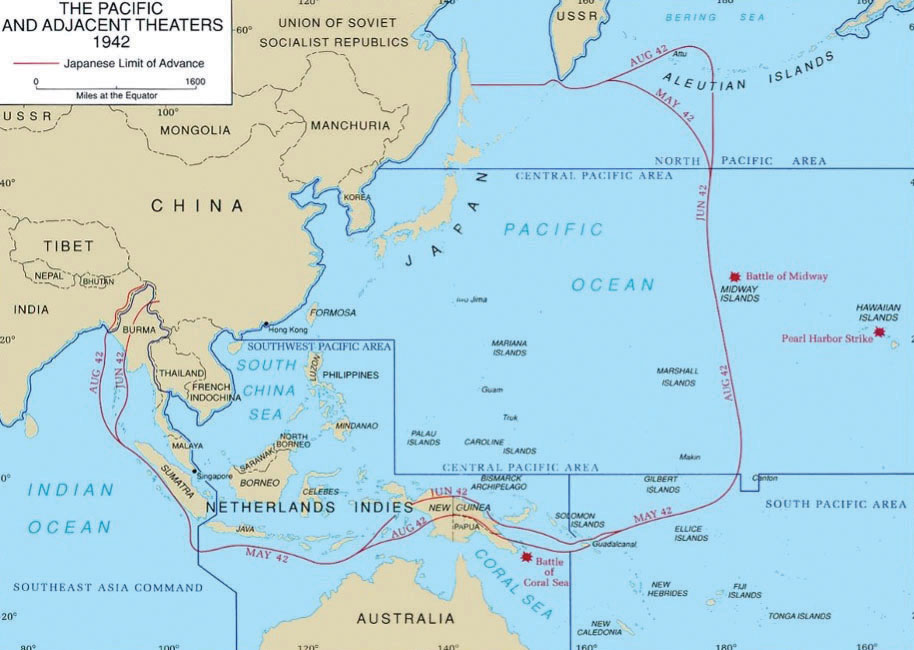
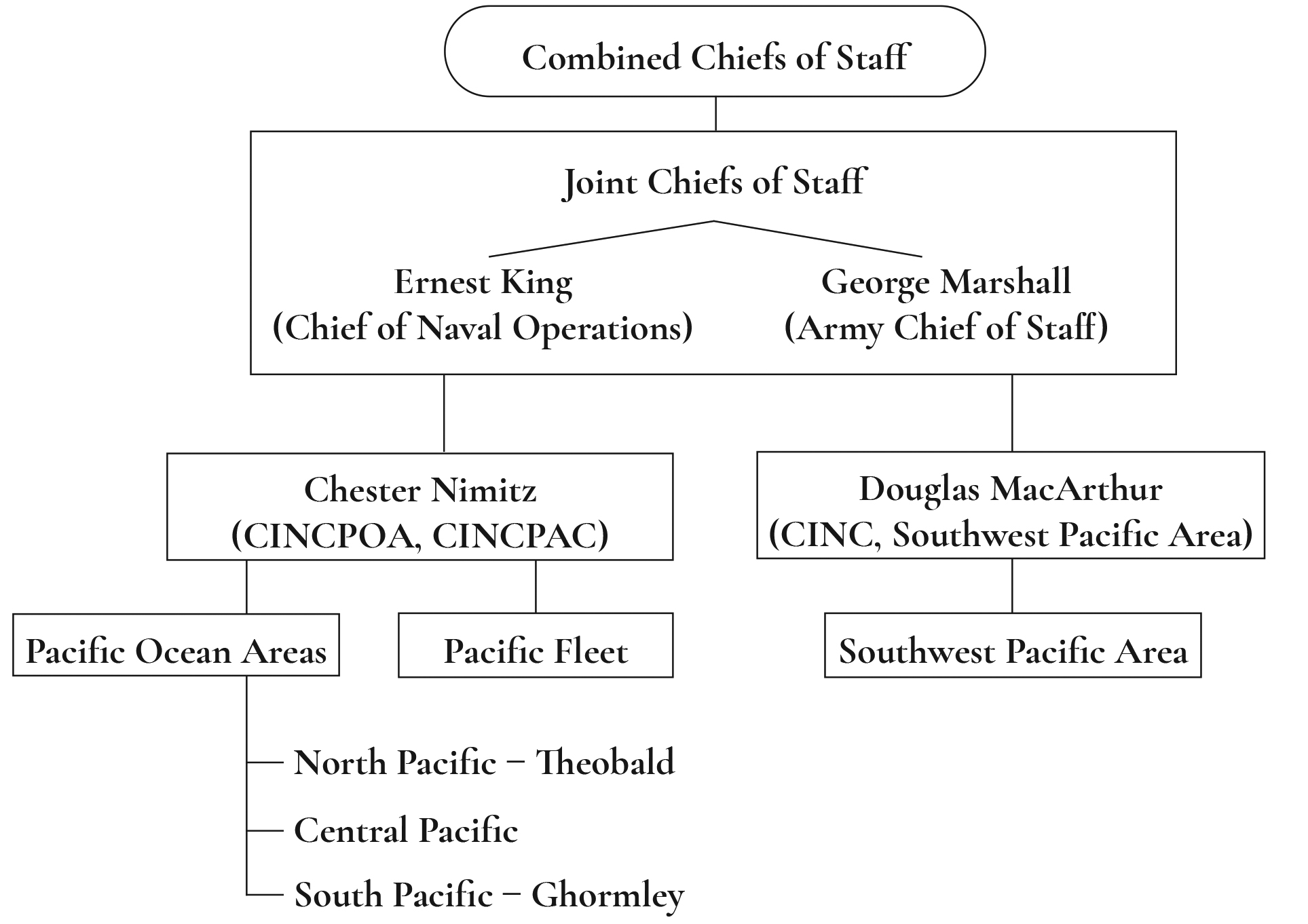
Following their success at Pearl Harbor in December 1941, Japanese forces expanded their perimeter and quickly captured the Philippines, Thailand, Malaya, Singapore, Burma, the Dutch East Indies, Wake Island, the Gilbert Islands, New Britain, and Guam (figure 1). As the Japanese advanced, the United States, acting as the principal Allied authority in the Pacific theater, adopted a defensive strategy and organized the Pacific into two main areas of responsibility. In part due to its size, but perhaps more due to personality conflicts, General George C. Marshall and Admiral Ernest J. King of the Joint Chiefs of Staff divided the Pacific theater between the Army and the Navy into MacArthur’s Southwest Pacific Area and Nimitz’s Pacific Ocean Areas. These adjacent and supporting commands fell directly under the authority of the Joint Chiefs in Washington. The Southwest Pacific Area primarily included the Philippines, the Dutch East Indies, New Guinea, and Australia while the Pacific Ocean Areas spanned the remainder of the Pacific Ocean to include its network of islands and archipelagos (figure 1).[25]
Figure 1. Map of the Pacific theater and Japanese conquests, 1942.
U.S. Army Center of Military History
As part of this construct, the Pacific Ocean Area required further subdivision, resulting in the creation of the North, Central, and South Pacific Areas, and required the establishment of entirely new commands. Nimitz retained command of the Central Pacific and appointed Rear Admiral Robert A. Theobald to command the North Pacific Area and Ghormley to command the South Pacific (figure 2). Under this complex command structure, a request from Ghormley in New Zealand to MacArthur in Australia traveled to Nimitz’s staff in Hawaii, then to the Joint Chiefs in Washington, and then finally back across the international date line to MacArthur in Australia, traveling more than 28,000 kilometers and crossing nine time zones. While serving in Washington, DC, as the deputy chief for the Pacific and the Far East in the War Plans Division, Major General Dwight D. Eisenhower summarized that MacArthur’s unwillingness to serve under a naval officer and the Navy’s defiance that its ships would not be controlled by MacArthur led to the creation of the distinct theaters.[26] Whatever the reasons, this decision had tremendous consequences on the conduct of the war and, in MacArthur’s words, “resulted in divided effort, waste, diffusion, and duplication of force.”[27] The Marines who fought on Guadalcanal echoed that sentiment.
Figure 2. Allied command structure in the Pacific theater.
Adapted by MCUP
Although it was the Japanese attack on Pearl Harbor that finally brought the United States into the war, the Allied strategy prioritized Germany and therefore subjugated the Pacific theater to enormous difficulties throughout the war. Despite continued Japanese successes throughout the Pacific, American shipping as of February 1942 prioritized essential support to the United Kingdom, maintenance of already existing garrisons, and Lend-Lease aid to Russia and China above any shipments to the Pacific theater. Even then, these shipments were focused on approved reinforcements for MacArthur in the Southwest Pacific and continued shipments to Hawaii.[28] While fighting for their lives in the Philippines in early 1942, MacArthur’s staff saw the majority of their logistical requirements go unfulfilled. Forced to request support from Australia, they were reminded of their low place in the logistical pecking order.[29] Allied victory during the Battle of the Coral Sea halted the Japanese advance and canceled their planned invasions of New Caledonia, the Fiji archipelago, and Samoa. Following their defeat at Midway in June 1942, the Japanese turned toward the Solomon Islands in order to threaten Allied control of the sea from Hawaii to Australia. While the Joint Chiefs recognized the importance on the preservation of open lines of communication to Australia, they prioritized the build-up of offensive forces in and across the Atlantic over a strategic defensive in the Pacific.[30] This strategic defensive provided just enough ambiguity for the offensive-minded King to propose aggressive action against the Japanese in the Solomon Islands in order to halt any further Japanese advances and to prevent interference with the critical sea line of communication between Hawaii and Australia.[31]
With acute knowledge of the limited logistical means to pursue offensive action, King successfully convinced the other members of the Joint Chiefs to approve Operation Watchtower and take advantage of the initiative gained through victory at the Battle of Midway. Confident in his persuasive abilities, he issued a warning order to Nimitz on 24 June before confirming command of the operation and its key objectives with Marshall.[32] These essential details were not confirmed until Operation Watchtower’s originally planned D-day of 1 August was less than one month away.
While they both agreed on the importance of the operation, the back-and-forth between King and Marshall reflected the sort of inter-Service squabbling that took place throughout the war and significantly plagued this operation to its logistical detriment. King insisted the Navy command this amphibious operation because he did not trust MacArthur with the Navy’s carriers or the Marines.[33] Marshall argued for Army command because it fell within his theater within which he and his existing staff already had considerable experience operating together and because this operation was just part of the larger strategic objective to capture New Britain and New Ireland and required the same command structure throughout. Marshall felt that “it would be most unfortunate to bring in another commander at this time to carry out the operation.”[34] After multiple memos, missed phone calls, and finally an in-person meeting, King and Marshall came to an agreement that was “reached with great difficulty” on 2 July 1942.[35] Their agreement, issued as part of a Joint Chiefs directive that same day, outlined the operation as three sequential tasks focused on the seizure and occupation of New Britain and New Ireland. Task one, the assault on Tulagi (Guadalcanal was not identified as a key objective until 6 July), was assigned to Nimitz which required a shift in the theater boundaries.[36] Tasks two and three, the seizure of the remaining Solomon Islands followed by Rabaul, were assigned to MacArthur.[37] Although they ultimately reached an agreement, King and Marshall again failed to provide the Pacific theater with a unified command. Wounded by the compromise that further weakened his influence, MacArthur turned indignant and wanted little to do with the operation or supporting the Navy. Unless ordered to, MacArthur did not intend to participate in Watchtower. This compromise and MacArthur’s stubbornness meant resources, supplies, and logistics were split throughout the area and required coordination and distribution of resources beyond the capabilities of either command, which further weakened the logistical shoestring.
Since the Japanese seized it during the Battle of the Coral Sea, Nimitz had recommended the recapture of the island of Tulagi. With this in mind, it is likely his staff already had something to work off of when, at their daily staff meeting on 25 June, Nimitz informed them of the warning order from King and they were able to begin “active preparations” for an offensive in the Solomon Islands.[38] With Watchtower’s D-day only five weeks away, the sense of urgency was high. Cargo ships, limited in availability, took three weeks just to travel from the West Coast to the South Pacific Area.[39] Aware of their logistical constraints and lack of time, Nimitz and his staff set out right away to confront these challenges.
On 2 July, Nimitz flew to San Francisco for a meeting with King about plans for Watchtower. Inconveniently, King did not arrive until 4 July because the Joint Chiefs delayed publishing their official directive for Watchtower. During their meeting, they were interrupted by intelligence of Japanese efforts to establish an airfield on Guadalcanal. They quickly agreed to add this much larger island as a primary objective. While discussing details of the operation with Rear Admiral Richmond K. Turner, also present at this conference, Nimitz supposed that three days would be sufficient to put all the men and materiel on shore. Turner, set to command the amphibious task group responsible for such landings during Watchtower, agreed with his assessment.[40] On his return to Hawaii, Nimitz focused on equipping Ghormley with what he needed to execute this operation, mainly men, ships, and fuel.[41] Indicative of his command style, Nimitz allowed Ghormley the freedom of action to command this operation without much interference.[42] Nimitz offered guidance and did his best to equip Ghormley with the tools he needed, but otherwise Ghormley was now the one holding the hot potato.
Almost immediately, Ghormley began to degrade the confidence bestowed on him. Armed with official orders and little else, he was clearly, and understandably, overwhelmed. Before he could begin planning, Ghormley had to find and build his staff. One of Marshall’s chief arguments for Army command of the operation, that of an existing and experienced staff under MacArthur, seemed all the more compelling considering the extensive effort Ghormley went through to establish his new command in such a short amount of time. This endeavor officially began on 18 April, only one day after he returned to Washington, at the conclusion of his time as special naval observer in England. King informed him of his command appointment, instructed him to establish his headquarters in Auckland, New Zealand, and told him to prepare for offensive operations to begin later that year.[43] On 1 May, he and the first few members of his new staff departed San Francisco and stopped in Pearl Harbor to meet with Nimitz. On 17 May, they visited Noumea, New Caledonia, long enough to observe the tensions between the Free French and the U.S. Army forces on the island. After his arrival in Auckland on 24 May, Ghormley discovered few preparations had been made for him and his staff. He declined the inadequate facilities offered to them and transitioned his command headquarters to the USS Argonne (AP 4). From then until the end of June, he continued to receive new staff members and focused his efforts on establishing critical components of his new command in preparation for future operations.[44]
One critical component he established shortly after his arrival in New Zealand was the South Pacific Service Squadron, the primary logistics agency throughout his command. This headquarters issued a logistical plan that formalized coordination of all surface transportation, to include shipping lanes and ports of call, as well as distribution of supplies throughout the vast theater.[45] The plan also called for the use of the naval construction battalions to build up the infrastructure at the numerous advanced bases established throughout the South Pacific. This plan, issued on 15 July, within weeks from the operation’s start date, had little impact on Operation Watchtower. Those preparing for departure to Guadalcanal had no choice but to improvise and make hasty preparations without the benefit of a formalized logistics plan.[46] The fact that this crucial command was not established until after Ghormley’s arrival and only three weeks before the commencement of Watchtower highlights the Navy’s logistical unpreparedness in this vast and undeveloped theater.
The challenges Ghormley faced in establishing his new command are but one small example of the struggles common to all operating in the immature South Pacific Area in 1942. The distances alone explain a majority of the struggles, compounded by the fact that any resupply required movement across vast expanses of water using scarcely available shipping. Supplies transported in began their oceanic voyage in San Francisco, bypassed Hawaii, and traveled more than 10,000 kilometers to Auckland, 11,600 kilometers to Brisbane, or 10,300 kilometers to Noumea at approximately 10–12 knots (three weeks transit, one way).[47] This meant that once committed to the task, vessels assigned to these missions did not return home for months, causing continued frustrations back in Washington as the Services and theater commanders fought over precious resources.[48]
The next major hurdle in this immature theater was the severe lack of adequate port facilities. Because of the tremendous lack of shipping, all cargo loaded in the United States was administratively or commercially loaded so as to maximize every square inch. To make these materials useful for the Marines waiting for them, all cargo needed to be combat loaded based on desired offload sequence at its final destination. This meant that all cargo had to be offloaded, sorted, temporarily stored, and then reloaded onto different vessels. The only ports in the South Pacific with any useful facilities and necessary infrastructure were in Auckland, Wellington, Suva, and Noumea, but none of these were fully equipped with adequate capabilities for a massive military buildup.[49] Of these, Auckland was the only location in theater with a deep-water harbor equipped with enough facilities and space to unload, sort, store, and reload all the cargo administratively loaded in the United States.[50] Auckland was also considered to be safer from Japanese attacks compared to the alternatives.[51] From Auckland, combat loaded transports loaded with their own landing craft and accompanied with requisite escorts (once available) traveled the 2,937 kilometers to Guadalcanal to be offloaded on the beach using predominantly manual labor.[52] Absent the necessary escorts or not effectively combat loaded, vessels otherwise made the 1,931-kilometer journey north to Noumea, where an entirely new set of problems awaited.
Noumea, beneficial for its strategic location, possessed very few qualities needed to be a useful supply base. Despite this, it became a central link in the logistics chain for unloading, storage, and transshipment of supplies throughout the South Pacific Area. Follow-on destinations included Guadalcanal, Espiritu Santo, and Efate.[53] Competition for berths and dock space was a central component of the struggle between all interested parties in Noumea. This competition was not limited to inter-Service rivalries, but also included challenging diplomacy with the Free French government of New Caledonia and businessmen in Noumea. The French nickel company, Le Nickel, owned and operated one of the main docks and played an essential role in the economy of the island for its commercial exports. Because warehouses on shore were almost nonexistent, floating warehouses became the norm where the Services offloaded cargo from their vessels as needed, left the remaining supplies on board, and sent the partially loaded vessels back into the harbor.[54] Unbeknownst to Ghormley’s service squadron in New Zealand, their best efforts and intentions to ensure ships were loaded to their fullest capacity before departure often compounded their issues due to the inadequate discharge facilities.[55] This backlog of shipping, with vessels defenselessly floating at anchor in the harbor, dangerously waiting to discharge their essential cargo in order to resume their critical duties transporting additional supplies throughout the theater caused severe criticism from Washington directed at Ghormley.[56] This specific crisis remained unsolved until April 1943.[57]
Another issue common throughout the theater was the severe lack of skilled manpower. Even in the United States, where skilled laborers were plenty, the Navy was behind on training sailors and contractors on the art of combat loading.[58] As a result, cargo was loaded haphazardly, often missing manifests, without any consideration for offload sequencing in the Pacific or the limited offload capabilities at the various ports of debarkation.[59] In the more developed countries of Australia and New Zealand, skilled labor was available but in significantly short supply. Throughout the various underdeveloped economies of the South Pacific, local labor was entirely unskilled. Therefore, port facilities throughout the theater employed unskilled and often defiant labor in insufficient quantities supported with poor facilities that could not keep up with the workload.[60] In Australia, where all dock labor had been unionized, longshoremen were typically well into their forties and generally unenthusiastic about their work or their role in supporting the war.[61] In Wellington, the port director was known to be hostile to Americans and afforded his stevedore union numerous breaks, never permitted them to work after quitting time, and allowed them to walk off the wharf whenever it rained (a frequent occurrence that time of year).[62] In Noumea, the labor shortage and unrest among the French colonialists significantly delayed offloading and nearly resulted in martial law.[63] The Army and Navy did their best to provide their own longshoremen, but these were in short supply as well. Ghormley requested more, but the only ones that made it to the South Pacific before Operation Watchtower began went to New Zealand.[64]
In concert with the lack of shipping, inadequate facilities, and limited workforce, the climate of the South Pacific Area also caused significant issues that hampered logistics. While the heat and humidity claimed many victims and naturally slowed individual effort, it was the rain that caused greater issues. Because ships were desperately needed to offload as quickly as possible, much of the cargo was stored outdoors in yards and fields. Because most supplies were packaged hastily without consideration for their end destination, much of the cardboard cartons quickly disintegrated in the constant and heavy rains and resulted in the loss “of much food, clothing, stores, and other material.”[65]
Under conditions imposed on him by strategic-level decisions made in Washington, Ghormley set about the task of planning this offensive with insufficient time, a brand-new staff, an indignant (and senior) adjacent commander, and an immature theater. A student of the South Pacific who understood the logistical challenges associated with his new theater, Ghormley knew he needed more personnel and materiel to be able to establish advanced naval bases. Unfortunately, Ghormley failed to impress on Nimitz the urgency of his needs, and resources continued to flow to the Mediterranean to support Operation Torch. Ghormley succeeded in coordinating with the Army to source as many local goods and materiel in New Zealand as possible; however, they were unable to source enough equipment required to support the upcoming amphibious operations.[66]
The two-week period that began with receipt of the Watchtower warning order indicated the first signs of Ghormley’s defeatist attitude.[67] On 2 July, the official order from the Joint Chiefs came in, which formally tasked Ghormley with command of task one and the seizure of Tulagi.[68] Despite this new order, he considered his responsibility to defend the area around Australia and New Zealand, outlined in his original orders, to be more important and remained steadfast in his defensive efforts instead of focusing on the necessary preparations for this upcoming operation.[69] On 6 July, the coastwatchers identified the construction of the airfield on Guadalcanal, which replaced Ndeni in the Santa Cruz Islands with Guadalcanal as an official objective and intensified the urgency of this operation. On 8 July, Ghormley and MacArthur commiserated at MacArthur’s headquarters in Melbourne about the futility of this operation.[70] Ironically, just two months before, MacArthur had proposed even more aggressive action in this area, but with him in command.[71] Now, relegated to the supporting element for task one, he changed his tune and eagerly pointed out its deficiencies and expected it to fail. Together, they composed a letter to the Joint Chiefs that expressed their “gravest doubts” of success and requested a deferment of the operation due to insufficient resources.[72] On 10 July, they received a response from King and Marshall that included an appreciation for “the disadvantage of undertaking Task One before adequate forces and equipment can be made available” but directed them to proceed as planned.[73] Having just squandered two weeks of planning time, Ghormley finally began planning for the tasks as outlined in the directive, albeit focused more on the defense of the sea lanes than on the offensive in the Solomon Islands.
As the operation’s D-day drew near, unsolved strategic and operational issues caused multiple headaches at the tactical level of command and resulted in numerous controversies. Despite specific direction to command the operation in person, Ghormley delegated tactical command to Fletcher, commander of the carrier strike force, and devoted his attention to the defense of his theater in Noumea.[74] King, who disliked and distrusted Fletcher as a fleet commander for what he believed to be a pattern of hesitancy, only begrudgingly approved Fletcher’s command of the carrier task force after Nimitz vouched for him. Bestowed with even greater responsibilities from Ghormley, and unbeknownst to King or Nimitz, Fletcher now had tactical command of the entire operation. Therefore, Phase I of Operation Watchtower, the fate of which determined King’s legacy, was commanded by someone for whom he had little respect.[75] Furthermore, in preparation for this operation, Ghormley provided limited guidance and never met with Fletcher in person. Even as forces assembled at sea, Fletcher remained uncertain about who would directly command the operation.[76] While underway from Fiji to the rendezvous point, Fletcher finally issued his operations order. Significantly vague, his order simply listed their mission to “seize, occupy, and defend Tulagi and adjacent positions.”[77] Throughout the operation, his focus remained on the protection of the carriers and not on the success of the Marines on Guadalcanal.
Although committed to the success of the operation and directly responsible for the landings on Guadalcanal and Tulagi, Turner hardly contributed to the planning and preparation of Watchtower. On receiving word of his assignment as the commander, Amphibious Force, South Pacific Force, on 3 June, he traveled a similar route as Ghormley from Washington to New Zealand, stopping in San Francisco for his conference with Nimitz and King on the way. He arrived in New Zealand on 16 July, the same day Ghormley published his operations order, which assigned Turner as commander of the amphibious task force for Operation Watchtower, responsible for the 13 transports, 5 cargo ships, and 1st Marine Division. Turner organized his command on 18 July, only four days before they set sail to meet Fletcher in Fiji. Absent adequate time to inject himself into the planning process and without anyone on his staff with amphibious experience, Turner published his operations order with heavy reliance on the planning conducted by the Marines.[78]
Lying at the bottom of the hill where these strategic, theater, and operational problems collectively rolled were Vandegrift and 1st Marine Division. Before embarking Turner’s transports in New Zealand for their voyage to Guadalcanal, these Marines endured and contributed to many of the adverse effects of the events that preceded their historic operation. On 23 March 1942, Vandegrift assumed command of 1st Marine Division in New River, North Carolina. Established less than a year earlier based on recommendations following after actions from the FLEXs, New River boasted a fine training area to conduct amphibious operations and little else. As the Marine Corps rapidly expanded at the beginning of the war, thanks in large part to Lieutenant General Thomas Holcomb, Commandant of the Marine Corps, experience needed to be shared across the force. This resulted in the transfer of trained personnel away from Vandegrift’s command and the influx of new Marines, recently graduated from a truncated version of boot camp. Furthermore, thousands of his Marines were sent to Iceland to support the defense of the island, which relieved the British of that responsibility and enabled them to focus on defense of their own islands.[79] Numerous requests for Marine Raider Battalions and garrison defense forces further gutted his forces. As the conflict intensified, Vandegrift feared he would spend the war in North Carolina, training subordinate units for piecemeal deployments.[80]
Fortunately for Vandegrift, readiness across the Marine Corps was a challenge common to all. As early as February 1942, Headquarters Marine Corps identified 1st Marine Division as the most ready and available unit to deploy for amphibious operations in the Pacific.[81] The order to do so did not come until 29 April, when Vandegrift’s operations officer, Lieutenant Colonel Merrill B. Twining, discovered news of Operation Lone Wolf, which directed the transfer of Vandegrift’s division to New Zealand to establish Turner’s South Pacific Amphibious Force.[82] Despite an aggressive timeline for departure, Vandegrift comforted himself with reassurances given to him that they would have six months of training in New Zealand before undertaking any offensive operations.
Shipping shortages split 1st Marine Division into two deployments from North Carolina to New Zealand. Vandegrift and the first group embarked the transport USS Wakefield (AP 21) in Norfolk, Virginia, on 20 May for their 26-day, 16,000-kilometer voyage through the Panama Canal and across the Pacific Ocean. They finally arrived on 14 June, after suffering grueling conditions on board, during which the average Marine lost 15 pounds. Vandegrift stated, “We in no way sailed as a combat-ready force.” The second group traveled via rail to San Francisco and set sail on their transports on 22 June. They did not arrive until 11 July, mere weeks away from departure for Guadalcanal. Despite assumptions made by the Joint Chiefs, their vessels were not combat loaded.[83] Regardless of who to blame for this oversight, the decision to depart with administratively loaded vessels contributed mightily to the Marines’ struggles in the South Pacific.
On the docks in Wellington, the Marines got their first taste of the immature theater while conducting frantic preparations for their departure. Immediately on arrival, Vandegrift was informed of the “catastrophic news that the unloading of cargo which proceeded us, stood days behind schedule.”[84] A member of the advance party, Twining already had valuable experience in dealing with the frustrating Kiwis. Specifically, he learned of their tendency to take breaks for every meal and anytime it rained. Vandegrift immediately ordered his Marines to be organized into working parties with shifts around the clock to offload the vessels themselves. In addition to the devastating effect on the Marines’ morale, the working parties caused enough of an uproar from the dockyard union in Wellington that Pete Fraser, the prime minister of New Zealand, became involved and summoned Vandegrift to his office.[85] Absent adequate shelter, Marines worked in continuous, cold rain while their cargo, unprotected and drenched, disintegrated in front of them on the quay. From Vandegrift’s final report on Operation Watchtower, he remembered, “Weather conditions demonstrated the terrible unsuitability of paper or cardboard containers for expeditionary supplies, and the loss of these supplies on the Wellington docks was later to be felt by all hands.”[86]
Although Vandegrift and the 1st Marine Division arrived in New Zealand on 14 June, Ghormley did not feel the need to call Vandegrift to Auckland to meet him in person until two weeks later when he received the warning order for Watchtower.[87] Expecting this to be the normal social call to meet with his immediate senior, and still not expecting offensive operations for months, Vandegrift was dumbfounded when informed they were to execute an amphibious operation in the Solomon Islands in less than five weeks.[88] Dutifully, Vandegrift and his staff immediately set about preparing for the operation. Absent an operations order from higher headquarters for weeks, the Marines began planning on their own. In what must have been discouraging news for the Marines, Ghormley (and apparently his entire staff) possessed such limited knowledge on amphibious operations that on 12 June, Ghormley requested a copy of the Marine Corps manual on amphibious operations from Vandegrift, specifically requesting information on Navy landing craft.[89] Clearly, the tactical planning for this operation was up to the Marines. This feeling of isolation in the planning process serves as a good precursor to the isolation they soon felt on Guadalcanal. Working around the clock on the rain-soaked docks in Wellington, the Marines of 1st Marine Division experienced the full weight of problems brought to bear on them from strategic decisions in Washington, an immature theater, and insufficient operational planning. To Vandegrift and his Marines, the term shoestring inadequately described the logistical hand they were dealt.
Enough Throughput to Live, Survive, and Thrive
As Vandegrift and his Marines set about planning for Watchtower, they were immediately confronted with the challenge of amphibious shipping. As is common in most operations, the unfortunate realities of logistics immediately imposed constraints on Watchtower. Shortly after notification from Ghormley in Wellington, Vandegrift’s primary logistician and assistant chief of staff for supply, Lieutenant Colonel Randolph McCall Pate (a.k.a. Ran Pate), informed Vandegrift that their already conservative estimates were still too high and the division’s shipping requirements greatly exceeded their shipping allocations. Vandegrift responded with a timely and critical decision. He ordered his division to load only “items actually required to live and fight.”[90] The division then set about dividing and sorting their equipment to remove all “luxuries” beyond the basic necessities of “bullets, beans, and blankets.”[91] Items designed to kill the Japanese occupants on Guadalcanal such as combat gear, weapons, and ammunition were given top priority. Coffee pots, tents, and spare clothing were all left behind. Typically allocated two sea bags, individual Marines were reduced to only one and forced to prioritize their individual equipment along these same lines.[92] Equipment left behind was marked for temporary storage under the optimistic assumption for an eventual reunion with its owners in Guadalcanal. Shedding all amenities, Vandegrift’s Marines cared only for what they needed to fight and live.
To ensure they brought enough supplies and equipment, the division’s logisticians and the ships’ quartermasters had to work together to combat load their vessels. At this point in the war, combat loading ships—loading the most essential equipment last, so it is the first to come off—was still a relatively new concept. It was initially incorporated into the FLEXs of the 1930s, which proved critical to the preparation and understanding of this logistical blend of science and art, although at a limited scale. During the FLEXs, the logistical footprint required was greatly diminished, as Marines were only prepared to go on shore for a few days, not months on end. These exercises also provided the Marines with dedicated shipping based on their needs on board empty ships. They did not incorporate the unforeseen challenge of unloading administratively loaded vessels at the same time as combat loading.[93] Some ignorant criticism has been directed toward Vandegrift for his decision to depart the United States on board administratively loaded vessels, blaming him for relying on the assumption that the division would not see combat for months until after their arrival.[94] In his final report, he adequately defends his actions by highlighting the embarkation challenges they faced in North Carolina that required the separation of his Marines from their equipment due to shipping limitations. Additionally, the advantage of administratively loading vessels is that it maximized their load capacity, which was essential for any vessel transiting the Pacific to avoid wasting any space. Lastly, it is worth mentioning that the majority of the ships they embarked for Watchtower were not the same ships that carried them across the Pacific, making this criticism a moot point. Years later, Vandegrift praised King’s difficult decision to take decisive action to “stop without delay the enemy’s southward advance.”[95]
No foreigner to difficult decisions and also not a fan of delays, Vandegrift decided to abandon the hostile Kiwi workforce in Auckland and charged his Marines to combat load their own vessels instead. His decision to employ his Marines in backbreaking labor in cold winter conditions further degraded their combat readiness following their long and harrowing journey into the theater. So close to battle, their combat readiness was already a source of concern, as most of the division was made up of brand-new Marines who had graduated from a truncated boot camp. Vandegrift had comforted himself with the knowledge that they would have months to train in New Zealand to correct this deficiency. Instead, he found it necessary to prioritize his Marines to fulfill logistical requirements over the ingrained desire to train and hone their infantry skills for upcoming combat. Reacting to the hostile Kiwis, Vandegrift’s decision in Auckland set the precedent that logistics was the top priority to ensure his division could live and fight on Guadalcanal.[96]
Following Vandegrift’s crucial decisions, thousands of subsequent and equally challenging decisions had to be made in order to load their vessels. While these decisions were often difficult to make, they were even harder to execute. Equipment that did not make the list for embarkation still had to be offloaded, staged, inventoried, and transported to storage facilities to be handled by the division’s rear party. Equipment that did make the list also had to be offloaded, inventoried, and staged until it could eventually be loaded. Debates on the demarcation line between essential and nonessential nearly resulted in the divestment of critical landing force equipment from the ships, highlighting the tensions between the need for combat equipment and combat support equipment.[97] Once assigned, essential equipment spent more time in the way at the port, being moved countless times while waiting to be loaded last, while all the lesser and nonessential equipment was either placed into storage or loaded deep into the transports. This excerpt from the division’s final report highlights the enormity of the logistics struggles in New Zealand.
Loading and unloading operations in Wellington were centralized at one large wharf (Aotea Quay) capable of berthing five vessels at once. Combat loading necessarily took place simultaneously with the discharge of incoming cargo and the operation was exceedingly complex and most difficult to control. A working team of three hundred men was assigned to each vessel and maintained around the clock by a system of eight-hour reliefs. Divisional transportation was augmented by vehicles of the First Base Depot and by a daily detail of thirty flat-topped New Zealand Army lorries which proved particularly useful in this type of work. Ammunition, organizational equipment, and gasoline dumps were established in open areas on the wharf. Rations and perishables were classified in a large warehouse which occupied one end of the wharf. The operation was directed by D-4 through a field officer in charge of each loading team, and the transport quartermasters of the various ships. Dock labor was restricted to skilled operators of special loading machinery, cranes, hoists, carriers, and stacking machines. Use of general civilian labor was rejected in favor of employment of troops as it had been found both inadequate and unreliable during earlier operations.[98]
The chaos that ensued on board Aotea Quay is unimaginable, and this most complex version of Tetris was further compounded by King’s repressive timeline for Watchtower’s D-day.
Originally scheduled for 1 August 1942, D-day for Operation Watchtower became a controversial issue. Already beseeched by MacArthur and Ghormley, King finally relented and granted a delay of no more than one week—7 August—after Vandegrift’s concurrence with Ghormley that made it clear his division needed more time.[99] Despite their best efforts, which the division operations officer commended as a smooth reembarkation process, it was impossible for them to load all of their ships to depart on time.[100] Fortunately, and unintentionally, this delay provided the Japanese with another week to nearly complete the airstrip on Guadalcanal for the Marines. Willing to risk surprise and initiative, Vandegrift again prioritized logistics for his division.
Here, the limited accomplishments of 1st Marine Division were essential to ensuring logistical success of Watchtower. The period between notification and departure was only 26 days.[101] What these Marines accomplished in that short amount of time truly “defied the science of logistics.”[102] In that short time frame, 1st Marine Division successfully unloaded 3 administratively loaded transports, reconfigured their equipment, and combat loaded the 18 amphibious ships of Turner’s amphibious force.[103] Embarked and underway, they were ready with just enough to fight and live on Guadalcanal.
Before tackling their next major throughput hurdle on the shores of Guadalcanal, two key events, both of which are well documented and have been written about ad nauseum, took place in Fiji while underway to the Solomon Islands. Here, the entire task force of 76 ships assembled for their only rehearsals before launching the invasion. For various reasons, the amphibious assault rehearsals went poorly, and Turner eventually cancelled them. In their place, he had his entire force conduct basic ship-to-shore drills, which proved extremely beneficial during the landings. While they were assembled, Fletcher hosted his commanders on board his flagship for a conference that became a tumultuous affair. In Ghormley’s absence, Fletcher assumed command of the task force and used this authority to make decisions previously left incomplete. This included the controversial decision to provide air coverage from his carriers for only three days. Consequentially, Turner and his amphibious force would be forced to withdraw his transports at the same time so as not to expose them to Japanese air attacks. Despite pleas from Turner and Vandegrift for a minimum of five days to offload their equipment, Fletcher remained firm. Laden with doubt and pessimistic towards the success of this operation, he prioritized protection of the carriers over the survival of the Marines.[104]
As 1st Marine Division assaulted the beach on 7 August 1942, the rubber finally met the road on all their logistical woes. Although the amphibious assault achieved an incredible tactical success, the logistical beach operations that followed went horrendously. The numerous issues are well documented, and the combat photographs of the cluttered beach provide visual proof for those who focus on the failed logistics of Guadalcanal.[105] Numerous after-action reports and historical accounts deplore the Marines for their laziness, incompetence, and seeming nonchalance toward the mounting logistical chaos.[106] After reaching shore, Vandegrift observed his division’s supplies piling up on Red Beach, but decided this problem would be dealt with once the tactical situation was no longer in doubt. Unlike in Wellington, where he focused on logistics, he now prioritized his tactical objectives: the establishment of a defensive perimeter and the seizure of Guadalcanal’s airfield.[107] Instead of applying more manpower to assist the shore parties, he used everyone available to pursue the enemy and seize the objective, including the Pioneers. This left 1st Pioneer Battalion’s shore parties undermanned and overwhelmed.[108] As the beach congestion increased, Turner’s transports were forced to pause unloading operations due to lack of space on shore and limited maneuverability in the water for their landing craft. Furthermore, multiple Japanese aerial attacks forced numerous halts to unloading operations. In the chaos, Turner ordered his transports closer to the beach to reduce transit times and increase the pace of the offload. This exacerbated beach congestion and gridlocked the landing craft lanes. Idling dangerously in the shallow waters waiting their turn, many boat captains offloaded their cargo haphazardly near the shore and returned to their transports. In their haste, many of them offloaded below the high-water mark. The situation rapidly deteriorated and many containers were destroyed and their contents were prematurely discharged and subsequently ruined.[109]
Turner augmented the workforce on shore with dozens of sailors per boat crew to help offload. Although appreciated, this further tangled the web of logistics that was clearly focused on quantity and not quality. Ignoring the doctrinal concept that specified the shore party commander is in control of logistics on shore, Turner’s commanders continued to saturate the beach with supplies.[110] Lieutenant Colonel George Rowan, 1st Pioneer Battalion’s commanding officer, appealed to Vandegrift for more help on the beach. Despite Vandegrift’s refusals to fulfill the request, he successfully persuaded Turner to temporarily halt the rapid discharge of cargo from his transports so they could better organize their efforts on the beach. Unfortunately, Fletcher decided to depart 12 hours earlier than planned, and shortly thereafter, on 9 August, Turner and his amphibious force departed as well.[111] During this three-day period, only 26 hours and 20 minutes were devoted to actual unloading.[112] Standing in heaps of soggy cornflakes and other ruined rations, the shore party Marines watched Turner’s amphibious task force depart with half of the division’s embarked supplies, leaving behind a panorama of utter confusion that greatly surpassed the untidy scene in Wellington.
Reciprocal recriminations abound for this seeming disaster. Turner faulted the Marines for the “vast amount of unnecessary impediments taken,” embarking so many unessential items such as “cheeses and fancy groceries.”[113] Conversely, Vandegrift and Twining blamed Navy logistics planners for insisting on typical commercially packaged Navy rations that required refrigeration, intentionally ignoring the basic supply needs of a landing force destined for an inhospitable location. Turner also disparaged 1st Marine Division for not providing “adequate and well-organized unloading details at the beach.” In their defense, the Marines accused Turner for withholding 2d Marines, the division reserve, for potential secondary objectives, limiting Vandegrift’s available manpower to seize the primary objective and conduct beach logistics. The Marines also complain that Turner’s transports withheld 1st Pioneer Battalion to serve as working parties instead of releasing them to shore to support the shore parties. Some of these Marines were still on board when Turner departed and returned with the task force to New Caledonia.[114] Vandegrift’s initial indifference to the logistical bottleneck due to a lack of manpower on Red Beach may have held a selfish touch of “I told you so” after weeks of fierce debate with Turner.
Despite the bleak situation in the first days on Guadalcanal, there was still cause for optimism. Exact reports of offloaded tonnage do not exist; however, it is estimated that from the morning of 7 August until the early afternoon on 9 August, the combined Navy and Marine Corps team successfully offloaded nearly 50 percent of their cargo, which equated to more than 30 days of supply.[115] Had Fletcher been willing to remain on station for the five days Vandegrift requested, it is almost certain the Marines would have been blessed with their full allotment of equipment and supplies. Instead, they were fortunate to survive with what they had.
Fortunately, the Japanese unintentionally contributed greatly to their survival. Not only did Japanese bombers fail to capitalize on the opportunity to target Marines’ exposed logistics during the initial offload, but in their haste to retreat into the jungle, they left a significant quantity of supplies and equipment for the Marines. The vast quantities of rice and canned rations were essential to their survival and were used to supplement their rationing of two meals a day per Marine. The equipment consisted of “innumerable pieces of machinery” necessary to finish the construction of the airfield and “over 100 trucks” that proved indispensable in the follow-on throughput of cargo and equipment from the beach.[116] Although the Marines were successful in bringing enough on shore to survive, the enhancements they received from captured Japanese materiel were providential and became critical to their survival on Guadalcanal.
After the Marines successfully established a defensive perimeter from the beach and around the airfield, logistics once again became the division’s priority. Duly resourced, the 1st Pioneer Battalion was finally able to organize the beach and transport equipment inland. Using all available vehicles, including the captured Japanese vehicles, amphibian tractors, and lighters left behind by the Navy, and reinforced with sufficient manpower, they successfully cleared the beach in four days. During those four days, working parties reported promptly at 0600 and vehicles were used incessantly to maximize daylight hours. At night, Marines stood watch and fortified their defensive positions in preparation for Japanese counterattacks.[117] Once these attacks came, this monumental effort to clear the beach proved essential to their survival.
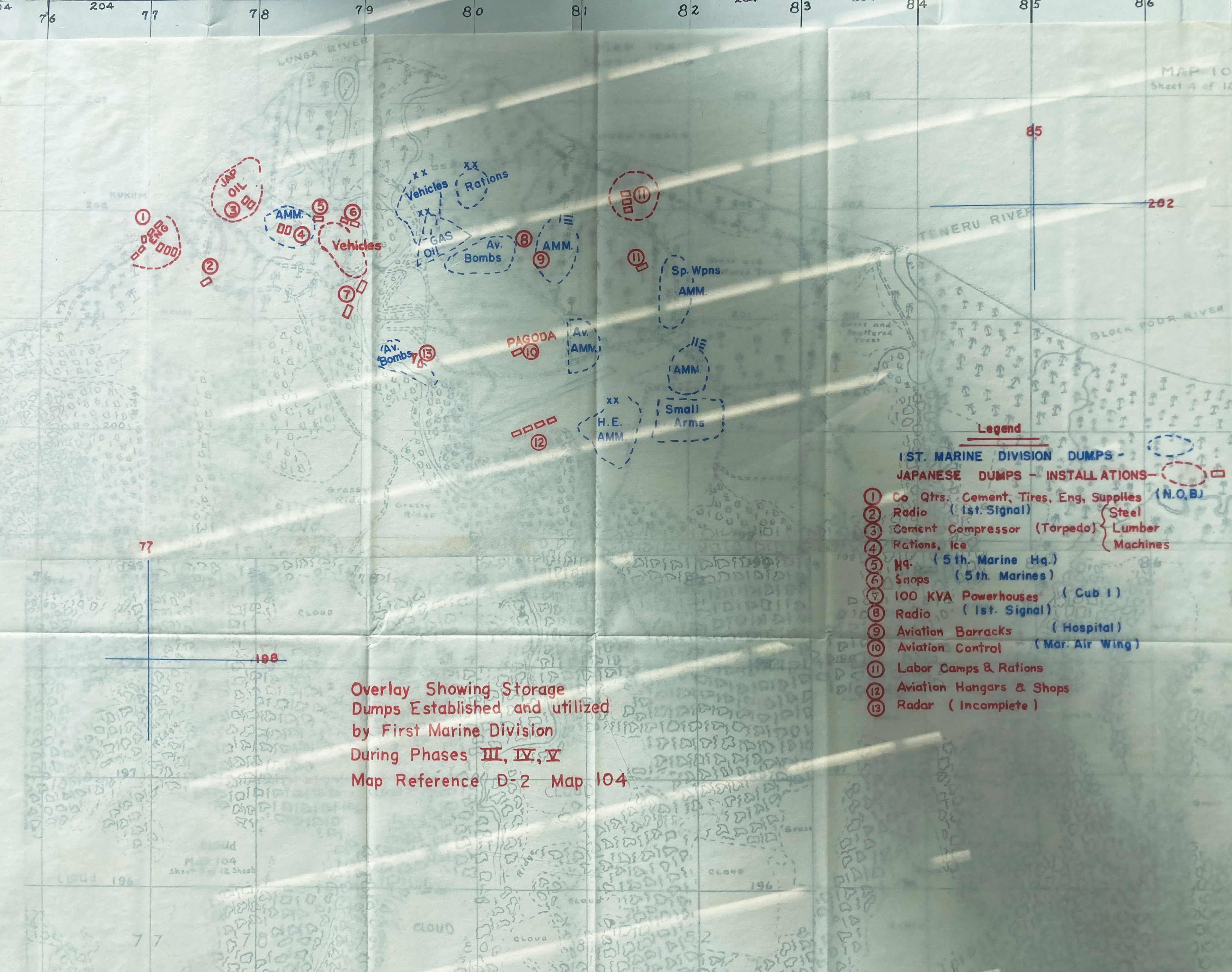
During their fight to survive in August and September, 1st Pioneer Battalion learned from the mistakes of 7 August and developed an efficient throughput system in anticipation for future deliveries by sea. First, they organized Red Beach into five unloading points based on classification of supply and established secondary and tertiary beaches for offloading operations. These additional beaches enabled the Navy to unload each vessel in separate locations and relieve congestion in the boat lanes from ship to shore.[118] Second, they improved the terrain between the beaches and their inland supply depots (figure 3).[119] This included the construction of a bridge across the Lunga River using captured pier materials, palm trees, and their own amphibian tractors.[120] Third, they established segregated and dispersed supply dumps in vicinity of the airfield, well within their defensive perimeter.
This intricate system was essential for the accountability and protection of the supplies and remained carefully organized throughout their time on Guadalcanal. In addition to these steps, the battalion dedicated working parties of hundreds of Marines to assist for any offload operation in order to expedite the throughput from ship to shore to supply dump.[121] When the reinforcements came on shore from 7th Marines in September, Turner changed his tune and praised the Marines for their incredible efforts. In his report, Turner exclaimed:
The Task Force Commander had estimated that the Seventh Marines could be landed with all its weapons, its essential equipment, most of its motor vehicles, three units of fire, and forty days’ rations in the twelve hours which were expected to be available for debarkation. No more time was available because of the practical certainty of night attack. This estimate had contemplated an interruption of about two hours due to enemy air attacks. These did not develop. Furthermore, so well had the loading of the transports been done, and so well was the unloading of the transports and at the beach organized and prosecuted, that the material unloaded with the Seventh Marines far exceeded expectations.[122]
This was exceedingly high praise from a very tough man to please.
Taken in contrast with the Japanese, these throughput efforts were all the more impressive. The Japanese failed to prioritize logistics until it was too late. Each time the Imperial Navy’s “Tokyo Express” delivered more soldiers and combat equipment, they did not even unload enough supplies for those newly arriving, further exacerbating a tragic condition for troops already there. Despite numerous attempts, which included floating daisy-chained oil barrels filled with rice and nightly submarine deliveries, their half-hearted efforts failed. Reduced to a fraction of their normal daily food ration, Japanese troops suffered greatly and many were unable to survive the harsh conditions. In order to survive, many resorted to digging for grass roots, scraping moss, picking tree buds, and drinking seawater.[123] As the Japanese forces deteriorated due to starvation, 1st Marine Division’s logistical conditions steadily improved. By October, Marines were back to full rations. The intricate throughput system they implemented continued successfully throughout the remainder of their time on Guadalcanal and proved essential to their survival on the island.
Figure 3. Map of Lunga Point with overlay storage dumps.
Map of Lunga Point, Annex L (Overlay of Storage Dumps), RG 313, A1 211, box 18, folder COMAIRSOPAC/Blue 242, NARA II
The final hurdle U.S. forces successfully overcame to prevent failure and ensure logistical success took place at the port in Noumea. In terms of tonnage, this strategic location eventually became the second largest throughput node in the Pacific. Unfortunately for the Marines who depended on throughput at Noumea, this port remained gridlocked for the first three months of Watchtower and cast doubts on their hopes for survival. In November 1942, the logistical logjam finally began to clear. The joint efforts of the Army and the Navy coupled with a change in leadership, priorities, and management of logistics enabled Noumea to fulfill its strategic responsibility as a massive throughput node in support of the Marines so that they could eventually thrive on Guadalcanal, especially in comparison to the Japanese.
The original reasons for the logjam in Noumea can be attributed to the immaturity of the theater, discussed previously. However, after a few months without progress, leaders in Hawaii and Washington became increasingly suspicious and frustrated with Ghormley and his staff. Nimitz and King both steadily became discouraged by Ghormley’s frantic pessimism. Congruently, Marshall began to receive scathing reports from Major General Alexander M. Patch on the ground in Noumea about the complete lack of logistical planning.[124] All of this eventually came to a head and on 18 October 1942, Nimitz replaced Ghormley with Admiral William F. Halsey Jr. as the commander of the South Pacific because he felt the “critical situation there require[d] a more aggressive Commander.”[125] Known for his aggressive nature, Halsey’s appointment immediately provided intangible impacts on his forces throughout the South Pacific. It injected the Marines with vigor, and many jubilantly celebrated the news from their foxholes on Guadalcanal. More importantly, this change in leadership steadily provided tangible results, as well, that dramatically improved the logistical situation throughout the theater.
With his first act as commander, Halsey established his headquarters on shore in New Caledonia. The USS Argonne, previously used by Ghormley and his staff, was unacceptable to him. Instead of placating the French government of New Caledonia, known for its indifference to the war effort, Halsey immediately established his authority and demanded better accommodations “as a military necessity.”[126] Famously, he even went so far as to acquire for himself the previous Japanese consul’s house at the port overlooking the harbor.[127] More importantly, he directed the establishment of more facilities on shore for his staff and at the port and successfully negotiated “despite the customary dilatoriness of the French” for dedicated use of the Le Nickel’s piers.[128] Never satisfied, he demanded more support from the French, appealing directly to the governor-general of New Caledonia, to meet his requirements.[129] Nicknamed “Bull” by the American press, Halsey’s forceful style of leadership was necessary to break the French logistics dam at Noumea.
Halsey quickly demonstrated his commitment to the new logistical priorities of his command. On his third day of command, Halsey made the major decision to shift the buildup of the South Pacific’s main fleet base from Auckland to Noumea, specifying “New Zealand as a main base is as much use as last year’s bird’s nest.”[130] While this may seem inconsequential, since Auckland and Noumea are approximately the same distance from major ports in the United States, the change’s benefit lay in the removal of an additional stop along the way and saved significant time in transporting supplies forward. This decision came with risks, since it placed supply lines closer to the Japanese, but it was still quickly approved by Nimitz and the Free French. This decision also redirected vast quantities of personnel and equipment to New Caledonia instead of New Zealand, and the build-up in Noumea became a major priority so that it could fulfill the logistical functions of a main fleet base.[131] While this decision caused challenges and complaints in other subordinate locations, it ultimately proved essential to streamline logistical throughput and was a decision Halsey was prepared to make repeatedly as they advanced closer to Japan throughout the war.[132]
Intent on achieving victory in the Solomon Islands and dedicated to supporting Vandegrift and his Marines, Halsey directed his newly appointed logistician, Vice Admiral William L. Calhoun, to fly to Guadalcanal to provide a better appraisal of the logistics situation on the island. On 5 November 1942, Calhoun strap-hanged on a flight transporting supplies to Henderson Field.[133] During his three-day visit, he observed the direct needs and challenges of the Marines, specifically in regard to transportation issues and the impacts of combat. Until then, the Marines were surviving on the island with help from Turner’s amphibious forces, who sent what they could when they could. Summarized by Halsey: “The whole logistic problem in the South Pacific in these early days was accomplished by guess and by God.”[134] After his return to Noumea, Calhoun immediately set out to solve these issues and implemented a new throughput system throughout the South Pacific. By the end of November, Calhoun delivered a tank farm to Guadalcanal and established a fuel delivery schedule to the island. He even delivered Thanksgiving turkeys to the Marines.[135] Immensely grateful, Halsey submitted Calhoun for the Legion of Merit and credited him for the reorganization of the Service force and the fulfillment of logistical support to the Marines on Guadalcanal.[136] Calhoun’s organized throughput system, designed to be less reactive, enabled the Marines to move beyond merely surviving to thriving.
Following the change in leadership and priorities, the final change in Noumea that proved consequential was the change in management of shore logistics. Due to their increasing presence, on 16 November, Halsey turned over control of this critical throughput node to the Army. Prior to this, each Service competed for space, facilities, equipment, and labor—the epitome of inefficiency. Under unified control, Army brigadier general Raymond E. S. Williamson focused his command each day on the efficient loading and unloading of cargo for the entire port. When he took over, 37 ships floated at anchor with 88,000 tons of cargo waiting to be unloaded. During his first month, another 52 ships were added to that number. Effectively resourced with trained personnel and reinforced with enough manpower that included the fully manned port company, combat troops awaiting orders, Navy longshoremen, host-nation workers, and experienced port personnel from New Zealand, Williamson successfully unloaded two ships per day during his first month. Their pace steadily increased as more space became available in and around Noumea, and they more than quadrupled their throughput efficiency in three months.[137] Halsey summarized his satisfaction with this effort in a letter to Nimitz highlighting the significant change in six weeks: from unloading 1,500 tons per day to nearly 10,000.[138]
After 124 days on Guadalcanal, this sleek new throughput system also enabled Vandegrift and 1st Marine Division to finally be relieved by General Patch and the Americal Division. On 8 December 1942, 1st Marine Division bid a final farewell to 1,152 Marines buried in the Guadalcanal cemetery and left Guadalcanal victorious after nearly suffering defeat.[139] Although most of them were so ravaged by malaria they had to be assisted onto the transports, these Marines lived, survived, and eventually thrived in comparison to the Japanese at the end of a logistical throughput system that refused to fail.
Conclusion
Operation Watchtower’s success vindicated King and his strategic gamble to conquer the Solomon Islands. It proved that a timely response is better than a perfect response, and Vandegrift reinforced that stance in a lecture at the Pentagon two months after he departed Guadalcanal.[140] Once achieved, victory at Guadalcanal halted the Japanese and knocked them back to defense, a position they maintained for the remainder of the war. Strategically, it secured the sea lines of communication between the United States and Australia. Operationally, it provided an advanced naval base and forward airfield that enabled U.S. forces to begin an island-hopping campaign into the Gilbert, Marshall, and Mariana Islands. Tactically, it proved the United States was able to stand toe-to-toe with the Japanese and defeat them in fierce jungle warfare. Perhaps more importantly, Watchtower provided an expensive set of lessons to be applied for all future operations in the Pacific. Because the response was rushed and far from perfect, many of the lessons applied to the art and science of logistics. Most of these logistical lessons ring true today.
While Marines and sailors were still fighting and dying on and around Guadalcanal, the Army executed its own amphibious operation in North Africa in November 1942. Even with the benefit of lessons learned from the Marines on Guadalcanal, the Army proved the challenges of combat loading and ship-to-shore logistics would be hard to learn, and they too dealt with “defective plans, delays, and confusion,” as well as inexperienced personnel.[141] Perhaps more acutely aware of their recent struggles, the Navy and Marine Corps implemented many changes while planning for their next major amphibious operation to seize Tarawa. Still far from perfect, the emphasis on combat loading, better prioritization of landing craft, and efficient use of manpower proved learning had occurred and paid dividends. As the island-hopping campaign followed its course across the Pacific toward the Japanese home islands, Marines, sailors, and soldiers steadily embraced the challenges of logistics and honed their skills. By the time MacArthur returned to the Philippines, combat loading, ship-to-shore logistics, and throughput became second nature. Aided by a reinvigorated throughput system stretching all the way back to the U.S. mainland, backed by a weaponized industrial base that provided a seemingly infinite shipping capacity, and executed by massive shore parties, the Army throughput 11,000 tons of cargo per day when they seized Leyte Gulf in October 1944.[142] Those numbers, when compared to the meager amount the Marines brought on shore in August 1942, prove the Pacific supply chain was no longer held together by a meager shoestring.
Today, when studying logistics in support of operations against a peer competitor across the world’s largest ocean, it is impossible to ignore the lessons learned from Guadalcanal. While technology has improved during the last 80 years, many of the logistical challenges related to space, time, and force remain the same or have increased. The Pacific Ocean and its distributed islands make it difficult to provide and sustain ready forces spread across incredible distances. New capabilities extend range and decrease time available to respond. Units today will not be afforded the same amount of time 1st Marine Division had to deploy into theater. Similarly, units cannot expect time to train on arrival and commanders will likely be forced, like Vandegrift, to prioritize ship loading and sustainment over basic infantry training. Furthermore, units must be prepared to live and survive with less than perfect logistics and will likely find themselves with surplus days on shore while deficit days of supply.
To thrive, the United States. must maintain an interconnected throughput system that stretches all the way back to and through the mainland that is strengthened by redundancy and relationships. During World War II, the capacity of railroads to connect the East Coast to the West Coast had a direct impact on logistics in the Pacific. Ports of origin along the nation’s coasts needed strong and well-trained logisticians just as much, if not more so, than ports of destination, a harsh fact not realized until late in 1944.[143] The scarce supply of capable throughput nodes increased the criticality of each node and threatened the safety of the convoys reliant on extremely predictable resupply routes. Poor relationships with the Free French in Noumea had severe consequences on the half-starved, malaria-ridden Marines on Guadalcanal. Additionally, training for large-scale exercises must ensure all personnel understand their role in logistics and can participate in its fulfillment instead of simulating or assuming logistics during large-scale fleet exercises. This problem existed during the FLEXs of the 1930s and continues today. To ensure logisticians are prepared to enjoy the resounding silence of a job well-done, they must be challenged in training environments that stress the complicated balance between the art and science of logistics so they can do more than just enough when it truly matters. During the contest for Guadalcanal, just-enough throughput operations prevented failure and ensured success. Combat loading, beach operations, and port operations enabled the Marines to live, survive, and eventually thrive despite the mass of chaos, confusion, and cornflakes.
•1775•
About the Author
Maj Samuel T. Wetselaar is the operations officer for 8th Marine Corps District. He has a master of arts in defense and strategic studies with a graduate certificate in maritime history from the U.S. Naval War College. He received a bachelor’s degree in history from Dordt University, IA, and a master’s degree in leadership studies from Marshall University, WV. His academic interests are World War II history with an emphasis on the Pacific theater, the Marine Corps, and logistics.