International Perspectives on Military Education
volume 2 | 2025
Teaching Beyond the "Band of Brothers"
Shakespeare at War
Megan J. Hennessey, PhD
https://doi.org/10.69977/IPME/2025.005
PRINTER FRIENDLY PDF
EPUB
AUDIOBOOK
Abstract: This article shares course materials, student insights, and instructor lessons learned from a pilot elective at the master’s degree-granting Command and Staff College at Marine Corps University. During this eight-session, one credit hour elective, the O-4 and O-5 students learned to explain the influence of storytelling on adults’ cognitive and affective development and how to apply that influence to lead others in the profession of arms. Then, students analyzed the rhetorical structure and value of Shakespearean texts within the context of representations of war and in alignment with the core intermediate level professional military education (PME) curriculum. Building on pedagogical precedents set throughout military education institutions and civilian policy schools, the article brings a fresh perspective to incorporating rhetorical analysis instruction into national security curricula. The author offers resources for PME educators considering new coursework, such as discussion points, and targeted excerpts from the Shakespeare canon for readers who might seek to replicate this learning experience in their own organizations.
Keywords: William Shakespeare, storytelling, narrative, historical mindedness, rhetoric, professional military education, PME, profession of arms
The inspirational leader, whether of good or evil character, loves a kind of theater, can use words, and hears their
music.
~ Eliot Cohen[1]
List his discourse of war, and you shall hear
A fearful battle rend’red you in music.
~ William Shakespeare[2]
Introduction
Stories take many shapes in military culture. Ranging from sea stories to historical case studies, stories are embedded in the way servicemembers communicate with each other. As a language and modality-agnostic method of transferring information, storytelling is an ancient and universal pedagogy that builds community and contributes to collective sense-making. Hertha D. Wong references the rich Native American warrior storytelling tradition as “commune-bio-oratory (community-life-speaking)” and Frank Usbeck describes post-9/11 storytelling, in particular, as “ritualized practices of relationship-building and mutual rapprochement among U.S. soldiers, veterans, and civilians.”[3] The act of sharing through storytelling has become entrenched in the way warfighters understand their lived experiences and, in turn, how they teach and learn.
This article shares course materials, student insights, and instructor lessons learned from a pilot elective applying William Shakespeare’s works to the profession of arms in the master’s degree-granting Command and Staff College at Marine Corps University. The eight-session, one credit hour elective began with an exploration into the neuroscience of storytelling and the influence of storytelling on adults’ cognitive and affective development. Then, students applied findings from Caroline P. D’Abate and Hali Alpert’s study on the value of storytelling in leadership and mentorship to their identification of key themes across Shakespeare’s writings and those of his contemporaries and Shakespearean adaptations.[4] Finally, students discussed how lessons from Shakespeare’s works on war can be applied to military leaders’ ability to teach, inspire, and lead others in a time when social and emotional connection is both paramount and challenged. Inspired by U.S. Military Academy professor Elizabeth D. Samat’s reflections in her book Soldier’s Heart: Reading Literature Through Peace and War at West Point, the author shares resources such as discussion points and targeted excerpts from the Shakespeare canon for readers who might seek to replicate this learning experience in their own organizations and concludes with lessons learned from teaching the course.[5] Each section in this article aligns with the topic of a lesson within the course and includes points to consider and readings that students discussed in the seminar.
The Value of Storytelling in Military Education
The course was titled Beyond the Band of Brothers: Shakespeare at War and included eight students at the field grade officer rank, all of whom volunteered for this elective out of a catalog of options across the college. There were two international military students included among these eight, one from the United Kingdom and one from France that, though accidental, became valuable during the class’s eventual discussion of the Hundred Years’ War (fourteenth–fifteenth centuries) and the Wars of the Roses (1455–85) as depicted in Shakespeare’s works. However, regardless of the elective students’ backgrounds, what makes storytelling an especially valuable tool across the military education continua is its ability to influence readers and listeners to humanize characters beyond artificial barriers like rank and country of origin.
As Randee L. Lawrence and Dennis S. Paige further explain, “Storytelling is a collaborative nonhierarchical process that involves the learners as active agents in the learning process rather than passive receivers.”[6] In other words, storytelling transcends rank and encourages the team to make sense of the presented problem, conflict, or struggle together. It is especially important for professional military education (PME) educators to recognize that storytelling thereby becomes a collective pedagogy and a group-learning strategy. Anders Engberg-Pedersen and Neil Ramsey carry this line of thought even further, arguing that “war and its knowledge” can be a “rhizomatic becoming,” or a cocreation of something entirely new.[7] Regarding PME, this argument is born out in policies such as the Department of Defense Instruction 1322.35, Military Education, which advocates for peer learning, among other strategies that are reflective of adult learning principles.[8]
In a global security environment described as volatile, uncertain, complex, and ambiguous (VUCA) the need for warfighters’ quick meaning-making and accurate recall is crucial.[9] For those searching for tools to assist in developing these skills, storytelling can help because it appeals to learners’ episodic memory, or autonoetic consciousness. As the American Psychological Association elaborates, “Autonoetic consciousness is a corresponding kind of consciousness in which one’s knowledge of facts, concepts, and meanings is mediated through an awareness of one’s own existence in time” and “one is aware not only of the known or remembered thing but also of one’s personal experience in relation to that thing.”[10] When using stories, teachers activate this type of cognitive processing and situate new knowledge within the context of individual learners’ previous experiences and ways of thinking. This rationale neatly echoes David A. Kolb’s experiential learning theory with its “concrete experience,” “reflective observation,” and “abstract conceptualization” phases, in particular.[11]
Even stories previously unknown to learners can have a similarly powerful effect on recall of curricular information when used in a learning environment. This is true because stories are messages encoded with sensory details and are specific to particular experiences, narratives, and events—even if those experiences, narratives, and events are not the learner’s own. Here, the structure of the story (i.e., the organization via plot) is more important, perhaps, than the substance. Human brains are hardwired to recognize plot and characters because they are essentially patterns.[12] As Paul B. Armstrong writes, “stories help the brain negotiate the never-ending conflict between its need for pattern, synthesis, and constancy and its need for flexibility, adaptability, and openness to change”; the latter being, of course, qualities that we want to develop in our military leaders.[13] Angus Fletcher, Patricia Enciso, and Mike Beneveniste go into more detail on the power of narrative as a driver of causal reflection, complementing Celestino Perez and Jeffrey Meiser’s explorations on causal literacy as an essential skill to be taught in PME curricula.[14]
Stories create a sort of scaffolded episode, or situation model, in the learner’s mind that can then be easily and concretely referenced later in a way that other types of memory and cognition may not.[15] This is akin to recalling a certain television episode clearly in your mind and, as Marines love to do, sharing quotes from memory. One can surely recognize the value in encoding curricular material in military learners’ memories in this way, so clearly and easily referenced when needed.
Stories are powerful instructional tools and are therefore powerful leadership tools. Storytelling can, put simply, help you say what you need to say in a way in which listeners/learners will remember and value it. In their article specific to Army leaders, Jordan Swain and Jeremy Boeh emphasize the outcomes-based nature of storytelling, sharing that it is not “simply spinning a yarn or recounting some humorous or heroic adventure around a campfire,” but rather used with a specific end state in mind.[16]
The influence of storytelling on adults’ cognitive and affective development is especially well-documented within mentoring and coaching relationships; for example, how the educational institution referenced in this article—Marine Corps University’s seminar-based, resident Command and Staff College—considers the relationship of teacher and learner. In a study noteworthy for its diverse and senior-ranking participants across multiple career fields, D’Abate and Alpert explored how frequently mentors use storytelling to achieve certain outcomes from and elicit certain emotions in their mentees (table 1).[17]
Table 1. Using storytelling to achieve outcomes
|
Rank order
|
Description
|
Frequency of use in stories by percentage of total number of stories told to mentees
|
|
1
|
Teaching: the story helps the protege to learn expertise, skills, or knowledge
|
48%
|
|
2
|
Role modeling: the story role models appropriate (or inappropriate) behaviors to help the protege learn
|
44%
|
|
3
|
Career progression socialization: the story socializes or orients the protege to the organization, industry, or field
|
27%
|
|
4
|
Emotional affirming: the story offers the protege support in the form of affirmation, acceptance, or confirmation
|
21%
|
|
5
|
Emotional calming: the story calms the protege by reducing his or her anxiety or stress
|
19%
|
Source: Caroline P. D’Abate and Hali Alpert, “Storytelling in Mentoring: An Exploratory, Qualitative Study of Facilitating Learning in Developmental Interactions,” Sage Open 7, no. 3 (2017), https://doi.org/10.1177
/2158244017725554.
In D’Abate and Alpert’s findings, teaching others is the primary use of storytelling, although one can see how each of the uses described above could have a place in PME.[18]
Storytelling is already widely recognized as a valuable tool within the global PME community, as evidenced by its coverage in frequently taught curricula by the international Defense Education Enhancement Program (DEEP) organized by NATO and the Partnership for Peace Consortium. This program deploys mobile teams of faculty developers to work with partner nation military education organizations. One lesson in their repertoire is “Storytelling and Case Studies,” in which they extend the value of storytelling to the practical application of the case method in the military classroom using the Harvard method. This connection is a logical one. Most cases have plots—beginnings, middles, and ends—as well as conflict (i.e., decision points) and characters. This connection also reinforces the U.S. Department of Defense’s prioritization of case studies within a menu of military instructional strategies, as seen in DODI 1322.35, Military Education.
Class One: The Art and Science of Storytelling
|
Points to consider:
• What is the role of literature and liberal arts in preparation for war?
• What is the influence of storytelling on adults’ cognitive and affective development?
• How can one apply that influence to lead others in the profession of arms?
|
|
Readings:
Lisa Brown, “Storytelling as an Instructional Technique,” Journal of Military Learning (October 2022): 54–72.
Caroline P. D’Abate and Hali Alpert, “Storytelling in Mentoring: An Exploratory, Qualitative Study of Facilitating Learning in Developmental Interactions,” Sage Open 7, no. 3 (2017), https://doi.org/10
.1177/2158244017725554.
Stephen Denning, “How Storytelling Ignites Action in Knowledge-Era Organisations,” RSA Journal 149, no. 5501 (2022): 32–34.
Elizabeth D. Samat, Soldier’s Heart: Reading Literature through Peace and War at West Point (New York: Picador, an imprint of Farrar, Straus and Giroux, 2008).
|
Why Shakespeare?
Any number of storytellers could provide rich fodder for students to attain the course’s two learning outcomes:
- Explain the influence of storytelling on adults’ cognitive and affective development and how to apply that influence to lead others in the profession of arms.
- Analyze the rhetorical structure and value of texts within the context of representations of war and in alignment with the Command and Staff College core curriculum.
However, Shakespeare provided the richest source material to delve into questions of not only the art and science of storytelling relevant for military learners, but also the situation models the characters in his history tetralogies present for military leaders. The author has translated these situation models into “points to consider” throughout this article, which were also discussed in class at the beginning of each session. By reading the tetralogies (a.k.a. Henriad), students analyzed both the evolution and downfall of England’s monarchs during the long periods of war from 1377 to 1485 and, perhaps more importantly, those monarchs’ influence on the militaries and nations they led.[19] No other playwright or author has a canon to match Shakespeare’s in this regard.
There is also a strong precedent for Shakespeare’s inclusion in PME curricula (e.g., the Great Books for Senior Leaders course taught at the Army’s top-level school), and Peter Campbell and Richard Jordan make a strong argument for using Shakespeare’s work to teach grand strategy.[20] Of course, Shakespeare’s works have also been referenced by military and civil leaders for centuries. In his 2023 book The Hollow Crown: Shakespeare on How Leaders Rise, Rule, and Fall, Dr. Eliot Cohen describes how Shakespeare was “adored by both the heroes and the monsters of modern politics,” including Abraham Lincoln’s love of Macbeth.[21] In the early 1920s, then-Major Dwight D. Eisenhower was mentored by Army general Fox Conner to read Shakespeare’s plays for insights into soldiers’ mannerisms and behaviors.[22] As another example, Richard Ned Lebow describes in detail how the Nazi staging of The Merchant of Venice “mobilized Shakespeare’s play through textual, staging, and acting choices to make it conform as much as possible to National Socialist ideology.”[23] Beyond the substance that can be analyzed through any number of military lenses, the style of Shakespeare’s works also provides a proven stimulus to learners’ brain activity. Specifically, the syntax of his works contributes to sense-making of uncertain or unfamiliar concepts via verbal inversions, also called functional shift.[24] This relevance of substance and unique style makes Shakespeare ideal for exploration in PME contexts.
Historical Mindedness
With the case for Shakespeare being so strong, it may be easy to lose track of his humanity in the context of time. The concept of New Historicism, a school of literary criticism that analyzes texts as indivisible from their historical context, shaped the class discussion. This sense of historical mindedness is not new to PME but has experienced a renaissance of its own in the 2020s due in part to the U.S. Army War College’s (USAWC) reference to historical mindedness as a foundational skill for strategic thinkers. The USAWC frames historical mindedness as including elements of structure (historical patterns), agency (who the influencers are), width-depth-context, contingency (events may have happened differently), causation (considering causal logic), origin (how did we get here), lessons learned, empathy (putting aside preconceptions to assess risk and opportunities), and analogies (building heuristics).[25] At Marine Corps University, Marine Corps War College students discuss the value of “thinking in time” via a close reading of Richard E. Neustadt and Ernest R. May’s book of the same name, and Command and Staff College students develop their historical mindedness skills in the war studies curriculum.[26] The value of studying history extends to the curricula at international PME institutions, as well.[27] Throughout the Shakespeare elective, students applied historical mindedness throughout their analyses of the primary texts and matched these with their own perspectives as practitioners of the profession of arms.
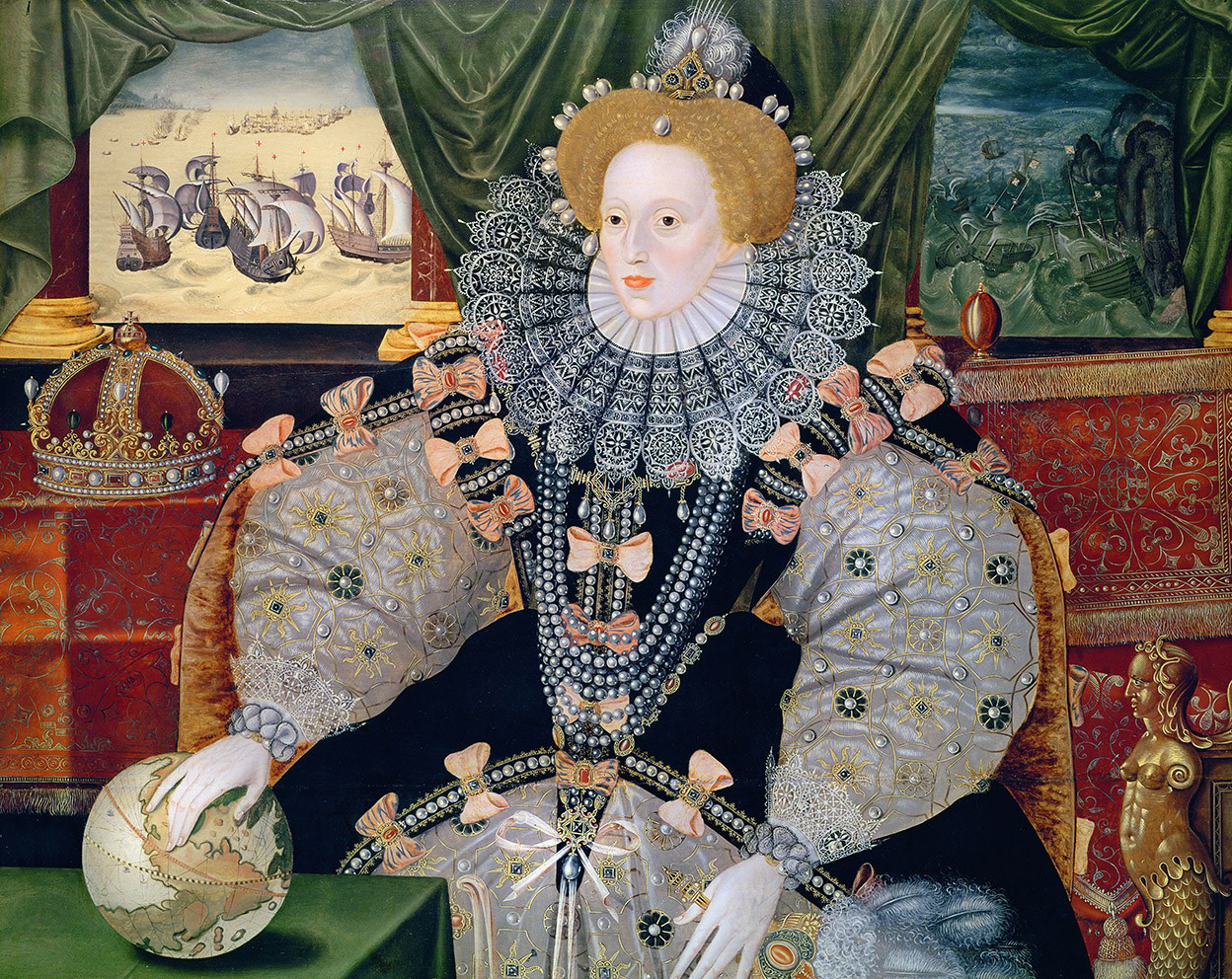
To first situate Shakespeare in his time during class, we used the Armada Portrait of Queen Elizabeth I, ca. 1588, as a visual touchstone. The class reviewed the contemporary events and mindsets that surely influenced the Shakespearean canon—the Renaissance in Elizabethan England that led to all manners of exploration and expansion, the Protestant Reformation, and the defeat of the Spanish Armada, to name a few. The class then considered specific literary influences, specifically Ovid’s Metamorphoses, Virgil’s Aeneid, and Holinshed’s Chronicles. Metamorphoses, first published in English in 1567 with its tales about the dangers of ambition (Daedalus and Icarus) and love and loss (Orpheus and Eurydice), would have been hugely influential for Shakespeare. It is primarily an epic about transformations, a favorite theme of Shakespeare’s and one that the class discussions touched on repeatedly. The Aeneid, perhaps the most germane of the three titles for a PME audience, would have driven Shakespeare to consider themes like balancing sense of duty with sacrifice, and, of course, the horrors of war. Finally, Holinshed’s Chronicles, a copy of which the students saw in person on the last day of class during a visit to the Folger Shakespeare Library, was Shakespeare’s source for England’s historical accounts and genealogies.[28]
Figure 1. The Woburn Abbey version of the Armada Portrait, ca. 1588, Woburn Abbey, Bedfordshire, UK
Source: U.S. Library of Congress, open domain.
Rhetorical Analysis
Studying sources for both content and style allowed students to then shift to analyzing Shakespeare’s language. We briefly discussed the basics of iambic pentameter and blank verse within the context of Shakespeare’s works as performance, with the reminder to students that the plays were intended to be spoken, not read. With this reminder, the class was able to connect once again to the value of storytelling and development of both the cognitive and affective domains via structured and emotive delivery. Diction and delivery are key components of rhetoric that, along with the art and science of storytelling, was a key tenet of the entire course.
From this class on, the author framed the basis of class discussion on the rhetorical analysis of these three questions: (1) What is the message? (2) How is that message communicated? and (3) Is the delivery of the message effective? The class closely read Winston S. Churchill’s essay “The Scaffolding of Rhetoric.”[29] As England’s most famous wartime leader, Churchill was an avid Shakespeare reader and was said to have “mobilized the English language and sent it into war.”[30] The class considered this while referencing several of Churchill’s speeches and their rhetorical reflections of the soldier king in Shakespeare’s Henry V. They are included here at length to facilitate potential future use by readers:
- Speech to the House of Commons (13 May 1940): “We have before us an ordeal of the most grievous kind. We have before us many, many long months of struggle and of suffering. You ask, what is our policy? I can say: It is to wage war, by sea, land, and air, with all our might and with all the strength that God can give us; to wage war against a monstrous tyranny, never surpassed in the dark, lamentable catalogue of human crime. That is our policy. You ask, what is our aim? I can answer in one word: It is victory, victory at all costs, victory in spite of all terror, victory, however long and hard the road may be.”[31]
- Broadcast to the British People (19 May 1940): “Today is Trinity Sunday. Centuries ago words were written to be a call and a spur to the faithful servants of Truth and Justice: ‘Arm yourselves, and be ye men of valour, and be in readiness for the conflict; for it is better for us to perish in battle than to look upon the outrage of our nation and our altar. As the Will of God is in Heaven, even so let it be’.”[32]
- Speech to the House of Commons (4 June 1940): “Even though large tracts of Europe and many old and famous States have fallen or may fall into the grip of the Gestapo and all the odious apparatus of Nazi rule, we shall not flag or fail. We shall go on to the end, we shall fight in France, we shall fight on the seas and oceans, we shall fight with growing confidence and growing strength in the air, we shall defend our Island, whatever the cost may be, we shall fight on the beaches, we shall fight on the landing grounds, we shall fight in the fields and in the streets, we shall fight in the hills; we shall never surrender.”[33]
- Speech to the House of Commons (18 June 1940): “Upon this battle depends the survival of Christian civilization. Upon it depends our own British life, and the long continuity of our institutions and our Empire. The whole fury and might of the enemy must very soon be turned on us. Hitler knows that he will have to break us in this Island or lose the war. If we can stand up to him, all Europe may be free and the life of the world may move forward into broad, sunlit uplands. But if we fail, then the whole world, including the United States, including all that we have known and cared for, will sink into the abyss of a new Dark Age made more sinister, and perhaps more protracted, by the lights of perverted science. Let us therefore brace ourselves to our duties, and so bear ourselves that, if the British Empire and its Commonwealth last for a thousand years, men will still say, ‘This was their finest hour’.”[34]
- Victory in Europe Speech (8 May 1945): “I say that in the long years to come not only will the people of this island but of the world, wherever the bird of freedom chirps in human hearts, look back to what we’ve done and they will say ‘do not despair, do not yield to violence and tyranny, march straightforward and die if need be unconquered’.”[35]
Analyzing the rhetoric of Churchill’s impassioned speeches allowed students to consider an example of language and story in the real application of war in a way that Shakespeare’s source material—specifically the Battle of Agincourt (25 October 1415) for Henry V, covered in the next class—could not. This was further helped by the recent release of the Netflix documentary series, Churchill at War.[36]
Class Two: Shakespeare in time and rhetoric
|
Points to consider:
• Why is it important to develop historical mindedness as a military learner?
• How can one apply the fundamentals of rhetoric to leadership in the profession of arms?
|
|
Readings:
Winston S. Churchill, “The Scaffolding of Rhetoric” (unpublished article, November 1897).
Leslie Dunton-Downer and Alan Riding, Essential Shakespeare Handbook (London: DK, 2004), 9–45.
Stephen Greenblatt, Will in the World: How Shakespeare Became Shakespeare (New York: W. W. Norton, 2004).
Lois Potter, The Life of William Shakespeare: A Critical Biography (West Sussex, UK: Wiley-Blackwell, 2012), 13–37, 51–57, 90–97.
Andrew Roberts, “Churchill Saw British History through the Eyes of Shakespeare,” YouTube, video, 2018.
Michael Whitmore, “Politics, Persuasion, Churchill, and Shakespeare,” YouTube, video, 2018.
|
Leaders’ Legitimacy
After an introduction to the chronology and key events of the Hundred Years’ War and the Wars of the Roses by Marine Corps University historian Dr. James Lacey—and an entertaining skim of Jeffrey R. Wilson’s book Shakespeare and Game of Thrones—the class launched into a close reading of Richard II.[37] Class three also marked the start of student-led discussions tied to specific excerpts. For example, the British Royal Marine student read the original text and then led a discussion on the “Sceptred Isle Speech,” which is John of Gaunt’s eulogy to England and a speech that Churchill also invoked during the Great Depression.[38] As the student explained in his accompanying course paper: “At its core the ‘Sceptred Isle’ speech reflects a sense of nationalism, and English exceptionalism, that Shakespeare retrofitted to medieval England.”[39] Spanning beyond its source in medieval England, through Shakespeare’s early modern era, and past Churchill’s 1930s England to the classroom in Quantico, Virginia, in 2025, the speech allowed a class of modern military officers a mechanism through which to consider patriotism, national and individual identity, and the profession of arms. The class discussion also focused on the challenging concept of legitimacy as, in the play, Richard II’s embodiment of the divine right to rule is violently called into question by Henry Bolingbroke’s representation of political savvy and the power of popular opinion.
Class Three: The Hundred Years’ War, the War of the Roses, and Richard II
|
Points to consider:
• What makes a leader legitimate? How is that legitimacy perceived by followers and others?
• How do various types of leadership roles shape a military officer’s identity?
• How should officers consider their legacy as leaders within the context of themselves as individuals, their followers, and their organizations?
|
|
Readings:
Keith Dockray, William Shakespeare, the War of the Roses, and the Historians (Berkshire UK: Tempus, 2002), 15–42.
William Shakespeare, Richard II (Washington, DC: Folger Shakespeare Library, 2024).
Jeffry R. Wilson, Shakespeare and Game of Thrones (London: Routledge, 2021).
|
Leading Through Transitions
England’s national history continues with the accession of Bolingbroke, or King Henry IV, depicted in parts 1 and 2 of Shakespeare’s plays by the same name. The class discussion in this session focused on individual leadership choices in the context of managing others through times of transition, and how to communicate those choices through story. This nested with one of the Command and Staff College student learning outcomes for academic year 2024–25, “Analyze culture, diversity, and change as factors that affect organizational performance and leadership.”[40]
Plagued by constant uprisings and doubts about his legitimacy due to his usurpation of the throne from Richard II, Henry IV provides a fascinating case study through which to consider bearing and stability. Even as he claims to “pluck allegiance from men’s hearts,” Henry IV cannot manage the turmoil within his own line of succession.[41] His anxiety extends into the second part of the play, as he rails against insomnia with the infamous line, “Uneasy lies the head that wears the crown,”[42] Class discussion here revealed personal experiences of students leading through combat in Iraq and Afghanistan, feeling the constant burden of responsibility. One student made the connection in their analysis of this excerpt to the Command and Staff College’s Leadership in the Profession of Arms course, explaining that “the curriculum contrasts the idealized Marine Corps ethos of a ‘band of brothers’ with the psychological realities of trauma under extreme hardship and adversity.” Henry IV’s physical and spiritual restlessness also served as a transition to reading a more modern work in class, the poem “Night of Battle” by Yvor Winters:
Impersonal the aim
Where giant movements tend
Each man appears the same,
Friend vanishes from friend.
In the long path of lead
That changes place like light,
No shape of hand or head
Means anything tonight.
Only the common will
For which explosion spoke,
And stiff on field and hill
The dark blood of the folk.[43]
At this point in the Henriad series, the tension is building toward the Battle of Agincourt and the ultimate ascension of Henry V.
Class Four: Henry IV, Parts 1 and 2
|
Points to consider:
• How does the burden of redemption influence a leader’s decision-making?
How does diversity of personalities influence the collective behavior of a unit?
How can we understand and manage change through narratives?
|
|
Readings:
William Shakespeare, Henry IV, Part 1 (Washington, DC: Folger Shakespeare Library, 2024).
William Shakespeare, Henry IV, Part 2 (Washington, DC: Folger Shakespeare Library, 2024).
Philip G. Zimbardo and Robert L. Johnson, Psychology According to Shakespeare: What You Can Learn about Human Nature from Shakespeare’s Great Plays (Lanham, MD: Prometheus Books, an imprint of Globe Pequot, 2024), 53–81.
|
The Power of Lore and Personality
With the course’s aim to expose students to diverse forms of rhetoric from both fictional and real military leaders, the students watched a clip from the film The King, a loose adaptation of Henry V, to prepare for the next class. In the clip, the young king dismounts his horse before his troops and tells them that in their hearts they “are that kingdom united. . . . You are England. . . . England is you.” More direct and less flowery than the famous “Band of Brothers” or “Saint Crispin’s Day” speech from Henry V, the movie nevertheless visually helped to situate the students in the geography and aesthetic leading to the Battle of Agincourt.[44] In class, the students then reviewed the trajectory that led Henry toward that battle, beginning with the siege of the port of Harfleur, Normandy, in August and September 1415. In another of Shakespeare’s most famous military speeches, Henry spurs on his hesitant troops at the city walls of Harfleur—they are the forlorn hope, a sixteenth century phrase meaning the small unit of soldiers who are first to breach the walls of a fortification in a siege. He yells,
Once more unto the breach, dear friends . . .
When the blast of war blows in our ears,
Then imitate the action of the tiger:
Stiffen the sinews, summon up the blood,
Disguise fair nature with hard-favored rage . . .
I see you stand like greyhounds in the slips,
Straining upon the start. The game’s afoot.
Follow your spirit, and upon this charge
Cry “God for Harry, England, and Saint George!”[45]
Adding to the power of the speech was the president of Marine Corps University, Brigadier General Matthew Tracy’s recitation of it as he visited class that day. Historically, Henry wins the battle at Harfleur but at great cost as he lost what historians believe was up to one-third of his force due to the battle and dysentery.[46]
From there, Henry marches his remaining forces across France toward Calais, pursued by the French and forced into a confrontation south of Calais in Agincourt. At this point in class, the students read aloud the “Chorus Before Agincourt,” wherein Shakespeare writes of “the poor condemned English, / Like sacrifices, by their watchful fires / Sit patiently and inly ruminate / The morning’s danger” to come when the battle begins.[47] It is a sad scene, and a seemingly hopeless one, until Shakespeare explains that Henry is walking among the troops and “Upon his royal face there is no note / How dread an army that enrounded him. . . . That every wretch, pining and pale before, / Beholding him, plucks comfort from his looks.”[48] The class discussion then focused on the power of military bearing and stoicism in leadership to transcend the emotion and friction in the moment so that subordinates do not lose heart and instead stay focused on the mission. This is what the profession of arms demands, and Henry, whose worthiness and stature as a leader his father Henry IV questioned in the previous play, now meets the moment and does what is needed, best heard in the Saint Crispin’s Day Speech.[49]
The speech’s famous lines “We few, we happy few, we band of brothers” inspired, of course, the HBO miniseries Band of Brothers, telling the story of the U.S. Army’s 101st Airborne Division’s Easy Company during World War II, with which the students were very familiar.[50] In his rhetorical analysis of the speech, one student explained, “Henry’s powerful rhetoric shapes his soldier’s perception of their circumstances, inspiring them to see their disadvantage as a fantastic opportunity to achieve glory and cement their legacies. The speech’s focus on memory and storytelling highlights how narratives of war are created and how they can shape the long-lasting cultural memory of a conflict.” Through the play Henry V, Shakespeare creates a legendary battle through the legends who fought it. For this student, the power of legends is clear, writing that “the Marine Corps recruiting slogan captures the same simple power of William Shakespeare’s most famous line from his most famous martial monologue,” and the staccato slogan “The Few. The Proud. The Marines.” does have a certain resonance with the famous Shakespearean verse.
The class’s discussion about the power of lore—with all its advantages and disadvantages—then extended to another legend in English (and French) history, Joan of Arc. In the next series in the Henriad, the Henry VI plays, we see the young Frenchwoman who will become a warrior saint present herself to the dauphin of France and seek his permission to fight by testing him in combat: “My courage try by combat, if thou dar’st, / And thou shalt find that I exceed my sex.”[51] Convincing the dauphin, who in turn deputizes her to lead his forces, she then urges the French to remain in Orleans and never surrender, to “Fight till the last gasp.”[52] These heroes—Henry IV, Joan of Arc, and the others portrayed in the Henriad—are endless source material for rich discussions about the responsibility of leadership by example in combat.
Class Five: Henry V and Henry VI, Parts 1 and 2
|
Points to consider:
• What are the advantages and disadvantages of a story that becomes lore in the service?
• What does it mean to be called to serve in the profession of arms? How do we instill this in others through language and narrative?
• How does one balance virtue and ambition as a leader?
|
|
Readings:
Nancie Saxton, ed., Poems by Marines in Combat (Bloomington, IN: Author House, 2010).
William Shakespeare, Henry V (Washington, DC: Folger Shakespeare Library, 2024).
William Shakespeare, Henry VI, Pt. 1 (Washington, DC: Folger Shakespeare Library, 2024).
William Shakespeare, Henry VI, Pt. 2 (Washington, DC: Folger Shakespeare Library, 2024).
William Shakespeare, Henry VI, Pt. 3 (Washington, DC: Folger Shakespeare Library, 2024).
|
Authenticity and Inner Torment
The class then learned through discussions of Richard III and Macbeth that legends of heroism can cut both ways: powerful for both the betterment and for the demoralization or even destruction of the unit. Richard III, arguably Shakespeare’s most tyrannical leader, presents for the class a compelling question on authenticity in rhetoric: Do you need to believe the story to use it to influence others as a leader? Shakespeare portrays Richard III as a deformed, angry younger brother outside the line of succession who is “determined to prove a villain.”[53] Despite his ability in the play to smooth talk his way into a marriage with his brother’s widow and, later, onto the throne (with the alleged murder of the young princes along the way), he does not fool Henry VI’s widow Margaret of Anjou, who hurls at him some of Shakespeare’s best written insults: “abortive rooting-hog . . . son of hell . . . loathed issue of thy father’s loin” among them.[54] Even with his enemies growing in number, Richard’s self-confidence remains true until the very bitter end, with no plea for redemption. His case is an intriguing one for questions of authentic leadership.
The title character of Macbeth also struggles with the stories he tells to the point of madness. As the protagonist careens toward his fate before the burning forest of Birnam Wood, he grieves the sudden loss of his wife with the speech that “Life’s but a walking shadow, a poor player / That struts and frets his hour upon the stage / And then is heard no more. It is a tale / Told by an idiot, full of sound and fury, / Signifying nothing.”[55] Philip G. Zimbardo and Robert L. Johnson argue that Macbeth is exhibiting all the signs of a “psychotic break with reality,” akin to schizophrenia.[56] Other scholars write of the inner battle Macbeth fights in his own mind, with Harold Bloom explaining that “Macbeth himself can be termed the unluckiest of all Shakespearean protagonists, precisely because he is the most imaginative.”[57] Yet, he remains loyal to his claim to the throne to the last, refusing to “play the Roman fool and die / On my own sword” and dying by MacDuff’s sword instead.[58] One student reflected, “Macbeth’s downfall stems from unchecked ambition, a cautionary tale for any leader. Analyzing his trajectory helps leaders recognize the dangers of prioritizing personal gain over ethical duty. It underscores that true leadership is about service and the team’s needs, not self-promotion.”
Class Six: Richard III and Macbeth
|
Point to consider:
• Do you need to believe the story yourself to use it to influence others as a leader?
|
|
Readings:
Stephen Greenblatt, “Shakespeare’s Close Call with Tyranny,” New Yorker, 4 May 2018.
William Shakespeare, Richard III (Washington, DC: Folger Shakespeare Library, 2024).
William Shakespeare, Macbeth (Washington, DC: Folger Shakespeare Library, 2024).
Philip G. Zimbardo and Robert L. Johnson, Psychology According to Shakespeare: What You Can Learn about Human Nature from Shakespeare’s Great Plays (Lanham, MD: Prometheus Books, an imprint of Globe Pequot, 2024), 141–69.
|
Post-War Reflections and the Folger Shakespeare Library
For the penultimate session, the class hosted guest speaker Dr. Nicholas Utzig, assistant professor of English and world languages at the U.S. Military Academy at West Point. Utzig, an Army veteran, led a discussion based on his work titled “Our Wars Are Done: Returning from War in the Drama of Shakespeare and His Contemporaries.”[59] He encouraged the students to think of Shakespeare’s plays, specifically Henry V, Coriolanus, and Much Ado about Nothing, as prompts for considering military homecomings and for Titus Andronicus, Henry V, and Coriolanus about how wars ought to and ultimately do end.[60] Central to the discussion was the question of purpose, not only in regard to why soldiers go to war in the first place, but who they are when war is no longer a part of their daily lives or identity. Consider Tim Collins, former commanding officer of the British Royal Irish Regiment, who delivered a well-known speech on the eve of the invasion of Iraq in 2003 that was modeled on the Henry V Saint Crispin’s Day speech. He noted 20 years later that his troops now “look back with dismay” at the “botched occupation of Iraq,” and he mused that “perhaps we need a Shakespeare of the future to write a screenplay to remind us that we went with the very best of intentions.”[61]
For the last class period, the group traveled north from Quantico to Washington, DC, for a guided tour and archival visit at the Folger Shakespeare Library, featuring the world’s largest Shakespeare collection and contemporary materials, including art and play production artifacts. This experiential end to the eight-session course aligned with educational research on the value of museums for developing learners’ critical thinking skills through seven observable behaviors: observation, interpretation, evaluation, association (i.e., making connections with extant knowledge or experiences), problem finding, comparison, and flexible thinking.[62] As one student reflected, this experience and the class as a whole “allowed me to consider the stories our society tells of the conflicts I had deployed to, and the stories I choose to share with my friends. It made me appreciate all the more the quirky moments with my teammates between the chaos and grind of the war. This wasn’t a new discovery for any of us, but it gave us a chance to see it a bit differently and I’m incredibly grateful for it.”
Class Seven: When the War Is Over
|
Point to consider:
• Do you need to believe the story yourself to use it to influence others as a leader?
|
|
Readings:
Nicholas Utzig, “Our Wars Are done: Returning from War in the Drama of Shakespeare and His Contemporaries” (PhD diss., Harvard University, 2022).
|
Instructor Lessons Learned and Conclusion
When the author considered how they might prepare to teach this class again, they saw several lessons learned: first, they would greatly scale back the number of plays in the syllabus, based on both the students’ recommendations and their own sense that the group was overwhelmed by material in such a short course. Instead, the author might focus specifically on Henry V and structure the class as a deep dive into the text and context of that play, which would still allow for an engaging discussion of Churchill’s Shakespearean rhetoric and other adaptations. Additionally, the author would enhance the authenticity and military purpose of the summative assessment, replacing the final course paper with a simulated speech to the students’ hypothetical units under their leadership. As Collins shared, this type of exercise is surely one that the students will encounter after graduation after their return to the operational forces and so offering it as an assessment in lieu of a traditional academic paper makes good sense.[63] Finally, the author would more explicitly coidentify with students where Shakespeare’s characters leverage the empirical value of storytelling and impactful rhetoric based on what we know from cognitive science research.
Teaching this class was a highlight of the author’s PME career. The confluence of the students’ bright, creative thinking, their willingness to share their relevant combat experiences from the Long War and the complexity of the Shakespearean canon as provocative material for class discussion was invaluable. The author’s love of Shakespeare stems from their time earning their master’s degree in Shakespeare studies from University College London, with long hours spent in the British Library and on the train back and forth to Stratford-Upon-Avon. To share what they learned from that world with Marine Corps University students was an immense honor, and it is fair to say that they learned more from their shared experiences and analyses than from graduate school.
Endnotes
[1] Eliot A. Cohen, The Hollow Crown: Shakespeare on How Leaders Rise, Rule, and Fall (New York: Basic Books, 2023).
[2] William Shakespeare, Henry V, Act 1, Sc. 1, as quoted in The Oxford Shakespeare: Henry V, ed. Gary Taylor (Oxford, UK: Oxford University Press, 2012), https://doi.org/10.1093/actrade/9780198129127.book.1.
[3] Hertha D. Wong, Sending My Heart Back across the Years: Tradition and Innovation in Native American Autobiography (New York: Oxford University Press, 1992), 6; and Frank Usbeck, Ceremonial Storytelling: Ritual and Narrative in Post-9/11 US Wars (Berlin: Peter Lang, 2019), 12.
[4] Caroline P. D’Abate and Hali Alpert, “Storytelling in Mentoring: An Exploratory, Qualitative Study of Facilitating Learning in Developmental Interactions,” Sage Open 7, no. 3 (2017), https://doi.org/10.1177/2158244017725554.
[5] Elizabeth D. Samat, Soldier’s Heart: Reading Literature through Peace and War at West Point (New York: Picador, an imprint of Farrar, Straus and Giroux, 2008).
[6] Randee L. Lawrence and Dennis S. Paige, “What Our Ancestors Knew: Teaching and Learning Through Storytelling,” New Directions for Adult and Continuing Education, no. 149 (2016): 67, https://doi.org/10.1002/ace.20177.
[7] Anders Engberg-Pedersen and Neil Ramsey, eds. War and Literary Studies, Cambridge Critical Concepts Series Cambridge, UK: Cambridge University Press, 2023), 10, https://doi.org/10.1017/9781009052832.
[8] Department of Defense Instruction (DODI) 1322.35, vol. 1, Military Education: Program Management and Administration (Washington, DC: Department of Defense, 26 April 2022).
[9] Herbert F. Barber, “Developing Strategic Leadership: The US Army War College Experience,” Journal of Management Development 11, no. 6 (1992): 4–12, https://doi.org/10.1108/02621719210018208; and Lisa Kerr, “From the Archives: From Revolution to Evolution: Expanding Methodologies in PME,” Naval War College Review 78, no. 1 (2025).
[10] “Autonoetic,” APA Dictionary of Psychology, updated 19 April 2018.
[11] David A. Kolb, Experiential Learning: Experience as the Source of Learning and Development (Englewood Cliffs, NJ: Prentice-Hall, 1984). See David Pierson, “Reengineering Army Education for Adult Learners,” Journal of Military Learning 1, no. 2 (October 2017): 31–41 for more information on the application of Kolb’s theory in PME.
[12] Richard Van Eck, “Digital Game-Based Learning: It’s Not Just the Digital Natives Who Are Restless,” EDUCAUSE Review 41, no. 2 (March/April 2006): 1–16; and P. H. Yuan and M. S. Chen, “A Study of Influence of Storytelling toward Organizational Memory,” Journal of Educational Media & Library Sciences 45, no. 4 (2008): 461–82.
[13] Paul B. Armstrong, Stories and the Brain: The Neuroscience of Narrative (Baltimore, MD: Johns Hopkins University Press, 2020), 11.
[14] Angus Fletcher, Patricia Enciso, and Mike Beneveniste, “Narrative Creativity Training: A New Method for Increasing Resilience in Elementary Students,” Journal of Creativity 33, no. 3 (December 2023): 100061, https://doi.org/10.1016/j.yjoc.2023.100061; Celestino Perez Jr., “A Modest Proposal for Improving Assessment in Professional Military Education,” War on the Rocks, 22 February 2019; and Jeffrey Meiser, “Bringing a Method to the Strategy Madness” War on the Rocks, 2 May 2024.
[15] R. A. Zwaan, M. C. Langston, and A. C. Graesser, “The Construction of Situation Models in Narrative Comprehension: An Event-Indexing Model,” Psychological Science 6, no. 5 (1995): 292–97. https://doi.org/10.1111/j.1467-9280.1995.tb00513.x; A. C. Graesser, M. Singer, and T. Trabasso, “Constructing Inferences during Narrative Text Comprehension,” Psychological Review 101, no. 3 (July 1994): 371–95, https://doi.org/10.1037/0033-295x.101.3.371; and Yuan and Chen, “A Study of Influence of Storytelling toward Organizational Memory.”
[16] Jordan Swain and Jeremy Boeh, “4 Storytelling Tips for Army Leaders,” Center for Junior Officers, 2 December 2020.
[17] D’Abate and Alpert, “Storytelling in Mentoring.”
[18] D’Abate and Alpert, “Storytelling in Mentoring.”
[19] William Shakespeare, Richard II, Henry IV, Part 1, Henry IV, Part 2, Henry V, Henry VI, Part 1, Henry VI, Part 2, Henry VI, Part 3, and Richard III (Washington, DC: Folger Shakespeare Library, 2024).
[20] Peter Campbell and Richard Jordan, “Forming the Grand Strategist According to Shakespeare,” Texas National Security Review 3, no. 1 (Winter 2019/2020): 12–33.
[21] Cohen, The Hollow Crown, 17.
[22] Dwight D. Eisenhower, At Ease: Stories I Tell to Friends (Garden City, NY: Doubleday, 1967), 187.
[23] Richard Ned Lebow, “Unser Shakespeare in Nazi Germany,” in Shakespeare at War: A Material History, eds. Amy Lidster and Sonia Massai (Cambridge, UK: Cambridge University Press, 2023),175, https://doi.org/10.1017/9781009042383.019.
[24] An example of verbal inversion from Henry V is found in Act 3, Sc. 1, lines 33–35: “I see you stand like greyhounds in the slips, straining upon the start. The game’s afoot; follow your spirit, and upon this charge cry ‘God for Harry, England, and Saint George’!” See also Barbara Mowat and Paul Werstine, “Reading Shakespeare’s Language: Henry V,” Folger Shakespeare Library, accessed 3 December 2025; Guillaume Thierry et al., “Event-related Potential Characterisation of the Shakespearean Functional Shift in Narrative Sentence Structure,” NeuroImage 40, no. 2 (April 2008): 923–31, https://doi.org/10.1016/j.neuroimage.2007.12.006.
[25] U.S. Army War College, “Historical Mindedness: An Essential Characteristic for Strategists,” YouTube video, 7 August 2020; and Churchill at War, directed by Malcom Venville (Los Gatos, CA: Netflix, 2024).
[26] Richard E. Neustadt and Ernest R. May, Thinking in Time: The Uses of History for Decision-makers (New York: Free Press, a division of Macmillan, 1986); and Paul D. Gelpi and Bradford A. Wineman, “It’s Not Either/Or but How: A ‘War Studies’ Approach to History in PME,” Marine Corps Gazette (November 2022).
[27] M. Todd, “Aligning Our Sights: The Role of History in PME,” British Army Review, no. 193 (17 June 2025).
[28] Holingshed’s Chronicles: England, Scotland, and Ireland, 6 vols. (New York: AMS Press, 1807; 1965 reprint).
[29] Winston S. Churchill, “The Scaffolding of Rhetoric” (unpublished article, November 1897).
[30] Attributed to Edward R. Murrow in “Winston Churchill, 1874–1965,” Oxford Essential Quotations, 4th ed., ed. Susan Ratcliffe (Oxford, UK: Oxford University Press, 2016).
[31] Winston Churchill, “Blood, Toil, Tears and Sweat,” House of Commons, London, 13 May 1940.
[32] Winston Churchill, “Be Ye Men of Valour,” BBC, London, 19 May 1940.
[33] Winston Churchill, “We Shall Fight on the Beaches,” House of Commons, London, 4 June 1940.
[34] Winston Churchill, “Their Finest Hour,” House of Commons, London, 18 June 1940.
[35] Winston Churchill, “VE Day,” BBC, 8 May 1945.
[37] Jeffrey R. Wilson, Shakespeare and Game of Thrones (London: Routledge, 2021).
[38] William Shakespeare, Richard III, Act II, Sc. 1 (Washington, DC: Folger Shakespeare Library, 2024).
[39] Student excerpts are used with their permission.
[40] This learning outcome has since been revised to omit “diversity.”
[41] Shakespeare, Richard III, Act 3, Sc. 2.
[42] Shakespeare, Richard III, Act 3, Sc. 1, 31.
[43] Yvor Winters, “Night of Battle,” in Poets of World War II, ed. Harvey Shapiro (New York: Library of America, 2003).
[44] The King, directed by David Michôd (Los Gatos, CA: Netflix, 2019).
[45] Shakespeare, Henry IV, Act 3, Sc. 1, 1–37.
[46] Benjamin Trowbridge, “A Baptism of Fire, Steel, and Stone: Henry V’s Army and the Siege of Harfleur,” UK National Archives (blog), 22 September 2015.
[47] Shakespeare, Henry IV, Act 4, Prologue, 23–26.
[48] Shakespeare, Henry IV, Act 4, Prologue, 36–43.
[49] Shakespeare, Henry IV, Act 4, Sc. 3, 21–69.
[50] Band of Brothers, created by Tom Hanks and Steven Spielberg, aired on HBO, 9 September–4 November 2001.
[51] Shakespeare, Henry IV, Act 1, Sc. 2, 90–91.
[52] Shakespeare, Henry IV, Act 1, Sc. 2, 130.
[53] William Shakespeare, Richard III, Act 1, Sc. 1, 30 (Washington, DC: Folger Shakespeare Library, 2024).
[54] Shakespeare, Richard III, Act 1, Sc. 3, 225–29.
[55] William Shakespeare, Macbeth, Act 5, Sc. 5, 27–31 (Washington, DC: Folger Shakespeare Library, 2024).
[56] Philip G. Zimbardo and Robert L. Johnson, Psychology According to Shakespeare: What You Can Learn about Human Nature from Shakespeare’s Great Plays (Lanham, MD: Prometheus Books, and imprint of Globe Pequot, 2024), 148.
[57] Harold Bloom, Shakespeare: The Invention of the Human (New York: Riverhead Books, an imprint of Penguin Putnam, 1998), 519.
[58] Shakespeare, Macbeth, Act 5, Sc. 8, 1–2.
[59] Nicholas Utzig, “Our Wars Are Done: Returning from War in the Drama of Shakespeare and His Contemporaries” (PhD diss., Harvard University, 2022).
[60] See also Nicholas Utzig, “Shakespearean Jus Post Bellum: Ethical Ends to War in Henry V,” in Shakespeare Studies, vol. 51, ed. James R. Siemon and Diana E. Henderson (London: Bloomsbury Publishing, 2023), 73–83.
[61] Tim Collins, “Henry V and the Invasion of Iraq,” in Shakespeare at War, 229.
[62] Brian Kisida, Daniel H. Bowen, and Jay P. Greene, “Measuring Critical Thinking: Results from an Art Museum Field Trip Experiment,” Journal of Research on Educational Effectiveness 9, sup. 1 (2016): 171–87, https://doi.org/10.1080/19345747.2015.1086915; and John H. Falk and Lynn D. Dierking, Learning from Museums: Visitor Experiences and the Needs of Learners (New York: Altamira Press, an imprint of Rowman & Littlefield, 2000).
[63] Collins, “Henry V and the Invasion of Iraq.”
About the Author
Dr. Megan J. Hennessey is the provost at Marine Corps University (MCU). She is a member of the editorial board for Marine Corps University Press and a founding editor of International Perspectives in Military Education. Dr. Hennessey created the Military Scholarship of Teaching and Learning Forum with Dr. Lauren Mackenzie (MCU). Previously, Dr. Hennessey held positions at Air University, the U.S. Army War College, the National Geospatial Intelligence College, the FBI Academy, and the Expeditionary Warfare School. Her research interests include the scholarship of teaching and learning in PME environments and faculty development. She holds a PhD in education from George Mason University, an MA in English from University College London, and a BA in English and religious studies from Hollins University. She earned a direct commission as a public affairs officer in the U.S. Navy.
https://orcid.org/0000-0002-9310-2860